The Universal Logic of Quadratic Equations
The quadratic equation represents a fundamental threshold in mathematical literacy, marking the transition from simple linear relationships to the complex, curved dynamics of the physical world....
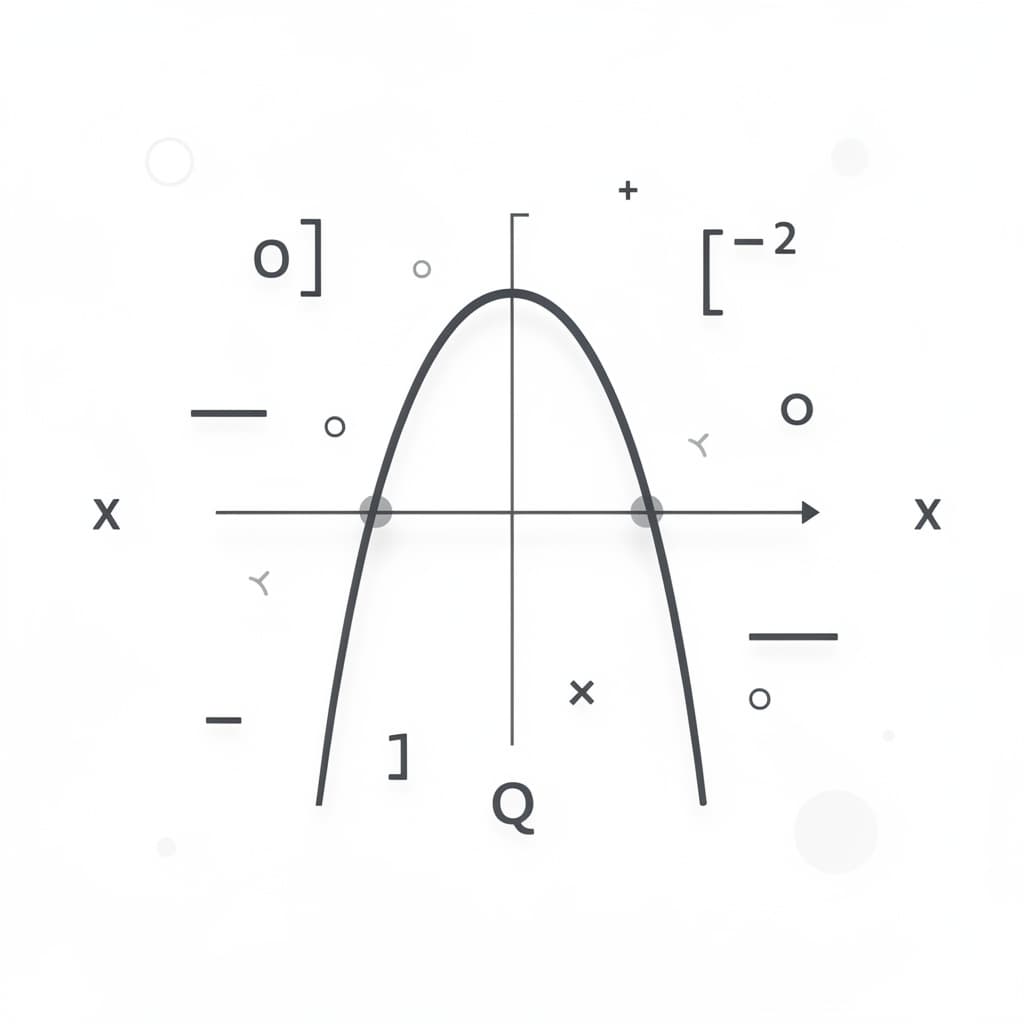
The quadratic equation represents a fundamental threshold in mathematical literacy, marking the transition from simple linear relationships to the complex, curved dynamics of the physical world. Whether calculating the trajectory of a projectile, determining the optimal pricing for a product, or designing the curves of a suspension bridge, understanding how to solve quadratic equations is an essential skill for scientists, engineers, and economists alike. This comprehensive guide explores the structural logic of second-degree polynomials, detailing the diverse methodologies available for finding their roots—from the intuitive logic of factoring and the geometric elegance of completing the square to the universal reliability of the quadratic formula. By mastering these techniques, students move beyond rote memorization into a deeper realization of how algebraic structures mirror the laws of nature.
Defining the Second-Degree Polynomial
The Standard Form Equation
To begin the journey of learning how to solve quadratic equations, one must first recognize the anatomy of the second-degree polynomial in its standard form. A quadratic equation is defined as any equation that can be rearranged into the form $$ax^2 + bx + c = 0$$, where $x$ represents an unknown variable, and $a$, $b$, and $c$ represent known coefficients. The defining characteristic of this equation is the exponent of 2 on the lead variable, which ensures that the relationship is non-linear and produces a characteristic symmetrical curve known as a parabola when graphed. It is a strict mathematical requirement that the lead coefficient $a$ is not equal to zero, as a zero value would eliminate the $x^2$ term and collapse the equation into a first-degree linear relationship.
The coefficients $a$, $b$, and $c$ are not merely arbitrary numbers; they dictate the specific geometry and behavior of the equation's graph on a Cartesian plane. The lead coefficient $a$ serves as the scaling factor, determining whether the parabola opens upward (if $a$ is positive) or downward (if $a$ is negative), as well as how narrow or wide the curve appears. The linear coefficient $b$ influences the position of the parabola's vertex and its horizontal shift, while the constant term $c$ indicates the y-intercept, the point where the curve crosses the vertical axis. Recognizing these roles is the first step in solving quadratics step by step, as it allows the mathematician to visualize the solution space before performing a single calculation.
In many real-world scenarios, quadratic equations do not appear in their standard form immediately and require algebraic manipulation to be identified correctly. For instance, an equation like $$3x^2 + 5 = 2x$$ must be transformed by subtracting $2x$ from both sides to reach the standard form $$3x^2 - 2x + 5 = 0$$. This process of normalization is critical because all standard solution methods, including the quadratic formula and the discriminant analysis, rely on the coefficients being identified from this specific zero-equated format. Clear identification of these constants prevents sign errors and ensures that the structural integrity of the polynomial is maintained throughout the solving process.
Identifying Coefficients and Constants
Precision in identifying coefficients is the bedrock of algebraic accuracy, especially when dealing with negative values or missing terms. In the equation $$x^2 - 9 = 0$$, a novice might be confused by the "missing" middle term, but a seasoned mathematician recognizes that the coefficient $b$ is simply zero, meaning the equation is written as $$1x^2 + 0x - 9 = 0$$. Here, $a = 1$, $b = 0$, and $c = -9$. Correctly identifying that $a=1$ when no number is visible (the implicit identity property) is a common hurdle for students learning how to solve quadratic equations for the first time. Failure to recognize these implicit values often leads to catastrophic errors when substituting into the quadratic formula later in the process.
The constants and coefficients also represent physical dimensions in applied mathematics, such as initial velocity, acceleration, and starting height in kinematics. In the context of a falling object, the $ax^2$ term typically represents the influence of gravity over time, while the $bx$ term represents the initial upward or downward thrust. By viewing $a$, $b$, and $c$ as "knobs" that tune the behavior of a physical system, the equation ceases to be an abstract puzzle and becomes a functional model. This conceptual shift is vital for moving beyond basic arithmetic and into the realm of mathematical modeling, where equations describe the very fabric of moving objects and changing systems.
Methods for Factoring Quadratic Equations
The Zero Product Property
One of the most elegant ways to find solutions is through factoring quadratic equations, a method that relies on the Zero Product Property. This fundamental principle states that if the product of two quantities is zero, then at least one of those quantities must itself be zero—mathematically expressed as: if $P \cdot Q = 0$, then $P = 0$ or $Q = 0$. By decomposing a complex trinomial into a product of two simpler linear binomials, such as $$(x - r_1)(x - r_2) = 0$$, we can instantly identify the roots of the equation as $x = r_1$ and $x = r_2$. This method is often the fastest way to solve an equation, provided the roots are rational numbers and the coefficients are relatively small.
The transition from a quadratic trinomial to a product of binomials is essentially a "reverse engineering" of the FOIL (First, Outside, Inside, Last) multiplication method. When we look at $$x^2 + 5x + 6 = 0$$, we are searching for two numbers that, when added, equal the linear coefficient ($5$) and, when multiplied, equal the constant term ($6$). In this instance, the numbers 2 and 3 satisfy both conditions, allowing us to rewrite the equation as $$(x + 2)(x + 3) = 0$$. Setting each factor to zero reveals the solutions $x = -2$ and $x = -3$, demonstrating the direct and intuitive power of factoring when applied to "clean" integer-based problems.
However, factoring is not a universal tool, as many quadratic equations possess irrational or complex roots that cannot be easily derived through mental arithmetic or simple integer searches. While every quadratic equation can theoretically be factored over the complex number field, it is often impractical to do so without using the quadratic formula first. Therefore, factoring should be viewed as a specialized surgical tool—highly efficient for specific "factorable" cases but needing to be supplemented by more robust methods when the numbers become unwieldy or the solutions involve square roots of non-perfect squares.
Techniques for Monic and Non-Monic Trinomials
The difficulty of factoring quadratic equations depends largely on whether the trinomial is monic (where $a = 1$) or non-monic (where $a \neq 1$). For monic trinomials, the process is straightforward as it only requires finding factors of $c$ that sum to $b$. However, when the lead coefficient $a$ is a value other than 1, such as in $$6x^2 + 11x + 3 = 0$$, the "AC Method" or "Factoring by Grouping" becomes necessary. This technique involves multiplying $a$ and $c$ (in this case, $6 \cdot 3 = 18$) and finding two numbers that multiply to 18 and add to 11. These numbers, 2 and 9, are then used to split the middle term, transforming the trinomial into a four-term expression: $$6x^2 + 9x + 2x + 3 = 0$$.
Once the middle term is split, the mathematician employs factoring by grouping to find common binomial factors within the expression. In our example, we group the first two terms and the last two terms: $$3x(2x + 3) + 1(2x + 3) = 0$$. Because the term $(2x + 3)$ appears in both halves of the equation, it can be factored out, resulting in $$(3x + 1)(2x + 3) = 0$$. Solving for $x$ by setting each binomial to zero gives the roots $x = -1/3$ and $x = -3/2$. While this process involves more steps than monic factoring, it follows a rigorous logical path that demystifies how large coefficients interact to produce specific roots.
For students, mastering non-monic factoring builds essential "algebraic stamina" and a keen eye for patterns. It encourages a deeper exploration of the relationship between coefficients and roots, which is a precursor to understanding more advanced topics like synthetic division and the Rational Root Theorem. While the quadratic formula will always provide the correct answer, the ability to factor an equation quickly provides a significant advantage in competitive mathematics and timed examinations where efficiency is paramount. Furthermore, factoring reveals the multiplicity of roots, clearly showing whether a parabola touches the x-axis at a single point (a double root) or crosses it at two distinct locations.
The Mechanics of Completing the Square
Geometric Interpretations of Square Completion
Before it was a purely algebraic exercise, completing the square was a geometric technique used by ancient mathematicians like Al-Khwarizmi to solve area-based problems. Imagine you have a literal square with side length $x$, representing $x^2$, and a rectangle with sides $x$ and $b$, representing $bx$. To "complete the square," you split the $bx$ rectangle into two equal halves, each with a width of $b/2$, and place them on two adjacent sides of the $x^2$ square. This creates a larger, nearly complete square, but with a small square-shaped "hole" in the corner. The area needed to fill this hole is precisely $(b/2)^2$, which is why we add this specific value to both sides of the equation to maintain balance.
This geometric visualization transforms an abstract algebraic rule into a tangible physical reality. When we solve $$x^2 + 6x = 7$$, we are essentially looking at a square of $x$ and two rectangles of $3x$. To turn this into a perfect square, we need to add a $3 \cdot 3$ (or 9) unit area to the corner. By adding 9 to both sides, we get $$x^2 + 6x + 9 = 16$$, which can be rewritten as the area of a single large square: $$(x + 3)^2 = 16$$. From here, the solution becomes a simple matter of taking the square root of both sides, leading to $x + 3 = \pm 4$, and eventually $x = 1$ or $x = -7$. This method is the bridge between the visual world of geometry and the symbolic world of algebra.
Understanding the geometric roots of this method helps students remember the steps without relying solely on memorization. It explains why we divide the $b$ coefficient by 2 (to split the rectangle) and why we square that result (to find the area of the missing corner). This technique is particularly powerful because it works for every quadratic equation, even those that cannot be factored using integers. It serves as the logical foundation upon which the quadratic formula is built, proving that there is a consistent, mechanical way to isolate $x$ regardless of how complex the coefficients might be.
Transforming Equations into Perfect Squares
The algebraic process of completing the square involves a series of highly disciplined steps designed to force the equation into a format where the variable $x$ appears only once. The first step is to ensure that the lead coefficient $a$ is equal to 1; if it is not, the entire equation must be divided by $a$. Once the equation is in the form $$x^2 + (b/a)x = -c/a$$, we apply the core transformation by adding $[(1/2)(b/a)]^2$ to both sides. This creates a perfect square trinomial on the left side, which can be factored into a squared binomial, effectively "collapsing" the two instances of the variable $x$ into a single expression that can be isolated through inverse operations.
Consider the equation $$2x^2 + 8x - 10 = 0$$. First, we divide by 2 to get $$x^2 + 4x - 5 = 0$$, then move the constant to the other side: $$x^2 + 4x = 5$$. To complete the square, we take half of 4 (which is 2) and square it (which is 4). Adding 4 to both sides yields $$x^2 + 4x + 4 = 9$$. This simplifies to $$(x + 2)^2 = 9$$. Taking the square root of both sides gives $x + 2 = \pm 3$, leading to the final solutions $x = 1$ and $x = -5$. This process is essentially a way of "repackaging" the quadratic information so that it resembles a simple linear equation that has been squared, making the extraction of roots a linear path.
Beyond finding roots, completing the square is the primary method used to convert a quadratic equation from standard form to vertex form, $$y = a(x - h)^2 + k$$. In this format, the coordinates of the parabola's vertex $(h, k)$ are immediately visible, providing instant insight into the maximum or minimum value of the function. This is invaluable in optimization problems, such as finding the maximum height of a rocket or the minimum cost of production. Thus, completing the square is not just a solving technique but a powerful tool for functional analysis and graphing.
Deriving the Quadratic Formula
From General Form to Universal Solution
The quadratic formula is perhaps the most famous equation in secondary mathematics, but it is not an arbitrary rule handed down by decree; it is the logical result of applying the "completing the square" method to the general standard form equation $$ax^2 + bx + c = 0$$. By treating $a$, $b$, and $c$ as constants and following the rigorous steps of isolation, mathematicians were able to create a "universal key" that unlocks any second-degree polynomial. This derivation is a milestone in algebraic thought because it represents the shift from solving individual problems to creating a generalized solution that applies to an entire class of mathematical structures.
The beauty of the derivation lies in its symmetry. We begin by dividing the general equation by $a$ to get $$x^2 + \frac{b}{a}x + \frac{c}{a} = 0$$. We then move the constant term to the right: $$x^2 + \frac{b}{a}x = -\frac{c}{a}$$. To complete the square, we add the square of half the linear coefficient, which is $(\frac{b}{2a})^2$, to both sides of the equation. This yields $$x^2 + \frac{b}{a}x + \frac{b^2}{4a^2} = \frac{b^2}{4a^2} - \frac{c}{a}$$. This step is the most critical, as it balances the equation while creating a perfect square on the left, allowing for the eventual isolation of $x$.
By finding a common denominator for the terms on the right side ($$4a^2$$), the equation becomes $$(x + \frac{b}{2a})^2 = \frac{b^2 - 4ac}{4a^2}$$. When we take the square root of both sides, we introduce the plus-or-minus sign, accounting for the two possible roots of any quadratic equation. After subtracting $b/2a$ from both sides and combining the fractions, we arrive at the final, elegant formula: $$x = \frac{-b \pm \sqrt{b^2 - 4ac}}{2a}$$. This formula is a testament to the power of generalization, providing a direct path to the solution without the need for trial-and-error factoring or manual square completion.
Algebraically Isolating the Unknown Variable
The core objective of the quadratic formula is the absolute isolation of the variable $x$. In a standard quadratic expression, $x$ appears in two different "strengths"—the squared $x^2$ and the linear $x$. This makes it impossible to solve using the basic arithmetic rules applied to linear equations, where one simply subtracts and divides. The derivation of the formula solves this "two-form problem" by using the perfect square trinomial as a vehicle to combine these two disparate $x$ terms into a single binomial quantity that is then subjected to a square root.
This isolation process reveals the inherent relationships between the coefficients and the roots. For example, the formula shows that the average of the two roots (the x-coordinate of the vertex) is always $-b/2a$, which is the part of the formula that stands outside the radical. The distance from this center point to each of the roots is determined by the term under the radical divided by $2a$. This structural insight allows mathematicians to understand the "balance" of a parabola, seeing the formula not as a string of characters, but as a description of a geometric shape's center and its spread.
Furthermore, the formula handles the existence of imaginary numbers with perfect consistency. If the term under the square root is negative, the isolation process doesn't fail; it simply moves the solution into the complex number plane. This ability to maintain logical consistency across different number systems is what makes the quadratic formula a "universal solution." Whether the roots are simple integers or complex conjugates, the formula follows the same algebraic path to the truth, providing a reliable anchor in the often-turbulent sea of mathematical problem-solving.
The Discriminant in Quadratic Formula Analysis
Predicting Real and Complex Roots
Within the quadratic formula lies a small but incredibly powerful expression known as the discriminant ($$D = b^2 - 4ac$$). This value serves as a diagnostic tool that tells the mathematician the "nature" of the roots before they even finish the calculation. By evaluating only this part of the formula, one can determine whether the equation has two distinct real roots, one repeated real root, or two complex (imaginary) roots. This predictive power is essential in fields like physics and engineering, where the existence of a real solution might determine whether a bridge can withstand a certain load or if a circuit will remain stable.
The logic of the discriminant is rooted in the properties of square roots. If the discriminant is positive ($D > 0$), the square root results in a positive real number, which, when added to and subtracted from $-b$, produces two unique real solutions. If the discriminant is exactly zero ($D = 0$), the plus-or-minus term disappears entirely, leaving only $x = -b/2a$. This indicates a single "double root," where the vertex of the parabola sits exactly on the x-axis. Finally, if the discriminant is negative ($D < 0$), the formula requires taking the square root of a negative number, which results in two complex roots containing the imaginary unit $i$.
| Discriminant Value ($b^2 - 4ac$) | Nature of the Roots | Graphical Interpretation |
|---|---|---|
| Positive ($D > 0$) | Two Distinct Real Roots | Parabola crosses the x-axis twice. |
| Zero ($D = 0$) | One Repeated Real Root | Parabola vertex touches the x-axis once. |
| Negative ($D < 0$) | Two Complex Conjugate Roots | Parabola never touches the x-axis. |
Graphical Intersections with the X-Axis
The discriminant provides a direct link between the symbolic world of algebra and the visual world of coordinate geometry. When a student is asked how to solve quadratic equations, they are fundamentally being asked to find the points where the parabola intersects the x-axis (also known as the zeros or x-intercepts). A positive discriminant indicates that the parabola is "deep" enough to pass through the x-axis in two places. Conversely, a negative discriminant describes a parabola that has "floated" entirely above or below the x-axis, never making contact with it in the real number plane.
This graphical understanding is vital for interpreting the results of a mathematical model. For instance, in an optimization problem regarding business profit, if the discriminant of the profit equation is negative, it indicates that there is no price point at which the company can break even (the profit never reaches zero). In a projectile motion scenario, a negative discriminant might suggest that an object never reaches a certain required height. By checking the discriminant first, a mathematician can save significant time, avoiding the pursuit of real-world solutions that are mathematically impossible within the given parameters.
Additionally, the discriminant can tell us whether the roots are rational or irrational. If $a$, $b$, and $c$ are rational and the discriminant is a perfect square (like 1, 4, 9, 16, etc.), then the square root will resolve into a rational number, meaning the original equation could have been solved by factoring. If the discriminant is not a perfect square, the roots will involve radicals and be irrational. This distinction helps in deciding which method to use: if the discriminant is a perfect square, factoring is likely possible; if not, the quadratic formula or completing the square is mandatory for an exact answer.
Solving Quadratics Step by Step
Organizing the Substitution Process
Success in solving quadratics step by step relies heavily on organization and the avoidance of common clerical errors. The first step is always to write the equation in standard form and clearly list the values of $a$, $b$, and $c$, including their signs. It is a common mistake for students to overlook a negative sign—for example, in the equation $$2x^2 - 4x + 1 = 0$$, they might identify $b$ as 4 instead of $-4$. By explicitly writing $a=2, b=-4, c=1$ at the top of the workspace, the risk of "sign-flipping" during the substitution phase is significantly reduced.
Once the coefficients are identified, the next step is to substitute them into the quadratic formula using parentheses. Writing out $$x = \frac{-(-4) \pm \sqrt{(-4)^2 - 4(2)(1)}}{2(2)}$$ rather than jumping straight to the simplified numbers ensures that the order of operations is respected. This is particularly important for the $b^2$ term, as many students mistakenly calculate $-4^2$ as $-16$ on their calculators, when it should be $(-4)^2 = 16$. The use of parentheses serves as a protective barrier against these common arithmetic pitfalls, preserving the accuracy of the discriminant.
After substitution, the process moves into the simplification phase, which should be done in three distinct waves: first, simplify the $-b$ term and the $2a$ denominator; second, calculate the value inside the radical (the discriminant); and third, simplify the radical itself. By breaking the process into these discrete stages, the mathematician can check for errors at each level rather than trying to track a dozen moving parts simultaneously. This methodical approach is the hallmark of professional mathematical practice, where accuracy is prioritized over speed.
Avoiding Common Arithmetic Pitfalls
The most frequent error in how to solve quadratic equations occurs during the final simplification of the fraction. Students often attempt to cancel out a term in the numerator with the denominator before they have fully distributed the division. For example, in the expression $$\frac{4 \pm 2\sqrt{2}}{4}$$, a common mistake is to "cancel" the 4s and leave the answer as $1 \pm 2\sqrt{2}$. However, the denominator applies to both terms in the numerator. The correct simplification would be to divide both 4 and 2 by 4, resulting in $1 \pm \frac{\sqrt{2}}{2}$ or $\frac{2 \pm \sqrt{2}}{2}$.
Another pitfall involves the misuse of the plus-or-minus ($\pm$) symbol. Some students treat it as a single operation or forget to split the equation into two separate paths at the end. It is vital to remember that $\pm$ represents two distinct mathematical realities occurring simultaneously. Especially in applied problems, one of these roots might be "extraneous"—for example, a negative time value in a physics problem. Failing to evaluate both roots separately can lead to missing the only physically viable solution or providing an answer that makes no sense in the context of the problem.
Finally, the simplification of the square root requires careful attention to surds. If the discriminant is 24, it shouldn't just be left as $\sqrt{24}$; it should be simplified to $\sqrt{4 \cdot 6}$, which is $2\sqrt{6}$. Keeping answers in their simplest radical form is preferred in higher-level mathematics because it maintains absolute precision. While a decimal approximation (like 4.899) might be useful for a construction worker, the exact radical form is necessary for further algebraic manipulation or for proving complex theorems. Developing the habit of simplifying radicals early is a key step in moving from basic algebra to advanced calculus.
Detailed Quadratic Formula Examples
Rational Solutions and Perfect Squares
To see the formula in action, let us look at quadratic formula examples that result in rational roots. Consider the equation $$x^2 - 5x + 6 = 0$$. Here, $a = 1$, $b = -5$, and $c = 6$. Substituting these into the formula, we get: $$x = \frac{-(-5) \pm \sqrt{(-5)^2 - 4(1)(6)}}{2(1)}$$ Simplifying the terms, we have: $$x = \frac{5 \pm \sqrt{25 - 24}}{2} = \frac{5 \pm \sqrt{1}}{2}$$ Since the discriminant is 1 (a perfect square), we know the roots will be rational. The two solutions are $x = (5 + 1)/2 = 3$ and $x = (5 - 1)/2 = 2$. This matches what we would have found by factoring, but the formula provided the answer through a purely mechanical process.
Another example involving a non-monic trinomial is $$2x^2 + 7x + 3 = 0$$. Here, $a = 2$, $b = 7$, and $c = 3$. The formula gives: $$x = \frac{-7 \pm \sqrt{7^2 - 4(2)(3)}}{2(2)}$$ $$x = \frac{-7 \pm \sqrt{49 - 24}}{4} = \frac{-7 \pm \sqrt{25}}{4}$$ Again, the discriminant (25) is a perfect square, leading to: $x = (-7 + 5)/4 = -0.5$ and $x = (-7 - 5)/4 = -3$. These examples demonstrate how the formula functions as a reliable fallback when the coefficients are larger or when the factoring isn't immediately obvious to the eye.
Irrational Roots and Radical Simplification
The true power of the quadratic formula is seen when the roots are irrational and cannot be found by factoring. Let us examine $$x^2 - 4x + 1 = 0$$. Here, $a = 1$, $b = -4$, and $c = 1$. The formula yields: $$x = \frac{-(-4) \pm \sqrt{(-4)^2 - 4(1)(1)}}{2(1)}$$ $$x = \frac{4 \pm \sqrt{16 - 4}}{2} = \frac{4 \pm \sqrt{12}}{2}$$ Since 12 is not a perfect square, we must simplify the radical: $\sqrt{12} = \sqrt{4 \cdot 3} = 2\sqrt{3}$. The equation becomes: $$x = \frac{4 \pm 2\sqrt{3}}{2} = 2 \pm \sqrt{3}$$ This result, $2 + \sqrt{3}$ and $2 - \sqrt{3}$, provides an exact value that a decimal approximation could never fully capture, representing the precise points where the curve crosses the axis.
Consider a final example with complex roots: $$x^2 + 2x + 5 = 0$$. Using the formula: $$x = \frac{-2 \pm \sqrt{2^2 - 4(1)(5)}}{2(1)}$$ $$x = \frac{-2 \pm \sqrt{4 - 20}}{2} = \frac{-2 \pm \sqrt{-16}}{2}$$ In this case, the discriminant is negative, meaning there are no real roots. However, using the imaginary unit $i = \sqrt{-1}$, we can simplify $\sqrt{-16}$ to $4i$. The solutions are: $$x = \frac{-2 \pm 4i}{2} = -1 \pm 2i$$ These complex conjugates show that while the parabola does not cross the x-axis, the equation still possesses a logical solution within the broader field of complex numbers, a concept vital for electrical engineering and quantum mechanics.
Physical and Geometric Applications
Parabolic Trajectories in Motion
The most iconic application of quadratic equations is in the study of projectile motion. When an object is thrown into the air, its height over time is governed by the kinematic equation $$h(t) = -1/2gt^2 + v_0t + h_0$$, where $g$ is the acceleration due to gravity, $v_0$ is the initial velocity, and $h_0$ is the initial height. Because the $t^2$ term is present, the path of the object is a parabola. To find when the object will hit the ground, we set $h(t) = 0$ and solve for $t$. This is a direct real-world application of how to solve quadratic equations, where the roots represent the time of impact.
In these physics scenarios, the discriminant plays a crucial role. For example, if a firework is designed to explode at a height of 100 meters, we set the equation to $h(t) = 100$. If the resulting discriminant is negative, it means the firework will never reach that height with its current initial velocity. If the discriminant is zero, it means the firework will reach exactly 100 meters at its peak before falling back down. This predictive modeling allows engineers to calculate safety margins and fuel requirements without having to rely on dangerous and expensive trial-and-error testing.
Furthermore, the symmetry of the quadratic solution reflects the physical symmetry of the flight path. The vertex of the parabola, found at $t = -b/2a$, represents the time when the object reaches its maximum height. The two roots of the equation—one often representing the launch time and the other the landing time—are equidistant from this peak. This geometric harmony between algebra and the physical world is why quadratics are considered the "language of motion" in classical Newtonian mechanics.
Optimization and Area Calculations
Quadratic equations are also the primary tool for optimization in geometry and economics. Suppose a farmer has 100 meters of fencing and wants to create a rectangular enclosure with the maximum possible area. If one side is $x$, the other side is $50 - x$ (since the perimeter is 100). The area equation becomes $$A = x(50 - x) = -x^2 + 50x$$. To find the maximum area, we look for the vertex of this downward-opening parabola. Using the vertex formula $x = -b/2a$, we find $x = -50 / 2(-1) = 25$. This tells us that a square (25x25) provides the maximum area, a fundamental principle in spatial design.
In business, profit functions are often quadratic because profit is revenue minus cost, both of which may depend on the quantity of items sold. If the price of an item is lowered, volume increases, but profit per item decreases, creating a parabolic "sweet spot" for total profit. By finding the roots of the profit equation's derivative (which is linear) or analyzing the vertex of the quadratic profit curve, managers can determine the exact price point that maximizes their bottom line. Solving these equations is thus not just an academic exercise but a critical component of strategic decision-making in the commercial world.
Finally, quadratic relationships appear in the laws of optics and acoustics. The shape of a satellite dish or a car headlight is a paraboloid, a 3D extension of a quadratic curve. This shape has the unique mathematical property that all incoming parallel rays (like light or radio waves) are reflected to a single focal point. The coordinates of this focus are derived directly from the coefficients of the quadratic equation that defines the curve. From the ancient Greeks studying conic sections to modern engineers designing deep-space telescopes, the logic of the quadratic equation remains a cornerstone of human innovation and understanding.
References
- Stewart, J., "Precalculus: Mathematics for Calculus", Cengage Learning, 2015.
- Al-Khwarizmi, M., "The Compendious Book on Calculation by Completion and Balancing", Translated by Frederic Rosen, 1831.
- Boyce, W. E. & DiPrima, R. C., "Elementary Differential Equations and Boundary Value Problems", Wiley, 2012.
- Stroud, K.A., "Engineering Mathematics", Bloomsbury Academic, 2020.
Recommended Readings
- Unknown Quantity: A Real and Imaginary History of Algebra by John Derbyshire — A fascinating narrative that traces the evolution of algebraic thought from ancient civilizations to the discovery of complex numbers.
- The Joy of x: A Guided Tour of Math, from One to Infinity by Steven Strogatz — An accessible look at how mathematical concepts, including the quadratic formula, connect to our daily lives.
- Algebra: Form and Function by McCallum et al. — A deep dive into the structural logic of algebra that focuses on understanding the meaning behind the symbols.
- How to Solve It by George Pólya — The definitive classic on mathematical problem-solving strategies that helps students approach quadratic equations and beyond with a systematic mindset.