mathematics10 min read
The Geometric Logic of the Unit Circle
The unit circle serves as one of the most vital conceptual bridges in mathematics, linking the rigid geometry of triangles with the fluid, periodic nature of algebraic functions. By defining a circle...
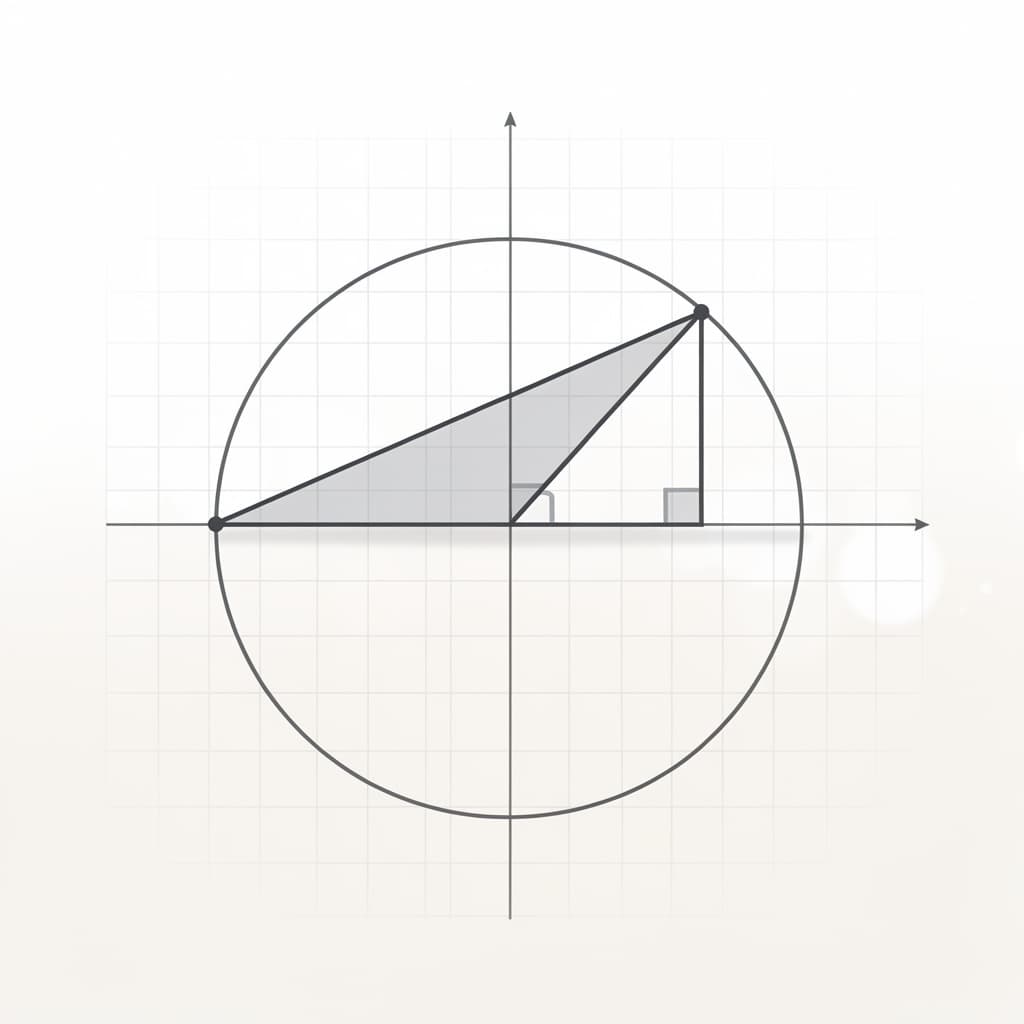
The unit circle serves as one of the most vital conceptual bridges in mathematics, linking the rigid geometry of triangles with the fluid, periodic nature of algebraic functions. By defining a circle with a radius of exactly one unit centered at the origin of a Cartesian coordinate plane, mathematicians transformed trigonometry from a study of right-angled ratios into a universal language of rotation and oscillation. This geometric construct allows for the evaluation of trigonometric functions for any angle, extending far beyond the 90-degree limitations of classical Euclidean geometry. Through the unit circle, we move from the static world of "opposite over hypotenuse" into a dynamic system where every point on a circumference describes a unique relationship between horizontal and vertical displacement.
Fundamentals of the Unit Circle
The foundational definition of the unit circle begins with its spatial placement and its fixed dimensions. In a two-dimensional Cartesian system, the circle is centered at the coordinates $(0, 0)$, providing a symmetrical anchor for all subsequent measurements. The radius is strictly defined as $r = 1$, a choice that simplifies calculations by making the radius the denominator in trigonometric ratios. Because the radius is one, the distance from the origin to any point $(x, y)$ on the circle’s perimeter is always constant, creating a perfect equilibrium that serves as the standard for rotational mathematics. The relationship between the coordinates of any point on the circle is governed by the Cartesian equation of the circle. Derived from the Pythagorean theorem, this equation is expressed as $$x^2 + y^2 = 1$$. This formula implies that for any point positioned on the edge of the circle, the sum of the squares of its horizontal and vertical distances from the origin must equal the square of the radius. This structural constraint is what allows mathematicians to solve for a missing coordinate if only one is known, ensuring that every movement along the circle maintains a rigorous logical consistency. To measure movement along this circle, we establish what is known as standard position. An angle is said to be in standard position when its vertex is at the origin and its initial ray lies along the positive x-axis. As the terminal side of the angle rotates away from this initial ray, it sweeps across the circumference, identifying specific points that correspond to unique angular measurements. This orientation provides a universal starting point, ensuring that an angle of 30 degrees or $\pi/6$ radians always refers to the same spatial orientation regardless of the context in which it is used.Mapping Unit Circle Angles
Navigating the unit circle requires an understanding of how the coordinate plane is divided into four distinct regions, known as quadrants. Quadrant I encompasses angles from $0$ to $90$ degrees, where both $x$ and $y$ coordinates remain positive. As the terminal side rotates into Quadrant II (90 to 180 degrees), the $x$ values become negative while $y$ remains positive. Moving into Quadrant III (180 to 270 degrees) results in both coordinates becoming negative, and finally, in Quadrant IV (270 to 360 degrees), $x$ returns to positive while $y$ stays negative. This cyclical transition of signs is fundamental to determining the behavior of trigonometric functions in various rotational stages. The direction of rotation is equally significant in determining the sign and magnitude of unit circle angles. By convention, counter-clockwise rotation is considered positive, representing the natural progression through the quadrants from I to IV. Conversely, clockwise rotation is treated as negative, which is particularly useful in applications involving reverse mechanical motion or phase shifts in physics. Despite the direction taken, any angle greater than 360 degrees or less than 0 degrees can be mapped back to a "coterminal" position within the standard circle, reinforcing the concept that circular motion is inherently repetitive and bound by the $2\pi$ limit. To simplify the calculation of coordinates for large or negative angles, mathematicians utilize reference angles. A reference angle is the acute version of any angle, measured between the terminal side and the x-axis, and it always falls between 0 and 90 degrees. Because of the symmetry of the circle, the absolute values of the coordinates for an angle like 150 degrees are identical to those of its reference angle, 30 degrees. By identifying the reference angle and then applying the appropriate signs based on the quadrant, one can solve complex trigonometric problems without needing to memorize an infinite number of coordinate pairs.Logic of Radians to Degrees
While degrees are a familiar unit of measurement derived from ancient Babylonian astronomy, the unit circle is most naturally described using radians. A radian is defined by the arc length along the circumference; specifically, one radian is the angle created when the arc length is equal to the radius of the circle. Since the circumference of a circle is $2\pi r$ and the radius of a unit circle is 1, the total distance around the circle is exactly $2\pi$. This creates a direct, intrinsic link between the geometry of the circle and the numerical value of the angle, making radians the preferred unit for calculus and high-level physics. The process of converting radians to degrees relies on the fundamental equivalence that $180$ degrees is equal to $\pi$ radians. This relationship stems from the fact that a half-circle covers an arc length of $\pi$ on the unit circle. To convert from degrees to radians, one multiplies the degree measure by the ratio $\frac{\pi}{180}$. This operation effectively "scales" the Babylonian degree system into the real-number system of the circle's circumference. For example, a $60$-degree angle multiplied by $\frac{\pi}{180}$ simplifies to $\pi/3$, representing one-third of the way across the upper semi-circle. Reverse conversion, from radians back to degrees, utilizes the reciprocal ratio of $\frac{180}{\pi}$. This formula allows for the translation of abstract mathematical results into the more intuitive degree-based system used in navigation and construction. If a calculation results in an angle of $3\pi/2$ radians, multiplying by $\frac{180}{\pi}$ yields $270$ degrees, immediately identifying the angle as pointing directly down along the negative y-axis. Mastering these conversion constants is essential for any student, as it allows for seamless transitions between the theoretical elegance of radians and the practical utility of degrees.Deciphering Sine and Cosine Values
The true power of the unit circle lies in its ability to define sine and cosine values as direct coordinate points. For any point $(x, y)$ on the unit circle corresponding to an angle $\theta$, the $x$-coordinate is defined as $\cos(\theta)$ and the $y$-coordinate is defined as $\sin(\theta)$. This definition is a direct consequence of the right-triangle definitions of trigonometry; since the hypotenuse (radius) is 1, the ratio of "adjacent over hypotenuse" simply becomes $x/1$. Consequently, the unit circle is not just a shape, but a functional map where every horizontal position represents a cosine value and every vertical position represents a sine value. This coordinate-based definition leads directly to the most famous equation in trigonometry: the Pythagorean Identity. By substituting the trigonometric definitions into the circle's Cartesian equation $x^2 + y^2 = 1$, we derive the identity $$\cos^2(\theta) + \sin^2(\theta) = 1$$. This identity holds true for every possible angle, whether positive, negative, or multiple rotations deep. It serves as a rigorous proof that the sine and cosine of an angle are inextricably linked; as one value increases, the other must decrease in a specific proportion to ensure the point remains exactly one unit away from the origin. Understanding the functional mapping of these values is made easier by examining the intercepts where the circle crosses the axes. At 0 degrees, the point is at $(1, 0)$, meaning $\cos(0) = 1$ and $\sin(0) = 0$. At 90 degrees ($\pi/2$), the point is $(0, 1)$, showing that the cosine has vanished while the sine has reached its maximum. At 180 degrees ($\pi$), the point is $(-1, 0)$, and at 270 degrees ($3\pi/2$), it is $(0, -1)$. These four "quadrantal angles" provide the skeleton of the unit circle chart, establishing the boundaries within which all other trigonometric values must fluctuate.Expanding Trigonometric Functions
Beyond sine and cosine, the unit circle provides the geometric basis for the remaining four trigonometric functions: tangent, cotangent, secant, and cosecant. The tangent of an angle is defined as the ratio of the y-coordinate to the x-coordinate, or $\frac{\sin(\theta)}{\cos(\theta)}$. Geometrically, this represents the slope of the terminal side as it radiates from the origin. If the terminal side is vertical (at 90 or 270 degrees), the $x$-coordinate is zero, which explains why the tangent function is undefined at those specific points, resulting in vertical asymptotes when graphed. The reciprocal identities are also clearly visualized through the geometry of the plane. The cosecant ($csc$) is the reciprocal of the sine ($\frac{1}{y}$), and the secant ($sec$) is the reciprocal of the cosine ($\frac{1}{x}$). In a unit circle, these values can be visualized as the lengths of segments tangent to the circle. For instance, if you draw a line tangent to the circle at the point $(x, y)$, the distance from the origin to the point where this tangent line intersects the x-axis is exactly the secant of the angle. This depth of geometric connection ensures that these functions are not just arbitrary divisions, but actual physical lengths related to the circle's structure. The cotangent function completes the set as the reciprocal of the tangent, defined as $\frac{x}{y}$ or $\frac{\cos(\theta)}{\sin(\theta)}$. Like the tangent, it represents a ratio of coordinates, but it focuses on the horizontal-to-vertical relationship. Together, these six functions describe every possible spatial relationship within the circular system. By understanding that tangent and secant are derived from the primary sine and cosine coordinates, students can move away from rote memorization and toward a logical derivation of the entire trigonometric landscape.Reading the Unit Circle Chart
The unit circle chart is a standardized reference tool that highlights specific "special" angles derived from geometric proofs. These angles—typically 30, 45, and 60 degrees (and their radian equivalents $\pi/6$, $\pi/4$, and $\pi/3$)—originate from the properties of special right triangles. In a $45-45-90$ triangle inscribed in the circle, the legs must be equal, leading to coordinates of $(\frac{\sqrt{2}}{2}, \frac{\sqrt{2}}{2})$. In a $30-60-90$ triangle, the shorter leg is exactly $1/2$ and the longer leg is $\frac{\sqrt{3}}{2}$. These specific constants appear repeatedly across the chart because they represent the exact algebraic solutions for dividing the circle into symmetrical arcs. Symmetry is the primary engine for filling out the rest of the unit circle chart across the other three quadrants. Once the values for the first quadrant are established, they are reflected across the y-axis for Quadrant II, the origin for Quadrant III, and the x-axis for Quadrant IV. For example, the coordinates for 150 degrees ($\pi/6$ units away from the 180-degree mark) are simply the coordinates of 30 degrees with the x-value negated: $(-\frac{\sqrt{3}}{2}, 1/2)$. This symmetric reflection allows a student to master the entire circle by only truly "learning" the first 90 degrees of information. Effective memorization strategies often involve identifying patterns in the denominators and numerators of these coordinates. One popular method is the "square root sequence," where the sine values for 0, 30, 45, 60, and 90 degrees are viewed as $\frac{\sqrt{0}}{2}, \frac{\sqrt{1}}{2}, \frac{\sqrt{2}}{2}, \frac{\sqrt{3}}{2},$ and $\frac{\sqrt{4}}{2}$. This simplifies to $0, 1/2, \frac{\sqrt{2}}{2}, \frac{\sqrt{3}}{2},$ and $1$, creating a clear logical progression. By internalizing these patterns and the "All Students Take Calculus" mnemonic (indicating which functions are positive in each quadrant), the unit circle becomes an intuitive mental map rather than a daunting table of numbers.Periodicity and Wave Motion
The most profound application of the unit circle is its ability to model periodicity, or the phenomenon of values repeating at regular intervals. As a point moves continuously around the circle, its y-coordinate (sine) and x-coordinate (cosine) oscillate back and forth between 1 and -1. If we "unroll" the circle along a horizontal time axis, the height of the point traces out a perfect sine wave. This transition from circular motion to linear wave motion is the foundation of trigonometry in the modern world, explaining how a spinning turbine generates a fluctuating electrical current. In this wave model, a cycle completion occurs every time the point returns to its starting position, which is every $2\pi$ radians (or 360 degrees). This interval is known as the period of the function. Adjustments to the speed of rotation change the frequency of the wave, while changes to the starting position on the circle create phase shifts. Because the unit circle is perfectly smooth and continuous, the resulting waves are also smooth, making them the ideal mathematical tool for representing sound, light, and seismic energy. The modeling of periodic physical phenomena extends to nearly every branch of science. Astronomers use the unit circle to predict the positions of planets in their orbits, while engineers use it to analyze the vibration of bridges and buildings. Even biological rhythms, such as the human circadian clock or the beating of a heart, can be approximated using the periodic logic of the circle. By mastering the unit circle, we gain the ability to quantify the rhythm of the natural world, proving that the simple geometry of a one-unit radius is the key to unlocking the complex behavior of the universe.References
- Stewart, J., "Calculus: Early Transcendentals, 9th Edition", Cengage Learning, 2020.
- Euclid, "The Elements", Alexandria, c. 300 BCE (Modern translation by T.L. Heath).
- Larson, R., & Edwards, B. H., "Trigonometry", Cengage Learning, 2017.
- Boyer, C. B., "A History of Mathematics", John Wiley & Sons, 1991.
Recommended Readings
- Trigonometry: A Very Short Introduction by Glen Van Brummelen — An accessible guide that explores the historical development of the circle and its role in human discovery.
- The Joy of x: A Guided Tour of Math, from One to Infinity by Steven Strogatz — Includes illuminating chapters on how circular motion translates into the waves that power modern technology.
- Precalculus: Mathematics for Calculus by James Stewart — A comprehensive textbook that builds deep intuition for the unit circle before transitioning into complex algebraic identities.
unit circleunit circle chartradians to degreestrigonometric functionsunit circle anglessine and cosine values