The Mechanics of Heat Transfer
Master the three primary modes of heat transfer: conduction, convection, and radiation. Explore the physical laws and engineering mechanics of thermal energy.
In this articleThermodynamics and the Nature of Energy Flow
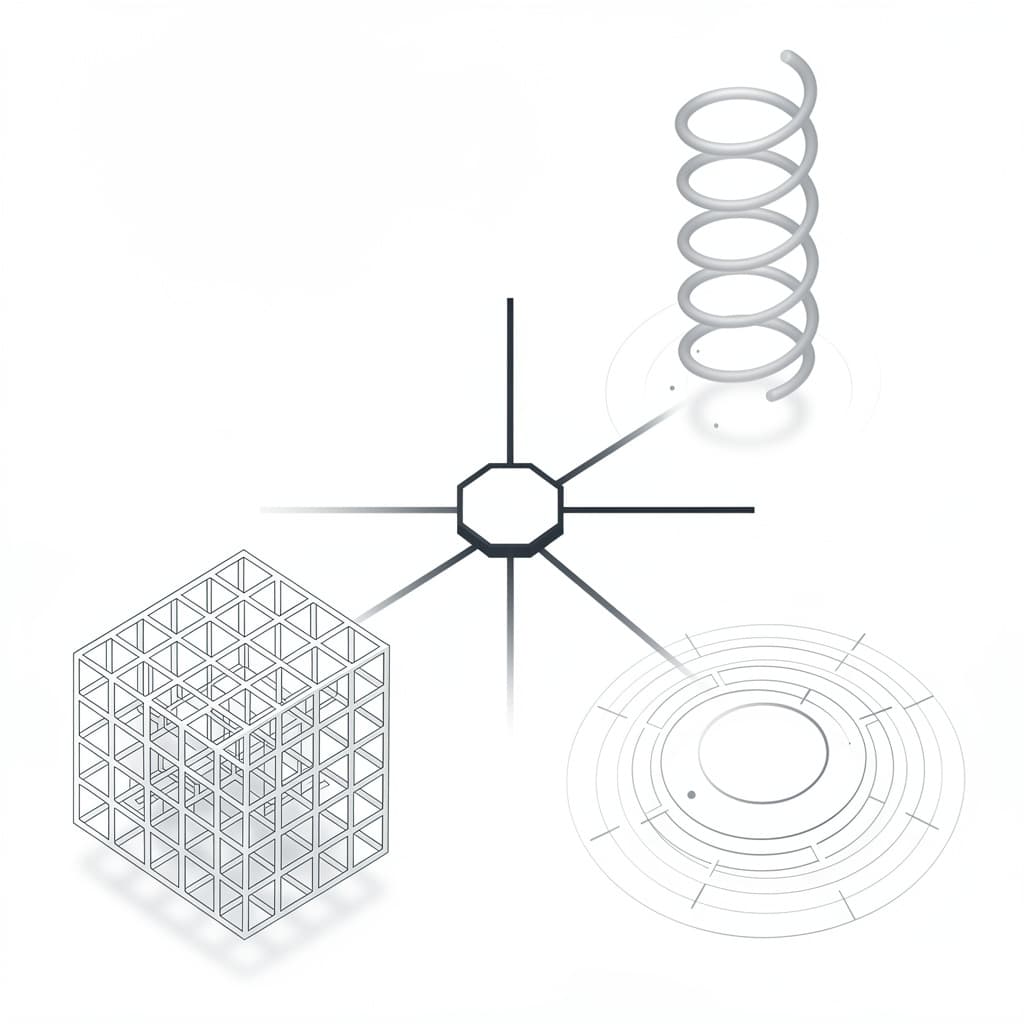

Heat transfer is the discipline of thermal engineering that concerns the generation, use, conversion, and exchange of thermal energy between physical systems. Unlike thermodynamics, which focuses on systems at equilibrium, heat transfer analyzes the rate at which energy moves due to a temperature gradient. The three fundamental modes of heat transfer—conduction, convection, and radiation—operate through distinct physical mechanisms and are governed by unique mathematical laws. Understanding these processes is essential for designing everything from high-performance microprocessors to industrial-scale power plants. By examining the molecular and electromagnetic nature of energy flow, engineers can predict and control temperature distributions in complex environments.
Thermodynamics and the Nature of Energy Flow
The Molecular Basis of Kinetic Energy
At the microscopic level, heat is the manifestation of the kinetic energy of atoms and molecules within a substance. In a gas, this energy is represented by the random translational motion of particles, while in solids, it primarily exists as vibrations within a crystal lattice structure. When a temperature difference is established, higher-energy particles interact with lower-energy neighbors, facilitating a net transfer of energy toward the region of lower kinetic intensity. This microscopic perspective explains why temperature is a scalar measure of the average kinetic energy of a system's constituents. In engineering thermodynamics, we treat these microscopic interactions as a macroscopic continuum to simplify the analysis of heat flux and energy conservation.
The transition of energy from one particle to another is never perfectly efficient, as governed by the underlying quantum and classical mechanics of collisions. In metallic solids, free electrons act as primary carriers of thermal energy, moving rapidly through the lattice and colliding with ions to redistribute heat. In non-metallic solids, the transport is dominated by lattice waves known as phonons, which propagate through the material. Understanding these molecular carriers allows material scientists to tailor the thermal properties of substances for specific industrial needs. This molecular foundation ensures that heat transfer is always a dynamic process, inherently linked to the physical state and atomic arrangement of the matter involved.
Entropy and the Direction of Heat Flow
The Second Law of Thermodynamics dictates the directionality of energy flow, stating that the total entropy of an isolated system can never decrease over time. In the context of heat transfer, this implies that thermal energy spontaneously flows from a region of higher temperature to a region of lower temperature. This "downhill" flow continues until the system reaches thermal equilibrium, where the temperature gradient vanishes and net heat transfer ceases. Engineers must design systems that either accelerate this progression, such as in cooling systems, or retard it, as seen in thermal insulation. Entropy production during these processes represents a loss of "available" energy, often referred to as exergy destruction in advanced thermodynamic analysis.
Mathematically, the Second Law ensures that the heat flux vector always points in the direction of the decreasing temperature gradient. While the First Law of Thermodynamics tracks the conservation of energy, the Second Law provides the "arrow of time" that governs the physical possibility of a process. For instance, a cup of coffee cooling in a room is a spontaneous process because it increases the overall entropy of the universe. Attempting to reverse this process without external work would violate the fundamental nature of thermodynamic systems. Therefore, the study of heat transfer mechanisms is fundamentally an exercise in managing the inevitable increase of entropy through controlled energy gradients.
Temperature Gradients in Physical Systems
A temperature gradient is the physical quantity that describes in which direction and at what rate the temperature changes most rapidly around a particular location. It is the fundamental driving force for all modes of heat transfer, acting much like a pressure difference drives fluid flow or a voltage difference drives electric current. The magnitude of the gradient determines the intensity of the heat flux, while the medium's properties determine the resistance to that flow. In a steady-state system, the gradient remains constant over time, but in transient systems, it evolves as energy is redistributed. Precision in engineering often requires mapping these gradients across three-dimensional spaces to prevent localized overheating or structural failure.
The mathematical representation of this gradient is typically denoted as , a vector field that points toward the greatest rate of temperature increase. Heat flux, conversely, moves in the direction, seeking the path of least thermal potential. In composite materials, gradients can become highly non-linear as the energy encounters varying levels of thermal resistance at material interfaces. Designing effective heat exchangers or thermal barriers requires a deep intuition of how these gradients behave under different boundary conditions. By manipulating geometry and material selection, engineers can "shape" the temperature gradient to optimize the performance of thermal systems.
Conduction and Thermal Conductivity Explained
Fourier's Law and the Mathematics of Flow
Conduction is the transfer of energy through a stationary medium, whether solid, liquid, or gas, due to a temperature gradient. The fundamental relationship governing this mode is known as Fourier's Law of Heat Conduction, which states that the heat transfer rate is proportional to the negative gradient of temperature and the area through which the heat flows. In a simple one-dimensional form, the law is expressed as: where is the heat flow rate, is the thermal conductivity of the material, is the cross-sectional area, and is the temperature gradient. The negative sign is a mathematical necessity to show that heat flows from high to low temperature.
This linear relationship serves as the foundation for conduction analysis in both steady-state and transient conditions. In more complex three-dimensional systems, the law is generalized using vector calculus to account for heat flow in all spatial directions simultaneously. For isotropic materials, the thermal conductivity is a scalar value, but in anisotropic materials like carbon fiber composites, can be a tensor, meaning heat flows more easily in one direction than another. Engineers utilize these mathematical models to predict internal temperatures in components where direct measurement is impossible. Fourier's insights transformed heat transfer from a qualitative observation into a rigorous, predictive science.
Molecular Collisions in Solid Lattice Structures
In solids, conduction occurs through two primary mechanisms: the migration of free electrons and lattice vibrational waves called phonons. In metals, the presence of a "sea" of delocalized electrons allows for extremely efficient energy transport, which explains why metals are generally excellent conductors of both electricity and heat. The Wiedemann-Franz Law provides a quantitative link between electrical and thermal conductivity in metals, illustrating their shared reliance on electron mobility. As a metal is heated, these electrons gain kinetic energy and collide with ions and other electrons, rapidly distributing the energy throughout the bulk material. This process is significantly faster than the energy transfer found in non-metallic substances.
In insulators and semiconductors, where free electrons are scarce, heat is conducted through phonons—quantized modes of vibration in the crystal lattice. When one end of an insulator is heated, the atoms vibrate more vigorously, and these vibrations are transmitted to adjacent atoms through interatomic bonds. This process is generally less efficient than electron-mediated conduction because phonons are easily scattered by impurities, grain boundaries, and other phonons. At extremely low temperatures, phonon behavior becomes a critical focus of cryogenic engineering and quantum computing hardware design. Understanding these microscopic interactions allows engineers to select materials that either facilitate rapid cooling or provide robust thermal shielding.
Factors Influencing Material Conductivity
The thermal conductivity, , is not a universal constant but a material property that depends heavily on the physical state, chemical composition, and temperature of the substance. For gases, conductivity is relatively low because molecules are widely spaced, leading to infrequent collisions; it typically increases with temperature as molecular velocity increases. Liquids occupy an intermediate range, where the proximity of molecules allows for more frequent interactions than in gases but lacks the ordered structure of solids. In solids, can span several orders of magnitude, from vacuum-grade insulators to diamond, which possesses the highest known natural thermal conductivity. Engineers must consult detailed property tables to ensure accuracy in their thermal calculations.
Temperature also plays a pivotal role in determining the conductivity of a material, often in non-linear ways. For most metals, conductivity decreases slightly as temperature rises because increased lattice vibrations scatter the flow of free electrons more effectively. Conversely, in many insulators, conductivity may increase with temperature as more vibrational modes become active. Phase changes, such as melting or vaporization, result in drastic shifts in , necessitating complex modeling in applications like metal casting or boiling. Environmental factors, such as pressure in gases or moisture content in porous building materials, further complicate the practical application of thermal conductivity explained in real-world scenarios.
Studying this for an exam?
Noesis builds the syllabus, notes and tests for you, and you study them with a tutor that knows your material.
Convection and Newton's Law of Cooling
Fluid Dynamics and Bulk Motion Transport
Convection is the mode of heat transfer that occurs between a surface and a moving fluid when they are at different temperatures. It is a complex mechanism because it combines the effects of conduction through the fluid and the "bulk motion" or advection of the fluid itself. As a fluid moves over a hot surface, it absorbs energy via conduction at the interface, and this energy is then swept away by the macroscopic movement of the fluid molecules. This constant replenishment of cool fluid at the surface maintains a high temperature gradient, making convection far more effective at removing heat than stagnant conduction. Convection is the primary mechanism utilized in radiator systems, air-conditioning, and biological thermoregulation.
The study of convection is inextricably linked to fluid dynamics and the concept of the boundary layer. When a fluid flows over a surface, a thin region develops where the fluid velocity transitions from zero at the wall to the full stream velocity. This boundary layer acts as the primary zone of thermal resistance; a thinner boundary layer, often achieved through higher flow velocities, results in higher heat transfer rates. Engineers categorize convective flows based on their Reynolds number to determine if the flow is laminar or turbulent. Turbulent flow, characterized by chaotic eddies and rapid mixing, significantly enhances the heat transfer coefficient by physically moving hot fluid away from the surface more aggressively than laminar flow.
Characterizing Forced and Natural Convection
Convection is broadly classified into two categories: forced convection and natural (or free) convection. Forced convection occurs when an external source, such as a fan, pump, or wind, induces the fluid motion. In this scenario, the velocity of the fluid is largely independent of the temperature difference between the surface and the fluid. Forced convection is the "workhorse" of industrial cooling, allowing for high-density energy removal in compact spaces like automobile engines or power electronics. The efficiency of these systems is typically characterized by the Nusselt number, a dimensionless ratio of convective to conductive heat transfer across the boundary.
Natural convection, by contrast, is driven by buoyancy forces that arise from density differences within the fluid caused by temperature variations. When a fluid near a hot surface warms up, it becomes less dense and rises, while cooler, denser fluid flows in to take its place, creating a "convection cell." This process is generally much slower and less efficient than forced convection but is vital in many passive systems, such as domestic heating radiators or the cooling of large electronic transformers. In the absence of gravity, such as in orbiting spacecraft, natural convection essentially ceases to exist, posing unique challenges for thermal management in microgravity environments. Engineers must carefully evaluate which type of convection is most appropriate based on power availability and reliability requirements.
The Heat Transfer Coefficient in Boundary Layers
The mathematical treatment of convection is summarized by Newton's Law of Cooling, which states that the heat flux is proportional to the temperature difference between the surface and the bulk fluid. The formula is expressed as: where is the convective heat transfer coefficient, is the surface area, is the surface temperature, and is the fluid temperature far from the surface. Unlike thermal conductivity , which is a material property, the coefficient is a complex function of the flow conditions, geometry, and fluid properties. It is often the most difficult parameter to determine in a thermal analysis, frequently requiring empirical correlations or computational fluid dynamics (CFD) simulations.
The value of can vary wildly depending on the medium and the state of the flow. For example, natural convection in air might have an value of 5 to 25 , while forced convection in water can reach values as high as 10,000 . Phase change processes, such as boiling or condensation, can result in even higher coefficients due to the massive energy exchange associated with latent heat. Consequently, the boundary layer is the "bottleneck" of convective heat transfer, and much of engineering design focuses on "tripping" the flow into turbulence or using fins to increase surface area. By mastering the variables that influence , engineers can optimize the size and cost of heat exchange equipment.
Radiation and Electromagnetic Energy Transport
The Stefan-Boltzmann Law for Blackbodies
Thermal radiation is the only one of the modes of heat transfer that does not require a physical medium to propagate. It occurs via the emission of electromagnetic waves from any matter that has a temperature above absolute zero. The idealized model for this process is the "blackbody," a theoretical surface that absorbs all incident radiation and emits the maximum possible energy for a given temperature. The total power emitted by a blackbody is governed by the Stefan-Boltzmann Law: where is the Stefan-Boltzmann constant (approximately ), is the surface area, and is the absolute temperature in Kelvin. The dependence makes radiation incredibly significant at high temperatures, such as in combustion chambers or solar applications.
In real-world engineering, most surfaces are "gray bodies" rather than ideal blackbodies, meaning they emit only a fraction of the maximum theoretical energy. This fraction is defined as the emissivity, , a dimensionless value ranging from 0 to 1. To calculate the actual heat transfer between two surfaces, engineers must also consider the "view factor," which accounts for the geometric orientation and visibility of the surfaces to one another. Radiation is unique because it allows for energy exchange across vast distances, such as the transport of solar energy through the vacuum of space to the Earth's atmosphere. This independence from a medium makes radiation the dominant heat transfer mechanism in vacuum systems and high-altitude aerospace vehicles.
Wave-Particle Duality in Thermal Emission
The mechanics of radiation can be understood through the lens of wave-particle duality, where thermal energy is transported by photons. These photons are generated by the transitions of electrons between energy levels or the vibrational and rotational transitions within molecules. According to Planck’s Law, the spectrum of emitted radiation depends on the temperature of the source; hotter objects emit more energy and shift their peak emission toward shorter wavelengths. This is why a heating element glows red-hot as it reaches higher temperatures, eventually appearing "white-hot" as it begins to emit across the entire visible spectrum. This spectral distribution is critical for designing sensors, infrared cameras, and solar energy harvesters.
The interaction of these photons with matter involves absorption, reflection, and transmission. When radiation strikes a surface, the energy can be absorbed and converted back into internal thermal energy, reflected away, or passed through if the material is transparent. Kirchhoff’s Law of Thermal Radiation states that for an arbitrary body in thermal equilibrium, its emissivity is equal to its absorptivity at a given wavelength. This principle is vital for engineers designing coatings; for example, a "selective surface" for a solar collector might be designed to have high absorptivity for short-wave solar radiation but low emissivity for long-wave thermal radiation. This sophisticated manipulation of electromagnetic properties allows for the high-efficiency capture and retention of thermal energy.
Surface Emissivity and Absorptivity Mechanics
The surface finish and material composition of an object dictate how it interacts with thermal radiation. Polished metals, like silver or aluminum, have very low emissivity (often below 0.10) and high reflectivity, making them excellent choices for radiation shields or "space blankets." In contrast, oxidized surfaces, dark paints, and organic materials typically have high emissivity (above 0.85), meaning they are efficient at both emitting and absorbing thermal energy. This is a common point of confusion: a surface that is a good "reflector" is a poor "emitter," and vice versa. Engineers must choose coatings based on whether the goal is to keep heat in, reflect external heat away, or maximize cooling through emission.
Furthermore, emissivity can be highly dependent on the wavelength and the angle of emission. Many materials that appear transparent to the human eye, like glass, are actually "opaque" to long-wave infrared radiation, creating the "greenhouse effect" where energy enters as visible light but is trapped as heat. Understanding these nuances is critical for architectural engineering, where window coatings are used to reduce cooling loads in summer and heating loads in winter. The development of metamaterials has recently allowed for even greater control over radiation, enabling "radiative cooling" surfaces that can stay cooler than the ambient air by emitting energy directly into the cold sink of outer space. These advancements represent the cutting edge of heat transfer mechanisms research.
Systems Combining Conduction Convection and Radiation
Thermal Resistance Networks in Composite Walls
In practical engineering, heat rarely moves through a single mode; instead, multiple modes of heat transfer act in series or parallel. To simplify the analysis of such systems, engineers use the thermal resistance analogy, which treats heat flow () as current (), temperature difference () as voltage (), and thermal resistance () as electrical resistance. For a composite wall, the total resistance is the sum of the individual resistances of each layer. Conduction resistance is defined as , while convection resistance is . By constructing a "thermal circuit," engineers can quickly calculate the total heat loss through a building’s facade or a cryogenic tank’s insulation without solving complex differential equations for every layer.
The total heat transfer through a system is often expressed using the Overall Heat Transfer Coefficient, , which combines all modes into a single value. The relationship is given by , where is the reciprocal of the total thermal resistance. This approach is particularly useful when designing heat exchangers, where heat must move from a hot fluid, through a metal tube wall, and into a cold fluid. In such cases, the "fouling factor"—the resistance added by mineral deposits or corrosion on the tube surface—must also be included in the network. This holistic view of energy transport allows for the optimization of multi-layer systems where different materials serve different structural and thermal purposes.
The Role of Insulators in Reducing Loss
Insulation is the intentional use of materials with high thermal resistance to minimize the rate of heat transfer. Most common insulators, like fiberglass or expanded polystyrene, work by trapping air in small pockets to prevent large-scale convection while relying on the low thermal conductivity of air to minimize conduction. Because air is a poor conductor, these "stagnant air" systems are highly effective and inexpensive. However, for extreme applications like liquefied natural gas (LNG) storage or space exploration, even better performance is required. This is achieved through vacuum insulation, which removes the medium entirely, eliminating conduction and convection and leaving only radiation to be managed by reflective multi-layer insulation (MLI).
The effectiveness of an insulator is often quantified by its R-value, which is the thermal resistance per unit area. Higher R-values indicate better insulating properties. In the construction industry, the placement of insulation is as important as the material itself; for instance, "thermal bridging" occurs when a highly conductive material, like a steel stud, bypasses the insulation and creates a path for rapid heat loss. Preventing these bridges is crucial for energy-efficient building design and for protecting sensitive components in industrial machinery. Through the strategic combination of low-conductivity materials and low-emissivity coatings, engineers can create environments that maintain stable temperatures despite extreme external fluctuations.
Environmental Heat Exchange in Atmosphere
Heat transfer in the Earth's atmosphere is a monumental example of all three modes working in tandem on a global scale. The sun provides energy primarily through radiation, which is absorbed by the Earth’s surface. This heated surface then warms the adjacent air through conduction, which in turn triggers massive convective currents (weather patterns) that redistribute the energy toward the poles. Simultaneously, the atmosphere and the surface emit long-wave radiation back toward space, much of which is absorbed by greenhouse gases and re-emitted, maintaining the planet's habitable temperature. This balance is incredibly sensitive to the concentration of gases and the reflectivity (albedo) of the surface.
Engineers and climate scientists model these interactions using Global Circulation Models (GCMs) that solve the energy balance equations for millions of small volumes of air and water. On a more local scale, urban heat islands occur because asphalt and concrete have different thermal storage and radiation properties than natural vegetation, leading to significantly higher temperatures in cities. Managing these environmental heat exchanges is a core component of modern civil engineering, involving everything from "cool roofs" that reflect solar radiation to the design of urban green spaces that use evapotranspiration (a form of latent heat convection) to cool the surrounding air. The study of heat transfer is thus central to our ability to adapt to and mitigate climate change.
Engineering Thermodynamics and Heat Transfer Mechanisms
Transient vs Steady-State Thermal Analysis
Engineering problems are generally divided into steady-state and transient analyses. Steady-state analysis assumes that the temperatures within a system do not change over time, meaning the energy entering the system exactly balances the energy leaving it. This is a common assumption for machines running at a constant load, such as an industrial boiler or a computer running a steady process. It simplifies the governing equations from partial differential equations to algebraic or ordinary differential equations, allowing for quick design iterations. However, steady-state analysis fails to capture the "startup" and "shutdown" phases where temperatures may temporarily exceed safe limits.
Transient analysis, on the other hand, accounts for the change in internal energy over time, which is essential for understanding thermal shock, cyclical heating, or cooling after a failure. The key parameter in transient conduction is the Biot number (), which compares the internal conductive resistance to the external convective resistance. If the Biot number is very small (typically ), the "lumped capacitance" method can be used, assuming the entire object maintains a uniform temperature as it cools or heats. For larger Biot numbers, the temperature varies significantly throughout the interior, requiring more complex solutions such as Heisler charts or finite element analysis (FEA). Mastering both regimes is vital for ensuring the safety and longevity of mechanical components.
The Efficiency of Commercial Heat Exchangers
Heat exchangers are specialized devices designed to transfer heat between two or more fluids at different temperatures. They are ubiquitous in industry, found in everything from the "intercoolers" of turbocharged engines to the massive condensers in nuclear power plants. The two most common designs are the shell-and-tube exchanger and the plate heat exchanger. In a shell-and-tube design, one fluid flows through a bundle of tubes while the other flows over them within a larger shell. Plate exchangers use thin, corrugated metal plates to create a large surface area in a compact volume, offering very high heat transfer coefficients but limited by pressure constraints. The design choice depends on the required efficiency, the nature of the fluids, and the available space.
To evaluate these devices, engineers use the Log Mean Temperature Difference (LMTD) method or the Effectiveness-NTU (Number of Transfer Units) method. These methods account for the fact that as fluids move through the exchanger, their temperatures change, causing the local temperature gradient—and thus the heat transfer rate—to vary along the length of the device. Counter-flow arrangements, where the fluids move in opposite directions, are generally more efficient than parallel-flow because they maintain a more uniform temperature difference throughout the exchanger. Optimization involves balancing the desire for high heat transfer rates with the costs of pumping fluids through the system, as higher velocities lead to higher pressure drops and energy consumption.
Governing Equations for Energy Conservation
The ultimate framework for all heat transfer analysis is the principle of Conservation of Energy, or the First Law of Thermodynamics. For a control volume, the general energy balance is: where and are the rates of energy entering and leaving through the boundaries, is the rate of internal energy generation (e.g., electrical resistance heating or chemical reaction), and is the rate of energy storage (temperature change). This equation allows engineers to account for all energy flows in a system simultaneously, ensuring that no energy is "lost" in the model. It serves as the basis for the heat diffusion equation, the fundamental partial differential equation used to solve for temperature distributions in solids.
In fluid systems, this energy balance is coupled with the Navier-Stokes equations (momentum conservation) and the continuity equation (mass conservation). This coupling is what makes convection so difficult to solve analytically, as the fluid's velocity field depends on the temperature field (through buoyancy) and the temperature field depends on the velocity field (through advection). Modern engineering relies heavily on numerical methods to solve these coupled equations for complex geometries. Whether designing a simple finned heat sink or a sophisticated jet engine turbine blade, the governing equations provide the rigorous logical structure that ensures the resulting design will operate within its thermal limits.
Thermal Management in Advanced Industrial Applications
Cooling Strategies for High-Power Electronics
As transistors shrink and power density increases, thermal management has become the primary limiting factor in electronic performance. High-performance CPUs and GPUs generate hundreds of watts of heat in an area no larger than a postage stamp, creating heat fluxes comparable to those on the surface of the sun. To handle this, engineers use sophisticated heat sinks equipped with "heat pipes"—sealed tubes containing a working fluid that evaporates at the hot end and condenses at the cold end. This utilizes the latent heat of vaporization, which can transport energy hundreds of times more effectively than solid copper. In data centers, liquid immersion cooling—where the entire server is submerged in a non-conductive dielectric fluid—is becoming more common to manage the massive heat loads generated by AI processing.
Another emerging technology is the use of Phase Change Materials (PCMs) to handle transient thermal peaks. These materials absorb large amounts of energy at a constant temperature as they melt, acting as a "thermal buffer" for devices that experience bursts of activity. When the device idles, the PCM slowly solidifies, releasing the stored heat to the surroundings. On a smaller scale, thermoelectric coolers (Peltier devices) use the Peltier effect to create a temperature difference using electric current, allowing for active, solid-state refrigeration of sensitive sensors. These diverse strategies illustrate how the fundamental modes of heat transfer are creatively combined to solve the most pressing challenges in modern computing.
Aerospace Materials and Thermal Protection
Aerospace vehicles face some of the most extreme thermal environments known to man, from the cryogenic temperatures of liquid hydrogen fuel to the searing heat of atmospheric re-entry. Spacecraft re-entering Earth's atmosphere generate temperatures exceeding 1,500 degrees Celsius due to adiabatic compression and friction. To protect the vehicle, engineers use "ablative" heat shields that are designed to char and erode, carrying heat away through the phase change and the resulting mass loss. Alternatively, the Space Shuttle used silica ceramic tiles that were so efficient at preventing conduction that one side could be white-hot while the other was cool enough to touch with a bare hand. This level of thermal protection is a masterclass in managing the modes of heat transfer under life-or-death conditions.
In aircraft engines, turbine blades operate at temperatures above their own melting point. This is made possible through "film cooling," where cool air is bled from the compressor and forced through tiny holes in the blade's surface, creating a thin, protective layer of air that "insulates" the metal from the hot combustion gases. Thermal barrier coatings (TBCs)—thin layers of ceramic materials—are also applied to the blades to provide an additional layer of conductive resistance. These advancements in materials science and fluid dynamics allow modern jet engines to operate at higher pressures and temperatures, significantly improving fuel efficiency and reducing emissions. The survival of these components is a testament to the precision of modern thermal analysis.
Sustainability and Thermal Waste Recovery
In a world focused on sustainability, the recovery of waste heat is one of the most significant opportunities for increasing energy efficiency. Over 60 percent of the energy produced globally is lost as waste heat, primarily through power plant cooling towers and industrial exhaust. Waste Heat Recovery (WHR) systems, such as Organic Rankine Cycles (ORC), use this low-grade heat to boil a fluid with a lower boiling point than water, which then drives a turbine to generate additional electricity. This process effectively "recycles" thermal energy that would otherwise be rejected into the atmosphere, improving the overall efficiency of industrial processes and reducing the demand for primary fuel sources.
Heat pumps represent another critical application of these principles, moving heat from a cold source to a warm sink using a small amount of work. By "pumping" heat from the ground or the ambient air, these systems can provide three to four units of heating for every unit of electricity consumed, making them far more efficient than traditional resistive heating. Large-scale thermal energy storage, using molten salts or underground aquifers, allows for the storage of excess solar or wind energy as heat for later use. As we transition to a low-carbon economy, the ability to manipulate and store thermal energy through an understanding of conduction, convection, and radiation will be paramount in creating a resilient and efficient global energy infrastructure.
References
- Incropera, F. P., & DeWitt, D. P., "Fundamentals of Heat and Mass Transfer", John Wiley & Sons, 2017.
- Cengel, Y. A., & Ghajar, A. J., "Heat and Mass Transfer: Fundamentals and Applications", McGraw-Hill Education, 2014.
- Lienhard, J. H. IV, & Lienhard, J. H. V, "A Heat Transfer Textbook", Phlogiston Press, 2020.
- Bergman, T. L., & Lavine, A. S., "Introduction to Heat Transfer", Wiley, 2011.
- Fourier, J., "The Analytical Theory of Heat", Cambridge University Press (Original work published 1822).
Recommended Readings
- The Laws of Thermodynamics: A Very Short Introduction by Peter Atkins — A concise and brilliantly written conceptual overview of the laws that govern all energy flow.
- Heat Transfer by Adrian Bejan — This text provides a deep dive into the "Constructal Law" and the evolution of flow systems in nature and engineering.
- Conduction of Heat in Solids by Carslaw and Jaeger — The definitive mathematical reference for solving complex conduction problems, widely regarded as a classic in the field.
- Thermal Design: Heat Sinks, Thermoelectrics, Heat Pipes, Compact Heat Exchangers, and Solar Cells by H. S. Lee — A practical guide for engineers looking to apply heat transfer theory to modern industrial cooling challenges.
Turn this topic into a full course
Noesis builds the syllabus, notes and tests for you, and you study them with a tutor that knows your material.