The Geometric Logic of the Unit Circle
The unit circle is perhaps the most elegant and fundamental tool in the arsenal of a mathematician, serving as the bridge between the rigid structures of Euclidean geometry and the fluid, periodic...
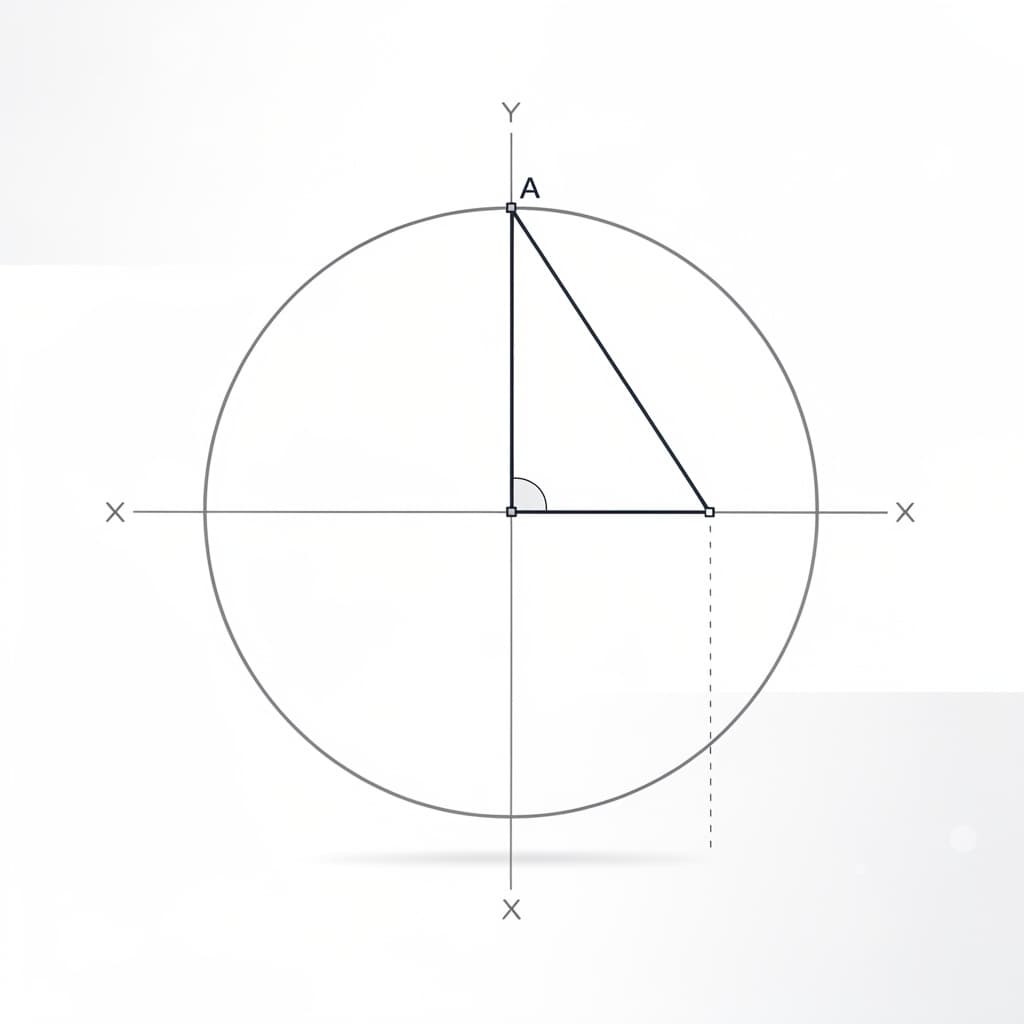
The unit circle is perhaps the most elegant and fundamental tool in the arsenal of a mathematician, serving as the bridge between the rigid structures of Euclidean geometry and the fluid, periodic nature of trigonometry. At its simplest level, the unit circle is defined as a circle with a radius of exactly one unit, centered at the origin $(0,0)$ of a two-dimensional Cartesian coordinate system. This geometric simplicity, however, belies a profound mathematical depth that allows students and scientists to map linear movement onto rotational motion. By understanding the unit circle explained through its logical construction, one can transcend the rote memorization of coordinates and instead see the inherent symmetry that governs the relationships between angles and lengths. This article explores the geometric logic that transforms a simple shape into a universal calculator for periodic phenomena.
The Foundation of the Unit Circle
The structural integrity of the unit circle begins with its fixed radius of one, a value chosen not for its magnitude but for its mathematical utility as the multiplicative identity. When the radius ($r$) is equal to 1, the arithmetic governing the circle’s properties becomes significantly streamlined, as any division or multiplication by the radius leaves the primary value unchanged. This radius originates at the coordinate $(0,0)$ and extends to any point $(x, y)$ on the circumference, effectively acting as the hypotenuse of a right-angled triangle. Because the radius is constant, every point on the circle’s edge satisfies the equation of a circle, which is deeply rooted in the ancient wisdom of the Pythagorean theorem.
The intersection of geometry and algebra within the unit circle is crystallized in the formula $$x^2 + y^2 = 1$$. In this context, the $x$-coordinate represents the horizontal displacement from the origin, while the $y$-coordinate represents the vertical displacement. This relationship implies that for any given angle, the sum of the squares of the horizontal and vertical components must always equal the square of the radius, which remains 1. This algebraic constraint ensures that the unit circle is a closed, perfectly symmetrical loop that provides a consistent framework for defining trigonometric ratios. By grounding the circle in the Cartesian plane, we allow for the seamless transition from static geometric shapes to dynamic algebraic functions.
Historically, the unit circle represents a shift in mathematical thought from the study of triangles in isolation to the study of circular motion and periodic functions. While traditional trigonometry often focuses on the ratios of sides in right-angled triangles, the unit circle generalizes these concepts to include any angle, whether positive, negative, or greater than 360 degrees. This generalization is what makes the unit circle indispensable for fields ranging from engineering to quantum mechanics. It provides a standardized environment where the relationship between an angle and its corresponding point on the plane is fixed and predictable. This predictability is the cornerstone of trigonometric functions unit circle analysis, allowing for the calculation of exact values in a systematic way.
Mapping Radians and Degrees Unit Circle
To navigate the unit circle, one must master the dual languages of angular measurement: degrees and radians. Degrees are a historical artifact, likely descending from the ancient Babylonian base-sixty system, which divided a full rotation into 360 equal parts. While degrees are intuitive for many due to their prevalence in common navigation and elementary geometry, they are mathematically arbitrary. In contrast, radians and degrees unit circle mapping reveals that radians are a "natural" unit of measure derived directly from the circle’s own geometry. A radian is defined as the angle subtended at the center of a circle by an arc whose length is exactly equal to the radius of the circle.
The conceptual origin of the radian is tied to the fundamental constant $\pi$, which represents the ratio of a circle's circumference to its diameter. Since the circumference of any circle is $2\pi r$, and the radius of the unit circle is 1, the total distance around the unit circle is exactly $2\pi$. This means that a full 360-degree rotation is equivalent to $2\pi$ radians, a half-rotation of 180 degrees is $\pi$ radians, and a quarter-rotation of 90 degrees is $\pi/2$ radians. This direct relationship between the angle and the arc length makes radians the preferred unit in calculus and physics, where the rates of change are often tied to the physical dimensions of the motion. Understanding this connection is vital for anyone looking into how to memorize the unit circle effectively.
Converting between these two systems is a matter of applying the ratio $180^\circ = \pi$ radians. To convert from degrees to radians, one multiplies the degree measure by $\pi/180^\circ$, whereas the reverse process involves multiplying by $180^\circ/\pi$. This conversion logic is not merely a computational trick but a way of translating between the human-centric degree system and the nature-centric radian system. Most unit circle chart resources display both values simultaneously to help students build an intuitive sense of how they correspond. For example, the 45-degree angle, which bisects the first quadrant, is naturally expressed as $\pi/4$ radians, representing one-eighth of the total circumference.
The Trigonometric Functions Unit Circle
The true power of the unit circle is realized when we define sine and cosine not as ratios of a triangle, but as the coordinates of a point on the circle. For any angle $\theta$ measured from the positive $x$-axis, the point where the terminal side of the angle intersects the circle is designated as $(\cos \theta, \sin \theta)$. This means that $\cos \theta$ is the $x$-coordinate (horizontal distance) and $\sin \theta$ is the $y$-coordinate (vertical distance). This definition is elegant because it eliminates the need to consider the hypotenuse, as the hypotenuse is always 1. Thus, the identity $\cos^2 \theta + \sin^2 \theta = 1$ is simply a restatement of the unit circle’s defining equation $x^2 + y^2 = 1$.
The tangent function, while often thought of as "opposite over adjacent," takes on a geometric meaning as the slope of the line forming the angle. Algebraically, $\tan \theta = \frac{\sin \theta}{\cos \theta}$, which is equivalent to the rise over run of the terminal side. Geometrically, the name "tangent" comes from the length of a line segment tangent to the circle at the point $(1,0)$ that extends to the terminal side of the angle. This visualization helps explain why tangent is undefined at $\pi/2$ (90 degrees) and $3\pi/2$ (270 degrees), as the terminal side becomes vertical and never intersects the vertical tangent line at $x=1$. This spatial logic is a key component of the sin cos tan unit circle relationship.
Furthermore, the reciprocal functions—secant, cosecant, and cotangent—can also be visualized as specific lengths related to the circle. Cosecant ($1/\sin \theta$) and secant ($1/\cos \theta$) represent the distances from the origin to the points where the tangent line to the circle intersects the $y$ and $x$ axes, respectively. These relationships demonstrate that trigonometry is not a collection of isolated formulas but a cohesive geometric system. By seeing these functions as physical lengths and positions on a graph, the behavior of their graphs—such as their periods and asymptotes—becomes much more intuitive. This comprehensive view is essential for a complete unit circle explained experience.
Navigating the Four Quadrants
The Cartesian plane is divided into four quadrants, and the behavior of trigonometric functions changes predictably as an angle sweeps through each one. In the first quadrant (0 to 90 degrees), both $x$ and $y$ coordinates are positive, meaning all trigonometric functions yield positive results. As the angle moves into the second quadrant (90 to 180 degrees), the $x$-coordinate becomes negative while the $y$-coordinate remains positive; consequently, cosine is negative and sine is positive. This leads to the common "ASTC" mnemonic, which stands for "All, Sine, Tangent, Cosine," indicating which primary function is positive in each successive quadrant. Understanding these signs is the first step in correctly applying trigonometric functions unit circle logic to real-world problems.
Symmetry across the axes allows us to relate angles in the second, third, and fourth quadrants back to their counterparts in the first quadrant. For any angle $\theta$ in the latter quadrants, there exists a "reference angle" $\alpha$ in the first quadrant that shares the same absolute coordinate values. For example, an angle of 150 degrees ($\pi - 30^\circ$) in the second quadrant has a reference angle of 30 degrees. Its sine value will be the same as $\sin(30^\circ)$, while its cosine value will be the negative of $\cos(30^\circ)$. This symmetry is a powerful tool for calculation, as it reduces the amount of information one needs to memorize by a factor of four. By reflecting points across the $x$-axis, $y$-axis, or the origin, we can find the coordinates for any of the 16 primary angles on the circle.
The logic of reference angles is based on the idea that the "distance" to the $x$-axis determines the magnitude of the trigonometric values. In the third quadrant, where both $x$ and $y$ are negative, the tangent function becomes positive because the ratio of two negatives is positive. In the fourth quadrant, the $x$-coordinate returns to being positive while the $y$-coordinate remains negative, making cosine positive and sine negative. This cyclic nature of signs is perfectly captured by the unit circle's rotation. Recognizing these patterns is a major milestone in learning how to memorize the unit circle, as it allows one to derive values logically rather than relying on pure rote recall.
Decoding the Unit Circle Chart
At the heart of every unit circle chart are the special right triangles: the 30-60-90 and the 45-45-90 triangles. These triangles provide the exact values for the most commonly used angles in mathematics and physics. A 45-45-90 triangle, formed by the angle $\pi/4$, has legs of equal length. Since the hypotenuse is 1, the Pythagorean theorem ($x^2 + x^2 = 1$) tells us that each leg must be $1/\sqrt{2}$, which is commonly rationalized to $\sqrt{2}/2$. This value, approximately 0.707, represents both the sine and cosine of 45 degrees, marking the point where the horizontal and vertical influences on the circle are perfectly balanced.
The 30-60-90 triangle provides the coordinates for $\pi/6$ (30 degrees) and $\pi/3$ (60 degrees). Based on the properties of an equilateral triangle bisected in half, the side opposite the 30-degree angle is always half the length of the hypotenuse. On the unit circle, this means $\sin(30^\circ) = 1/2$. Using the Pythagorean identity, we can then determine that the cosine of 30 degrees must be $\sqrt{3}/2$. At 60 degrees, these values simply swap, with $\cos(60^\circ) = 1/2$ and $\sin(60^\circ) = \sqrt{3}/2$. These three values—$1/2$, $\sqrt{2}/2$, and $\sqrt{3}/2$—form the numerical backbone of the entire unit circle. The following table summarizes these primary values in the first quadrant:
| Angle (Degrees) | Angle (Radians) | Cosine ($x$) | Sine ($y$) | Tangent ($y/x$) |
|---|---|---|---|---|
| 0° | 0 | 1 | 0 | 0 |
| 30° | $\pi/6$ | $\sqrt{3}/2$ | 1/2 | $\sqrt{3}/3$ |
| 45° | $\pi/4$ | $\sqrt{2}/2$ | $\sqrt{2}/2$ | 1 |
| 60° | $\pi/3$ | 1/2 | $\sqrt{3}/2$ | $\sqrt{3}$ |
| 90° | $\pi/2$ | 0 | 1 | Undefined |
The role of the square root of two and the square root of three in these values is not accidental; they arise from the geometric necessity of the Pythagorean theorem. When looking at a unit circle explained in a classroom setting, these values are often presented as "exact values." Unlike decimal approximations like 0.866, exact values allow mathematicians to maintain precision throughout complex calculations. These values recur across all four quadrants, with their signs changing according to the quadrant's rules. This repetition is exactly why the unit circle is such a powerful mnemonic device; once the first quadrant is mastered, the rest of the chart follows as a series of logical reflections.
The Logic of Sin Cos Tan Unit Circle
The periodicity of the sin cos tan unit circle functions is a direct consequence of the circle’s roundness. Because a circle has no beginning or end, rotating by 360 degrees ($2\pi$ radians) returns a point to its exact starting position. This means that $\sin(\theta) = \sin(\theta + 2\pi)$ and $\cos(\theta) = \cos(\theta + 2\pi)$. This circular recurrence is the foundation of wave mechanics; it describes anything that oscillates, from the seasons of the year to the alternating current in electrical wires. The sine and cosine functions are periodic with a period of $2\pi$, meaning their values repeat every time the terminal side completes a full circuit of the origin.
The tangent function, however, behaves slightly differently, with a period of only $\pi$ radians (180 degrees). This is because the slope of a line is the same whether you are looking at one end of the line or the end 180 degrees opposite to it. For instance, the slope of the line at 45 degrees is 1, and the slope of the line at 225 degrees (180 + 45) is also 1, because $(- \sqrt{2}/2) / (- \sqrt{2}/2) = 1$. This periodicity is interrupted by vertical asymptotes where the cosine value is zero. These points of discontinuity occur at $\pi/2$ and $3\pi/2$, where the tangent function shoots off to infinity, representing a vertical line whose slope is mathematically undefined.
One of the most useful features of the unit circle is its ability to handle angles beyond 360 degrees or even negative angles. A negative angle, such as $-30$ degrees, simply indicates a clockwise rotation instead of the standard counter-clockwise motion. Co-terminal angles are angles that share the same terminal side, such as 30 degrees and 390 degrees ($30 + 360$). By using the unit circle, we can see that these angles will always have the same sine, cosine, and tangent values. This property allows engineers to model rotating machinery and planetary orbits, where an object might complete thousands of rotations, yet its position at any given moment can be reduced to a single point on the unit circle.
Techniques for How to Memorize the Unit Circle
The secret to how to memorize the unit circle is not to memorize all 16 points as individual facts, but to understand the patterns that link them. The primary focus should always be the first quadrant, as it serves as the template for everything else. A useful trick for the coordinates is the "counting" pattern: for the $y$-values (sine) of 0, 30, 45, 60, and 90 degrees, the numerators follow the sequence $\sqrt{0}/2, \sqrt{1}/2, \sqrt{2}/2, \sqrt{3}/2, \text{ and } \sqrt{4}/2$. This simplifies to 0, 1/2, $\sqrt{2}/2$, $\sqrt{3}/2$, and 1. The $x$-values (cosine) follow the exact same sequence but in reverse order. This numerical symmetry makes the first five points remarkably easy to reconstruct from scratch.
Once the first quadrant is mastered, the rest of the circle is populated through reflection. To find the coordinates of an angle in the second quadrant, such as $2\pi/3$ (120 degrees), one simply takes the coordinates of the 60-degree angle ($\pi/3$) and negates the $x$-value. The coordinates $(1/2, \sqrt{3}/2)$ become $(-1/2, \sqrt{3}/2)$. This reflection logic applies to the third quadrant (negate both $x$ and $y$) and the fourth quadrant (negate only $y$). By viewing the circle as a set of mirrored images, the student reduces the cognitive load of memorization from 16 coordinate pairs down to just three core values and a set of directional rules.
Another recurring pattern involves the denominators of the radian measures. In the unit circle, the "special" angles always have denominators of 6, 4, 3, or 2 when expressed in their simplest radian form. The angles closest to the $x$-axis (30-degree increments) always have a denominator of 6. The angles exactly in the middle of the quadrants (45-degree increments) always have a denominator of 4. The angles closest to the $y$-axis (60-degree increments) always have a denominator of 3. Recognizing these geometric placements allows one to quickly identify the radian measure and its associated coordinates without having to perform a degree-to-radian conversion every time.
Geometric Applications of Circular Logic
The logic of the unit circle extends far beyond the classroom, finding its most prominent application in the study of Simple Harmonic Motion (SHM). SHM describes the movement of objects like pendulums, springs, and vibrating strings. If you imagine a point moving at a constant speed around the unit circle, its "shadow" cast on the $x$-axis or $y$-axis moves back and forth in a way that perfectly describes harmonic oscillation. The $y$-coordinate of the point corresponds to the displacement of a sine wave over time. This projection is why the sine function is used to model sound waves, light waves, and even the rise and fall of tides.
Projecting circular points into sine waves is a process of "unwrapping" the circle onto a linear time axis. As an angle $\theta$ increases linearly, the $y$-value ($\sin \theta$) rises to 1, falls back to 0, drops to -1, and returns to 0. This creates the characteristic "S" curve of the sine graph. This transformation is fundamental to signal processing and Fourier analysis, which breaks down complex sounds into a series of simple sine waves. Without the unit circle to define these functions precisely, we would lack the mathematical language to describe the frequencies that make up modern telecommunications and digital music.
In physics, the unit circle is also used to resolve vectors into their component parts. When a force is applied at an angle, the unit circle's sine and cosine values tell us exactly how much of that force is acting horizontally versus vertically. This is essential in civil engineering for ensuring that bridges can withstand wind and weight, and in aeronautics for calculating the lift and drag on an airplane wing. By standardizing these ratios through the unit circle, scientists can apply consistent logic to any problem involving angles and rotation. Ultimately, the unit circle is more than just a chart; it is a fundamental map of the physical world’s underlying circularity.
References
- Stewart, J., "Precalculus: Mathematics for Calculus", Cengage Learning, 2015.
- Larson, R., "Trigonometry", Cengage Learning, 2017.
- Boyce, W. E., & DiPrima, R. C., "Elementary Differential Equations and Boundary Value Problems", Wiley, 2012.
- Maor, E., "Trigonometric Delights", Princeton University Press, 1998.
Recommended Readings
- Trigonometric Delights by Eli Maor — A fascinating historical and mathematical journey that explores the origins and applications of trigonometry beyond the classroom.
- A History of Pi by Petr Beckmann — An engaging look at the world's most famous constant and its deep connection to the geometry of circles.
- Visual Complex Analysis by Tristan Needham — For those looking to go deeper, this book shows how circular logic and the unit circle form the basis for the beautiful world of complex numbers.
- Calculus by Michael Spivak — A rigorous look at how the unit circle's trigonometric functions are built from the ground up using modern analysis.