The Elegant Symmetry of Coulomb's Law
Explore the principles of Coulomb's Law and the electric force formula. Learn the physics of electrostatics, constants, and the inverse square law today.
In this articleThe Origins of Electrostatic Theory

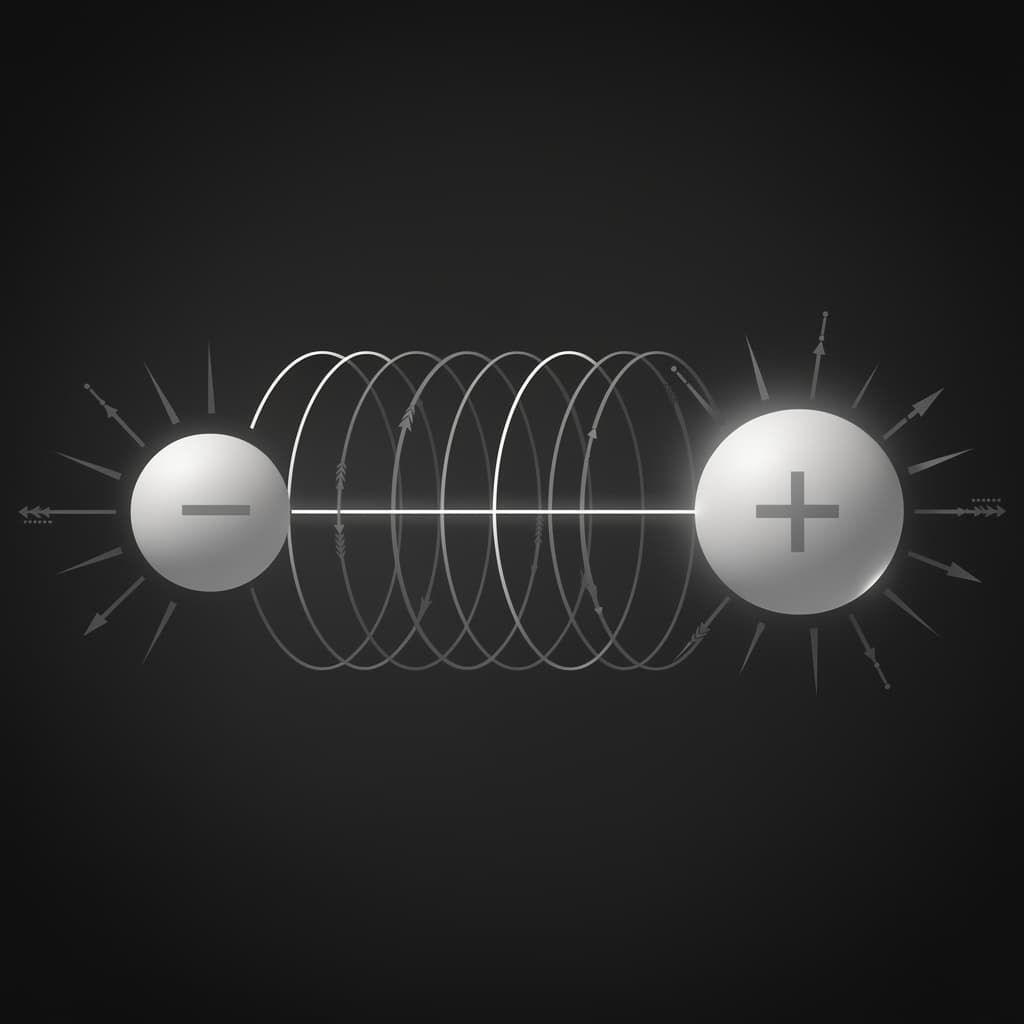
The study of electromagnetism represents one of the most significant triumphs in the history of physical science, serving as the bridge between classical mechanics and the modern understanding of the universe's fundamental interactions. At the heart of this discipline lies Coulomb's Law, a mathematical description of the force that stationary, electrically charged particles exert upon one another. This law does more than simply provide a formula for calculation; it defines the very architecture of matter, dictating how atoms form, how molecules bond, and how the macroscopic world maintains its structural integrity. By quantifying the invisible "action at a distance" that early scientists found so baffling, Charles-Augustin de Coulomb provided the first rigorous footing for electrostatics, an achievement that remains a cornerstone of physics education and engineering today.
The Origins of Electrostatic Theory
The realization that matter could exert influence without direct contact dates back to antiquity, with Thales of Miletus recording the attractive properties of rubbed amber around 600 BCE. However, the transition from qualitative observation to quantitative science took over two millennia to materialize. During the late eighteenth century, the scientific community was captivated by the "electric fluid" and sought to determine if the force between charges followed the same patterns as Isaac Newton’s law of universal gravitation. It was against this backdrop of inquiry that Charles-Augustin de Coulomb, a French military engineer, applied his expertise in structural mechanics and friction to the problem of electrostatic measurement. In 1785, using a sophisticated instrument known as a torsion balance, he successfully measured the extremely faint forces between charged spheres, confirming that the force was indeed proportional to the product of the charges and inversely proportional to the square of the distance between them.
To understand electrostatics basics, one must first appreciate the concept of the "point charge," a theoretical construct that Coulomb’s Law relies upon. In reality, physical objects have volume and shape, which can complicate the distribution of charge; however, if the distance between two objects is significantly greater than their size, they can be treated as mathematical points. This simplification allows physicists to model complex interactions without getting bogged down in the geometric irregularities of the physical bodies. When we speak of point charges, we are referring to an idealized state where the total charge is concentrated at a single coordinate in space. This abstraction is not merely a convenience but a necessity for deriving the fundamental symmetries that govern the behavior of subatomic particles like protons and electrons.
The behavior of these charges is governed by the fundamental duality of the electric force: it can be both attractive and repulsive. Unlike gravity, which always pulls matter together, the electric force responds to the "flavor" of the charge involved. Benjamin Franklin’s convention of "positive" and "negative" charges remains the standard; we observe that like charges (positive-positive or negative-negative) exert a repulsive force, while opposite charges (positive-negative) attract. This dual nature is what allows the universe to achieve a state of electrical neutrality on a large scale, as opposite charges tend to find each other and "cancel" out their long-range influences. This concept of balance is central to the stability of the physical world, preventing macroscopic objects from flying apart or collapsing under the sheer magnitude of the electric forces contained within their constituent atoms.
Dissecting the Electric Force Formula
The mathematical expression of Coulomb's Law is elegant in its simplicity, yet it contains profound implications for the nature of physical reality. The electric force formula is typically written as follows: In this equation, represents the magnitude of the electrostatic force between two point charges, and represent the magnitudes of the charges themselves, and represents the separation distance between the centers of the two charges. The term is known as Coulomb's constant, a proportionality factor that ensures the units on both sides of the equation are consistent. By inspecting this formula, we can see that if the magnitude of either charge doubles, the force doubles; if the distance between them doubles, the force is reduced to one-fourth of its original value.
While the scalar version of the formula tells us the magnitude of the force, it does not explicitly describe the direction, which is critical for solving multi-charge problems. In a vector representation, the force exerted by charge 1 on charge 2 is directed along the straight line connecting them. We can express this vectorially as: Here, is a unit vector pointing from charge 1 toward charge 2. If the product is positive, the force vector points in the same direction as , indicating repulsion. If the product is negative, the force vector points in the opposite direction, indicating attraction. This vector notation allows physicists to apply the law of superposition, which states that the net force on any single charge is the vector sum of the individual forces exerted by all other charges in the vicinity.
Furthermore, it is important to recognize that Coulomb's Law adheres to Newton's Third Law of Motion. The force that exerts on is exactly equal in magnitude and opposite in direction to the force that exerts on . This symmetry holds true regardless of the size of the charges; even if a massive charge interacts with a tiny one, they pull or push on each other with the same amount of force. This reciprocal relationship is a fundamental property of all central forces in classical physics. When calculating electrostatic force, students must always account for this mutual interaction to avoid "double-counting" forces within a closed system of particles.
Studying this for an exam?
Noesis builds the syllabus, notes and tests for you, and you study them with a tutor that knows your material.
The Significance of Coulomb's Constant
The constant is not just a placeholder; it is a fundamental value that characterizes the strength of the electric interaction in our universe. In a vacuum, this constant is approximately . This value is extraordinarily large, especially when compared to the universal gravitational constant (). The massive discrepancy between these two constants explains why the electric force is the dominant force at the molecular and atomic scales, while gravity only becomes significant when dealing with planetary or stellar masses. To put it in perspective, the electric repulsion between two protons in an atomic nucleus is roughly times stronger than their gravitational attraction.
Physicists often express Coulomb's constant in terms of a more fundamental property of space called the vacuum permittivity, denoted by . The relationship is defined as: The value of is approximately . This permittivity represents the "capability" of a vacuum to allow electric field lines to pass through it. The in the denominator arises from the spherical geometry of the electric field emanating from a point charge. Since the surface area of a sphere is , incorporating into the constant simplifies many later equations in electromagnetism, such as Gauss's Law, by canceling out the geometric factors that appear in spherical integrations.
When charges are placed in a material medium rather than a vacuum, the effective force between them changes due to the polarization of the surrounding atoms. This is known as the dielectric effect. Every material has a relative permittivity (or dielectric constant), denoted as or , which scales the force. In such cases, the constant is replaced by . Since is always greater than or equal to 1 for physical materials, the presence of a medium always reduces the electrostatic force between two charges. The following table illustrates the relative permittivity of various common substances:
| Material | Relative Permittivity () at 20°C |
|---|---|
| Vacuum | 1.0000 |
| Air | 1.0006 |
| Paper | 3.7 |
| Water | 80.1 |
| Strontium Titanate | 310 |
Geometry and Inverse Square Law Physics
The inverse square law physics inherent in Coulomb's Law is not a random occurrence but a direct consequence of the three-dimensional geometry of our universe. Imagine a point charge at the center of a sphere; it emits an electric field that spreads out uniformly in all directions. As you move further from the center, the "influence" of that charge must spread over an increasingly large surface area. Since the surface area of a sphere increases with the square of the radius (), the density of that influence—and thus the force felt by another charge—must decrease by the inverse of that square. This geometric dilution is a universal feature of any field emanating from a point source in three-dimensional space, whether it be light, sound, or gravity.
The parallel between Coulomb's Law and Newton's Law of Universal Gravitation is one of the most striking examples of symmetry in physics. Both laws follow the form (for gravity) or (for electricity). This suggests a deep structural unity in the laws of nature. However, a key difference exists: mass is always positive, leading only to attraction, whereas charge can be positive or negative, allowing for both attraction and repulsion. This difference is why we don't usually feel the "Coulomb force" of the Earth, despite its enormous mass; the Earth is almost perfectly electrically neutral, so the countless trillions of individual electric forces cancel each other out, leaving only the much weaker gravity to dominate on a planetary scale.
This inverse square relationship also implies that the range of the electrostatic force is infinite. Although the force becomes extremely weak as distance increases, it never truly reaches zero. In practical terms, however, the force is often effectively "shielded" or neutralized at large distances because charges in a medium will rearrange themselves to counteract any large-scale electric field. This shielding effect is why we can use electronic devices without them being constantly disrupted by the charges in the atmosphere or nearby equipment. Nevertheless, on the microscopic scale, the drop-off is the primary factor that determines the size of atoms and the strength of the bonds that hold our bodies together.
Calculating Electrostatic Force Vectors
In real-world applications, we rarely deal with just two isolated charges. Instead, we encounter arrays of charges, such as those in a salt crystal or a complex molecule. To handle these scenarios, we use the Principle of Superposition. This principle states that the total electric force on a test charge is the vector sum of all the individual forces exerted by every other charge in the system. Because these forces are vectors, we cannot simply add their magnitudes; we must break each force into its , , and components and sum them independently. This process is essential for calculating electrostatic force in any system with more than two particles.
For example, consider a test charge surrounded by three other charges , , and . The net force is expressed as: In this equation, is the distance from charge to , and is the unit vector pointing from to . This summation is the basis for computational electromagnetics. In modern engineering, software uses this principle to model the behavior of electrons in semiconductors, ensuring that the tiny components in our smartphones and computers function correctly under the influence of complex internal electric fields.
The following Python example demonstrates a simplified way to calculate the magnitude of the force between two charges using the standard constant. This logic can be expanded into a loop to handle multiple charges using the superposition principle discussed above.
def calculate_coulomb_force(q1, q2, r):
    # k is Coulomb's Constant in N m^2 / C^2
    k = 8.9875517923e9

    # Calculate force magnitude
    # q1, q2 are in Coulombs, r is in meters
    force = k * (abs(q1 * q2) / (r**2))

    return force

# Example: Force between two 1.0 Coulomb charges 1.0 meter apart
force_result = calculate_coulomb_force(1.0, 1.0, 1.0)
print(f"The electrostatic force is {force_result:.2e} Newtons.")
Electrostatics Basics and Atomic Structure
The most profound application of Coulomb's Law is found within the atom itself. The stability of all matter depends on the balance between the attractive Coulomb force between the positive nucleus and the negative electrons, and the quantum mechanical effects that prevent those electrons from collapsing into the center. According to the early Bohr model, electrons travel in orbits where the centripetal force required to keep them moving in a circle is provided by the electrostatic attraction of the nucleus. Without this force, electrons would fly off into space, and matter as we know it would cease to exist. The energy required to remove an electron from an atom—known as ionization energy—is essentially the "work" needed to overcome the Coulombic pull of the nucleus.
Beyond the single atom, Coulomb's Law is the primary driver of chemical bonding. In ionic bonds, such as those found in sodium chloride (table salt), an electron is transferred from one atom to another, creating a positive sodium ion and a negative chloride ion. These ions then stack together in a three-dimensional lattice, held in place by the massive collective Coulomb's Law forces between neighbors. Even in covalent bonds, where electrons are shared, the "glue" that holds the atoms together is the electrostatic attraction between the shared negative electrons and the positive nuclei of both atoms. Therefore, every physical object you touch is essentially a vast network of Coulombic interactions holding itself together against the chaos of thermal motion.
Furthermore, molecular geometry is determined by the "Valence Shell Electron Pair Repulsion" (VSEPR) theory, which is an application of electrostatics. Because electrons are all negatively charged, they push each other away as much as possible while still remaining bound to the nucleus. This repulsion forces molecules into specific shapes—such as the tetrahedron of a methane molecule or the bent shape of a water molecule. These shapes, in turn, determine the biological and chemical properties of the substance. For instance, the specific way that water molecules attract each other via "hydrogen bonding" is just a specialized case of the dipole-dipole Coulomb interaction, which is responsible for water’s high boiling point and its ability to support life.
Limitations of Classical Electrostatics
While Coulomb's Law is exceptionally accurate for stationary charges at macroscopic and even atomic distances, it is a "classical" law that begins to falter under extreme conditions. One major limitation occurs at the subatomic scale, where quantum mechanics takes over. According to the Heisenberg Uncertainty Principle, we cannot know both the exact position and momentum of a particle like an electron. Therefore, the "point charge" approximation becomes problematic; instead of a single point , we must deal with a "probability cloud" of charge density. In these cases, we use the Schrödinger equation to find the wavefunction, though the potential energy term in that equation still relies on the Coulomb potential ().
Another limitation arises when charges are in motion. Coulomb's Law is strictly an "electrostatic" law, meaning it applies to charges that are standing still or moving very slowly. When a charge moves, it creates a magnetic field in addition to its electric field. If the charges are moving at relativistic speeds (approaching the speed of light), the simple force law must be modified to account for the effects of time dilation and length contraction. These effects are unified in Maxwell's Equations, which provide a complete description of the electromagnetic field. In this broader context, Coulomb's Law is viewed as a special, stationary case of the more complex Lorentz force law: Where is the electric field and represents the magnetic component.
Finally, at extremely short distances—specifically inside the atomic nucleus—Coulomb's Law would predict that the positive protons should fly apart due to intense repulsion. The fact that they stay together is evidence of a different fundamental force: the Strong Nuclear Force. This force is much stronger than the electric force but only acts over very short distances (about meters). Thus, Coulomb's Law defines the "outer" world of chemistry and electronics, while the nuclear forces define the "inner" world of the nucleus. Understanding where one law ends and the other begins is the key to modern particle physics and our understanding of the fundamental forces of nature.
References
- Halliday, D., Resnick, R., & Walker, J., "Fundamentals of Physics", Wiley, 2021.
- Griffiths, D. J., "Introduction to Electrodynamics", Cambridge University Press, 2017.
- Coulomb, C. A., "Premier Mémoire sur l’Électricité et le Magnétisme", Académie Royale des Sciences, 1785.
- Purcell, E. M., & Morin, D. J., "Electricity and Magnetism", Cambridge University Press, 2013.
Recommended Readings
- The Feynman Lectures on Physics, Vol. II by Richard Feynman — A masterclass in building physical intuition, particularly regarding the conceptual transition from individual charges to electric fields.
- Seven Brief Lessons on Physics by Carlo Rovelli — While broad, it provides an excellent context for how fundamental laws like Coulomb's fit into the grand tapestry of modern science.
- The Ghost in the Atom by P.C.W. Davies — Explores the quantum limitations of classical laws and how our understanding of "particles" has evolved.
Turn this topic into a full course
Noesis builds the syllabus, notes and tests for you, and you study them with a tutor that knows your material.