13 min read
Centripetal Force: The Geometry of Circular Motion
Master the principles of centripetal force and uniform circular motion. Explore the formulas, real-world examples, and the mechanics of curved paths today.
In this articleThe Geometry of Uniform Circular Motion
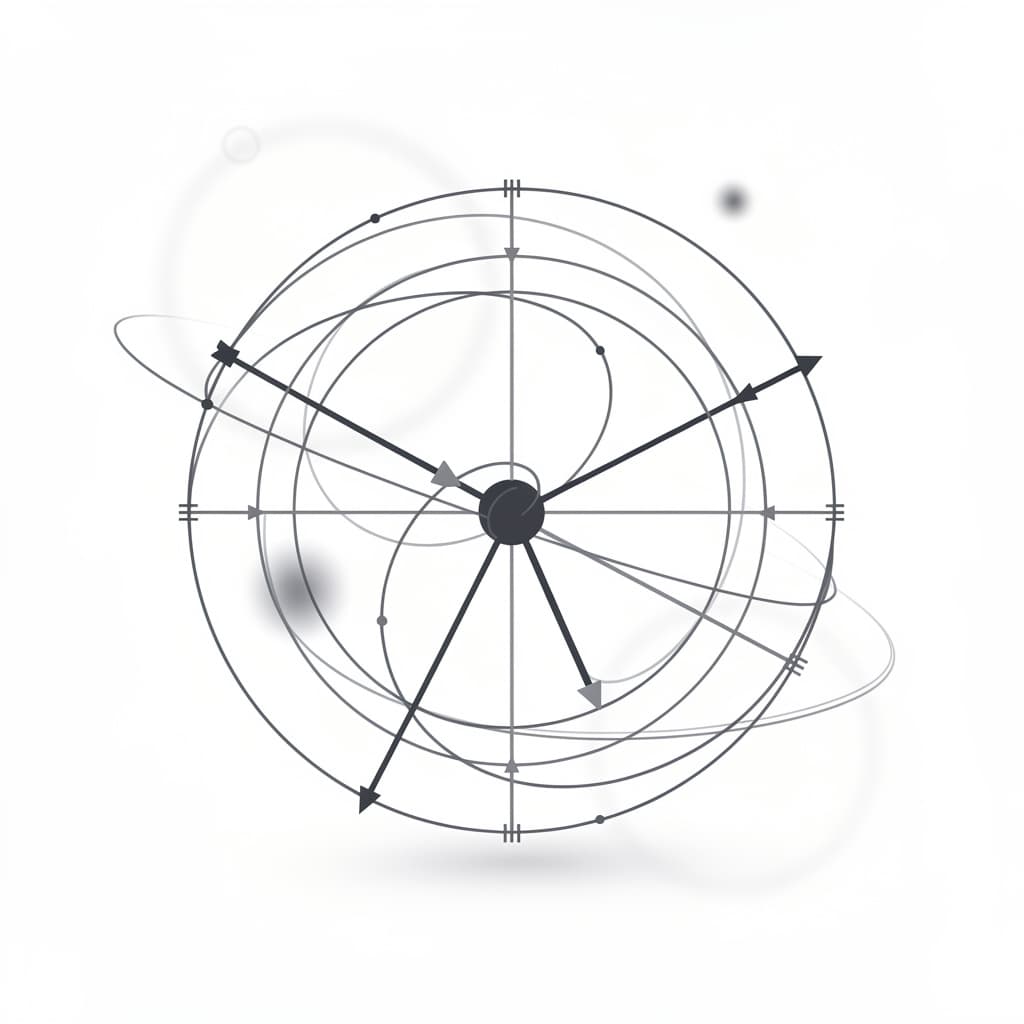
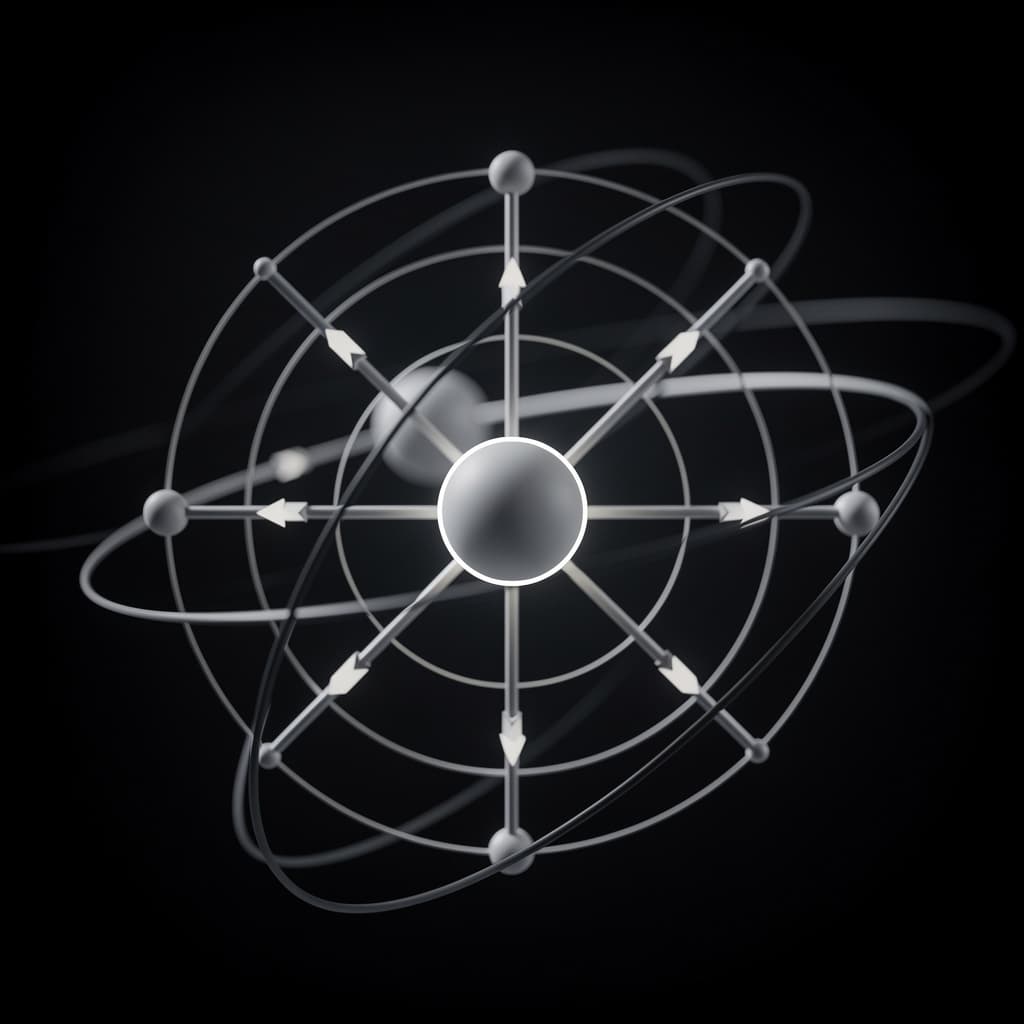
The concept of centripetal force serves as the fundamental link between linear momentum and curvilinear geometry, explaining why objects deviate from straight-line paths to follow circular trajectories. At its core, circular motion is a continuous state of change; even when an object maintains a constant speed, its velocity vector is perpetually rotating, necessitated by a center-seeking influence. Without this inward pull, the law of inertia would dictate that a moving body continues in a straight line tangent to its previous path. From the microscopic orbits of electrons in early atomic models to the grand celestial mechanics of galaxies, the structural mechanics of centripetal force govern the stability and behavior of rotating systems across the universe.
The Geometry of Uniform Circular Motion
The study of uniform circular motion begins with the precise definition of the spatial parameters that constrain a moving body to a curved path. The path radius, denoted as , represents the constant distance from a fixed central point to the moving object, effectively defining the curvature of the space through which the object travels. Coupled with this is the period, , which is the duration required for the object to complete one full revolution of radians. These geometric constraints ensure that the object’s position is always a function of its angular displacement, creating a predictable and repeating trajectory. Understanding these variables is essential because they establish the "boundary conditions" for the kinematics that follow in rotating frames of reference. In a rotating system, the velocity vector possesses a unique relationship with the path radius, as it must always remain perpendicular to the radial vector. While the magnitude of this velocity—the speed—may remain constant, the vector itself is never static because its direction is in a state of flux at every infinitesimal moment. This creates a fascinating kinematic paradox where a body can move at a constant speed of 100 meters per second yet still be accelerating because the orientation of its motion is shifting toward the center of the circle. This tangential velocity is mathematically expressed as the ratio of the circumference to the period, , linking the physical distance traveled to the time elapsed in a single cycle. The kinematics of constant speed rotation require a shift in perspective from Cartesian coordinates to polar coordinates to fully grasp the mechanics at play. In a standard linear system, acceleration is often perceived as a change in speed, such as a car pressing the gas pedal to go faster. In circular motion, however, acceleration is strictly directional, focusing on the rate at which the velocity vector "turns" around the center. This turning rate is described by the angular velocity, , which measures the change in angle over time in radians per second. The interplay between linear speed, angular velocity, and radius forms the geometric foundation upon which all dynamic calculations of center-seeking forces are built.Deriving the Centripetal Acceleration Formula
To understand why a centripetal acceleration formula is necessary, one must look at the geometric proof involving the change in velocity vectors over a small interval of time. Consider an object moving from point A to point B on a circle; the velocity vectors at these two points have the same magnitude but different directions. If we place these two vectors tail-to-tail, the change in velocity, , forms the third side of a triangle that is geometrically similar to the triangle formed by the two radii and the arc length . As the time interval approaches zero, the ratio of the change in velocity to the original velocity becomes equal to the ratio of the distance traveled to the radius of the circle. This similarity leads directly to the conclusion that acceleration, the rate of change of velocity, is proportional to the square of the speed divided by the radius. The resulting mathematical relationship, , reveals critical insights into the nature of curved motion and its physical requirements. For a constant radius, doubling the speed of an object does not merely double the required acceleration; it quadruples it, owing to the squared term in the numerator. Conversely, if the speed is held constant but the radius of the turn is halved, the acceleration must double to keep the object on its tighter path. This inverse relationship with the radius explains why sharp turns in a vehicle feel much more forceful than wide, sweeping curves even when the speedometer reads the same value. We can also express this in terms of angular velocity as , which is often more useful in mechanical engineering and rotational dynamics. A vector analysis of this directional change confirms that the acceleration vector must always point toward the center of the rotation, hence the name "centripetal," which is derived from the Latin words for "center-seeking." Because the velocity is always tangential to the circle, any component of acceleration parallel to the velocity would change the object's speed, not just its direction. Therefore, in uniform circular motion, the acceleration must be strictly radial and perpendicular to the motion at every point in time. This inward vector represents the continuous "tugging" required to prevent the object from flying off along a tangent line. Without this constant redirection, the geometry of the circle would immediately collapse into a linear path.Studying this for an exam?
Noesis builds the syllabus, notes and tests for you, and you study them with a tutor that knows your material.
Dynamics of the Center-Seeking Force
When we apply Newton's Second Law to circular paths, we find that the net force required to maintain rotation is simply the product of the mass and the centripetal acceleration. This relationship is expressed by the formula , which quantifies the total inward force needed to keep a mass moving in a circle. It is a common misconception to view centripetal force as a new, independent force like gravity or magnetism; in reality, it is a requirement that must be met by one or more physical forces. Depending on the system, this "job" of being the centripetal force might be performed by the tension in a string, the friction of tires on asphalt, or the gravitational pull between two celestial bodies. The dynamics of the system are defined by how efficiently these real-world forces can satisfy the mathematical demand of the equation. Identifying the net force in physical systems involves a careful audit of all interactions acting on the rotating body. For a car turning on a flat road, the static friction between the rubber and the pavement is the sole provider of the centripetal force. If the required (calculated from mass, speed, and radius) exceeds the maximum static friction the tires can provide, the car will fail to maintain the curve and will begin to slide. In the case of a bucket of water whirled in a vertical circle, the centripetal force is a combination of the tension in the person’s arm and the component of gravity acting toward the center. At different points in the loop, these forces vary in magnitude, but their vector sum must always equal to sustain the circular motion. The role of mass in radial tension is particularly evident in industrial applications and mechanical design. Heavier objects possess greater inertia, meaning they have a stronger natural tendency to resist changes in their state of motion, including changes in direction. Consequently, a more massive object requires a proportionally larger inward force to achieve the same turning radius as a lighter object at the same speed. This is why heavy machinery components undergoing high-speed rotation must be anchored with high-strength materials capable of withstanding immense radial tension. If the material strength is insufficient to provide the necessary centripetal force, the structural integrity of the system will fail, often resulting in the catastrophic outward ejection of components.Centripetal vs Centrifugal Force Perspectives
The distinction between centripetal vs centrifugal force is one of the most frequently misunderstood topics in introductory physics. To understand the "reality" of these forces, one must first identify the inertial reference frame, which is a frame that is not accelerating. From the perspective of a stationary observer watching a ball on a string, only the centripetal force exists; the observer sees the string pulling the ball inward to keep it on its path. The ball "wants" to go straight due to its inertia, but the string's tension constantly interrupts this linear progress. In this frame, there is no outward force acting on the ball; there is only the inward force and the ball's inherent resistance to changing direction. The confusion arises when we shift to a non-inertial or rotating reference frame, such as being a passenger inside a car making a sharp left turn. In this internal frame, you feel a distinct push toward the right, away from the center of the curve, which is commonly labeled as centrifugal force. However, this is a fictitious force, an apparent effect caused by your own inertia as your body tries to continue traveling in a straight line while the car seat pushes you toward the center. Because the car is accelerating, your internal perspective perceives this lack of equilibrium as an external outward force, even though no physical interaction is actually pulling you away from the center. It is essentially the "feeling" of inertia being overcome by the vehicle's centripetal redirection. Differentiating between real and apparent forces is vital for accurate physical modeling and engineering. Real forces, like the centripetal tension in a centrifuge, have a clear physical origin (electromagnetic interactions between molecules) and exist regardless of the observer's motion. Apparent forces, like the centrifugal effect, vanish the moment you analyze the system from a non-accelerating, external frame of reference. While centrifugal force is a useful mathematical tool in complex Lagrangian mechanics for rotating systems, it does not exist as an independent interaction in the Newtonian sense. Recognizing this prevents the common error of drawing an "outward" force on a free-body diagram of an object in circular motion, which would incorrectly imply the object is in static equilibrium.Engineering Through Banked Curves Physics
The application of banked curves physics is a masterclass in using geometry to overcome the limitations of natural friction. On a perfectly flat road, the only force available to push a car toward the center of a turn is the friction between the tires and the surface. This creates a dangerous dependency, as rain, ice, or oil can reduce friction to nearly zero, making the turn impossible to navigate. By tilting the road surface—banking the curve—engineers introduce the normal force into the centripetal equation. The normal force, which usually only supports the weight of the car, is tilted inward, meaning its horizontal component can now act as the primary source of the required centripetal force. In the design of frictionless turns, there exists an optimal banking angle where a vehicle can navigate the curve without needing any side-to-side friction at all. This "ideal speed" occurs when the inward component of the normal force, , exactly matches the required centripetal force, , while the vertical component, , perfectly balances the vehicle's weight, . By dividing these two equations, we derive the formula , which relates the angle of the bank to the speed and radius of the turn. This allows race tracks and highway off-ramps to be designed for specific speeds, ensuring that even in slippery conditions, the geometry of the road itself provides the necessary inward push to keep vehicles on track. Another fascinating application of these principles is found in vertical loops, such as those in roller coasters or stunt flying. In these scenarios, gravity acts as a variable component of the centripetal force depending on the object's position in the loop. At the very top of a vertical circle, both gravity and the track's normal force point downward toward the center. To ensure the object does not lose contact with the track, it must maintain a minimum speed where gravity alone provides the necessary centripetal acceleration. This "critical velocity" is found when , which simplifies to . Engineering these systems requires precise calculations to ensure that passengers experience the thrill of the turn while remaining safely constrained by the physics of their velocity.Planetary Orbits and Circular Motion Examples
In the vast theater of the cosmos, gravitation acts as the ultimate centripetal mechanism, binding moons to planets and planets to stars. Newton’s realization that the same force causing an apple to fall also keeps the Moon in orbit was a turning point in human understanding of circular motion examples. For a satellite in a stable circular orbit, the force of gravity, , provides exactly the amount of centripetal force required to maintain its path. Because gravity is the sole provider of this inward pull, we can set the gravitational force equal to the centripetal requirement, allowing us to calculate the exact velocity needed for any given orbital altitude. This celestial balance ensures that planets do not drift into the void or crash into their parent stars. Satellite motion and orbital velocity are governed by the relationship , where is the universal gravitational constant and is the mass of the central body. An interesting consequence of this formula is that the mass of the orbiting satellite itself does not affect the required velocity; a pebble and a space station must travel at the same speed to maintain the same orbit. This is because the satellite's mass appears on both sides of the force equation and cancels out. As the orbital radius increases, the required velocity decreases, which is why the outer planets in our solar system move much more slowly than the inner planets. This inverse relationship defines the rhythmic, clockwork nature of our planetary neighborhood. Natural phenomena in celestial mechanics often demonstrate the transition from circular to elliptical paths when the centripetal balance is slightly off. If a satellite's velocity is increased beyond the circular requirement but remains below the escape velocity, its path becomes an ellipse with the central body at one focus. Conversely, if it slows down, it will fall into a lower, tighter orbit or eventually re-enter the atmosphere. Geostationary satellites take advantage of this by orbiting at a specific altitude—approximately 35,786 kilometers—where their orbital period exactly matches the Earth’s 24-hour rotation. By matching the Earth’s angular velocity, these satellites appear to hover over a fixed point on the equator, providing consistent communication and weather data.Rotational Mechanics and Tethered Systems
Tethered systems, such as a ball whirled on a string or a hammer thrower in athletics, provide a clear laboratory for observing the relationship between tension and centripetal requirements. In these models, the tension in the tether is the physical manifestation of the centripetal force, and it must adjust dynamically to changes in speed or mass. If a person increases the speed of the whirling object, the tension in the string must increase to provide the higher demand. This is why strings often snap at the highest speeds; the material's molecular bonds can no longer provide the necessary inward force to counteract the object's growing inertia. This tension is a vector that points directly from the object to the center of the hand or anchor point. The conical pendulum offers a slightly more complex look at these systems, where the tether is not horizontal but forms a cone as it rotates. In this configuration, the tension vector has two components: a vertical component that supports the weight of the bob and a horizontal component that provides the centripetal force. As the angular frequency increases, the bob rises higher, and the angle of the string increases to provide a larger horizontal force component. The relationship between the angle and the rotation rate is a classic problem in rotational mechanics, illustrating how a system naturally seeks an equilibrium where its geometric configuration satisfies both the vertical and radial force requirements. Energy transfer in constant rotation is an essential consideration for tethered systems, particularly when the radius of rotation changes. According to the conservation of angular momentum, if a tethered object is pulled closer to the center, reducing the radius, its speed must increase proportionally. This is the "ice skater effect," where pulling in the arms results in a faster spin because the same amount of angular momentum is concentrated in a smaller radius. While the centripetal force does no work in a perfectly circular path (because the force is perpendicular to the displacement), changing the radius requires work to be done against or by the radial force. This interplay between force, radius, and speed ensures that rotational systems remain dynamic and sensitive to external inputs.References
- Halliday, D., Resnick, R., & Walker, J., "Fundamentals of Physics", Wiley, 2021.
- Newton, I., "Philosophiæ Naturalis Principia Mathematica", Royal Society, 1687.
- Young, H. D., & Freedman, R. A., "University Physics with Modern Physics", Pearson, 2019.
- Taylor, J. R., "Classical Mechanics", University Science Books, 2005.
Recommended Readings
- The Feynman Lectures on Physics, Vol. 1 by Richard Feynman — An unparalleled exploration of mechanics that emphasizes the conceptual beauty behind the formulas of circular motion.
- Physics for Scientists and Engineers by Serway and Jewett — A standard academic text that provides rigorous derivations and detailed engineering applications for banked curves and orbital mechanics.
- Orbital Mechanics for Engineering Students by Howard Curtis — A specialized resource for those interested in the advanced application of centripetal force in satellite and spacecraft trajectories.
- Classical Dynamics of Particles and Systems by Stephen Thornton and Jerry Marion — A deep dive into the vector calculus and advanced dynamics that govern non-uniform circular motion and rotating frames.
Turn this topic into a full course
Noesis builds the syllabus, notes and tests for you, and you study them with a tutor that knows your material.