11 min read
The Elegant Mechanics of Harmonic Motion
Master the physics of simple harmonic motion. This guide covers the restoring force definition, mass-spring systems, and pendulum periods in detail.
In this articleFoundations of Oscillatory Systems
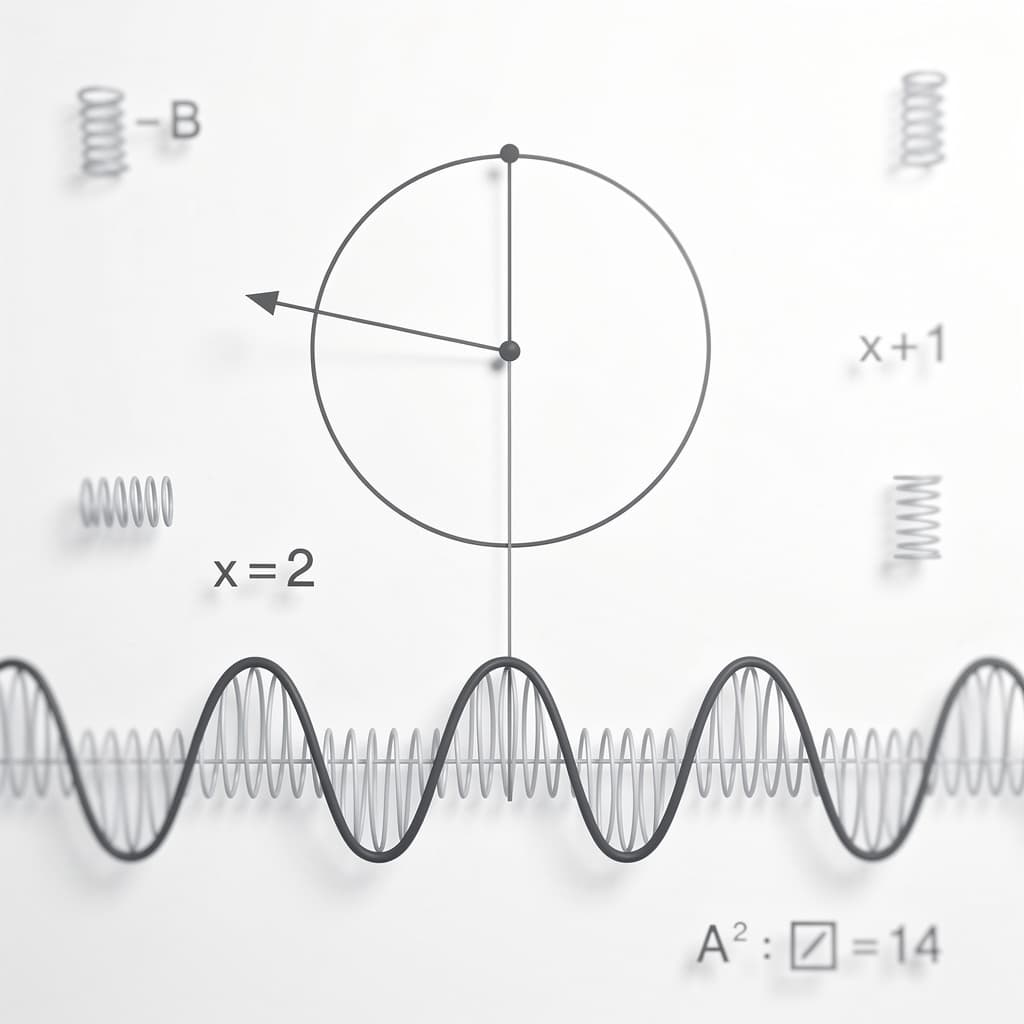
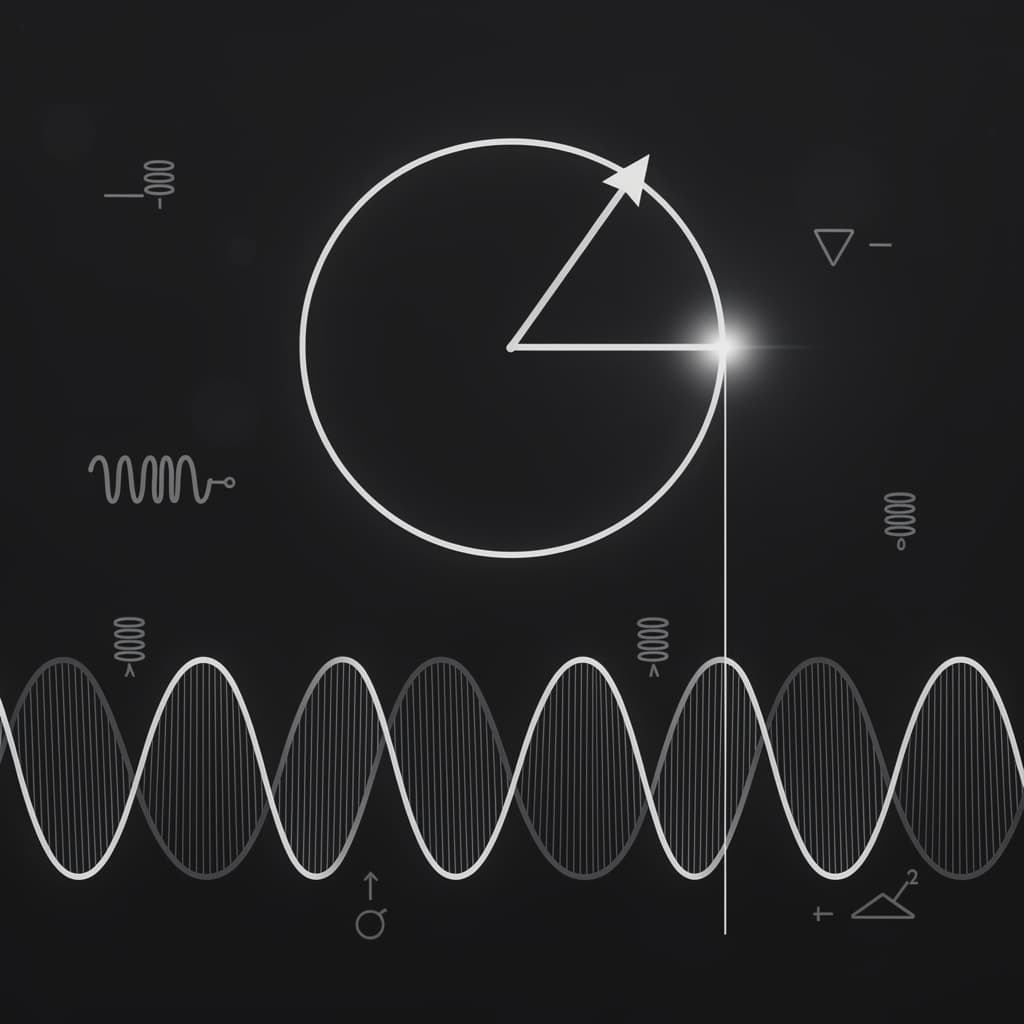
The study of physical systems that repeat their behavior over time, known as oscillatory motion, forms the backbone of classical mechanics and provides the foundational language for modern quantum physics. Among these rhythmic phenomena, simple harmonic motion (SHM) stands out as the most fundamental and mathematically elegant manifestation of oscillation. It describes a specific type of periodic motion where the force responsible for the movement is directly proportional to the distance from a central equilibrium point. Whether one examines the microscopic vibrations of atoms in a crystal lattice or the macroscopic swaying of a skyscraper in the wind, the principles of SHM provide a universal framework for understanding how systems return to stability after a disturbance.
Foundations of Oscillatory Systems
To understand the mechanics of these systems, one must first clarify the distinction between simple harmonic motion vs periodic motion. While all simple harmonic motion is periodic, the reverse is not true; periodic motion encompasses any movement that repeats at regular intervals, such as the orbit of a planet or the beating of a heart. Simple harmonic motion is a refined subset characterized by a specific mathematical relationship where the acceleration is always directed toward the equilibrium position and is proportional to the displacement. This requirement imposes a sinusoidal nature on the motion, meaning the position of the object can be described perfectly by a sine or cosine wave over time, a feature not shared by all periodic cycles. The physical engine driving this specific behavior is defined by the restoring force definition, which states that the force acting on an object is always pulling or pushing it back toward its central starting point. In the context of ideal springs, this is governed by Hooke’s Law, formulated by Robert Hooke in 1676, which states that the force is equal to . Here, represents the stiffness of the system, and the negative sign indicates that the force vector is always opposite to the displacement vector. This linear relationship ensures that as an object moves further from its rest position, the "urge" to return becomes stronger, creating the characteristic overshoot and return cycle that defines oscillation. In any oscillatory system, the equilibrium position acts as the reference point where the net force on the object is zero. When a mass is moved from this point, it possesses a displacement vector, denoted as , which measures its distance and direction from equilibrium. In an ideal vacuum, this motion would continue indefinitely as the system perfectly converts potential energy into kinetic energy and back again. Understanding these foundations allows physicists to model complex machinery by breaking it down into individual harmonic components, effectively treating complicated vibrations as a sum of simpler, more manageable mathematical parts.The Mathematical Framework of Oscillation
The rigorous analysis of simple harmonic motion begins with the application of Newton’s Second Law to the linear restoring force. By setting the net force equal to the restoring force , we arrive at the second-order linear differential equation . This equation implies that the second derivative of the position with respect to time—the acceleration—is proportional to the negative of the position itself. Solving this equation is a cornerstone of SHM physics formulas, revealing that the only functions that satisfy this relationship are sinusoidal functions, typically expressed in the form of sine or cosine. The general solution for the displacement of a particle in SHM as a function of time is expressed as:In this expression, represents the amplitude, which is the maximum displacement from equilibrium, and is the angular frequency, representing how fast the oscillations occur in radians per second. The term is the phase constant, which determines the starting position of the system at . This mathematical framework is incredibly powerful because it allows for the precise prediction of an object's position, velocity, and acceleration at any given moment, provided the initial conditions and system constants are known. Furthermore, we can derive the formulas for velocity and acceleration by taking the first and second derivatives of the position function. The velocity is given by , and the acceleration is , which can be simplified to . This relationship highlights a critical property of SHM: the maximum acceleration occurs at the points of maximum displacement, while the velocity is zero at those same points. Conversely, as the object passes through the equilibrium position, its acceleration is zero, but its velocity reaches its maximum magnitude, .
Dynamics of the Mass-Spring System
The mass-spring system physics model serves as the archetypal example for visualizing SHM in a laboratory setting. In this system, a mass is attached to a spring with a spring constant , and the resulting motion is determined by the interplay between the inertia of the mass and the elasticity of the spring. The angular frequency for such a system is derived as , which elegantly shows that increasing the stiffness of the spring increases the frequency, while increasing the mass slows the oscillation down. This relationship is fundamental to mechanical engineering, where designers must carefully choose materials to avoid unwanted vibrations in structures. Energy transformation is the defining dynamic of the mass-spring system, where the total mechanical energy remains constant in an ideal environment. When the spring is fully compressed or extended, the system holds maximum elastic potential energy, calculated as . As the mass moves toward equilibrium, this potential energy is converted into kinetic energy, . At the equilibrium point (), the potential energy is zero, and the kinetic energy is at its maximum, meaning the mass is moving at its highest speed before the restoring force begins to slow it down again on the opposite side. The conservation of energy in this system can be expressed mathematically to solve for the velocity at any point :By rearranging this formula, students can find that . This specific relationship demonstrates that the speed of the mass does not depend on the direction of travel, only on its distance from the center. This energy-centric view is often more practical for solving complex problems where time is not explicitly given, providing a shortcut to understanding the limits of the system’s physical capabilities.
Geometry of the Simple Pendulum
The simple pendulum represents a different physical configuration that nonetheless obeys the laws of SHM under specific conditions. A simple pendulum consists of a point mass (the bob) suspended from a massless, inextensible string of length . Unlike the mass-spring system where the force is linear, the restoring force here is a component of gravity: . Because the restoring force involves the sine of the angle rather than the angle itself, a pendulum does not strictly perform simple harmonic motion for large swings. To apply harmonic mechanics, physicists use the small angle approximation, which states that for small angles (typically less than 15 degrees), (in radians). Under this approximation, the restoring force becomes , and since the arc length , we can rewrite the force as . This linearizes the equation, allowing the pendulum to be treated as a linear harmonic oscillator where the effective "spring constant" is . The derivation for the period of a simple pendulum follows, resulting in the famous formula:One of the most striking aspects of this result is that the period is completely independent of the mass of the bob and the amplitude of the swing (within the small-angle limit). This observation was famously made by Galileo Galilei while watching a chandelier swing in the Cathedral of Pisa. It implies that two pendulums of the same length, one heavy and one light, will swing in perfect synchronization. However, the period is dependent on the local acceleration due to gravity, , which makes pendulums useful tools for gravimetry—measuring slight variations in the Earth's gravitational field across different geographical locations.
Circular Projections and Phase Space
A powerful conceptual tool for visualizing simple harmonic motion is its relationship to uniform circular motion. If one imagines a particle moving at a constant speed around a circle of radius , the projection of that particle's position onto a straight line (the diameter of the circle) exactly tracks the path of a harmonic oscillator. The radius of the circle corresponds to the amplitude of the oscillation, and the speed of the circular motion corresponds to the angular frequency . This projection method allows us to treat SHM as a "shadow" of circular motion, making it easier to calculate phase relationships. The phase constant $\phi$ is best understood through this circular mapping. It represents the starting angular position of the reference particle on the circle at $t = 0$. If the oscillator starts at the maximum positive displacement, $\phi$ is zero; if it starts at the equilibrium position moving in the positive direction, $\phi$ is $-\pi/2$. This phase information is crucial when analyzing two or more oscillators simultaneously, as it determines whether they are "in phase" (moving together) or "out of phase" (moving against each other). To illustrate how these parameters interact, consider the following Python code snippet which calculates the displacement for a given time array in an SHM system:
import numpy as np

def calculate_shm_displacement(amplitude, angular_freq, phase, time_points):
    """
    Calculates the displacement of a simple harmonic oscillator.
    """
    # x(t) = A * cos(omega * t + phi)
    displacement = amplitude * np.cos(angular_freq * time_points + phase)
    return displacement

# Example parameters
A = 0.5  # Amplitude in meters
omega = 2.0 * np.pi * 5.0  # 5 Hz frequency
phi = np.pi / 4  # 45 degree phase shift
t = np.linspace(0, 2, 1000) # 2 seconds of time

x_values = calculate_shm_displacement(A, omega, phi, t)
Energy Conservation and Dissipation
In an ideal theoretical model, an oscillator is considered "undamped," meaning it possesses a constant total mechanical energy . This energy is the sum of the kinetic and potential components, and it is proportional to the square of the amplitude: . This relationship highlights that doubling the amplitude of a vibration requires four times the energy. In real-world applications, however, no system is perfectly isolated, and energy is slowly lost to the environment through friction, air resistance, or internal molecular heating. This process is known as damped harmonic motion. When a damping force (usually proportional to velocity, ) is introduced, the amplitude of the oscillation decays over time. The rate of decay depends on the damping coefficient and the mass . The resulting motion can be classified into three distinct regimes: underdamped, where the system oscillates with a gradually decreasing amplitude; critically damped, where the system returns to equilibrium as quickly as possible without oscillating; and overdamped, where the system slowly creeps back to equilibrium without ever crossing it. The energy loss in an underdamped system is often quantified by the logarithmic decrement, which is the natural log of the ratio of two successive peak amplitudes. This value helps engineers determine how quickly a structure, such as a car’s suspension or a bridge, will stop vibrating after an impact. In many precision instruments, critical damping is the goal, as it ensures the needle or sensor returns to a stable reading in the shortest possible time without the distraction of repeated bouncing or "ringing."Advanced Wave Interactions
When two or more harmonic oscillations occur in the same medium, they interact according to the superposition principle. This principle states that the resulting displacement at any point is the algebraic sum of the individual displacements of the interacting waves. If two waves of the same frequency meet in phase, they undergo constructive interference, resulting in a wave with a larger amplitude. Conversely, if they meet 180 degrees out of phase, destructive interference occurs, which can lead to the total cancellation of the motion, a principle utilized in active noise-canceling headphones. A particularly significant phenomenon in harmonic mechanics is resonance. Resonance occurs when an external driving force is applied to a system at a frequency that matches its natural frequency of oscillation. When this happens, the system can absorb energy with high efficiency, leading to rapidly increasing amplitudes. While resonance is essential for the operation of musical instruments and radio receivers, it can be catastrophic for mechanical structures. The infamous collapse of the Broughton Suspension Bridge in 1831, caused by soldiers marching in step, is a classic example of mechanical resonance leading to structural failure. The study of resonance also leads to the concept of forced oscillations, where a system is driven by a periodic external force. The steady-state behavior of such a system is determined by the relationship between the driving frequency and the natural frequency. As the driving frequency approaches the natural frequency, the amplitude of the response increases dramatically, limited only by the amount of damping present in the system. Understanding these interactions is vital for modern technology, ranging from the design of earthquake-resistant buildings to the precise control of atoms in atomic clocks.References
- Halliday, D., Resnick, R., & Walker, J., "Fundamentals of Physics", John Wiley & Sons, 2021.
- French, A. P., "Vibrations and Waves", M.I.T. Introductory Physics Series, W. W. Norton & Company, 1971.
- Taylor, J. R., "Classical Mechanics", University Science Books, 2005.
- Thornton, S. T., & Marion, J. B., "Classical Dynamics of Particles and Systems", Cengage Learning, 2003.
Recommended Readings
- The Feynman Lectures on Physics, Vol. 1 by Richard Feynman — Specifically the chapters on oscillations and harmonic motion, which provide unparalleled physical intuition.
- Theory of Vibrations with Applications by William T. Thomson — A comprehensive look at how harmonic principles are applied to real-world engineering and structural design.
- Chaos and Nonlinear Dynamics by Robert C. Hilborn — An exploration of what happens when systems deviate from the "simple" in simple harmonic motion, leading into the world of complexity and chaos.
Turn this topic into a full course
Noesis builds the syllabus, notes and tests for you, and you study them with a tutor that knows your material.