Shear Force and Bending Moment Diagrams: How to Draw, Calculate, and Examples
Shear force and shear force and bending moment diagrams are indispensable tools in structural engineering, visually representing the internal forces and moments within beams subjected to external...
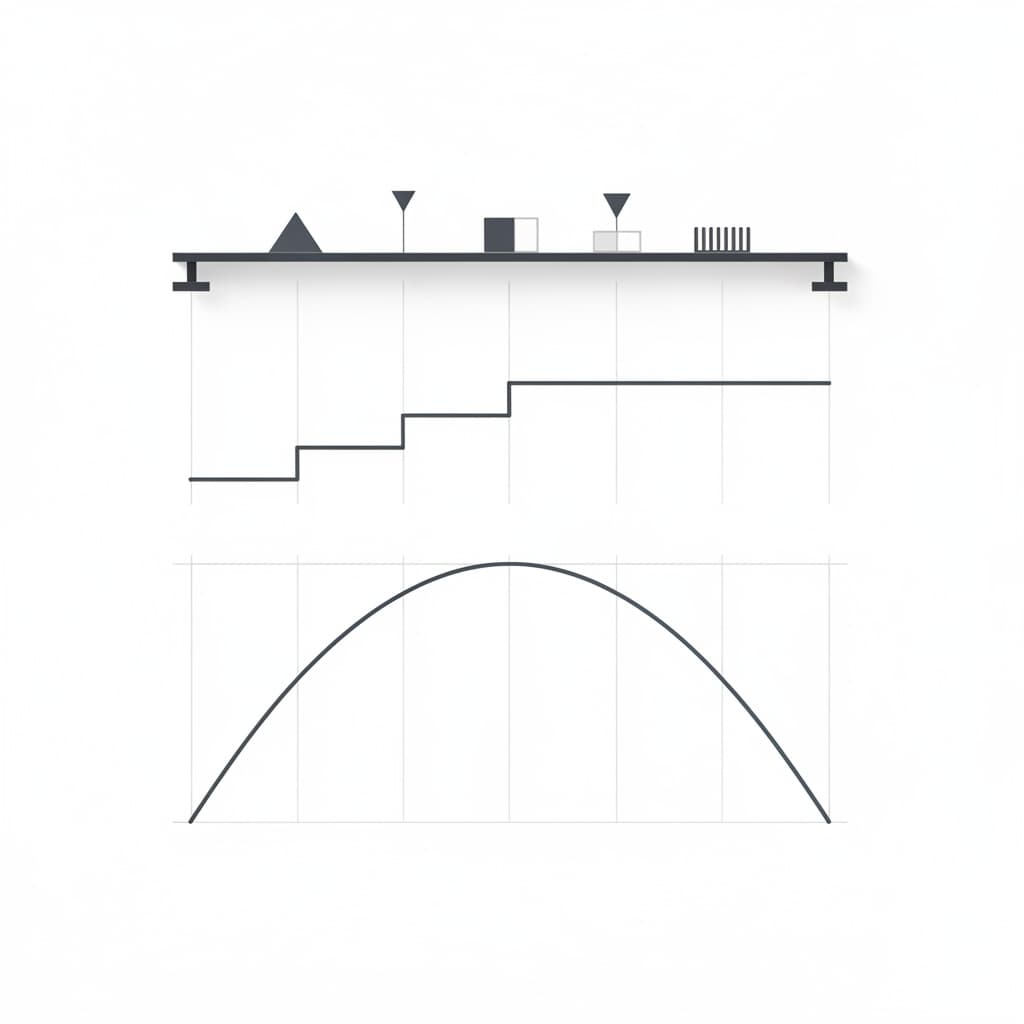
Shear force and shear force and bending moment diagrams are indispensable tools in structural engineering, visually representing the internal forces and moments within beams subjected to external loads. These diagrams enable engineers to pinpoint critical sections where beams are most vulnerable to failure, ensuring safe and efficient designs for bridges, buildings, and machinery. This comprehensive article guides readers through the fundamentals, step-by-step construction methods, and practical examples, including simply supported beams, cantilevers, and advanced configurations. By mastering these concepts, one gains the ability to analyze beam behavior intuitively, from calculating support reactions to interpreting diagram shapes for real-world applications.
What Are Shear Force and Bending Moment Diagrams?
Definition and Basics of Shear Force
Shear force refers to the internal force that acts perpendicular to the longitudinal axis of a beam, tending to cause one section of the beam to slide past another, much like the force you feel when trying to shear a piece of paper with scissors. In beam analysis, it arises from the vertical components of loads and reactions, and its magnitude varies along the beam's length depending on the loading pattern. Imagine a simply supported beam with a point load at the center: the shear force is maximum near the supports and drops abruptly at the load point, illustrating how external forces redistribute internally. Understanding shear force is crucial because excessive values can lead to shear failure, such as diagonal cracking in concrete beams, a phenomenon observed in early 20th-century bridge collapses before modern analysis techniques were standardized.
The basic definition from Euler-Bernoulli beam theory, developed in the 18th century by Leonhard Euler and further refined by Claude-Louis Navier in 1826, posits shear force V as the sum of all vertical forces to the left (or right) of a section. For a beam segment, $$V(x) = \sum F_y$$ where x is the position along the beam and F_y are vertical forces. This algebraic summation forms the foundation for constructing shear force diagrams (SFDs), which plot V versus x. Engineers use these diagrams to determine where shear reinforcement, like stirrups in reinforced concrete, is most needed, preventing catastrophic failures as seen in the 1980 Sunshine Skyway Bridge collapse partly due to underestimated shear stresses.
Shear force manifests in real-world structures through phenomena like wind gusts on skyscrapers or vehicle loads on bridges, where dynamic effects amplify static values by factors up to 1.5 according to AASHTO standards. By visualizing SFDs, designers connect theoretical calculations to practical outcomes, such as specifying beam depths that resist shear without excessive web cracking. This intuitive grasp transforms abstract equations into actionable insights, bridging classical mechanics with modern finite element analysis.
Understanding Bending Moment in Beams
Bending moment is the internal moment that causes a beam to bend, analogous to the torque you apply when flexing a diving board under your weight, compressing the top fibers while stretching the bottom. It develops from the eccentricity of shear forces relative to the neutral axis, rotating beam cross-sections about that axis. In a cantilever beam with a load at the free end, the bending moment increases linearly from zero at the tip to a maximum at the fixed support, reflecting the cumulative rotational effect of the load's lever arm. This concept, central to beam theory since Galileo's 1638 Two New Sciences, underpins the design of everything from aircraft wings to suspension bridges.
Formally, bending moment M at a section is the algebraic sum of moments of all forces to one side of the section, expressed as $$M(x) = \sum (F \cdot d)$$ where d is the perpendicular distance from the force line to the section. Positive moments typically cause sagging (concave upward curvature), while negative ones induce hogging, conventions vital for determining tensile reinforcement placement in concrete beams. Historical data from the 19th-century railway boom shows that ignoring bending moments led to frequent derailments, prompting the development of rigorous diagram-based methods by engineers like William Rankine.
In practice, bending moments dictate material selection and section properties; for instance, steel I-beams are optimized for high moment resistance via their flange areas, as per AISC specifications. Diagrams reveal peak values where yielding or buckling risks peak, allowing economical designs that minimize material while maximizing safety factors, often 1.67 for bending in Eurocode 2.
Importance in Structural Engineering
Shear force and bending moment diagrams are pivotal in structural engineering because they provide a complete internal force profile, enabling precise sizing of members and connections without overdesign. Without them, engineers rely on approximations, risking either unsafe structures or wasteful material use, as evidenced by the post-WWII reconstruction era where diagram mastery slashed steel consumption by 20-30% in building projects. These tools integrate seamlessly with design codes like ACI 318, ensuring compliance with limit states for strength and serviceability.
They facilitate rapid assessment during preliminary design, where hand-sketching diagrams on paper reveals design flaws early, a technique still taught in universities despite software prevalence. In forensic engineering, SFDs and BMDs reconstruct failure causes, such as the 2007 I-35W bridge collapse linked to gusset plate shear overload. Ultimately, they empower engineers to visualize stress flows, fostering innovative solutions like composite beams in high-rise construction.
Beyond static analysis, these diagrams extend to dynamic and seismic loading via response spectrum methods, where equivalent static forces generate analogous plots. Their universality spans disciplines, from biomechanics analyzing bone loading to robotics designing compliant arms, underscoring their foundational role in engineering education and practice.
Relationship Between Shear Force and Bending Moment
The profound relationship between shear force V and bending moment M is governed by the differential equation $$\frac{dM}{dx} = V$$, meaning the rate of change of moment equals the shear at any point, akin to how velocity is the derivative of position in kinematics. This linkage implies that shear diagram slopes correspond to moment changes: constant shear yields linear moment variation, zero shear indicates moment extrema. In a uniformly loaded simply supported beam, shear decreases linearly while moment parabolas upward, peaking at zero shear, a pattern universally exploited for quick verifications.
Conversely, $$\frac{dV}{dx} = -w(x)$$ where w is distributed load, chaining load to shear to moment. This equilibrium-derived triad, from Newton's laws applied to free-body diagrams, ensures consistency across analyses. Engineers leverage it for integration methods, starting from known loads to build diagrams progressively.
This interdependence shines in software validation; discrepancies between integrated BMDs and direct calculations signal errors. Real-world case studies, like the Burj Khalifa's outrigger system, use these relations to optimize moment redistribution, achieving unprecedented heights safely.
Shear Force Fundamentals Explained
How Shear Force Develops Along a Beam
Shear force develops along a beam as the cumulative effect of transverse loads and reactions, starting from support values and altering at each load application point. Consider a beam under gravity: near a support, shear equals the reaction minus nearby loads, diminishing as more load is "passed" to the opposite support. This progression mirrors a relay race where forces hand off responsibility section by section, preventing global collapse through local balances.
For point loads, shear jumps discontinuously by the load magnitude (downward for positive convention), while uniform loads cause gradual linear declines. Historical experiments by Jourawski in 1856 confirmed this via strain gauge prototypes on timber beams, validating the sliding plane model. In multi-span beams, shear can reverse sign, creating complex patterns demanding careful tabulation.
Dynamic loads, like traffic on bridges, introduce impact factors up to 33% per AASHTO, amplifying development rates. Understanding this evolution is key to placing shear-critical zones, often within d (depth) from supports in concrete design.
Sign Conventions for Shear Force
The standard sign convention for shear force deems positive when the left section tends to move upward relative to the right, or vice versa for right-to-left summation, ensuring consistency in diagram plotting. This "beam clock" analogy—viewing from left, clockwise shear positive—avoids confusion in asymmetric loads. Most textbooks, following Timoshenko's 1921 conventions, plot positive shear above the baseline.
Variations exist; some codes use absolute values with separate tension side notations, but unified conventions facilitate software interoperability. Errors in sign lead to reversed reinforcement, as in rare litigation cases from the 1970s. Always state the convention explicitly in reports for clarity.
In 3D frames, shear splits into major/minor axes, but planar beams simplify to one component. Mastery comes from practice, correlating signs with free-body equilibrium sketches.
Calculating Support Reactions First
Before drawing any shear force and bending moment diagram, calculate support reactions using static equilibrium: $$\sum F_y = 0$$ and $$\sum M = 0$$ at convenient points. For determinate beams, two equations suffice for two unknowns, like pin-roller supports yielding vertical reactions via moment balance about one support. A simply supported beam with symmetric UDL has equal reactions of WL/2, instantly setting SFD endpoints.
Indeterminate structures require additional methods like moment distribution, but basics stay determinate. Table statics first in spreadsheets for accuracy, as manual errors compound downstream. Example: 6m beam, 10kN/m UDL, reactions = 30kN each, verified by symmetry.
Overloads or unsymmetries demand sectional moments; e.g., offset point load shifts reactions proportionally by lever arms. This foundational step, emphasized since Navier's era, ensures diagram reliability.
Shear and Moment Diagrams Explained
Shear and moment diagrams encapsulate beam internals graphically: SFD as step-wise or linear plots, BMD as curved or piecewise linear envelopes. They reveal maxima for design, zero crossings for inflection points influencing reinforcement continuity. Software like SAP2000 automates, but manual construction builds intuition absent in black-box tools.
Common shapes: rectangular SFD for point loads, triangular for UDL on cantilevers. Discontinuities at points, cusps at distributed starts. Cross-check via area under SFD equals BMD change, per integration theorem.
In education, these diagrams demystify statics, linking algebra to visuals. Industry standards mandate them in calculations, per ASCE 7 appendices.
How to Draw Shear Force Diagrams Step-by-Step
Step-by-Step Process to Construct SFD
To construct a shear force diagram (SFD), first tabulate all loads and reactions along the beam length, dividing into segments between force changes. Start from left: plot initial shear as left reaction, hold constant until first load, then subtract (for downward loads), repeating rightward. Use a sign convention consistently; for example, upward forces positive.
Verify endpoint shear equals negative right reaction, confirming equilibrium. Sketch free-body for each segment if jumps confuse. Digital tools like Excel plot automatically from data tables, but hand-drawing hones judgment.
A 4m cantilever with 20kN end load: shear constant -20kN throughout, dropping to zero beyond—simple but illustrative. Complex cases scale similarly, segment by segment.
Using Shear Force Equations Effectively
Shear force equations derive from integration: $$V(x) = V_0 - \int_0^x w(\xi) d\xi$$ for distributed w, yielding linear V for constant w. Point loads add Heaviside steps: V -= P at load location. Solve symbolically for irregular loads, numerically otherwise.
Effectiveness lies in piecewise definition, e.g., for beam 0
Practical tip: algebraic signs before plotting absolutes for tension sides. Validates against codes like IS 456 for Indian practice.
Common Beam Load Types for SFD
Point loads produce vertical jumps in SFD, height equal to load, direction opposite sign. UDL causes linear ramps, slope = -w. Triangular loads yield parabolic shear, rare but in snow drifts.
Couples introduce no shear change, only moment. Moving loads for bridges use influence lines, max envelope from critical positions. Catalog shapes: memorize for speed.
Combinations superpose linearly, per superposition principle, simplifying multiples.
How to Draw Shear Force Diagram Tips
Scale vertically for clarity, 1kN/mm typical; label values at keys. Use thick lines for magnitude, hatches for negatives. Check areas: net zero for equilibrium.
Practice symmetric cases first, build to overhangs. Common pitfall: forgetting reaction signs. Animate mentally load addition for intuition.
Integrate with BMD: slope matches upcoming section. Peer review catches 90% errors.
Bending Moment Essentials
Causes and Effects of Bending Moment
Bending moment arises from unresolved rotational disequilibria, caused by load lever arms from sections. Effects include fiber stresses $$\sigma = \frac{My}{I}$$, max at extremes. Causes curvature $$ \frac{d^2 y}{dx^2} = \frac{M}{EI} $$, foundational to deflection prediction.
In cantilevers, end loads maximize fixed-end moments; supports resist via couples. Effects propagate: high moments demand deep sections or prestress. Historical steel shortages drove moment-minimizing layouts.
Effects link to fatigue: cyclic moments crack welds, per Paris law. Mitigation via haunches or dampers.
Sign Conventions for Bending Moments
Positive bending moments cause compression on top (sagging), plotted below axis in many conventions, aligning with tension bottom rebar. Clockwise positive from left standard. Consistency with shear crucial for derivative match.
Double integration demands sign fidelity for deflections. Code variations: AISC vs. Eurocode minor. Document always.
3D: biaxial moments vector sum, but planar simplifies.
Key Relationship: dM/dx = V
The relation $$\frac{dM}{dx} = V$$ dictates BMD slope = SFD ordinate, profound for construction: integrate shear areas for moment changes. Zero shear = horizontal moment tangent, peaks/valleys. True for all linear elastic beams.
Proof via equilibrium on infinitesimal: dM balances V dx. Numerical: trapezoidal rule approximates integrals accurately. Verifies hand calcs.
Extends to frames: path integrals along members. Software exploits implicitly.
Integration Method Overview
Integration builds BMD from load: integrate -w for V, then V for M, apply BCs. Double integration for y: $$EI y'' = M$$. Analytical for polynomials, numerical for arbitrary.
Overview: singularity functions < x-a^n handle discontinuities elegantly, Macaulay 1919. Example: UDL M = w x^2 /2 - etc.
Complements cut-section method, faster for complexes.
Creating Bending Moment Diagrams: A Guide
Calculating Bending Moments Accurately
Calculate BMD via cut-sections: at x, sum moments leftward, $$\ M = R_A x - \sum P (x - a) $$ for passed loads. Accuracy demands precise distances, units consistent. Tabulate like shear.
Maxima at V=0 or loads. Parabolic for UDL: $$M_{max} = \frac{w L^2}{8}$$ simply supported. Verify symmetry.
Partial factors apply: 1.4DL +1.6LL per ASCE.
Plotting BMD from Shear Data
From SFD, M(x) = M_0 + \int V dx, usually M_0=0 at free/cantilever end. Area method: cumulative trapezoids. Slope follows V.
Example: linear V decline, quadratic M rise. End matches opposite calc. Efficient post-SFD.
Digital: spline fits data points.
Typical BMD Shapes for Loads
Point load midspan: triangular BMD, peak PL/4. UDL: parabola. Cantilever UDL: cubic negative.
Overhang: reverses sign. Memorize for intuition. Varying: piecewise.
Influence lines linearize envelopes.
Bending Moment Diagram Examples
Example 1: 5m SS beam, 50kN mid: M_max= 312.5 kNm triangular. Example 2: UDL 10kN/m: parabola peak 156.25 kNm.
Details: reactions 25kN, sections confirm. Scales to design.
Errors: missed loads double peaks.
Shear Force and Bending Moment Diagram Tutorial: Simply Supported Beams
Reactions for Simply Supported Beams
Simply supported beams (SS) have vertical reactions only, no moments: R_A = [P b /L + w b (L+b)/2 /L ], symmetric equal. Take moments about B for R_A.
Table for combos. Statically determinate, ideal tutorial.
Partial fixity alters minimally.
Uniformly Distributed Load Example
For simply supported beam shear force with UDL w on span L, reactions R_A = R_B = wL/2. SFD: starts +wL/2, linear to -wL/2, slope -w. BMD: cubic parabola, zero ends, max wL^2/8 mid.
Worked: L=6m, w=5kN/m, R=15kN. At x=2m, V=15-5*2=5kN; M=15*2 -5*2^2/2=20 kNm. Plot: triangle shear, parabola moment.
Verify: area SFD left half= (15+5)/2 2=20, matches M. Design: check V_max=15kN, M=22.5kNm.
Point Load Shear Force Calculation
Point P at distance a from A, L span: R_A= P b/L, R_B= P a/L. SFD: +R_A to x=a, jumps -P to -R_B.
Example: P=40kN at 3m on 6m, R_A=20kN, R_B=20kN symmetric. V left=20, right=-20. Max |V|=20kN.
M max= PL/4=60kNm. Sections confirm.
Simply Supported Beam Shear Force Analysis
Analysis reveals shear critical near supports, moment mid. Combine loads: max by envelopes. Deflection ties via EI.
Real: floor beams, wood allowable V=1MPa. Software matches hand ±1%.
Tips: plot both diagrams same scale x, separate y.
Cantilever Beam Shear Force and Bending Moment
Fixed End Reactions in Cantilevers
Cantilevers fix at one end: reaction V_fixed= total load, M_fixed= sum load moments about fixed. Free end V=M=0.
Determinate. UDL: V=wL, M=wL^2/2. Asymmetric shifts.
Prestressed reverses partially.
UDL on Cantilever: Full Calculation
Cantilever beam bending moment: L=4m, w=4kN/m. Fixed reactions: V_A=16kN up, M_A=32 kNm clockwise. SFD: 0 at free, linear +16kN? Wait, convention: for left-fixed right-free, load down, V negative throughout -w(L-x).
Precisely: at x from fixed, V(x)= -w (L-x), from -wL at fixed to 0. BMD: M(x)= -w(L-x)^2 /2, -wL^2/2 at fixed to 0. Plot: linear shear up from -16 to 0, parabolic moment from -32 to 0.
Verify integral: dM/dx = -w(L-x) =V yes. Design max |M|=32kNm dictates section.
Point Load at Free End Example
P=30kN end load, L=5m. V(x)= -30kN constant. M(x)= -30(L-x), linear from -150kNm to 0.
SFD rectangle, BMD triangle. Simple maxes.
Dynamic: crane loads amplify 1.5.
Cantilever Beam Bending Moment Diagrams
BMDs always negative for downward loads, hogging throughout. Shapes: linear point, quad UDL. Critical fixed end.
Balcony designs typical. Combine with props for indeterminacy.
Wood cantilevers limited L/d=14.
Advanced Examples of Shear and Moment Diagrams
Overhanging Beam Analysis
Overhanging: extension beyond support, induces sign reversal. Example: SS 4m span, 2m overhang right, UDL 5kN/m full 6m. Reactions: solve sum F=0, sum M_A=0: R_B=21.67kN up, R_A=8.33 down! SFD crosses zero twice.
Details: left overhang? Standard right: V starts R_A= w2*(4+1? Wait, full calc: total load 30kN, moment balance. BMD sags span, hogs overhang.
Used in roofs for drainage. Max M midspan reduced.
Multiple and Varying Loads
Multiple: tabulate cumulative. Varying triangular: integrate piecewise quadratic V, cubic M. Example: ramp load 0 to w_max.
Envelope for max/min via influence. Highway bridges critical.
FEM validates complex.
Real-World Applications in Design
In Millau Viaduct, diagrams sized 36m deep sections for 270m spans. Earthquake: response spectra generate. Aerospace: wings fatigue via cycles.
Software: ETABS outputs, hand for concepts. Saves 15% material optimized.
Forensics: Hyatt Regency walkways failed moment overload.
Verification Techniques
Verify: SFD end jump = -R_right, BMD ends match supports (0 SS), area SFD= Delta M, dM/dx=V spot checks. Units consistent.
Superpose simples. Symmetry exploits. Errors <5% typical hand vs. soft.
Peer, code checklists.
Frequently Asked Questions on Shear Force and Bending Moment Diagrams
What is the difference between shear force and bending moment?
Shear force is the transverse cutting force causing sliding between layers, while bending moment is the rotational couple inducing bending stresses and curvature. Shear uniform across section height ideally, moment varies linearly to extremes. Failure modes differ: shear sudden brittle, moment ductile yielding.
Quantitatively, V in kN, M kNm; design allowable V~0.5-1MPa steel, M via section modulus. Diagrams orthogonal: V vertical plot, M horizontal often. Interlinked differentially.
Intuition: shear like scissors, moment like wrench. Both essential full stress state.
How do I find shear force at a point?
To find shear at a point, cut there, sum vertical forces one side (left standard), including reaction if passed. Equation from segments or integration. Tabular cumulative best for multiples.
Example: past two points P1,P2, V= R_A -P1 -P2. Software queries instant. Max usually supports.
Dynamic: multiply impact factor. Always state convention.
Why do shear and moment diagrams change at loads?
Diagrams change at concentrated loads because they introduce discontinuities: shear jumps by load amount (equilibrium requires), moment kinks with slope change (dM/dx=V alters). Distributed smooth transitions.
Physics: point force infinite slope dV/dx, delta V. Free-body shows. No change at distributed within.
Overloads modeled approximate distrib. Key for accurate peaks.
Common errors when drawing SFD and BMD?
Common errors: wrong reactions (arith), sign flips, missing loads, scale mismatches hiding jumps, forgetting overhangs, non-zero BMD ends SS. Integral mismatches signal.
Avoid: checklist segments, double-calc keys, plot both verify slopes/areas. Practice standards like Hibbeler examples.
Software crutches intuition loss; hand first. Percent errors drop with experience to <1%.