Newton's Laws: The Architecture of Motion
Master Newton's Laws of Motion with this deep dive into inertia, force equations, and action-reaction pairs. Explore the mechanics of our universe today.
In this articleThe Foundations of Inertial Physics

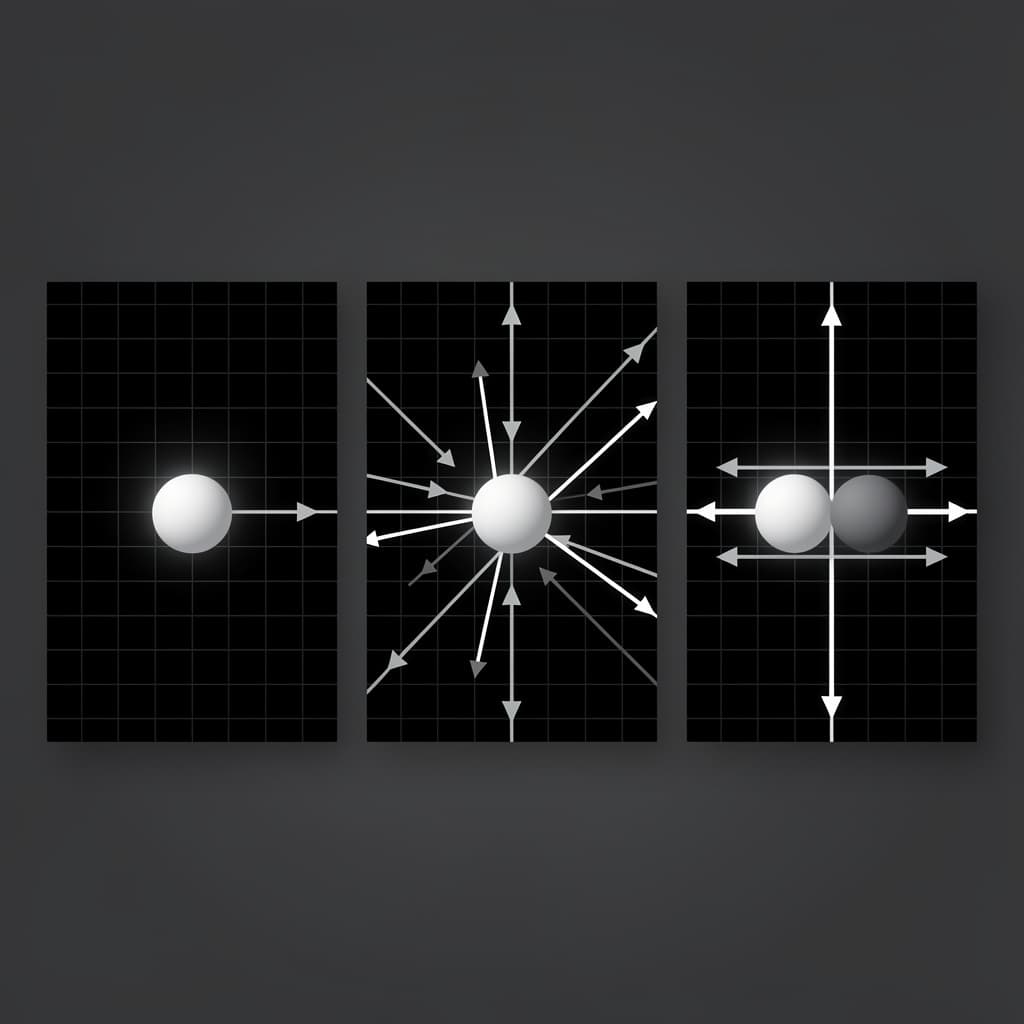
The publication of Philosophiæ Naturalis Principia Mathematica in 1687 marked a definitive turning point in human history, transitioning natural philosophy into the rigorous discipline of modern physics. Sir Isaac Newton synthesized the disparate observations of his predecessors, including Galileo Galilei and Johannes Kepler, into a coherent mathematical framework that governs the physical universe. This framework, collectively known as Newton's Laws of Motion, provides the essential vocabulary for describing how objects interact, move, and resist change. By establishing a causal link between force and acceleration, Newton allowed humanity to predict the trajectories of both falling apples and orbiting planets with unprecedented precision. Today, these laws remain the bedrock of classical mechanics, serving as the primary tool for engineers, architects, and physicists navigating the macroscopic world.
The Foundations of Inertial Physics
Defining Mass as Resistance to Change
In the Newtonian worldview, mass is not merely a measure of the quantity of matter within an object, but a fundamental expression of its inertia. Newton conceptualized inertia as the inherent "vis insita," or innate force, of matter that resists any attempt to alter its state of motion. When we describe an object as having a high mass, we are essentially stating that it requires a significant external influence to change its velocity, whether that means starting, stopping, or turning. This intrinsic resistance ensures that the physical universe maintains a level of predictability, preventing spontaneous changes in motion without an identifiable cause. Understanding mass as resistance allows us to quantify the "laziness" of matter, a concept that underpins the entire structure of classical dynamics.
The formalization of this concept leads to the realization that an object's state of motion is naturally persistent. Prior to Newton, many believed that motion required a continuous force to be maintained, a misconception rooted in daily observations of friction. However, Newton clarified that in the absence of external interference, an object possesses no internal mechanism to change its own velocity. This persistence is the hallmark of the first law, suggesting that the "natural" state of an object is not necessarily rest, but rather a state of constant, unchanging velocity. Consequently, mass serves as the scalar quantity that determines exactly how much "effort" is required to deviate from this natural persistence.
Newton's first law of motion examples in Static Systems
The first law, often called the Law of Inertia, is most clearly demonstrated in static systems where the net force acting on an object is zero. For instance, Newton's first law of motion examples include a heavy book resting on a desk; the book remains stationary because the downward pull of gravity is perfectly balanced by the upward normal force of the desk. Without an unbalanced external force, such as a person pushing the book, the object's inertia dictates that it will remain at rest indefinitely. This equilibrium is not a sign of the absence of forces, but rather a testament to the perfect cancellation of multiple competing influences. In such cases, the inertia of the book maintains the status quo of the system.
In dynamic yet frictionless environments, the same law governs objects in motion, such as a hockey puck gliding across a sheet of perfectly smooth ice. If we ignore the minor effects of air resistance and residual friction, the puck will continue to move in a straight line at a constant speed forever. This illustrates that motion itself does not need a "mover" to sustain it; rather, it is the change in motion that requires an explanation. In static engineering, this principle is used to ensure that structures like bridges and buildings remain "at rest" by carefully calculating forces to ensure the net sum is zero. Thus, the first law provides the criteria for mechanical equilibrium in both stationary and moving frames.
The Geometry of Galilean Relativity
Newton's understanding of inertia necessitated a rigorous definition of the space in which motion occurs, leading to the concept of the inertial frame of reference. A frame of reference is considered "inertial" if an object within it, subject to no net force, moves in a straight line at a constant speed. This geometric approach allows physicists to distinguish between "real" forces and "pseudo-forces" that appear only because the observer is accelerating. Newton recognized that the laws of physics should appear identical to any observer moving at a constant velocity relative to an inertial frame. This concept, known as Galilean Relativity, suggests that there is no fundamental physical experiment that can distinguish between being at absolute rest and moving at a constant velocity.
This relativity of motion means that the mathematics of inertia remains consistent across different perspectives, provided no acceleration is involved. For example, a passenger on a smoothly moving train might see a ball drop straight down, while an observer on the platform sees the ball follow a parabolic path. Both observers are correct within their respective frames because the horizontal inertia of the ball is preserved in both accounts. Newton’s laws provide the transformation rules that allow us to translate these observations from one frame to another. This geometric foundation ensures that the laws of motion are universal, applying to any observer in a non-accelerating state across the cosmos.
Force and the Mathematics of Change
Applying the Newton's second law equation
While the first law describes what happens in the absence of a net force, the second law provides the quantitative relationship for what happens when a force is applied. The most famous iteration of Newton's second law equation is expressed as: In this expression, represents the net force applied to an object, represents its inertial mass, and represents the resulting acceleration. This equation dictates that the acceleration of an object is directly proportional to the magnitude of the net force and inversely proportional to its mass. It serves as the primary tool for calculating the behavior of everything from industrial machinery to celestial bodies under the influence of gravity.
Applying this equation requires a careful summation of all vector forces acting upon a body to find the resultant force vector. Because force and acceleration are both vectors, the direction of the acceleration must always align with the direction of the net force. If multiple forces act on a single point, such as tension in a rope and the pull of gravity on a hanging sign, the second law allows us to predict exactly how that sign will move if one of those forces is altered. This predictive power is what transformed physics from a descriptive philosophy into a precise, predictive science. By isolating variables in the equation, we can determine the force required to achieve a specific velocity within a given timeframe.
Differential Forms of Motion Equations
In more advanced physical contexts, the second law is often expressed in its differential form to account for systems where mass or force may vary over time. Newton originally defined force not just as mass times acceleration, but as the time rate of change of linear momentum. This is mathematically represented as: where is the momentum of the object (). This formulation is more robust than the standard because it remains valid in scenarios where the mass of an object is changing, such as a rocket burning fuel as it ascends into orbit. By focusing on the change in momentum, the second law provides a continuous description of motion throughout a trajectory.
This differential approach allows for the use of calculus to solve complex problems where forces are not constant. For example, the force of air resistance often depends on the velocity of the object, meaning the acceleration changes as the object speeds up. By setting up a differential equation based on the second law, physicists can derive the "terminal velocity" of a falling object. This level of mathematical sophistication is necessary for modern ballistics, fluid dynamics, and aeronautics. The shift from algebraic snapshots to differential change is what allows Newtonian mechanics to model the fluid reality of the natural world.
Distinguishing Mass from Weight
A common point of confusion in introductory physics is the distinction between mass and weight, a distinction that Newton’s second law makes explicitly clear. Mass is an intrinsic property of an object, representing the amount of matter and the degree of inertia it possesses, and it remains constant regardless of location. Weight, however, is a force—specifically, the gravitational force exerted on an object by a massive body like the Earth. Weight is calculated using the second law equation as , where is the local acceleration due to gravity. Consequently, while your mass would be the same on the Moon as it is on Earth, your weight would be significantly less because the Moon’s gravitational pull () is much weaker.
This distinction is critical for engineering applications, particularly in aerospace where the "G-forces" experienced by pilots are actually measures of acceleration relative to standard gravity. When an elevator accelerates upward, a scale inside will show an increased weight even though the person's mass has not changed; this is because the scale must exert an additional upward force to accelerate the mass. Conversely, in a state of free-fall, an object appears "weightless" because there is no normal force opposing gravity, even though its mass and the gravitational force acting on it are still very much present. Understanding that weight is a vector force and mass is a scalar property is essential for accurate calculations in any gravitational field.
| Feature | Mass () | Weight () |
|---|---|---|
| Definition | Amount of matter / measure of inertia | Gravitational force acting on a mass |
| Type of Quantity | Scalar | Vector |
| SI Unit | Kilogram (kg) | Newton (N) |
| Variation | Constant regardless of location | Changes based on local gravity () |
| Measurement Tool | Inertial balance | Spring scale |
Studying this for an exam?
Noesis builds the syllabus, notes and tests for you, and you study them with a tutor that knows your material.
Reciprocity and the Third Law
Analyzing the law of action and reaction
Newton's Third Law introduces the principle of reciprocity, famously stating that for every action, there is an equal and opposite reaction. This law of action and reaction implies that forces never exist in isolation; they are always the result of an interaction between two distinct entities. When you push against a wall, the wall pushes back against your hand with exactly the same amount of force in the opposite direction. This is not a delay or a consequence, but a simultaneous pair of forces that define the interaction itself. If the wall did not push back, your hand would simply pass through it, as there would be no force to stop your hand's motion.
Crucially, the "action" and "reaction" forces act on different objects, which is why they do not cancel each other out to prevent motion. In the case of a swimmer, the "action" is the swimmer's hands pushing the water backward; the "reaction" is the water pushing the swimmer's body forward. Because the forward force is acting on the swimmer and the backward force is acting on the water, the swimmer accelerates forward. This law explains how propulsion works in a vacuum, such as how a rocket engine functions by expelling gas at high speeds. The rocket pushes the gas out the back, and the gas pushes the rocket forward, proving that propulsion does not require "pushing off" the atmosphere.
Interaction Pairs in Complex Systems
In complex systems involving multiple moving parts, identifying interaction pairs is essential for accurate mechanical analysis. Every tension in a cable, every friction force on a gear, and every collision between particles involves these reciprocal pairs. For instance, in a tug-of-war, the tension in the rope is a single interaction that manifests as an equal force pulling on both teams simultaneously. The winner is not the team that "pulls the rope harder"—since the rope pulls both teams with equal force—but the team that can exert more friction against the ground. This nuanced understanding of where forces are applied allows engineers to map out the stress and strain within a machine.
Identifying these pairs also helps in understanding the limits of structural integrity. In a suspension bridge, the weight of the deck pulls down on the vertical cables, and the cables pull up on the deck with an equal force. Simultaneously, those cables pull down on the main suspension cables, which in turn pull up on the vertical ones. By tracing these interaction pairs through the entire system, architects can ensure that every component is capable of sustaining the reciprocal forces it will encounter. This "accounting" of forces ensures that the architecture of the system remains stable under load.
Internal Forces and Center of Mass
One of the most profound implications of the third law is the behavior of internal forces within a closed system. Because internal forces always occur in equal and opposite pairs, their vector sum within a system is always zero. This means that no amount of internal interaction can change the motion of the system’s center of mass. A person sitting inside a car cannot make the car move forward by pushing on the dashboard, because the dashboard pushes back on the person with an equal force, and both forces remain internal to the vehicle system. Only an external force, like the friction between the tires and the road, can change the velocity of the car's center of mass.
This principle is vital for understanding the physics of explosions or collisions. If a firework explodes in mid-air, the internal forces of the explosion push the fragments in many directions, but the center of mass of all those fragments continues to follow the original parabolic trajectory. The reciprocal nature of the internal forces ensures that the momentum of the system is redistributed but not created or destroyed by the internal event. This allows physicists to simplify the study of complex bodies by treating them as single points located at their center of mass. It provides a bridge between the behavior of individual atoms and the motion of macroscopic objects.
The Synthesis of Inertia and Momentum
The Relationship Between inertia and momentum
To fully grasp Newtonian mechanics, one must understand the nuanced relationship between inertia and momentum. While inertia is an object's resistance to change (governed by its mass), momentum is a measure of the "quantity of motion" the object currently possesses. Momentum is defined as the product of an object's mass and its velocity (). A massive boulder at rest has high inertia (it is hard to move) but zero momentum. Conversely, a small bullet traveling at high speed has low inertia (relative to the boulder) but very high momentum, making it difficult to stop.
The interplay between these two concepts explains why it is much harder to stop a moving freight train than a moving car, even if they are traveling at the same speed. The train's massive inertia, coupled with its velocity, results in a momentum that requires an enormous amount of force applied over time to neutralize. In classical mechanics, momentum is the "currency" of motion that is exchanged during interactions. Newton’s laws essentially describe the rules of this exchange, with force acting as the mechanism that transfers momentum from one object to another. This synthesis allows us to calculate the outcomes of collisions and the efficiency of various propulsion methods.
Impulse as a Change in State
The second law's relationship to momentum introduces the concept of impulse, which is defined as the change in momentum resulting from a force applied over a specific interval of time. Mathematically, impulse () is expressed as: This equation reveals that a small force applied over a long time can produce the same change in momentum as a large force applied over a very short time. This is the fundamental principle behind modern safety engineering, such as the design of car crumple zones and air bags. By increasing the time () it takes for a passenger's momentum to reach zero during a crash, the average force () exerted on the passenger is significantly reduced.
Impulse is also central to sports and ballistics, where the goal is often to maximize the change in momentum of a ball or projectile. A golfer "follows through" on a swing to maximize the contact time between the club and the ball, thereby maximizing the impulse and the resulting exit velocity. In the context of Newton's Laws of Motion, impulse provides a way to look at the "history" of a force’s application rather than just its instantaneous effect. It bridges the gap between the abstract concept of force and the tangible result of a change in an object's state of motion.
Conservation Laws in Closed Systems
When we combine the third law (reciprocal forces) with the second law (change in momentum), we arrive at the Law of Conservation of Momentum. In a closed system where no external forces are acting, the total momentum of the system remains constant over time. This is because every internal force that changes the momentum of one object is matched by an equal and opposite force that changes the momentum of another object by the exact same amount in the opposite direction. Whether it is two billiard balls colliding or two galaxies merging, the total momentum before the interaction must equal the total momentum after the interaction.
This conservation law is one of the most powerful tools in physics because it allows us to solve for final velocities without knowing the complex details of the interaction itself. For example, if we know the mass and velocity of two colliding cars, we can predict their combined motion after the crash without knowing the exact molecular forces involved in the metal bending. This principle applies to elastic collisions, where kinetic energy is also conserved, and inelastic collisions, where kinetic energy is transformed into heat or sound. The persistence of momentum is a direct consequence of the symmetry found in Newton's architecture of motion.
Engineering and Applications of Newton's Laws
Ballistics and Projectile Trajectories
One of the most immediate applications of Newton's laws is found in ballistics, the study of projectiles in flight. By separating motion into horizontal and vertical components, we can apply the second law to each independently. Vertically, the object is subject to the constant force of gravity (), leading to a constant downward acceleration. Horizontally, in the absence of air resistance, the object's inertia (First Law) maintains a constant velocity. The combination of these two behaviors results in the characteristic parabolic path of a projectile, from a tossed stone to a long-range artillery shell.
Modern ballistics must also account for the non-ideal forces of the real world, such as air resistance or the Magnus effect on a spinning ball. These are handled by adding additional force vectors into the second law equation. For example, drag is a force that acts opposite to the direction of motion and increases with the square of the velocity. By calculating the net force of gravity minus drag, engineers can precisely determine the range, peak height, and impact velocity of a projectile. This level of calculation is what allows for the pinpoint accuracy seen in modern aerospace and defense systems.
Tension and Compression in Structures
In the field of civil engineering, Newton’s laws are applied to ensure that structures remain in a state of static equilibrium. For a building to stand, the sum of all forces (First Law) and the sum of all torques must be zero. This requires a deep understanding of tension (pulling forces) and compression (pushing forces) within the materials. When a load is placed on a beam, the internal atoms of the beam exert reciprocal forces (Third Law) to resist deformation. Engineers use the second law in its static form () to solve for the unknown forces within various members of a truss or a frame.
Consider the design of a skyscraper: the weight of the upper floors exerts a massive compressive force on the lower columns. According to the third law, those columns must push back with equal force, or the structure will accelerate downward (collapse). By selecting materials with high compressive strength, such as steel-reinforced concrete, and calculating the required thickness using principles, engineers prevent the "architecture of motion" from becoming motion itself. This application of Newtonian physics is what allows for the creation of safe, enduring infrastructure in our modern cities.
Fluid Dynamics and Drag Coefficients
Newton's laws also extend into the complex realm of fluid dynamics, where they govern how liquids and gases interact with solid objects. When a car moves through the air, it must "push" the air molecules out of the way; according to the third law, those air molecules push back on the car. This resistance is quantified as drag, which is a force that engineers strive to minimize to improve fuel efficiency. The shape of the car is designed to streamline the flow of air, reducing the net backward force according to the principles of the second law.
In hydraulics, the second law is used to calculate how pressure changes result in the acceleration of fluids through pipes and valves. The force exerted by a piston on a fluid is distributed throughout the system, allowing for the amplification of force in hydraulic lifts—a practical application of the interaction pairs described in the third law. Whether it is the lift generated by an airplane wing or the flow of blood through an artery, the movement of fluids is fundamentally a Newtonian process. By modeling fluids as a collection of interacting masses, we can apply the same laws that govern solid blocks to the most turbulent of currents.
Beyond the Classical Framework
Relativistic Corrections at High Velocity
As robust as Newton's Laws of Motion are, they are not the final word on the nature of the universe. In the early 20th century, Albert Einstein demonstrated that as objects approach the speed of light, the classical relationship begins to break down. In the realm of Special Relativity, mass is no longer a constant; instead, an object's "relativistic mass" effectively increases as it speeds up, making it progressively harder to accelerate. This means that no amount of force can ever accelerate a massive object to the speed of light, as its inertia would essentially become infinite.
While Newton's equations are perfectly adequate for the speeds we encounter in daily life—and even for most of our space travel—they are technically approximations. For particles in a high-energy accelerator or for the precise timing of GPS satellites, physicists must use Einsteinian corrections. However, it is important to note that Newton’s laws are not "wrong" in a general sense; rather, they are the low-velocity "limit" of the more general laws of relativity. For 99.9% of human engineering and scientific endeavors, the Newtonian framework remains the most practical and accurate tool available.
Revisiting inertia and momentum in Relativity
Relativity also forced a re-evaluation of the definitions of inertia and momentum. In the classical view, momentum is simply , but in the relativistic view, the formula must be modified to , where (gamma) is the Lorentz factor that increases with velocity. This ensures that momentum is conserved even at velocities near the speed of light. Similarly, the concept of inertia was expanded through the realization of mass-energy equivalence (). This reveals that an object's resistance to change is not just a function of its "matter," but also of its total energy content.
This deeper understanding does not diminish Newton’s contribution but highlights its foundational importance. Newton was the first to realize that there was a fundamental quantity () that represented the state of motion and was conserved during interactions. Einstein simply refined the "ruler" used to measure that quantity at the extremes of the universe. The legacy of the Principia is that it provided the initial map that allowed later scientists to find where the boundaries of the classical world actually lie. Even in a relativistic universe, the logic of force, mass, and reciprocal interaction remains the primary way we interpret physical reality.
The Enduring Legacy of the Principia
The enduring legacy of Newton's Laws of Motion lies in their universality and their role in the "Scientific Revolution." By showing that the same laws apply to a stone on Earth and the Moon in the heavens, Newton unified the terrestrial and celestial realms for the first time. This unity paved the way for the Industrial Revolution, as the ability to calculate forces and motion led to the development of steam engines, locomotives, and automated machinery. The philosophical shift—from a world governed by the whims of nature to a world governed by immutable mathematical laws—is perhaps Newton's greatest gift to humanity.
Even as we move into the era of quantum mechanics and general relativity, the architecture of motion described by Newton remains our primary interface with the physical world. When we build a skyscraper, fly a plane, or send a probe to Mars, we are practicing Newtonian physics. These laws provide a bridge between human intuition and the mathematical reality of the universe. Newton’s laws are not just historical artifacts; they are the living, breathing heart of modern science, continuing to guide our exploration of the physical world with the same clarity they provided over three centuries ago.
References
- Newton, I., "The Mathematical Principles of Natural Philosophy" (Principia), Benjamin Motte, 1729 (English Translation).
- Halliday, D., Resnick, R., & Walker, J., "Fundamentals of Physics", Wiley, 2013.
- Feynman, R. P., Leighton, R. B., & Sands, M., "The Feynman Lectures on Physics, Vol. 1", California Institute of Technology, 1963.
- French, A. P., "Newtonian Mechanics", W. W. Norton & Company, 1971.
Recommended Readings
- The Clockwork Universe by Edward Dolnick — A fascinating narrative that places Newton’s discoveries in the context of the chaotic and often superstitious world of the 17th century.
- Isaac Newton by James Gleick — A definitive biography that explores not just the laws of motion but the complex, often difficult personality of the man who discovered them.
- Classical Mechanics by John R. Taylor — An excellent modern textbook for those who want to dive deeper into the mathematical rigor of Newtonian dynamics beyond the introductory level.
Turn this topic into a full course
Noesis builds the syllabus, notes and tests for you, and you study them with a tutor that knows your material.