The Structural Logic of Linked Lists
To understand the fundamental architecture of modern software, one must first grasp the concept of linear data structures. At its most basic level, what is a linked list ? A linked list is a linear...
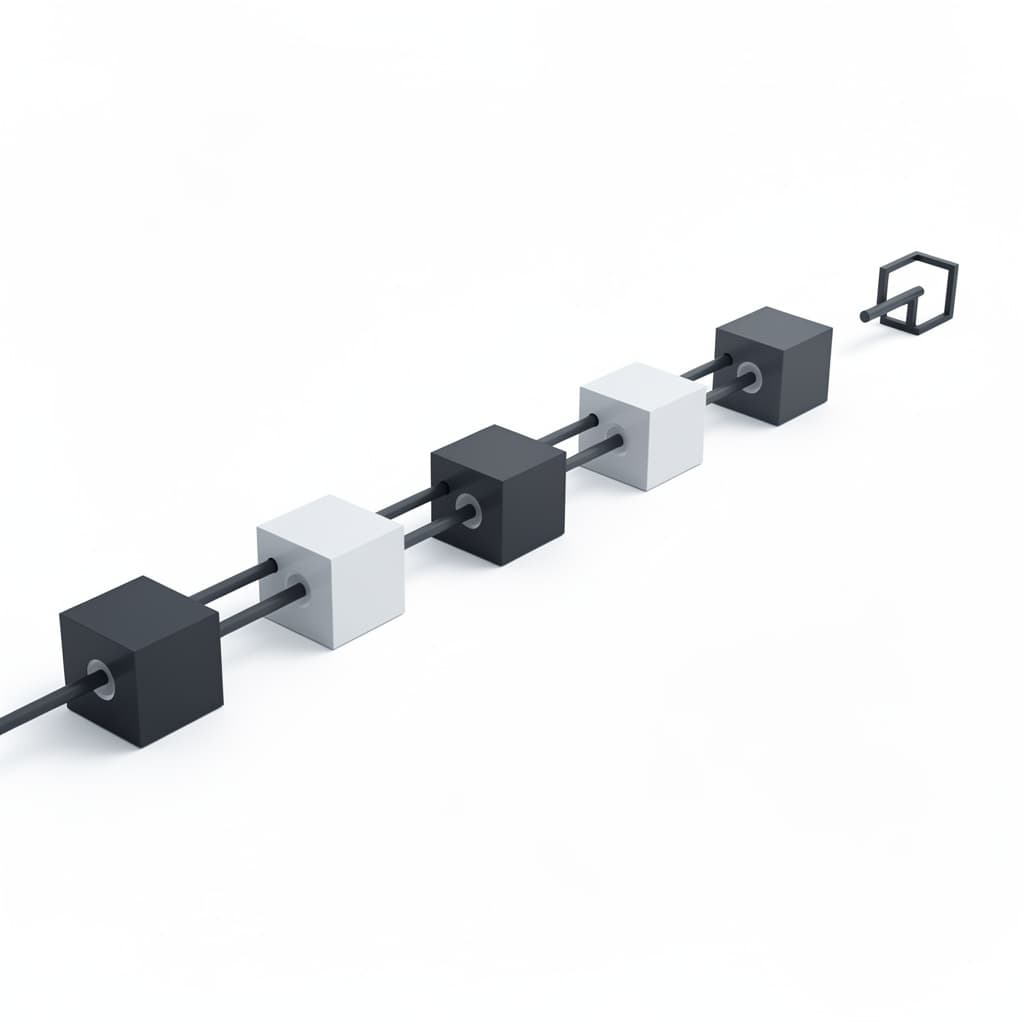
To understand the fundamental architecture of modern software, one must first grasp the concept of linear data structures. At its most basic level, what is a linked list? A linked list is a linear collection of data elements, called nodes, whose order is not defined by their physical placement in memory but rather by the logical connections maintained between them. Unlike the rigid, contiguous structure of a standard array, a linked list provides a fluid and dynamic way to organize information, allowing for efficient growth and reorganization without the need to shift existing elements. This structure serves as the backbone for more complex data types, such as stacks, queues, and even certain types of graphs, making it an essential topic for any computer science curriculum.
The Core Anatomy of Linear Links
The fundamental building block of this data structure is the node, a discrete object that encapsulates two distinct types of information. First, the node contains the actual data or payload, which could be an integer, a string, or a complex object representation. Second, the node contains a pointer or a reference, which serves as a memory address pointing directly to the next node in the sequence. By decoupling the data from its physical location, the linked list creates a chain-like structure where each element "knows" where the next one resides, even if they are scattered across non-adjacent segments of the system's random-access memory (RAM). This architectural choice is what differentiates a linked list from a static array, which requires a single, unbroken block of memory to function.
The role of pointers in this context is critical, as they act as the connective tissue that maintains the integrity of the list. In low-level languages like C or C++, these pointers are explicit memory addresses, while in high-level languages like Java or Python, they are abstracted as object references. Regardless of the implementation, the logic remains the same: the system navigates the list by following these references in a process known as traversal. Because the last node in the chain has no successor, its pointer field is typically set to NULL or None, signaling the end of the sequence. This termination marker prevents the traversal logic from attempting to access invalid memory locations, which could otherwise lead to system crashes or segmentation faults.
Understanding the conceptual leap from contiguous storage to pointer-based storage is the first step in answering what is a linked list in a professional context. When a programmer creates a new node, the operating system allocates memory for it wherever a sufficiently large hole exists in the heap. This flexibility allows the linked list to bypass the limitations of memory fragmentation, which often plagues large arrays. While an array might fail to initialize if a single contiguous block of 1,000 bytes is unavailable, a linked list can easily occupy 100 separate 10-byte blocks distributed throughout the memory space. This distributed nature is the defining characteristic of the linked list's anatomy, providing the structural logic required for dynamic data management.
Comparative Memory Allocation Strategies
To truly appreciate the utility of this structure, one must examine linked list vs array dynamics through the lens of memory allocation. Arrays use static allocation (or at least contiguous dynamic allocation), meaning that all elements are stored side-by-side in a single block. This proximity allows for "random access," where any element can be reached instantly via its index because the computer can calculate the exact memory offset using simple arithmetic. However, this rigid structure comes at a high cost: if the array needs to grow beyond its initial capacity, the system must often allocate an entirely new, larger block of memory and copy every single element from the old block to the new one, an operation with a time complexity of $O(n)$.
In contrast, linked lists utilize dynamic memory allocation, where memory is requested only as needed for each individual node. When a new element is added, the system simply creates a new node and updates the pointers of the neighboring nodes to include it in the chain. This means the list can grow or shrink indefinitely (limited only by the total available RAM) without ever needing to relocate existing data. There is no need for "buffer" space or pre-allocation, which makes linked lists highly efficient for applications where the total number of elements is unknown at compile time. This fluidity is why linked lists are preferred for implementing real-time data streams or undo/redo buffers in software applications.
However, this flexibility introduces a specific trade-off known as memory overhead. Because each node must store not only the data but also at least one pointer, a linked list consumes more memory per element than an array does. For example, if you are storing a list of 32-bit integers, an array uses exactly 4 bytes per element. A singly linked list, on the other hand, might use 4 bytes for the integer and an additional 8 bytes for a 64-bit pointer, effectively tripling the memory requirement. Furthermore, because nodes are scattered throughout memory, linked lists suffer from poor cache locality; the CPU cannot pre-fetch upcoming nodes as effectively as it can with the sequential elements of an array, often leading to more frequent cache misses and slower performance in large-scale data processing.
The Singly Linked List Model
The singly linked list is the most basic form of the structure and the primary focus for those learning what is a linked list for the first time. In this model, navigation is strictly unidirectional, meaning you can only move forward from the beginning of the list toward the end. Each node contains exactly one pointer field, traditionally named next. This simplicity makes the singly linked list the most memory-efficient variation, as it minimizes the pointer overhead per node. It is particularly well-suited for tasks like implementing a simple queue or managing a list of tasks that are processed in a specific, linear order.
Managing a singly linked list requires maintaining a reference to the head node, which is the very first element in the chain. If the reference to the head is lost, the entire list becomes inaccessible and constitutes a memory leak, as the system no longer has a starting point to begin traversal. Many implementations also maintain a tail pointer to the last node, which allows for constant-time $O(1)$ insertions at the end of the list. Without a tail pointer, adding a new node to the end would require traversing the entire list from the head to find the current last node, a process that takes $O(n)$ time and becomes increasingly inefficient as the list grows.
class Node:
    def __init__(self, data):
        self.data = data
        self.next = None

class SinglyLinkedList:
    def __init__(self):
        self.head = None

    def insert_at_beginning(self, data):
        new_node = Node(data)
        new_node.next = self.head
        self.head = new_node
The primary limitation of the singly linked list is the inability to "look back." Once the traversal logic moves from node A to node B, there is no way to return to node A without starting the traversal over from the head. This makes operations like "delete the node before X" or "traverse the list in reverse" computationally expensive. Despite this, the singly linked list remains a staple in computer science because its low memory footprint and simple logic are ideal for many high-speed applications where forward-only processing is the norm. It provides a lean, efficient mechanism for linking disparate data points into a coherent, manageable sequence.
Bi-Directional Doubly Linked Lists
To overcome the unidirectional constraints of the singly linked model, the doubly linked list introduces a second pointer to every node. In addition to the next pointer, each node contains a prev (previous) pointer that stores the address of the preceding element. This bi-directional architecture allows for traversal in both directions, enabling the program to move backward as easily as it moves forward. This capability is essential for many user-interface components, such as a web browser's back and forward buttons or the "most recently used" (MRU) lists found in modern operating systems.
The addition of the prev pointer significantly enhances the efficiency of certain linked list operations, particularly deletion. In a singly linked list, deleting a specific node requires a reference to the node immediately before it, so that the "next" pointer can be updated to bypass the deleted element. If you only have a reference to the node you want to delete, you must traverse from the head to find its predecessor. In a doubly linked list, the node itself contains a reference to its predecessor via the prev pointer, allowing for $O(1)$ deletion logic provided you already have the node's reference. This makes the doubly linked list much more robust for complex data manipulation tasks.
However, this increased functionality comes at the cost of both memory and complexity. Each node now requires space for two pointers instead of one, which can be a significant drawback in memory-constrained environments or when dealing with millions of small data points. Furthermore, every insertion and deletion operation becomes slightly more complex to code, as the programmer must ensure that four pointers are correctly updated (the next and prev pointers of the new node, plus the pointers of the surrounding nodes) to maintain the integrity of the chain. A single error in this "pointer dance" can lead to a broken link, causing the list to become corrupted or orphaned in memory.
Fundamental Linked List Operations
Operating on a linked list involves a series of logical steps designed to maintain the chain's continuity. The most common operation is insertion, which varies in complexity depending on the location. Inserting a node at the head is a constant-time $O(1)$ operation: you simply point the new node's next to the current head and then update the head reference to point to the new node. Inserting at the tail is also $O(1)$ if a tail pointer is maintained. However, inserting at a specific middle index is an $O(n)$ operation, as you must first traverse the list to find the correct position before you can perform the actual insertion.
Searching and traversal are the primary ways to access data within the list. Because nodes are not indexed like array elements, searching for a specific value requires a linear scan. You start at the head and compare the target value with each node's data field, moving to the next node until a match is found or the end of the list is reached. This linear search is inherently $O(n)$, making linked lists less efficient than arrays or binary search trees for retrieval-heavy workloads. This is why the answer to "what is a linked list used for" often excludes scenarios requiring rapid, random access to data.
Deletion operations follow a similar logic to insertion. To delete a node, the program must "bridge" the gap by making the predecessor node point directly to the successor node. In a singly linked list, this requires finding the predecessor through traversal. In a doubly linked list, the process is more direct. Once the pointers are updated, the target node is effectively removed from the chain. In languages with automatic garbage collection, like Java, the memory for the deleted node is eventually reclaimed; in languages like C, the programmer must explicitly free the memory to prevent leaks. The elegance of these operations lies in the fact that no data actually moves in memory; only the pointers change.
Analyzing Algorithmic Performance
When evaluating linked list time complexity, it is crucial to distinguish between operations that require traversal and those that do not. The primary strength of the linked list is its ability to perform insertions and deletions in $O(1)$ time, provided the pointer to the relevant location is already known. This is a massive advantage over arrays, where inserting an element at the beginning requires shifting every other element one position to the right, an $O(n)$ process. For applications that involve frequent additions and removals at the ends of the collection—such as a process scheduler in an operating system—linked lists offer superior performance.
The primary weakness, however, is access time. As previously mentioned, accessing the $i$-th element of a linked list requires $O(i)$ time because the system must follow the pointers from the head one by one. In contrast, an array provides $O(1)$ random access. This makes linked lists poorly suited for algorithms like binary search, which rely on jumping to the middle of a collection. Furthermore, the space complexity of a linked list is $O(n)$, but the "constant factor" is higher than that of an array due to the extra memory required for pointers. This distinction is vital for developers who must choose the right structure for a specific workload.
| Operation | Singly Linked List | Array (Static) | Dynamic Array |
|---|---|---|---|
| Access (Index) | $O(n)$ | $O(1)$ | $O(1)$ |
| Insert at Beginning | $O(1)$ | $O(n)$ | $O(n)$ |
| Insert at End | $O(1)$ (with tail ref) | $O(1)$ / N/A | $O(1)$ amortized |
| Search (Value) | $O(n)$ | $O(n)$ | $O(n)$ |
| Deletion (Known Node) | $O(n)$ (need pred) | $O(n)$ | $O(n)$ |
The trade-offs between these structures are a classic example of "no free lunch" in computer science. While linked lists offer better growth characteristics and faster insertions at the boundaries, arrays offer faster access and better use of modern CPU cache architectures. Modern high-performance computing often leans toward arrays for their speed, but linked lists remain indispensable in system-level programming where memory is fragmented or where the "logical" connection between items is more important than the physical proximity. Understanding these performance metrics is key to mastering what is a linked list and knowing when to deploy it effectively.
Specialized Architectural Variations
Beyond the standard models, several specialized variations of the linked list address specific engineering challenges. One such variation is the circular linked list, where the last node does not point to NULL, but instead points back to the head node. This creates a continuous loop, making it possible to traverse the entire list starting from any node. Circular lists are frequently used in round-robin scheduling algorithms, where a CPU allocates a small time slice to each running process in a repeating cycle. They are also useful in applications like multiplayer games, where the turn-taking logic loops back to the first player after the last player has moved.
Another common optimization is the use of sentinel nodes, also known as dummy nodes. A sentinel node is a non-data-bearing node placed at the head and/or tail of the list. By ensuring that the list is never truly empty, sentinels eliminate the need for many "null-check" edge cases in insertion and deletion logic. For example, without a sentinel, deleting the first node in a list requires updating the head pointer itself; with a sentinel, deleting the first "real" node simply involves updating the sentinel's next pointer. This leads to cleaner, more maintainable code and reduces the likelihood of "off-by-one" errors or null pointer exceptions during development.
Finally, we encounter the concept of the unrolled linked list, which attempts to bridge the gap between linked lists and arrays. In an unrolled linked list, each node stores an array of elements rather than a single data point. This hybrid approach improves cache locality and reduces pointer overhead while still allowing for the dynamic growth benefits of a linked list. It is a reminder that the answer to what is a linked list is not static; the structure continues to evolve as developers seek new ways to optimize data storage for modern hardware. By understanding these variations, a programmer gains a toolkit of logic that can be adapted to almost any structural requirement in software design.
References
- Cormen, T. H., Leiserson, C. E., Rivest, R. L., & Stein, C., "Introduction to Algorithms", MIT Press, 2022.
- Knuth, D. E., "The Art of Computer Programming, Volume 1: Fundamental Algorithms", Addison-Wesley, 1997.
- Sedgewick, R., & Wayne, K., "Algorithms, 4th Edition", Addison-Wesley, 2011.
- Wirth, N., "Algorithms + Data Structures = Programs", Prentice-Hall, 1976.
Recommended Readings
- Structure and Interpretation of Computer Programs by Abelson & Sussman — A foundational text that explains how data structures like linked lists are used to build abstraction layers in computing.
- A Common-Sense Guide to Data Structures and Algorithms by Jay Wengrow — An excellent resource for visualizing how pointers work and why big O notation matters for linked lists.
- Code: The Hidden Language of Computer Hardware and Software by Charles Petzold — Provides deep context on how memory is physically addressed, helping clarify why pointer-based structures are so powerful.