14 min read
The Geometric Logic of Trigonometric Functions
Explore the fundamental logic of trigonometric functions. Learn how sine, cosine, and tangent define the relationships between angles and circles today.
In this articleThe Geometry of the Right Triangle

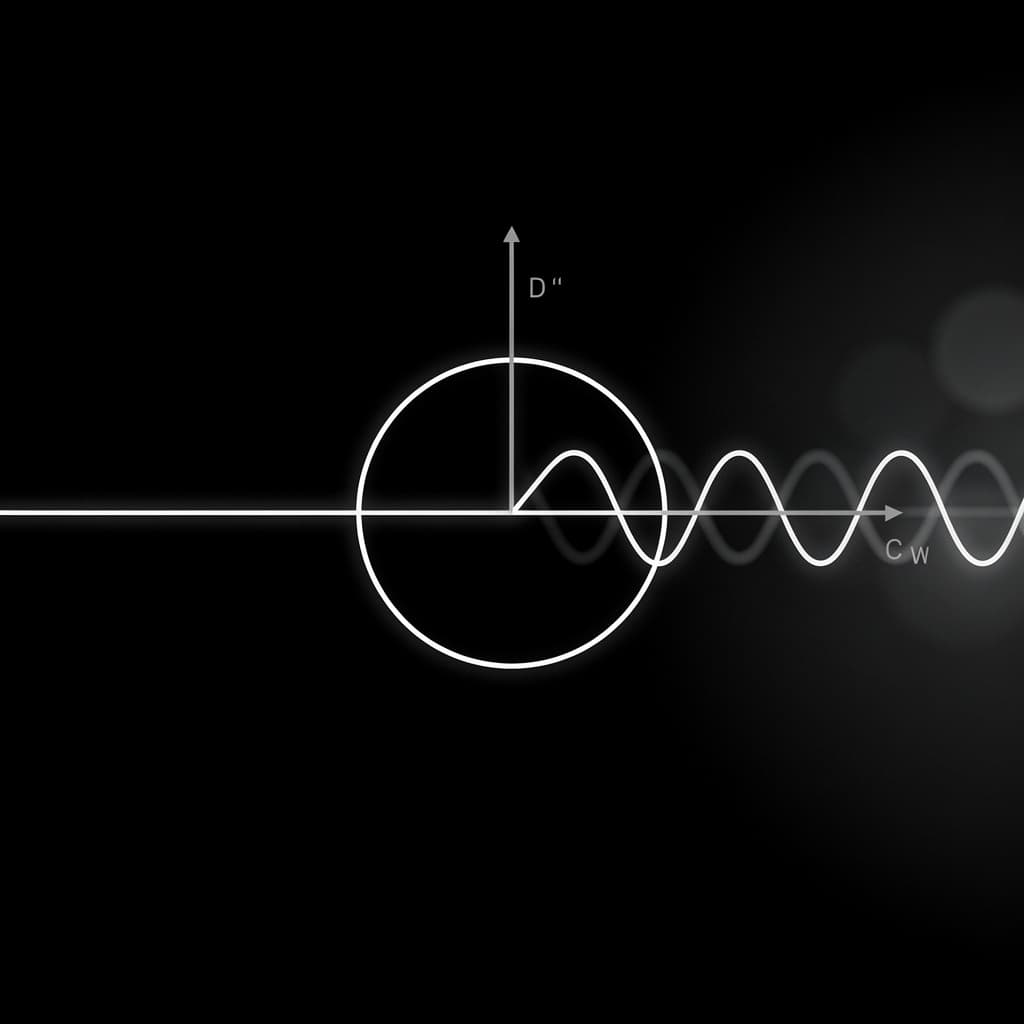
Trigonometry, derived from the Greek words trigonon (triangle) and metron (measure), represents one of the most elegant and foundational branches of mathematics. At its core, it is the study of the relationships between the side lengths and angles of triangles, specifically how a change in one affects the others. These trigonometric functions serve as the bridge between pure geometry and modern calculus, allowing mathematicians and scientists to describe periodic phenomena such as sound waves, light, and planetary motion. By examining the geometric logic of these functions, we can see how a simple ratio in a right triangle evolves into a complex tool for understanding the structure of the physical universe.
The Geometry of the Right Triangle
The study of trigonometry begins within the rigid constraints of the right triangle, where one interior angle is exactly 90 degrees. This geometric certainty provides a fixed frame of reference, ensuring that the remaining two angles are complementary and their sum equals 90 degrees. In this context, the primary trigonometric functions—sine, cosine, and tangent—are defined as ratios of the triangle's sides relative to one of the acute angles, often denoted as (theta). The side opposite the right angle is always the longest and is known as the hypotenuse, while the other two sides are categorized as the opposite or adjacent sides based on their position relative to the chosen angle . These labels are not static properties of the triangle but are relational, shifting depending on which acute angle the observer focuses on. The logic of these ratios is rooted in the concept of similar triangles, which states that triangles with the same angles will always have proportional side lengths. Therefore, for a given angle , the ratio of the opposite side to the hypotenuse will remain constant regardless of the triangle's actual size. This consistency allows us to treat these ratios as functions that take an angle as an input and return a precise numerical value. The primary ratios are defined as follows: the sine is the ratio of the opposite side to the hypotenuse; the cosine is the ratio of the adjacent side to the hypotenuse; and the tangent is the ratio of the opposite side to the adjacent side. These definitions establish a predictable mathematical language that translates the visual orientation of a shape into quantifiable data.The Mechanics of SOH CAH TOA
To assist students and professionals in recalling these foundational ratios, the mnemonic SOH CAH TOA has become a standard pedagogical tool in mathematics education. This acronym breaks down into three segments: SOH representing "Sine = Opposite / Hypotenuse," CAH representing "Cosine = Adjacent / Hypotenuse," and TOA representing "Tangent = Opposite / Adjacent." By memorizing this simple phrase, learners can quickly navigate the relationships within a right triangle without needing to re-derive the logic from first principles every time. This mnemonic serves as a gateway to more complex calculations, providing a reliable mental anchor when dealing with the orientation of different geometric figures in space. Understanding the mechanics of SOH CAH TOA requires more than just memorization; it requires an intuitive grasp of how side lengths interact under the constraint of the Pythagorean Theorem. Since the square of the hypotenuse is equal to the sum of the squares of the other two sides, , the values of sine and cosine are inherently limited. For any real angle in a right triangle, the hypotenuse is always the longest side, meaning that the absolute values of sine and cosine can never exceed 1. This restriction does not apply to the tangent function, as the opposite and adjacent sides can vary independently in size relative to one another. Thus, while sine and cosine describe a bounded relationship, tangent allows for a ratio that can range from zero to infinity as the angle approaches 90 degrees.The Logic of Sine Cosine Tangent
Beyond their basic definitions, the primary trigonometric functions are deeply interconnected through a series of foundational relationships. One of the most significant insights in trigonometry is that the tangent of an angle is equivalent to the ratio of its sine to its cosine, expressed as . This relationship emerges naturally from their definitions: since and , dividing sine by cosine cancels out the hypotenuse, leaving the ratio of the opposite to the adjacent side. This logic reveals that the tangent function is not merely a third, independent ratio, but a derivative value that describes the "slope" or rate of change between the horizontal and vertical components of the triangle. These relationships are further cemented by the Pythagorean Identity, which is arguably the most important formula in all of trigonometry. By dividing every term of the Pythagorean Theorem () by the square of the hypotenuse (), we derive the identity . This equation holds true for any angle , illustrating a profound geometric symmetry: the sum of the squared ratios of a triangle's legs to its hypotenuse is always unity. This identity is the cornerstone for simplifying complex trigonometric expressions and serves as the starting point for proving more advanced theorems in calculus and physics. It underscores the fact that trigonometry is not just about measuring triangles, but about exploring the inherent properties of the Euclidean plane.The Reciprocal Identities and Properties
In addition to the three primary functions, mathematicians utilize three reciprocal functions: cosecant (), secant (), and cotangent (). These are defined as the multiplicative inverses of sine, cosine, and tangent, respectively. Specifically, , , and . While these might seem like redundant labels, they are essential for simplifying algebraic operations where the ratios appear in the denominator. In architectural engineering and classical physics, using secant or cosecant often leads to cleaner formulas and more intuitive solutions when calculating forces or structural loads that act inversely to the primary dimensions. The logic of these reciprocal functions also extends to their own versions of the Pythagorean Identity. By manipulating the fundamental identity , we can derive and . These variations allow mathematicians to transition between different trigonometric terms with ease, depending on which variables are known or which function is easiest to integrate. This interconnected web of identities demonstrates that the six trigonometric functions are parts of a single, unified system. Each function provides a different perspective on the same geometric reality, much like looking at a three-dimensional object from different vantage points.Studying this for an exam?
Noesis builds the syllabus, notes and tests for you, and you study them with a tutor that knows your material.
The Unit Circle Explained
While right triangle trigonometry is limited to angles between 0 and 90 degrees, the unit circle expands the logic of these functions to include any angle imaginable, including negative angles and those far exceeding 360 degrees. The unit circle is a circle with a radius of exactly 1, centered at the origin of the Cartesian plane. In this model, any point on the circumference of the circle can be identified by the angle it makes with the positive x-axis. Because the radius (hypotenuse) is 1, the definitions of sine and cosine simplify beautifully: the x-coordinate of the point is exactly , and the y-coordinate is exactly . This shift from side-length ratios to coordinates allows trigonometry to move from the study of static shapes to the study of circular motion and rotation. The unit circle explained through this coordinate lens reveals why trigonometric functions are periodic and why their signs change across different quadrants. In the first quadrant, where both and are positive, all trigonometric functions return positive values. In the second quadrant, is negative and is positive, meaning is negative while remains positive. This pattern continues through the third and fourth quadrants, dictated entirely by the algebraic properties of the Cartesian coordinate system. This framework is essential for modern physics, as it allows for the mathematical modeling of rotating objects, such as an engine's crankshaft or a spinning planet, where the position is a function of time and rotation.Defining Functions Through Circular Motion
By viewing trigonometric functions as descriptions of circular motion, we can understand their behavior over time. Imagine a point moving at a constant speed around the unit circle; its vertical position (sine) will rise and fall in a smooth, repeating wave, while its horizontal position (cosine) will oscillate left and right in a similar fashion but shifted by 90 degrees. This visualization explains why the graphs of and are identical in shape but out of phase. The tangent function also takes on a new meaning in this context: it represents the slope of the line connecting the origin to the point on the circle. As the angle approaches 90 degrees, the line becomes vertical and the slope becomes infinite, which is why is undefined. This circular logic also introduces the concept of reference angles, which allow us to find the trigonometric values of any large angle by relating it back to a corresponding angle in the first quadrant. For example, the sine of 150 degrees is the same as the sine of its reference angle, 30 degrees, because they share the same vertical height relative to the x-axis. This property of symmetry is highly utilized in computer graphics and robotics, where complex rotations are calculated by breaking them down into simpler, predictable components. The unit circle effectively transforms trigonometry into a tool for mapping the infinite, providing a consistent way to calculate values for any degree of rotation.Applications of Right Triangle Trigonometry
The practical applications of right triangle trigonometry are vast, touching nearly every field of physical science and engineering. One of the oldest uses is in the field of surveying and land measurement, where the height of a distant mountain or the width of a wide river can be determined without ever crossing it. By measuring a baseline distance on the ground and the angle of elevation to the top of the object, a surveyor can use the tangent function to calculate the height. This method, known as triangulation, was the primary way that early cartographers mapped entire continents and determined the exact elevation of peaks in the Himalayas. Even today, despite the advent of GPS, the logic of trigonometry remains the fallback for verifying spatial data and ensuring architectural precision. In the realm of modern architecture and construction, trigonometry is indispensable for ensuring the structural integrity of buildings. When an architect designs a sloped roof or a vaulted ceiling, they must calculate the exact lengths of rafters and the angles at which they meet the supporting walls. Using right triangle trigonometry, they can determine how much weight a beam can support based on its angle and length. Similarly, the design of ramps, staircases, and even the curvature of roads for drainage depends on precise trigonometric calculations. Without these ratios, structures would be prone to failure, as the distribution of force—often calculated using the sine and cosine of the angles involved—would be left to guesswork.Applying Pythagorean Logic to Identities
The logic of the trigonometric functions also allows for the calculation of distances that are physically unreachable. For instance, in the field of astronomy, the distance to nearby stars can be measured using a technique called stellar parallax. As the Earth moves from one side of its orbit to the other, astronomers observe the apparent shift of a star against the background of more distant objects. This shift forms a very thin, long triangle where the Earth's orbital radius is the base and the distance to the star is the height. By applying the tangent function to the very small angle of shift, scientists can calculate the vast distance to the star with remarkable accuracy, bridging the gap between local geometry and the scale of the cosmos. Beyond simple distance, trigonometric identities derived from Pythagorean logic are used to resolve vectors in physics. Any force acting at an angle—such as the pull of a rope or the thrust of a jet engine—can be broken down into horizontal and vertical components. The horizontal force is calculated as the total force multiplied by the cosine of the angle, while the vertical force is the total force multiplied by the sine. This decomposition is vital for analyzing everything from the flight path of a projectile to the tension in the cables of a suspension bridge. By converting a single diagonal vector into two perpendicular components, engineers can apply Newton's Laws of Motion to each direction independently, simplifying complex physical problems into manageable equations.Transitioning to Radians and Rotation
As students move from basic geometry to advanced calculus, the unit of measurement for angles typically shifts from degrees to radians. While degrees are an arbitrary historical convention (likely based on the approximately 360 days in a year), radians are a natural unit based on the properties of the circle itself. One radian is defined as the angle created when the arc length of a circle is equal to its radius. Because the circumference of a circle is , there are exactly radians in a full 360-degree rotation. This transition is not merely a change of scale; it simplifies many mathematical formulas, particularly in calculus where the derivative of is exactly only when is measured in radians. The move to radians also facilitates the study of angular velocity, which measures how fast an object rotates. In many mechanical systems, such as turbines or gears, it is more useful to know the rate of rotation in radians per second rather than degrees per minute. Angular velocity, denoted by (omega), relates directly to linear velocity () through the simple formula . This relationship allows engineers to calculate the speed of a point on the edge of a spinning disk, such as a saw blade or a hard drive platter. By using radians, the math becomes "dimensionless," meaning the units cancel out in a way that makes physical equations more elegant and less prone to error.The Periodic Nature of Trig Graphs
One of the most powerful aspects of trigonometric functions is their periodic nature, which is best visualized through their graphs. When we plot , the resulting curve is a smooth, repeating wave known as a sinusoid. This wave oscillates between a maximum value of 1 and a minimum value of -1, repeating its pattern every radians (or 360 degrees). This periodicity makes trigonometry the primary tool for modeling any phenomenon that repeats over time, from the rise and fall of ocean tides to the vibrations of a guitar string. In these models, the horizontal axis represents time or distance, while the vertical axis represents the displacement from an equilibrium point. The behavior of these waves can be modified using specific parameters: amplitude, frequency, and phase shift. The amplitude, or the height of the wave from its center, corresponds to the strength or intensity of the signal, such as the volume of a sound or the brightness of a light. The frequency, which is inversely related to the period, determines how many cycles occur in a given unit of time; in acoustics, this is perceived as the pitch of a note. Finally, the phase shift moves the wave left or right along the horizontal axis, representing a delay in time. By adjusting these three variables, scientists can create a mathematical function that precisely matches almost any observed periodic signal in the natural world.Modeling Periodic Oscillations and Waves
The logic of these graphs extends into the realm of signal processing and electronics. Alternating current (AC), which powers our homes, is delivered in the form of a sine wave. Electrical engineers use trigonometric functions to calculate the voltage and current at any specific microsecond, ensuring that power grids remain stable and that sensitive electronic devices receive the correct amount of energy. When multiple sine waves of different frequencies are combined, they can create complex sounds or data streams. This is the basis of Fourier Analysis, a mathematical technique that decomposes any complex signal into a sum of simple sine and cosine waves, allowing for everything from MP3 compression to the filtering of static in radio communications. Trigonometry also plays a critical role in quantum mechanics and the study of light. Since light behaves both as a particle and a wave, its path and energy are described using wave functions that are fundamentally trigonometric. The interference patterns observed when light passes through a narrow slit—creating areas of brightness and darkness—are calculated by adding the sine waves of the light's electromagnetic fields. If the waves are "in phase" (their peaks align), they reinforce each other; if they are "out of phase," they cancel each other out. This geometric logic of wave superposition is what allows for the creation of technologies like noise-canceling headphones and the high-resolution imaging used in medical MRIs.Analytical Approaches to Oblique Triangles
While right triangles provide the foundation, much of the real world consists of oblique triangles—those without a 90-degree angle. To solve these, we must use more advanced analytical tools: the Law of Sines and the Law of Cosines. These laws extend the logic of trigonometric functions to any three-sided shape, allowing us to find missing side lengths or angles as long as we have a certain minimum amount of information. The Law of Sines states that the ratio of a side's length to the sine of its opposite angle is constant for all three sides of the triangle: . This is particularly useful when we know two angles and one side, common in navigation and aviation. The Law of Cosines serves as a more general version of the Pythagorean Theorem, accounting for the "tilt" of the triangle. The formula, , allows for the calculation of a third side when two sides and the included angle are known. If the angle happens to be 90 degrees, becomes zero, and the formula simplifies back to the familiar . This structural logic is used by structural engineers to calculate the stresses in triangular trusses and by GPS satellites to triangulate a user's position on the Earth's surface. By mastering these analytical approaches, we can move beyond simple geometry and apply trigonometric logic to the complex, irregular shapes that define our physical reality.References
- Stewart, J., "Precalculus: Mathematics for Calculus", Cengage Learning, 2015.
- Maor, E., "Trigonometric Delights", Princeton University Press, 1998.
- Boyce, W. E., & DiPrima, R. C., "Elementary Differential Equations and Boundary Value Problems", Wiley, 2012.
- Van Brummelen, G., "The Mathematics of the Heavens and the Earth: The Early History of Trigonometry", Princeton University Press, 2009.
Recommended Readings
- Trigonometry by I.M. Gelfand and Mark Saul — A brilliant, deep dive into the subject that focuses on logic and intuition rather than rote memorization.
- Measurement by Paul Lockhart — A beautiful exploration of geometry and trigonometry that treats mathematics as an art form and builds concepts from the ground up.
- The Joy of x: A Guided Tour of Math, from One to Infinity by Steven Strogatz — Includes excellent chapters on the beauty of sine waves and how they relate to the rhythm of the natural world.
- A History of Mathematics by Carl B. Boyer — For readers interested in how trigonometric functions evolved from ancient astronomical chords to modern analytical tools.
Turn this topic into a full course
Noesis builds the syllabus, notes and tests for you, and you study them with a tutor that knows your material.