The Foundational Architecture of Digital Information
The efficiency of a modern software system is rarely determined by the sheer speed of the hardware it runs on, but rather by the elegance and suitability of its underlying data structures . At its...
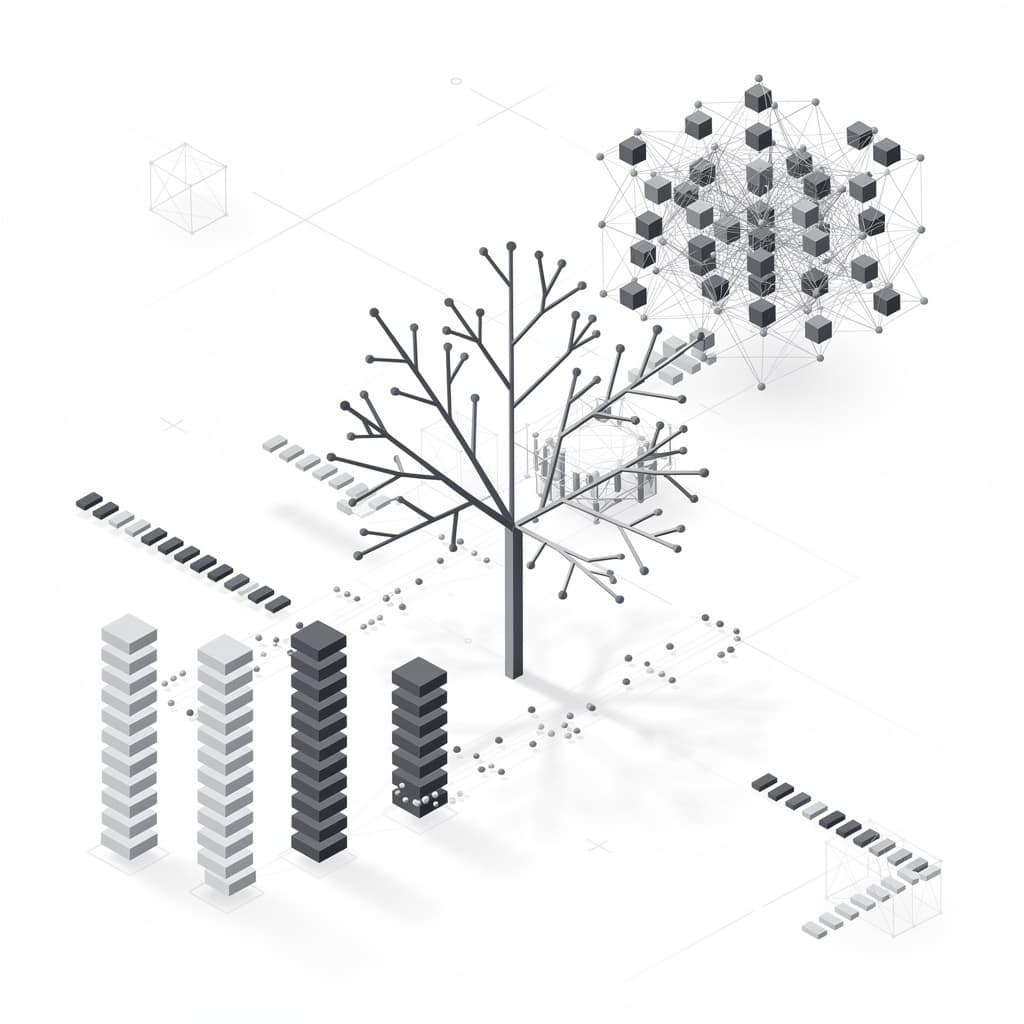
The efficiency of a modern software system is rarely determined by the sheer speed of the hardware it runs on, but rather by the elegance and suitability of its underlying data structures. At its most fundamental level, a data structure is a specialized format for organizing, processing, retrieving, and storing data, designed to serve specific algorithmic needs. In the realm of computer science, the choice of a data structure often dictates the difference between an application that responds instantaneously and one that collapses under the weight of its own information. By understanding how data is structured, engineers can minimize resource consumption and maximize the performance of complex operations, ranging from simple record-keeping to the sophisticated neural networks that power artificial intelligence.
The Anatomy of Organized Information
Defining Abstract Data Types
To understand the construction of software, one must first distinguish between a concrete implementation and an Abstract Data Type (ADT). An ADT serves as a logical description of how data should behave and what operations can be performed upon it, without specifying the exact physical layout in memory. For instance, a "List" is an ADT that defines operations like append, delete, and search, while its implementation could be an array or a linked list. This layer of abstraction allows developers to reason about the logic of their programs independently of the low-level machine constraints, facilitating a modular approach to system design where components can be swapped or optimized without breaking the overall architecture.
The transition from a logical ADT to a physical data structure involves making critical trade-offs regarding time and space complexity. When a programmer selects an implementation, they are essentially choosing which operations should be fast and which can afford to be slow based on the expected usage patterns. This decision-making process is guided by the Big O notation, a mathematical framework used to describe the limiting behavior of a function when the argument tends towards a particular value or infinity. For example, if a system requires frequent insertions but rare searches, a structure with $O(1)$ insertion time would be prioritized over one that offers $O(\log n)$ search efficiency but $O(n)$ insertion costs. Understanding these mathematical foundations ensures that data structures are not merely containers, but active participants in algorithmic efficiency.
How Hardware Influences Software Design
The design of data structures is inextricably linked to the physical realities of the Von Neumann architecture, which characterizes most modern computing hardware. In this model, the Central Processing Unit (CPU) and memory are separate entities, meaning that the speed of data retrieval often becomes the primary bottleneck in program execution. Hardware features such as the CPU cache significantly reward data structures that exhibit spatial locality—where data elements are stored close together in physical memory. Because fetching data from the main RAM is orders of magnitude slower than accessing the cache, structures like arrays often outperform more complex, fragmented structures because they allow the CPU to pre-fetch contiguous blocks of memory effectively.
Furthermore, the way memory is addressed at the hardware level imposes strict constraints on how composite data can be built from primitive components. Memory is typically treated as a vast, linear array of bytes, each with a unique numerical address, and most data structures are essentially clever ways of mapping logical relationships onto this linear space. For example, a multi-dimensional array must be "flattened" into a one-dimensional memory block using either row-major or column-major ordering. By acknowledging these hardware-level behaviors, developers can design software that works in harmony with the machine, reducing "cache misses" and ensuring that the electrical signals within the computer translate into fluid user experiences.
Classifying Primitive and Composite Data
Integers and Floating Points at the Core
Every complex data structure, no matter how sophisticated, is ultimately constructed from primitive data types provided by the programming language and supported directly by the hardware. These primitives include integers, floating-point numbers, characters, and booleans, which represent the simplest forms of information that a computer can manipulate. An integer, for example, is typically represented in binary using a fixed number of bits, such as 32 or 64, which determines its range and the precision of the calculations performed. The mathematical behavior of these types is governed by the laws of binary arithmetic, where overflow and underflow must be carefully managed to prevent logical errors in higher-level applications.
Floating-point numbers represent a more complex primitive designed to handle real numbers and scientific notation by separating the value into a significand and an exponent. Following the IEEE 754 standard, these types allow for a vast range of values but introduce the concept of "precision errors" due to the limitations of representing decimal fractions in binary. Because $0.1$ in base-10 is a repeating fraction in base-2, calculations involving floating points can accumulate small inaccuracies over time. A robust understanding of these primitives is essential because they form the "atoms" of larger structures; if the underlying primitives are chosen poorly—such as using a 32-bit integer for a value that might exceed 2 billion—the entire data structure built upon them will eventually fail.
Managing Contiguous Memory with Arrays
The array is perhaps the most fundamental composite data structure, consisting of a collection of elements of the same type stored in contiguous memory locations. Because each element is the same size, the memory address of any element can be calculated instantly using its index through the formula $$Address = Base + (Index \times ElementSize)$$. This mathematical predictability grants arrays the power of random access, allowing a program to jump to the millionth element as quickly as it can access the first. This $O(1)$ access time makes arrays the backbone of many other structures and algorithms, particularly those that require frequent lookups or sorting.
However, the rigidity of the array's structure introduces significant limitations, particularly regarding size and insertion flexibility. In most traditional implementations, an array must have a fixed size declared at the time of its creation, which can lead to wasted space if the array is too large or "overflow" if it is too small. Inserting a new element into the middle of an array is also a costly operation, requiring every subsequent element to be shifted one position to the right, resulting in $O(n)$ time complexity. To mitigate these issues, modern languages often provide dynamic arrays, which automatically resize themselves by allocating a new, larger block of memory and copying the old elements over when capacity is reached, balancing the benefits of contiguous memory with the need for flexibility.
Exploring Linear vs Non-linear Data Structures
Sequential Logic in Stacks and Queues
Linear data structures organize information in a sequence, where each element has a unique predecessor and successor, except for the first and last elements. A stack is a primary example of this, operating on a Last-In, First-Out (LIFO) principle, much like a physical stack of cafeteria trays. In a stack, the most recently added item is the first one to be removed, making it an ideal structure for managing function calls in a computer's memory or implementing "undo" features in text editors. The simplicity of the stack, restricted to push and pop operations, ensures that the state of a process can be tracked with minimal overhead and perfect chronological accuracy.
In contrast, a queue operates on a First-In, First-Out (FIFO) basis, mirroring a real-world line at a grocery store where the first person to arrive is the first to be served. Queues are essential in scenarios where resources are shared among multiple consumers, such as a printer queue or the scheduling of processes within an operating system's kernel. Variations like the priority queue allow elements to be dequeued based on an assigned importance rather than just their arrival time, which is critical for real-time systems where urgent tasks must bypass standard sequential processing. Both stacks and queues provide the logical discipline necessary to manage data flows where the order of operations is the defining characteristic of the problem.
Navigating Hierarchical Tree Architectures
As we move away from linear sequences, we encounter nonlinear data structures, which are designed to represent hierarchical relationships. The tree is the quintessential non-linear structure, consisting of nodes connected by edges, starting from a single "root" node and branching out to "leaf" nodes. Each node in a tree can have multiple children but only one parent, creating a structure that naturally models systems like a computer's file directory or the Document Object Model (DOM) of a webpage. The hierarchical nature of trees allows for efficient categorization and searching, as each step down the tree can potentially eliminate a large portion of the remaining data from consideration.
The binary search tree (BST) is a specialized version where each node has at most two children, and for any given node, all elements in the left subtree are smaller while all elements in the right subtree are larger. This property allows for search, insertion, and deletion operations to be performed in $O(\log n)$ time, provided the tree remains balanced. However, if a tree becomes "skewed"—where nodes are added in a strictly increasing or decreasing order—it effectively collapses into a linear list, losing its efficiency. To prevent this, advanced structures like AVL trees and Red-Black trees incorporate self-balancing algorithms that automatically rearrange nodes during insertion and deletion to maintain a logarithmic height, ensuring consistent performance even as the dataset grows.
The Dynamics of Linked Systems
Singly versus Doubly Linked Lists
While arrays rely on contiguous memory, linked lists provide a more fluid approach to data storage by scattering elements across memory and connecting them via pointers. In a singly linked list, each node contains a data field and a "next" pointer that stores the memory address of the subsequent node. This architecture allows for $O(1)$ insertions and deletions at any point in the list, provided you already have a pointer to the location, as no shifting of elements is required. This makes linked lists highly efficient for applications where the size of the dataset fluctuates constantly and memory is fragmented, though they sacrifice the random-access capabilities of arrays since one must traverse the list from the beginning to find a specific element.
The doubly linked list enhances this model by adding a "previous" pointer to each node, allowing for traversal in both directions. This bidirectional navigation is particularly useful for applications like web browser history, where users need to move both forward and backward through a sequence of pages. While the additional pointer increases the memory overhead per node, it simplifies certain operations, such as deleting a node when only a reference to that node is provided, as the "previous" node can be updated without a full traversal from the head. These structures demonstrate how adding a small amount of metadata (the extra pointer) can significantly expand the functional capabilities of a basic data organization strategy.
Dynamic Memory Allocation Strategies
The true power of linked systems lies in their relationship with dynamic memory allocation, a process where memory is requested from the system "heap" during program execution rather than being pre-allocated on the "stack." This allows linked lists to grow and shrink elastically, consuming only as much memory as they currently need. In languages without automatic garbage collection, such as C or C++, managing these links requires meticulous attention to prevent memory leaks, where pointers are lost but the memory they pointed to remains "reserved" by the OS. A robust linked system must always ensure that before a node is deleted, its successor is properly linked to its predecessor to maintain the integrity of the chain.
Modern memory management often utilizes these dynamic structures to implement sophisticated "pool" allocators that reduce the overhead of frequent system calls. By maintaining a linked list of free memory blocks, an application can quickly find a hole of sufficient size to store a new object without asking the operating system for a fresh allocation. This synergy between the data structure and the underlying memory manager is what allows high-performance systems to handle millions of objects per second. Thus, the linked list is not just a way to store data, but a fundamental tool for managing the very resources that allow a program to function within the constraints of physical hardware.
Advanced Nonlinear Network Structures
Modeling Relationships with Graph Theory
When the relationships between data points transcend simple hierarchies and become many-to-many, we employ graphs. A graph is a mathematical structure consisting of a set of vertices (or nodes) and a set of edges that connect pairs of vertices. Unlike trees, graphs do not have a designated root and can contain cycles, where a path leads from a node back to itself. This makes graphs the ideal tool for modeling complex, interconnected systems such as social networks, where vertices represent individuals and edges represent friendships, or the physical infrastructure of the internet, where routers are nodes and fiber-optic cables are edges.
Analyzing graphs often involves determining the degree of a vertex—the number of edges connected to it—and identifying "clusters" or "connected components" within the network. In computer science, we typically represent graphs using either an adjacency matrix or an adjacency list. An adjacency matrix is a 2D array where the cell at row $i$ and column $j$ indicates the presence of an edge between vertex $i$ and $j$, offering $O(1)$ edge lookups but consuming $O(V^2)$ space. For "sparse" graphs, where most nodes are not connected to most other nodes, an adjacency list is far more memory-efficient, storing only the neighbors for each vertex in a series of linked lists or dynamic arrays.
Directed and Undirected Data Flows
The nature of the connections within a graph can be further refined by distinguishing between directed and undirected graphs. In an undirected graph, an edge between Node A and Node B is bidirectional, representing a reciprocal relationship such as a mutual friendship. However, in a directed graph (or digraph), edges have a specific orientation, indicating a one-way relationship like a "follow" on a social media platform or a prerequisite for a college course. These directed edges allow for the representation of flow and dependency, which are crucial for algorithms that manage task scheduling, supply chain logistics, and the ranking of web pages in search engine results.
Specialized versions of directed graphs, such as the Directed Acyclic Graph (DAG), are particularly important because they contain no cycles, ensuring that a traversal will eventually terminate. DAGs are the foundation of version control systems like Git, where each commit points to its parent, and modern build systems that determine the order in which software components must be compiled. By applying graph theory to data structures, computer scientists can solve "shortest path" problems using algorithms like Dijkstra's or A*, which power the navigation systems used in everything from GPS devices to the pathfinding logic of non-player characters in video games.
Efficiency and Search Optimization
Efficiency in Hash Table Implementations
One of the most powerful tools for search optimization is the hash table, a structure that provides nearly instantaneous data retrieval by transforming a search key into an array index. This transformation is performed by a hash function, which takes an input of any size and produces a fixed-size integer. In an ideal scenario, every unique key would map to a unique index, allowing for $O(1)$ time complexity for insertions, deletions, and lookups. This makes hash tables the preferred choice for implementing dictionaries, caches, and unique sets where the speed of finding a specific item is the most critical performance metric.
However, because the range of possible keys is often much larger than the size of the underlying array, multiple keys may occasionally hash to the same index, a phenomenon known as a collision. To maintain efficiency, hash tables must implement collision resolution strategies, such as chaining, where each array slot holds a linked list of all items that hash to that index, or open addressing, where the algorithm searches for the next available slot in the array. A well-designed hash function and a reasonable "load factor" (the ratio of items to slots) are essential to prevent the structure from degrading into $O(n)$ performance. When tuned correctly, hash tables represent the pinnacle of average-case efficiency in the world of data organization.
Balancing Search Trees for Performance
While hash tables offer incredible speed, they do not maintain any inherent order among their elements, making them unsuitable for tasks like finding the "next" element or performing range queries. For these scenarios, balanced search trees are the superior choice. As mentioned earlier, trees like the Red-Black tree use a set of structural rules to ensure the tree never becomes too tall or lopsided. For instance, in a Red-Black tree, no path from the root to a leaf is more than twice as long as any other path, guaranteeing that even in the worst-case scenario, operations remain $O(\log n)$. This logarithmic performance is remarkably scalable; in a balanced tree containing one billion elements, a search only requires about 30 comparisons.
The trade-off for this guaranteed performance is the complexity of the insertion and deletion logic, which must perform "rotations" and "re-colorings" to preserve the balance of the tree. This overhead is often justified in systems where data is frequently updated and sorted access is required, such as in the implementation of the std::map in C++ or the TreeMap in Java. By combining the hierarchical logic of trees with the rigors of balancing algorithms, these structures provide a reliable middle ground between the rigid speed of hash tables and the slow flexibility of linked lists. They ensure that even as datasets grow to massive proportions, the cost of accessing any individual piece of information remains manageable and predictable.
Modern Data Structures Examples in Practice
Database Indexing and File Systems
In the world of persistent storage, where data must survive a system reboot, the B-Tree and its variant, the B+ Tree, are the undisputed kings. Unlike binary trees, B-Trees are "multi-way" trees, meaning each node can have dozens or even hundreds of children. This design is specifically optimized for systems that read and write large blocks of data, such as hard drives and Solid State Drives (SSDs). By increasing the "branching factor," the height of the tree is kept extremely low, which minimizes the number of disk I/O operations—the slowest part of any database query—required to find a record among millions of entries.
Every time you perform a search on a modern SQL database, you are likely traversing a B+ Tree index. These structures store the actual data records in the leaf nodes, which are also linked together in a sequence, allowing for incredibly fast range scans (e.g., "find all users born between 1980 and 1990"). Similarly, file systems like NTFS or APFS use these structures to manage the metadata of your files, ensuring that the operating system can locate a specific document on a multi-terabyte drive in a fraction of a second. The B-Tree demonstrates how data structure design can be tailored to the specific physical characteristics of storage media to achieve industrial-scale performance.
Network Routing and Pathfinding Logic
On the global scale of the internet, graph-based data structures enable the routing of packets across thousands of miles in milliseconds. Routers use a specialized version of a graph known as a Trie (or prefix tree) to store IP addresses and determine the "longest prefix match" for an incoming packet. Tries are exceptionally efficient for string-based or bit-based lookups because the search time is proportional to the length of the key rather than the number of keys stored. This allows a core internet router to handle millions of simultaneous routes without becoming a bottleneck for global traffic.
Furthermore, pathfinding logic in logistics and gaming utilizes Heuristic-driven graphs. In a game like "StarCraft" or "League of Legends," when a player clicks a destination, the game engine represents the map as a grid or a navigation mesh (a type of graph) and uses the A* Search Algorithm to find the most efficient path. This algorithm combines the known distance from the start (Dijkstra's approach) with an estimated distance to the goal (a heuristic), allowing it to ignore large portions of the map and focus only on the most promising directions. These real-world applications highlight that data structures are not just academic concepts but the invisible machinery that powers the interconnected, responsive, and data-driven world of the 21st century.
References
- Cormen, T. H., Leiserson, C. E., Rivest, R. L., & Stein, C., "Introduction to Algorithms, Fourth Edition", MIT Press, 2022.
- Knuth, D. E., "The Art of Computer Programming, Vol. 1: Fundamental Algorithms", Addison-Wesley, 1997.
- Sedgewick, R., & Wayne, K., "Algorithms, Fourth Edition", Addison-Wesley Professional, 2011.
- Aho, A. V., Hopcroft, J. E., & Ullman, J. D., "Data Structures and Algorithms", Addison-Wesley, 1983.
Recommended Readings
- A Common-Sense Guide to Data Structures and Algorithms by Jay Wengrow — An excellent, highly accessible introduction that uses plain language and visual intuition to explain complex topics.
- Purely Functional Data Structures by Chris Okasaki — A fascinating exploration of how data structures are implemented in functional programming languages where data is immutable.
- Algorithm Design Manual by Steven S. Skiena — A practical guide that focuses on how to choose the right data structure and algorithm for real-world engineering problems.
- The Pragmatic Programmer by Andrew Hunt and David Thomas — While not strictly about data structures, it provides essential context on how to apply these concepts in professional software development.