The Elegant Logic of the OSI Model
The Open Systems Interconnection (OSI) model represents one of the most significant intellectual achievements in the history of telecommunications. Developed during an era when proprietary networking...
Origins of Layered Communication Systems
In the late 1970s, the computing world was a chaotic landscape of incompatible proprietary systems where hardware from different vendors could rarely communicate. The International Organization for Standardization (ISO) recognized that for the digital revolution to reach its full potential, a standard architectural framework was required. This led to the birth of the Open Systems Interconnection project in 1977, spearheaded by experts such as Charles Bachman and Hubert Zimmermann. Their goal was to create a modular system where any two "open" systems could communicate regardless of their underlying hardware or software architecture. By 1984, the ISO 7498 standard was published, formally defining what we now call the OSI model.
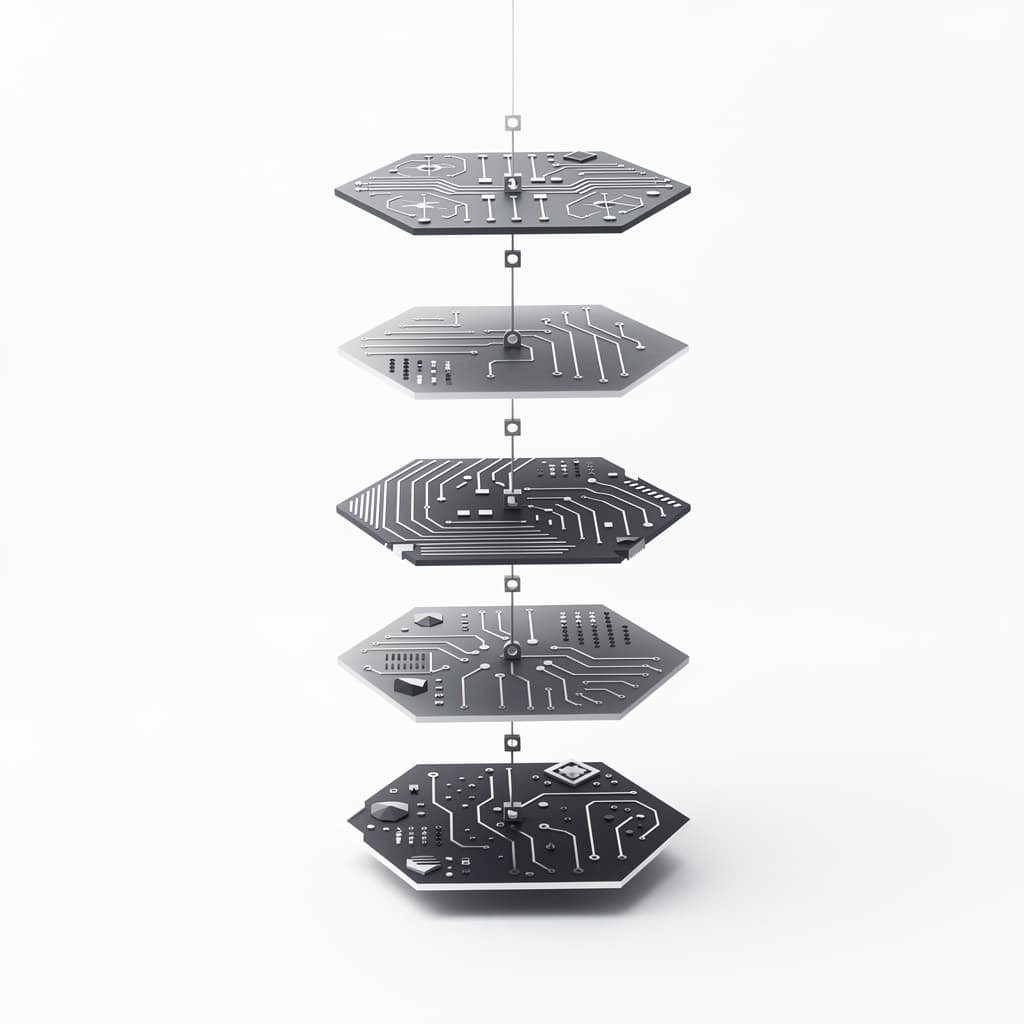
Conceptualizing the modular framework required a shift in thinking from monolithic software to discrete services. Each layer of the OSI model was designed to perform a specific set of functions and provide services to the layer immediately above it while receiving services from the layer below. This abstraction layer ensures that a change in one layer—such as upgrading from copper wire to fiber optics at the physical level—does not require a complete rewrite of the web browser at the application level. This separation of concerns is the "elegant logic" that allows for rapid innovation across the industry, as vendors can focus on optimizing specific layers without worrying about the entire stack.
Defining what is the OSI model involves recognizing it primarily as a conceptual tool rather than a strict implementation. While the TCP/IP protocol suite eventually became the dominant practical standard for the internet, the OSI model remains the gold standard for education and diagnostic theory. It serves as a mental map for engineers, allowing them to pinpoint where a failure occurs by moving systematically through the layers. When an IT professional asks if a problem is a "Layer 2 or Layer 3 issue," they are utilizing this framework to distinguish between local hardware addressing and global routing logic, demonstrating the model's enduring relevance in a post-proprietary world.
Hardware Control in the Physical Domain
The Physical Layer (Layer 1) is the foundation of the OSI model, dealing with the actual transmission and reception of raw bitstreams over a physical medium. At this level, data is no longer viewed as files or packets, but as electrical pulses, light signals, or radio waves. The primary responsibility of this layer is to define how a "1" and a "0" are represented physically. For instance, in an Ethernet cable, a specific voltage level might represent a binary one, while a different voltage represents a binary zero. This layer also manages the bit rate, or the number of bits sent per second, which is governed by the bandwidth of the medium.
Physical media and hardware standards are strictly defined at this layer to ensure that cables and connectors from different manufacturers are compatible. This includes everything from the shape of the RJ-45 plug to the internal twisting of copper pairs used to cancel out electromagnetic interference. Common technologies residing here include Ethernet (at the physical level), DSL, ISDN, and various wireless standards like 802.11. Even the hardware components such as hubs, repeaters, and cabling are considered Layer 1 devices because they do not "read" the data; they simply pass along the physical signal to its destination.
Mechanical and electrical specifications at Layer 1 also cover the synchronization of bits to ensure that the sender and receiver are operating at the same timing. Without this synchronization, the receiver might misinterpret the incoming signals, leading to data corruption. Engineers must account for signal attenuation, which is the loss of signal strength over distance, often requiring the use of repeaters to regenerate the signal. The mathematics of signal transmission at this layer can be expressed through Shannon’s Capacity Theorem, which defines the maximum possible data rate for a channel with a specific bandwidth and noise level: $$C = B \log_2(1 + \frac{S}{N})$$ where $C$ is the channel capacity, $B$ is the bandwidth, and $S/N$ is the signal-to-noise ratio.
Framing Logic within the Data Link Layer
The Data Link Layer (Layer 2) transforms the raw transmission facility provided by the physical layer into a reliable link. Its primary function is "framing," which involves breaking the bitstream into discrete blocks of data called frames. Each frame contains a header and a trailer that hold control information, such as start-of-frame and end-of-frame indicators. This allows the receiver to identify where one block of data ends and the next begins, providing a structured way to handle the flow of information across a single physical segment. If the physical layer is the wire, the data link layer is the protocol that governs how devices take turns talking on that wire.
Media Access Control (MAC) and hardware addressing are the defining characteristics of this layer. Every network interface card (NIC) is assigned a unique, permanent MAC address at the factory, which functions as the device's physical identity on a local network. In a local area network (LAN), switches operate at Layer 2 by maintaining a table of MAC addresses and the ports they are connected to. This allows the switch to direct frames only to the intended recipient rather than broadcasting them to every device, significantly improving network efficiency and security. This process of local delivery is distinct from the global routing found in higher layers.
Error detection and Logical Link Control (LLC) provide the necessary oversight to ensure the integrity of the data. The Data Link layer typically employs a Cyclic Redundancy Check (CRC) in the frame trailer to detect if bits were flipped or corrupted during transmission. If an error is detected, the frame may be discarded, and depending on the protocol, a retransmission may be requested. The LLC sublayer acts as an interface between the media access control and the network layer above, multiplexing different protocols and providing flow control to prevent a fast sender from overwhelming a slow receiver. Common Layer 2 protocols include Ethernet (802.3), Point-to-Point Protocol (PPP), and the High-Level Data Link Control (HDLC).
Global Routing and the Network Layer
The Network Layer (Layer 3) is responsible for the delivery of individual packets from the source host to the destination host, potentially across multiple networks. While the Data Link layer handles local delivery on the same segment, the Network layer provides the logic for end-to-end delivery across a complex web of interconnected routers. This is where the concept of logical addressing comes into play, most notably through the Internet Protocol (IP). Unlike MAC addresses, which are fixed to hardware, IP addresses are hierarchical and assigned based on the device's current location in the network topology, much like a mailing address includes a zip code to help sort mail.
Path determination and packet switching are the core "intelligent" functions of this layer. Routers, the primary devices at Layer 3, use complex algorithms and routing tables to determine the most efficient path for a packet to reach its destination. These algorithms, such as OSPF or BGP, consider factors like link speed, congestion, and hop count to make real-time decisions. When a packet arrives at a router, the router inspects the destination IP address, consults its table, and forwards the packet to the next "hop" in the journey. This process of routing allows for the massive, decentralized structure of the modern internet, where no single entity controls the path of every packet.
Managing traffic across the network layer also involves handling fragmentation and reassembly. Because different physical networks have different Maximum Transmission Unit (MTU) sizes, a large packet may need to be broken into smaller pieces to pass through a specific link. The Network layer header contains information to help the destination host reassemble these fragments into the original packet. Additionally, this layer manages congestion control by signaling to the source when the network is overloaded. Without the global logic of Layer 3, devices would be limited to communicating only with others on their immediate physical cable or local switch.
Reliability within the Transport Layer
The Transport Layer (Layer 4) acts as the bridge between the lower-level hardware-oriented layers and the upper-level application-oriented layers. Its fundamental role is to provide reliable, transparent transfer of data between end users, ensuring that the data arrives intact, in the correct order, and without duplication. While the Network layer handles the "delivery" of packets to a specific computer, the Transport layer handles the "delivery" of data to a specific software application. This is achieved through the use of port numbers, which allow a single computer to run multiple network services, such as web browsing (port 80/443) and email (port 25), simultaneously.
Segmenting data for end-to-end delivery involves breaking down large chunks of information from the application layer into smaller units called segments. This layer is where the distinction between connection-oriented and connectionless services occurs. The Transmission Control Protocol (TCP) is the most common connection-oriented protocol, utilizing a "three-way handshake" to establish a session before any data is sent. TCP provides rigorous error checking and sequencing, meaning if a segment is lost, it will be retransmitted. Conversely, the User Datagram Protocol (UDP) is connectionless and prioritizes speed over reliability, making it ideal for real-time applications like voice calls or online gaming where a slight loss of data is preferable to a delay.
Flow control mechanisms in the transport layer prevent the sender from overwhelming the receiver or the network itself. One such mechanism is "windowing," where the receiver tells the sender how much data it can accept before an acknowledgment is required. This dynamic adjustment allows the network to operate at peak efficiency based on current conditions. If the receiver's buffer is filling up, it can reduce the window size to slow down the incoming stream. By managing these end-to-end logistics, the Transport layer shields the upper layers from the complexities of the underlying network, providing them with a seemingly simple and reliable "pipe" for data exchange.
Dialogue Control and the Session Layer
The Session Layer (Layer 5) is the first of the three "upper" layers that deal primarily with the software and user experience rather than the mechanics of the wire. Its main responsibility is to establish, manage, and terminate "sessions" or dialogues between applications. A session is an exchange of information between two systems, and Layer 5 ensures that these exchanges are organized and synchronized. For example, when you log into a web-based banking application, the Session layer helps maintain that authenticated state as you click through different pages, ensuring you don't have to re-enter your credentials for every single request.
Synchronization and token management are critical functions performed at this level to prevent data collisions and ensure orderly communication. The Session layer can insert "checkpoints" into the data stream. If a network failure occurs during a large file transfer, the session can be resumed from the last checkpoint rather than starting from the beginning. Token management is used in certain protocols to designate which party has the right to perform a specific action, such as transmitting data or initiating a command, thereby managing the "dialogue" to ensure both sides don't try to send at the same time in a half-duplex environment.
Graceful termination of network sessions is another vital role of Layer 5. This involves ensuring that both parties agree the communication is complete and that all data has been successfully received before closing the connection. If a connection is simply cut, it could lead to "hung" sessions on the server, wasting resources, or incomplete data on the client side. By handling the opening and closing of these logical connections, the Session layer provides a stable environment for applications to interact, regardless of how many individual transport-layer segments were required to move the data.
Syntax and the Presentation Layer
The Presentation Layer (Layer 6) is often referred to as the "translator" of the OSI model. Its primary concern is the syntax and semantics of the information transmitted; it ensures that the data sent by the application layer of one system can be read by the application layer of another. Since different computer architectures may use different data representations—such as Big Endian vs. Little Endian byte ordering or ASCII vs. EBCDIC character encoding—the Presentation layer performs the necessary conversions. It takes the abstract data structures from the application and transforms them into a standardized format for network transmission.
Encryption and decryption processes are also historically associated with the Presentation layer, although in modern TCP/IP implementations, this often happens at the Transport layer (via TLS). In the strict OSI model, however, the Presentation layer is where sensitive data is scrambled to protect it from unauthorized access. When you enter a password or a credit card number, Layer 6 logic ensures that the data is encrypted before it is passed down the stack and decrypted only when it reaches the destination. This layer provides a layer of security that is independent of the network's physical or routing infrastructure.
Data compression for network efficiency is the third major function of Layer 6. By reducing the number of bits needed to represent information, the Presentation layer can significantly improve the speed and performance of the network. This is particularly important for multimedia files, such as images (JPEG), audio (MP3), and video (MPEG), which are often compressed at this stage. By handling these "presentational" details, Layer 6 allows the Application layer to focus on its primary task: serving the user and the software process, without worrying about how the data is encoded or compressed for the journey.
Service Access in the Application Layer
The Application Layer (Layer 7) is the top of the OSI stack and the layer closest to the end user. It does not refer to the actual software applications like Chrome or Outlook themselves, but rather the network services that those applications use to communicate. This layer provides the interface between the software running on the computer and the underlying network. When a user requests a web page, the browser interacts with the Application layer to initiate an HTTP or HTTPS request. This layer is responsible for identifying communication partners, determining resource availability, and synchronizing communication.
Common Application layer protocols are the tools we use every day to navigate the digital world. These include HTTP for web browsing, SMTP for sending emails, FTP for file transfers, and DNS for translating human-readable domain names into IP addresses. Each of these protocols defines a set of rules for how specific types of data should be requested and delivered. For instance, the HTTP protocol defines methods like GET and POST which specify how a web client should interact with a web server. Without these standardized protocols, every software developer would have to invent their own way of sending data, leading back to the interoperability nightmare the OSI model was designed to solve.
Resource sharing and virtual terminals are additional capabilities provided at this level. Layer 7 allows for remote file access, distributed database management, and the emulation of terminals on remote hosts (such as through Telnet or SSH). It provides the high-level logic for error recovery at the user level, such as displaying a "404 Not Found" message when a web page is missing. As the final link in the chain, the Application layer represents the culmination of all the work done by the lower 7 layers of the OSI model, turning a complex stream of electrical pulses into a meaningful, interactive experience for the user. By understanding this layered architecture, we gain a deep appreciation for the elegant logic that keeps our global network functioning seamlessly every second of the day.
References
- Zimmermann, H., "OSI Reference Model—The ISO Model of Architecture for Open Systems Interconnection", IEEE Transactions on Communications, 1980.
- International Organization for Standardization, "ISO/IEC 7498-1:1994 Information technology — Open Systems Interconnection — Basic Reference Model", ISO, 1994.
- Tanenbaum, A. S., & Wetherall, D. J., "Computer Networks", Pearson Education, 2011.
- Day, J. D., & Zimmermann, H., "The OSI Reference Model", Proceedings of the IEEE, 1983.
Recommended Readings
- Computer Networking: A Top-Down Approach by James Kurose and Keith Ross — An excellent pedagogical resource that explains networking layers by starting with the applications we use and drilling down to the physical bits.
- TCP/IP Illustrated, Volume 1: The Protocols by W. Richard Stevens — The definitive guide to how the internet actually works, providing a deep dive into the protocols that map to the OSI layers.
- Interconnections: Bridges, Routers, Switches, and Internetworking Protocols by Radia Perlman — Written by one of the pioneers of networking, this book provides deep technical insight into how Layer 2 and Layer 3 functions are implemented in the real world.
- The Essential Guide to Networking by James Keogh — A highly accessible overview for those looking to build a strong foundation in the concepts of the OSI model without becoming overwhelmed by advanced mathematics.