The Calculus of Change: Mastering Derivative Rules
The study of calculus represents a pivotal shift in mathematical thought, transitioning from the static analysis of algebra and geometry to a dynamic investigation of change and motion. At the heart...
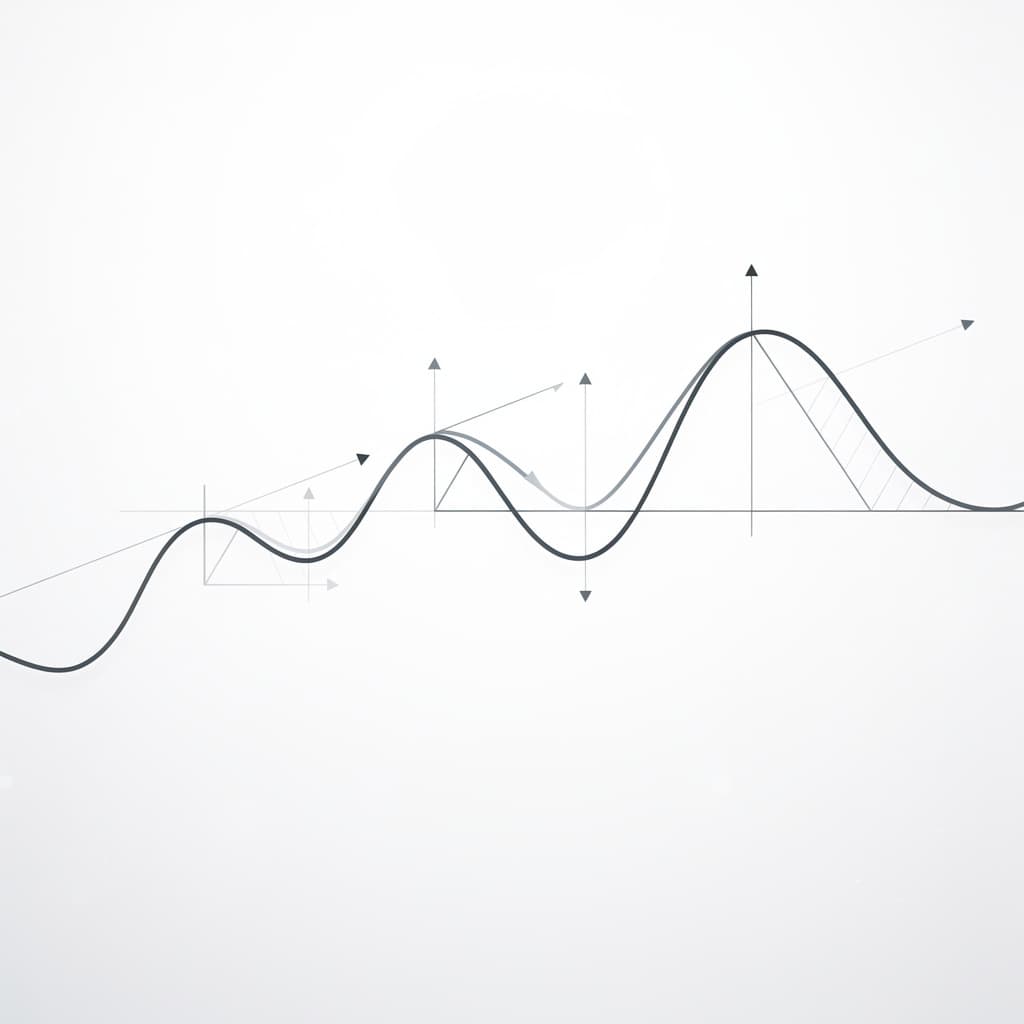
The study of calculus represents a pivotal shift in mathematical thought, transitioning from the static analysis of algebra and geometry to a dynamic investigation of change and motion. At the heart of this transition lies the derivative, a mathematical construct that quantifies how a function changes as its input varies. While the concept of a derivative is rooted in the rigorous logic of limits, the practical application of calculus relies heavily on a set of standardized derivative rules. These rules allow mathematicians, engineers, and scientists to bypass the exhaustive limit definition and compute rates of change with efficiency and precision. By mastering these fundamental formulas, one gains the ability to describe the trajectory of a planet, the volatility of a financial market, or the rate of a chemical reaction through a purely analytical lens.
Foundations of the Instantaneous Rate
To understand why derivative rules are necessary, one must first grasp the geometric problem they were designed to solve: the tangent line problem. In classical geometry, a tangent is a line that "just touches" a curve at a single point without crossing it. However, defining the slope of such a line is difficult because the traditional slope formula requires two distinct points to calculate a rise over run. Through the work of Isaac Newton and Gottfried Wilhelm Leibniz in the late 17th century, the derivative was defined as the limit of the slope of secant lines as the distance between two points approaches zero. This conceptual breakthrough allowed for the calculation of an "instantaneous" rate of change, effectively measuring the velocity of an object at a precise moment in time rather than over an interval.
The formal definition of a derivative is expressed through the limit of a difference quotient. If we consider a function $f(x)$, the derivative $f'(x)$ is defined as the limit as $h$ approaches zero of the ratio of the change in the function's output to the change in its input. Mathematically, this is written as: $$f'(x) = \lim_{h \to 0} \frac{f(x+h) - f(x)}{h}$$ While this formula is the theoretical bedrock of calculus, applying it to complex functions like polynomials or trigonometric curves can be algebraically grueling. This necessity for a more streamlined approach led to the development of the various derivative rules that serve as shortcuts, preserving the rigor of the limit definition while offering a much faster computational path.
Notation plays a critical role in how we interpret and apply these concepts across different scientific disciplines. Two primary systems of notation dominate the field: Leibniz's notation and Lagrange's notation. Leibniz used the symbols $\frac{dy}{dx}$ to suggest a small change in $y$ over a small change in $x$, a form that is particularly helpful when performing dimensional analysis or using the chain rule. Lagrange, on the other hand, introduced the prime notation, $f'(x)$, which emphasizes that the derivative is a new function derived from the original. Regardless of the notation used, the underlying concept remains the same: the derivative represents the slope of the function’s graph at any given point, providing a local linear approximation of the curve's behavior.
The Power Rule and Polynomial Logic
The most widely used of all derivative rules is the power rule, which provides a simple algorithm for differentiating functions of the form $f(x) = x^n$. According to this rule, the derivative is found by bringing the exponent down as a coefficient and then subtracting one from the original exponent. In mathematical terms, for any real number $n$, the derivative is: $$\frac{d}{dx}[x^n] = nx^{n-1}$$ This rule is incredibly powerful because it applies to a vast array of functions beyond simple squares and cubes. Whether $n$ is a positive integer, a negative integer, or even a fraction, the logic remains consistent, allowing for the rapid differentiation of polynomials which are the building blocks of many mathematical models.
Handling negative and fractional exponents is a common requirement in advanced calculus, and the power rule manages these cases with ease. For example, the square root of $x$ can be rewritten as $x^{1/2}$, and its derivative follows the same pattern: $\frac{1}{2}x^{-1/2}$, which simplifies to $\frac{1}{2\sqrt{x}}$. Similarly, the function $1/x$, which is $x^{-1}$, has a derivative of $-1x^{-2}$ or $-1/x^2$. This versatility allows students to transform radical and rational expressions into power functions, making the process of differentiation uniform and less prone to the errors that might arise from treating these as entirely different categories of functions.
The utility of the power rule is further amplified by the linearity of the derivative operator. Differentiation is a linear operation, meaning that the derivative of a sum is the sum of the derivatives, and the derivative of a constant times a function is the constant times the derivative. Specifically, $\frac{d}{dx}[cf(x)] = cf'(x)$ and $\frac{d}{dx}[f(x) + g(x)] = f'(x) + g'(x)$. These properties allow us to differentiate complex polynomials term-by-term. If one is faced with a function like $f(x) = 5x^3 - 4x^2 + 7$, they can simply apply the power rule to each component individually to arrive at the result $f'(x) = 15x^2 - 8x$. This systematic approach reduces the risk of conceptual "overload" when dealing with long algebraic expressions.
Product and Quotient Rule Mechanics
While the derivative of a sum is straightforward, the derivative of a product is not simply the product of the derivatives. This is a common point of confusion for beginners, but a closer look at the geometry of change explains why a more complex formula is required. When two functions $u(x)$ and $v(x)$ are multiplied, they can be thought of as the sides of a rectangle. When $x$ changes, both sides of the rectangle grow, and the total change in area depends on both the current size of the sides and how fast each side is expanding. This leads us to the product rule: $$\frac{d}{dx}[u(v)] = u'v + uv'$$ This formula ensures that we account for the contribution of both functions to the overall rate of change, effectively "weighting" each derivative by the value of the other function.
The quotient rule is applied when differentiating the ratio of two functions, and it is arguably the most algebraically "busy" of the fundamental derivative rules. For a function defined as $f(x) = \frac{u(x)}{v(x)}$, the derivative is calculated as: $$f'(x) = \frac{u'v - uv'}{v^2}$$ A popular mnemonic for this rule is "Low-de-High minus High-de-Low, all over Low-squared," where "Low" refers to the denominator and "High" refers to the numerator. This rule is essential for analyzing rational functions and understanding behaviors like vertical asymptotes or the marginal rates of change in economic models where one variable is divided by another, such as average cost functions.
Common pitfalls in multi-term differentiation often stem from neglecting the order of operations or signs within the quotient rule. Unlike the product rule, where the order of the terms in the numerator does not matter due to addition, the quotient rule involves subtraction, making the "order of operations" vital. Reversing the terms in the numerator will result in a derivative that has the correct magnitude but the wrong sign. Furthermore, beginners often forget to square the denominator, which is a necessary step to maintain the correct dimensionality of the rate of change. By practicing these rules on varied expressions, one builds the "muscle memory" needed to handle the complex rational functions encountered in engineering and physics.
The Chain Rule and Composite Functions
The chain rule is perhaps the most critical tool in the calculus toolkit, as it allows for the differentiation of composite functions, or functions "inside" other functions. In the real world, many processes are linked: the volume of a sphere depends on its radius, and the radius might depend on time. If we know how the volume changes with the radius, and how the radius changes with time, the chain rule allows us to find how the volume changes with time. Formally, if $y = f(g(x))$, then the derivative is the derivative of the outer function evaluated at the inner function, multiplied by the derivative of the inner function: $$\frac{dy}{dx} = f'(g(x)) \cdot g'(x)$$ This "linkage" is why it is called the chain rule; it connects rates of change across multiple layers of a system.
Applying the chain rule effectively requires the ability to decompose a function into its constituent "inner" and "outer" parts. Consider the function $h(x) = (3x^2 + 1)^5$. Here, the outer function is the "power of 5" operation, and the inner function is the polynomial $3x^2 + 1$. To differentiate, one first applies the power rule to the outer shell, resulting in $5(3x^2 + 1)^4$, and then multiplies by the derivative of the inner polynomial, which is $6x$. The final result is $30x(3x^2 + 1)^4$. This outside-in approach ensures that every layer of the composite function is accounted for, preventing the common error of only differentiating the innermost part of the expression.
Visualizing the chain rule can be aided by the analogy of a series of gears. If gear A turns twice as fast as gear B, and gear B turns three times as fast as gear C, then gear A turns $2 \times 3 = 6$ times as fast as gear C. In calculus, these ratios are the derivatives. The chain rule simply states that the total rate of change is the product of the intermediate rates of change. This concept is fundamental in physics, especially in kinematics and electromagnetism, where variables are often defined as functions of other variables which are themselves functions of time. Without the chain rule, it would be impossible to solve "related rates" problems, which are a staple of applied mathematics.
Calculus Derivative Formulas for Transcendental Functions
Beyond polynomials, derivative rules must also cover transcendental functions, which include exponential, logarithmic, and trigonometric curves. The exponential function $e^x$ is unique in all of mathematics because it is its own derivative. That is, $\frac{d}{dx}[e^x] = e^x$. This property makes $e^x$ the natural language of growth and decay; the rate at which a population grows or a radioactive substance decays is directly proportional to the amount present. Its inverse, the natural logarithm $\ln(x)$, has a derivative of $1/x$. Together, these two functions form the basis for modeling everything from compound interest to the spread of viral infections.
Trigonometric derivatives describe the periodic motion inherent in waves, pendulums, and alternating current. The derivatives of sine and cosine are cyclic:
- The derivative of $\sin(x)$ is $\cos(x)$.
- The derivative of $\cos(x)$ is $-\sin(x)$.
- The derivative of $\tan(x)$ is $\sec^2(x)$.
Inverse trigonometric functions, such as $\arcsin(x)$ and $\arctan(x)$, possess derivatives that are algebraic rather than trigonometric. For example, $\frac{d}{dx}[\arcsin(x)] = \frac{1}{\sqrt{1-x^2}}$. These formulas are derived by applying the chain rule to the definition of the inverse function. While they may appear complex, they are vital in integral calculus, particularly when performing substitutions to solve area problems involving circular or elliptical boundaries. Knowing these calculus derivative formulas by heart allows a mathematician to recognize patterns in complex data that others might overlook.
Higher-Order Derivatives and Curve Analysis
The process of differentiation does not have to stop at the first derivative. A higher-order derivative is simply the derivative of a derivative. If the first derivative $f'(x)$ represents the velocity of a particle, the second derivative $f''(x)$ represents its acceleration—the rate at which its velocity is changing. In Leibniz notation, the second derivative is written as $\frac{d^2y}{dx^2}$. Successive differentiation can continue to the third derivative (jerk), fourth derivative (snap), and beyond, providing a deeper profile of the motion or behavior being studied.
In the context of curve sketching and function analysis, the second derivative is the primary tool for determining "concavity." If $f''(x) > 0$ on an interval, the graph is "concave up," meaning it is shaped like a cup and its slope is increasing. If $f''(x) < 0$, the graph is "concave down," shaped like a cap, with a decreasing slope. Points where the concavity changes from up to down (or vice versa) are called inflection points. These points are significant in various fields; in economics, an inflection point on a cost curve might represent the "point of diminishing returns," where the rate of increase begins to slow down despite continued growth.
The physical significance of the second derivative is most evident in Newtonian mechanics. According to Newton's Second Law, $F = ma$, the force acting on an object is proportional to its acceleration. Since acceleration is the second derivative of position with respect to time, calculus provides the direct mathematical link between the position of an object and the forces acting upon it. This relationship allows engineers to calculate the stresses on a bridge as a heavy truck passes over it or to determine the fuel required for a rocket to reach escape velocity. Higher-order derivatives essentially allow us to look "under the hood" of a primary rate of change to see the forces driving it.
Implicit Differentiation and Multi-Variable Chains
In many mathematical contexts, variables are not given in an explicit form like $y = f(x)$. Instead, they are related through an equation such as $x^2 + y^2 = 25$, which describes a circle. To find the slope of the tangent line at a point on this circle, we use a technique called implicit differentiation. This method involves differentiating both sides of the equation with respect to $x$, treating $y$ as a function of $x$ and applying the chain rule whenever a $y$ term is encountered. For example, the derivative of $y^2$ with respect to $x$ is $2y \cdot \frac{dy}{dx}$.
Once the differentiation is complete, the resulting equation contains terms with $\frac{dy}{dx}$, which can then be isolated algebraically. In the case of the circle $x^2 + y^2 = 25$, differentiating gives $2x + 2y\frac{dy}{dx} = 0$. Solving for $\frac{dy}{dx}$ yields $\frac{dy}{dx} = -x/y$. This result is powerful because it allows us to find the slope at any point $(x, y)$ on the circle, even though $y$ was never isolated as a function of $x$. This is particularly useful for complex curves like ellipses, hyperbolas, and lemniscates that do not pass the "vertical line test" and thus cannot be represented by a single function.
Implicit differentiation also serves as a bridge to multi-variable calculus and more complex "chains" of dependence. In thermodynamics or fluid dynamics, a variable might depend on temperature, pressure, and volume simultaneously. Understanding how to differentiate these relationships implicitly is essential for deriving state equations and understanding conservation laws. By viewing every variable as potentially dependent on another, the student of calculus moves from simple one-dimensional problems to the sophisticated, multi-dimensional modeling required in modern aerospace, chemistry, and theoretical physics.
References
- Stewart, J., "Calculus: Early Transcendentals", Cengage Learning, 2015.
- Spivak, M., "Calculus", Publish or Perish, 2008.
- Kline, M., "Calculus: An Intuitive and Physical Approach", Dover Publications, 1998.
- Leithold, L., "The Calculus 7", HarperCollins College Publishers, 1996.
Recommended Readings
- The Calculus Lifesaver by Adrian Banner — An exceptionally clear guide that breaks down complex derivative rules into manageable steps with a focus on problem-solving intuition.
- A Tour of the Calculus by David Berlinski — A narrative exploration of the history and philosophy behind calculus, perfect for those who want to understand the "why" behind the formulas.
- Infinite Powers by Steven Strogatz — A compelling look at how calculus, and specifically the study of change, shaped the modern world, from celestial mechanics to medical imaging.
- Visual Complex Analysis by Tristan Needham — For those looking to see how derivative rules translate into the world of complex numbers and geometry.