The Architecture of Conditioned Behavior
The architecture of conditioned behavior represents one of the most significant pillars of behavioral psychology, explaining how organisms adapt to their environments through experience. This...
The architecture of conditioned behavior represents one of the most significant pillars of behavioral psychology, explaining how organisms adapt to their environments through experience. This process, known broadly as associative learning, allows animals and humans to predict future events and modify their actions based on previous outcomes. By examining the mechanics of classical vs operant conditioning, we can uncover the underlying logic that governs everything from simple physiological reflexes to complex, goal-oriented social behaviors. Understanding these systems requires a deep dive into how stimuli are processed, how consequences shape willpower, and how the brain builds a map of cause and effect in a chaotic world.
The Foundations of Associative Learning
At its core, associative learning is the process by which an organism learns that two events occur together. This is not a single mechanism but rather a category of behavioral psychology principles that describe how we form mental links between environmental cues and our reactions to them. Whether it is a child learning that a hot stove causes pain or a dog anticipating a walk when its owner picks up a leash, these associations are the building blocks of survival. In the early 20th century, researchers began to formalize these observations into a rigorous science, moving away from introspective "mentalism" toward observable, measurable actions.
The stimulus-response (S-R) framework provides the structural skeleton for all conditioning theories. A stimulus is any detectable change in the environment, such as a light, a sound, or a physical sensation, while a response is the organism's behavioral reaction to that change. Behavioral psychologists argue that the vast majority of human behavior is a product of these S-R chains, reinforced over time through repeated exposure and consequence. By isolating these variables, scientists were able to demonstrate that behavior is not purely random or driven by "soul," but is instead a predictable outcome of historical interactions between the organism and its surroundings.
Identifying the specific associative learning types requires distinguishing between the nature of the response being conditioned. In some cases, the response is a biological reflex that the organism does not consciously control, such as a blink or a heart rate increase. In other cases, the response is a voluntary action taken to achieve a specific goal or avoid a specific punishment. This fundamental split leads us to the two primary domains of behavioral science: the respondent conditioning studied by Ivan Pavlov and the operant conditioning pioneered by B.F. Skinner.
Classical Conditioning and Passive Response
The Pavlov vs Skinner debate often begins with Ivan Pavlov’s accidental discovery of classical conditioning while studying the digestive systems of dogs in the 1890s. Pavlov noticed that his canine subjects began to salivate not just when they tasted meat powder, but when they heard the footsteps of the laboratory assistants bringing the food. This led to the formalization of the Unconditioned Stimulus (US), which naturally triggers a response, and the Conditioned Stimulus (CS), which is a neutral cue that eventually triggers the same response through association. In this model, the learning is passive; the subject does not "do" anything to earn the reward, but rather learns to predict it based on the environment.
A fascinating component of this passive learning is signal tracking, or autoshaping, where an organism begins to treat the signal for a reward as if it were the reward itself. For example, if a light consistently precedes the delivery of food to a pigeon, the bird may begin to peck at the light bulb, even though pecking the light has no effect on the food's arrival. This highlights the involuntary nature of classical conditioning; the brain’s hardwired survival mechanisms are hijacked by the predictive signal. This explains why certain environmental triggers, like the smell of a specific perfume or the sound of a notification chime, can elicit powerful emotional or physiological reactions before we even have a chance to think.
Classical conditioning is primarily concerned with elicited behaviors, which are responses "drawn out" of the organism by a preceding stimulus. Because these responses are often autonomic—involving the nervous system's control of internal organs and glands—they are incredibly resistant to conscious suppression. Phobias are a classic example of this; a person may know intellectually that a harmless spider cannot hurt them, but their body’s conditioned fear response (increased heart rate, sweating) is triggered automatically by the visual stimulus of the spider. This passive, predictive mapping is the first half of the equation in the study of classical vs operant conditioning.
Operant Conditioning and Volitional Action
While classical conditioning deals with involuntary reflexes, operant conditioning focuses on emitted behaviors—actions that the organism "puts out" into the world voluntarily. This field was heavily influenced by Edward Thorndike’s Law of Effect, which states that behaviors followed by favorable consequences become more likely to recur, while those followed by unfavorable consequences become less likely. Thorndike’s work with cats in "puzzle boxes" showed that animals do not solve problems through sudden insight, but through a gradual process of trial and error where successful actions are "stamped in" by the satisfaction of escape.
B.F. Skinner expanded on this by developing the Skinner Box, a controlled environment where he could precisely measure how different consequences influenced the frequency of a behavior, such as a rat pressing a lever. Skinner argued that behavior is essentially a function of its consequences, a concept known as radical behaviorism. In this framework, the internal state of the organism is less important than the external reinforcement or punishment it receives. Unlike the passive subject in Pavlov’s experiments, the "operant" in Skinner’s model is an active agent that learns to manipulate its environment to achieve desired outcomes.
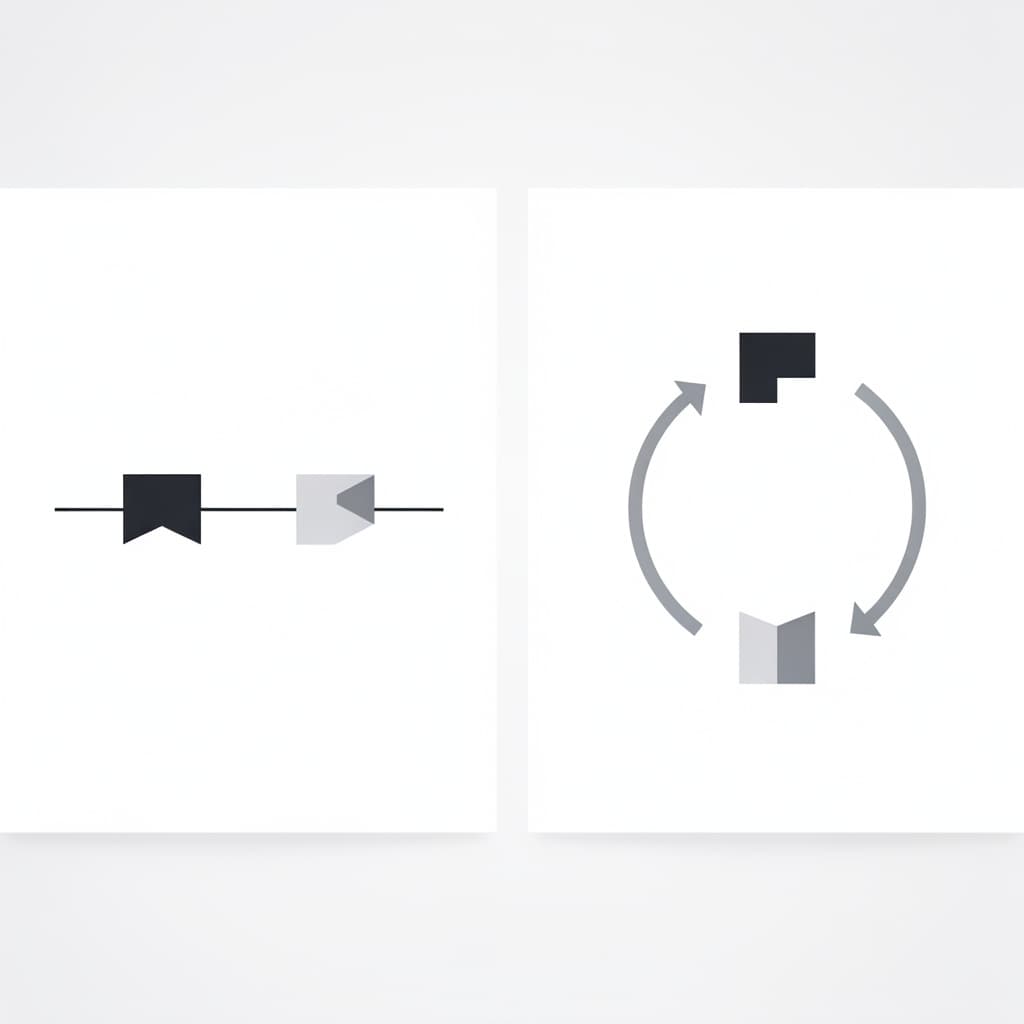
The modern application of these behavioral psychology principles can be seen in everything from workplace productivity to game design. When a person works overtime to receive a bonus, they are engaging in operant behavior; the bonus serves as the consequence that reinforces the high-effort behavior. The fundamental difference in classical vs operant conditioning is the direction of the association. In classical, the stimulus precedes the response ($S \rightarrow R$); in operant, the response precedes the consequence ($R \rightarrow C$), which then dictates the future probability of that response.
Mechanics of Reinforcement and Punishment
To master operant conditioning, one must understand the four distinct quadrants of consequences, which are defined by whether a stimulus is added or removed and whether the goal is to increase or decrease a behavior. Positive reinforcement involves adding a desirable stimulus after a behavior to increase its frequency, such as giving a dog a treat for sitting. Conversely, negative reinforcement involves removing an aversive or unpleasant stimulus to increase a behavior. A common example of negative reinforcement is the annoying "beep" in a car that only stops once you fasten your seatbelt; the behavior (buckling up) is reinforced by the removal of the noise.
Punishment operates on the opposite side of the spectrum, aiming to decrease the likelihood of a behavior. Positive punishment occurs when an unpleasant stimulus is added following an action, such as a student receiving a detention for talking in class. Negative punishment involves taking away something desirable, such as a teenager losing their phone privileges after breaking curfew. It is crucial to note that in behavioral science, "positive" and "negative" do not mean "good" and "bad," but rather "addition" (+) and "subtraction" (-) of a stimulus.
| Procedure | Action taken | Effect on Behavior | Example |
|---|---|---|---|
| Positive Reinforcement | Add Stimulus | Increase Behavior | Providing a bonus for high sales. |
| Negative Reinforcement | Remove Stimulus | Increase Behavior | Turning off an alarm by waking up. |
| Positive Punishment | Add Stimulus | Decrease Behavior | Scolding a child for running into the street. |
| Negative Punishment | Remove Stimulus | Decrease Behavior | Revoking a driver's license for speeding. |
The nuance of aversive conditioning—using unpleasant stimuli to change behavior—requires careful implementation. Behavioral research suggests that while punishment can stop a behavior immediately, it often fails to teach a desirable replacement behavior and can lead to side effects like aggression or fear of the person delivering the punishment. Reinforcement, particularly positive reinforcement, is generally considered more effective for long-term behavioral change because it builds a positive association with the desired task. In the context of positive and negative reinforcement examples, the most successful systems often use a combination of removing stressors and providing rewards to shape complex skill sets.
Patterns and Reinforcement Schedules
Learning does not just depend on what the consequence is, but also on when and how often it is delivered. These patterns are known as reinforcement schedules, and they significantly influence how quickly a behavior is learned and how long it persists after rewards stop. A continuous reinforcement schedule, where every single correct response is rewarded, is best for the initial acquisition phase of learning. However, behaviors learned through continuous reinforcement are very fragile and will stop almost immediately if the rewards cease, a phenomenon known as rapid extinction.
To create durable, persistent habits, psychologists use intermittent reinforcement, where only some responses are rewarded. These are divided into ratio schedules (based on the number of responses) and interval schedules (based on the passage of time). A Fixed Ratio (FR) schedule rewards a behavior after a specific number of occurrences, like a factory worker paid for every ten items produced, leading to high response rates but a short pause after each reward. In contrast, a Variable Ratio (VR) schedule rewards behavior after an unpredictable number of responses, similar to a slot machine. Because the next press could always be the "big one," VR schedules produce the highest and most steady rates of response with almost no pauses.
Interval-based schedules focus on time constraints. A Fixed Interval (FI) schedule reinforces the first response after a set amount of time has passed, such as a weekly paycheck or checking the mail. This often results in a "scallop" pattern, where the organism does very little work until the end of the interval, then ramps up activity as the deadline approaches. Finally, a Variable Interval (VI) schedule reinforces responses at unpredictable time increments, like checking for an important email that could arrive at any moment. VI schedules produce a slow, steady rate of response because the organism never knows when the "window" for reinforcement will open, making it very effective for maintaining consistent monitoring behavior.
Synthesis of Classical vs Operant Conditioning
While we often study classical vs operant conditioning as separate entities, they frequently overlap in real-world scenarios. This is best described through two-process theory, which suggests that many behaviors are initially triggered by classical associations and then maintained by operant consequences. For instance, a person who was once bitten by a dog may develop a classically conditioned fear of all dogs (CS = Dog, US = Bite, UR/CR = Fear). Later, they begin to avoid dogs entirely; this avoidance is an operant behavior that is negatively reinforced because it removes the unpleasant feeling of anxiety.
The lifecycle of a conditioned response involves several key phases: acquisition, extinction, and spontaneous recovery. Acquisition is the initial stage where the link between stimulus and response (or response and consequence) is established. Extinction occurs when the reinforcement or the unconditioned stimulus is removed, causing the behavior to gradually diminish. For example, if a rat stops receiving food for pressing a lever, it will eventually stop pressing it. However, extinction is not "unlearning" but rather "new learning" that the previous association is no longer valid.
We know this because of spontaneous recovery, where an extinct response suddenly reappears after a period of rest. If the rat is removed from the box for a day and then returned, it might press the lever a few more times despite the previous lack of reward. This suggests that the original memory trace remains in the brain, dormant but intact. This has profound implications for treating addiction or trauma; it reminds us that even after a habit appears to be broken, the underlying neural architecture may still be sensitive to old triggers, requiring long-term management of environmental cues.
Biological Constraints on Learning
Despite the power of conditioning, organisms are not "blank slates" that can be programmed to do anything. The theory of biological preparedness, proposed by Martin Seligman, suggests that evolution has predisposed certain species to learn specific associations more easily than others. For example, humans and other animals are genetically "prepared" to associate the taste of food with nausea (the Garcia Effect), even if the sickness occurs hours after eating. However, it is much harder to condition an animal to associate a sound or a light with nausea, as that does not align with evolutionary logic where taste is the primary indicator of poison.
Furthermore, behavior is shaped by the twin processes of generalization and discrimination. Generalization occurs when an organism responds to stimuli that are similar to the original conditioned stimulus, such as a child who was scared by a large dog becoming afraid of all furry animals. Discrimination is the opposite process, where the organism learns to respond only to a specific stimulus and not to others. A dog can learn to discriminate between the sound of its owner's specific car engine and the sound of other cars on the street, reacting only to the one that signals a potential arrival.
These constraints ensure that learning remains adaptive rather than accidental. Nature provides the boundaries—the biological "hardware"—while conditioning provides the "software" that allows for flexibility within those boundaries. By understanding the behavioral psychology principles behind classical vs operant conditioning, we gain more than just a toolkit for training animals or students; we gain a map of the functional logic of life itself, seeing how every action is a calculated response to a world of signals and consequences.
References
- Pavlov, I. P., "Conditioned Reflexes: An Investigation of the Physiological Activity of the Cerebral Cortex", Oxford University Press, 1927.
- Skinner, B. F., "The Behavior of Organisms: An Experimental Analysis", Appleton-Century, 1938.
- Thorndike, E. L., "Animal Intelligence: Experimental Studies", The Macmillan Company, 1911.
- Rescorla, R. A., "Pavlovian conditioning: It's not what you think it is", American Psychologist, 1988.
- Seligman, M. E. P., "On the generality of the laws of learning", Psychological Review, 1970.
Recommended Readings
- Science and Human Behavior by B.F. Skinner — A comprehensive exploration of how operant principles apply to complex human social structures, from government to religion.
- The Story of Psychology by Morton Hunt — Provides an engaging historical narrative of how the transition from classical to operant conditioning revolutionized the scientific study of the mind.
- Don't Shoot the Dog! by Karen Pryor — A practical, highly accessible guide to using reinforcement schedules and behavioral shaping in everyday life and animal training.
- Learning and Behavior by Paul Chance — A standard academic text that offers a deep technical dive into the experimental data behind associative learning types.