Pythagorean Theorem: Proof, Formula, and Real-World Applications
The Pythagorean theorem stands as one of the most fundamental principles in geometry, stating that in a right-angled triangle, the square of the hypotenuse equals the sum of the squares of the other...
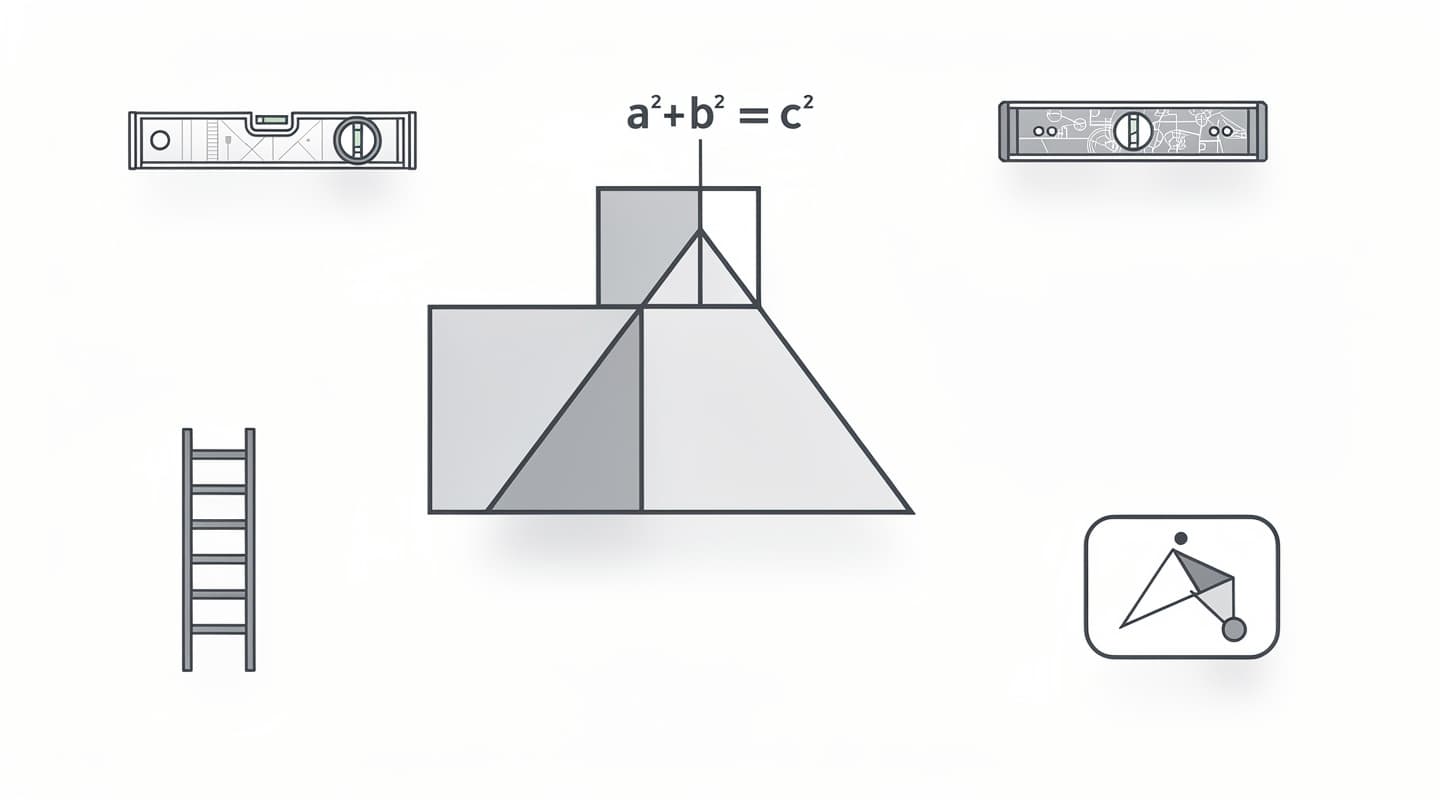
The Pythagorean theorem stands as one of the most fundamental principles in geometry, stating that in a right-angled triangle, the square of the hypotenuse equals the sum of the squares of the other two sides. Discovered millennia ago and attributed to the ancient Greek mathematician Pythagoras, this theorem underpins countless applications in mathematics, engineering, and everyday problem-solving. This article explores the Pythagorean theorem in depth, including its formula, proofs, practical usage, examples, word problems, converse, real-world applications, and frequently asked questions, providing a comprehensive resource for students and enthusiasts alike.
What Is the Pythagorean Theorem?
Definition and Basic Principles
The Pythagorean theorem applies exclusively to right-angled triangles, where one angle measures exactly 90 degrees. It relates the lengths of the sides: the two legs (the sides forming the right angle) and the hypotenuse (the longest side opposite the right angle). Mathematically, it asserts that the area of a square built on the hypotenuse equals the combined areas of squares on the legs, a geometric truth visualized through countless diagrams. This principle not only confirms right angles but also enables distance calculations in planar geometry. For instance, ancient builders used it to ensure perpendicularity without modern tools.
In a right triangle with legs of lengthsaandb, and hypotenusec,a² + b² = c².
Understanding this requires grasping Euclidean geometry's axioms, where parallel lines and similar triangles play key roles. The theorem's universality holds across all scales, from microscopic circuits to astronomical distances, making it indispensable in STEM fields.
Historical Background of Pythagoras
Pythagoras of Samos (c. 570–495 BCE) led a philosophical school in Croton, Italy, blending mathematics, music, and mysticism. While the theorem bears his name in Western tradition, evidence from Babylonian clay tablets like Plimpton 322 (c. 1800 BCE) suggests earlier knowledge of Pythagorean triples—integer solutions such as (3,4,5). Indian texts like the Sulba Sutras (c. 800–500 BCE) also describe it for altar constructions. Euclid formalized it in his Elements (c. 300 BCE), Book I, Proposition 47. Pythagoras's cult reportedly treated the theorem as sacred, linking it to cosmic harmony through musical intervals.
Despite legends of Pythagoras discovering it via fava beans or oxen yokes, historical consensus credits Mesopotamian and Indian civilizations for precursors. The theorem's naming reflects European Renaissance revival of Greek texts. Today, over 300 proofs exist, from Bhaskara's 12th-century diagram to modern vector methods, underscoring its enduring legacy.
Pythagorean Theorem Formula Explained
Breaking Down a² + b² = c²
The formula a² + b² = c² quantifies the relationship where a and b are legs, and c is the hypotenuse. Squaring denotes area: imagine squares erected on each side; those on a and b tile perfectly into the one on c. This dissection proof, popularized by Bhaskara II (1114–1185 CE), uses four copies of the triangle to rearrange into squares. Algebraically, it solves for unknowns: c = √(a² + b²). Units cancel in squares, preserving dimensional consistency.
Consider a 5-12-13 triangle: 5² + 12² = 25 + 144 = 169 = 13². This primitive triple generates others via multiples, like (6,8,10). The formula extends to vectors as the dot product magnitude.
Notation and Variables
Standard notation assigns a and b to legs, c to hypotenuse, though any side can be solved with rearrangement. In proofs, variables like AB = c, BC = a, AC = b clarify diagrams. Greek letters occasionally appear in advanced texts, but Latin prevail. Variables must be positive real numbers; zero or negative lengths invalidate the context. Software like GeoGebra visualizes dynamic changes, reinforcing intuition.
Pythagorean Theorem Proof
Euclid's Proof Using Similar Triangles
Euclid's proof in Elements (Proposition 47) constructs an altitude from the right angle to the hypotenuse, creating three similar triangles. The large triangle shares angles with two smaller ones and the altitude segments. Similarity ratios yield p/q = q/c and r/p = c/b, where p + q = c, pr = ab. Combining gives a² + b² = c². This geometric elegance avoids coordinates, relying on propositions 32 and 41 for parallels and proportionality.
Visualize triangle ABC, right-angled at C, altitude CD to AB. Triangles ACD ~ ABC ~ BCD, equating ratios: AC/AB = AD/AC implies b/c = p/b, so b² = cp. Similarly, a² = cq. Since p + q = c, sum to c². This proof influenced geometry for centuries.
Algebraic Proof Method
An algebraic proof assumes coordinates: place the right angle at (0,0), legs along axes to (a,0) and (0,b). Hypotenuse distance is √(a² + b²), squared to c². Using area: triangle area (1/2)ab equals differences in squares, but rearrangement is direct. Garfield's proof (1876) uses trapezoids from two triangles equaling rectangle areas.
For vector proof: legs as orthogonal vectors u, v; u · v = 0, so ||u + v||² = ||u||² + ||v||². This generalizes to inner product spaces. Each method illuminates facets: geometric for intuition, algebraic for computation.
How to Use the Pythagorean Theorem
Step-by-Step Guide for Finding Sides
- Identify the right triangle and label legs
a,b, hypotenusec. - Determine known values; square them.
- If finding
c, add squares and take square root:c = √(a² + b²). - If finding a leg, subtract:
a = √(c² - b²). - Verify with calculator or triple tables; round as needed.
- Check: plug back into formula.
This process applies universally. Use approximations for irrationals like √2 ≈ 1.414.
Solving for Hypotenuse vs. Legs
Hypotenuse solves directly via addition under radical, always largest. Legs require subtraction, risking imaginary if c < b—a non-triangle flag. Example: legs 3,4 yield c=5; hypotenuse 13, leg 5 yields 12. Precision matters: use √(25 - 16) = 3 exactly. Software aids complex cases.
Pythagorean Theorem Examples
Simple Right Triangle Calculations
| Leg a | Leg b | Hypotenuse c | Verification |
|---|---|---|---|
| 3 | 4 | 5 | 9+16=25 |
| 5 | 12 | 13 | 25+144=169 |
| 8 | 15 | 17 | 64+225=289 |
| 7 | 24 | 25 | 49+576=625 |
These primitives scale: (9,12,15) = 3×(3,4,5). Compute leg: in 5-12-13, missing leg opposite 5? No, solve √(169-25)=12.
Advanced Multi-Step Examples
Triangle with sides 10, hypotenuse 26: leg = √(676-100)=√576=24. Chained: path 30 right, 40 up; distance √(900+1600)=50. Isosceles right triangle legs x: x√2 = hypotenuse, x= hyp/√2. 30-60-90 uses half: legs x, x√3, 2x.
Vector sum: (3,4) + (5,0) = hypotenuse √((8)² + 4²)=√(64+16)=√80=4√5. These build problem-solving prowess.
Pythagorean Theorem Word Problems
Ladder Against Wall Problems
A 13-foot ladder leans against a wall, base 5 feet away: height = √(169-25)=12 feet. If ladder 10m, wall 8m away, height? √(100-64)=√36=6m. Vary angle: base = c cos θ, but theorem core. Wind shifts base 1ft closer: new height recalculates.
Real: firefighter reaches window. Safety: max angle ~75°, min base via theorem.
Field Diagonal Scenarios
Rectangular field 40m by 30m: diagonal √(1600+900)=√2500=50m for irrigation. Soccer field 105x68m: diagonal ~124.6m. Farmer fences diagonal shortcut. 3D extension later.
Surveyor measures offsets: east 100yd, north 75yd, straight √(10000+5625)=125yd. Efficient paths via theorem.
Converse of the Pythagorean Theorem
Statement and Proof
The converse states: if in triangle with sides a,b,c (c longest), a² + b² = c², then right-angled opposite c. Proof by contradiction: assume obtuse, but angle sum and cosine law show a² + b² < c²; acute >. Equality pins 90°. Euclid Prop. 48 formalizes.
Example: 6,8,10: 36+64=100, right. 2,3,4: 4+9=13<16, obtuse.
When to Use the Converse
Verify right angles without protractor: measure sides, check equation. Carpentry: ensure square frames. GPS triangles. Avoid assuming: test first.
Applications of the Pythagorean Theorem
In Navigation and GPS
GPS trilaterates via sphere intersections, but planar maps use theorem for distances. Sailors compute hypotenuse courses: 3km east, 4km north = 5km. Aviation: ground speed vectors. Modern: Google Maps straight-line "as crow flies."
Accuracy: error propagation √2 amplifies in 45°.
Architecture and Engineering Uses
Buildings: diagonal braces √(h² + w²). Pyramids: face slopes via triples. Bridges: cable lengths. Earthquake engineering: sway analysis.
Leaning Tower of Pisa: stability via virtual right triangles. 3D trusses generalize.
Physics and Everyday Scenarios
Projectile motion: range √(v² sin2θ / g), but paths Pythagorean. Light reflection equal angles, paths minimize via theorem. Sports: baseball throw distances. Gaming: pixel distances √(Δx² + Δy²).
Medicine: CT scans reconstruct via distances. Fitness: treadmill vs. path run.
Pythagorean Theorem FAQ
What if it's not a right triangle?
Use Law of Cosines: c² = a² + b² - 2ab cos C. For acute/obtuse, adjusts. Theorem subset when cos90°=0.
How does it apply in 3D?
Pythagorean theorem generalizes to a² + b² + c² = d² for perpendiculars. Distance formula √(x² + y² + z²). Example: cube diagonal √3 side.
Common Mistakes to Avoid
- Forgetting squares: add lengths, not.
- Wrong hypotenuse: always longest.
- Non-right: use converse or cosines.
- Calculator: order operations, √ last.
- Units: consistent.
Key Takeaways
The Pythagorean theorem formula a² + b² = c² powers geometry from ancient altars to modern tech. Master proofs like Euclid's for depth, practice examples and problems for skill. Converse identifies rights; applications span fields. Extend to 3D or vectors for advanced use. Avoid pitfalls through verification—timeless tool endures.