Mastering the Unit Circle: A Complete Guide to Radians and Trigonometry
The unit circle serves as the fundamental bridge between elementary geometry and advanced trigonometric analysis. By constraining a circle to a radius of exactly one unit and centering it upon the...
The Fundamentals of the Unit Circle Definition
Geometric Properties of the Circle
At its core, the unit circle is defined by the set of all points $(x, y)$ that maintain a constant distance of exactly one unit from a fixed central point. In the context of the Cartesian coordinate system, this central point is the origin $(0, 0)$, and the resulting shape is described by the elegant algebraic equation $$x^2 + y^2 = 1$$. This equation is a direct application of the distance formula, asserting that for any point on the boundary, the square of its horizontal displacement plus the square of its vertical displacement must equal the square of the radius. Because the radius is $1$, its square remains $1$, creating a perfectly symmetrical boundary that intersects the axes at four primary points: $(1, 0)$, $(0, 1)$, $(-1, 0)$, and $(0, -1)$.
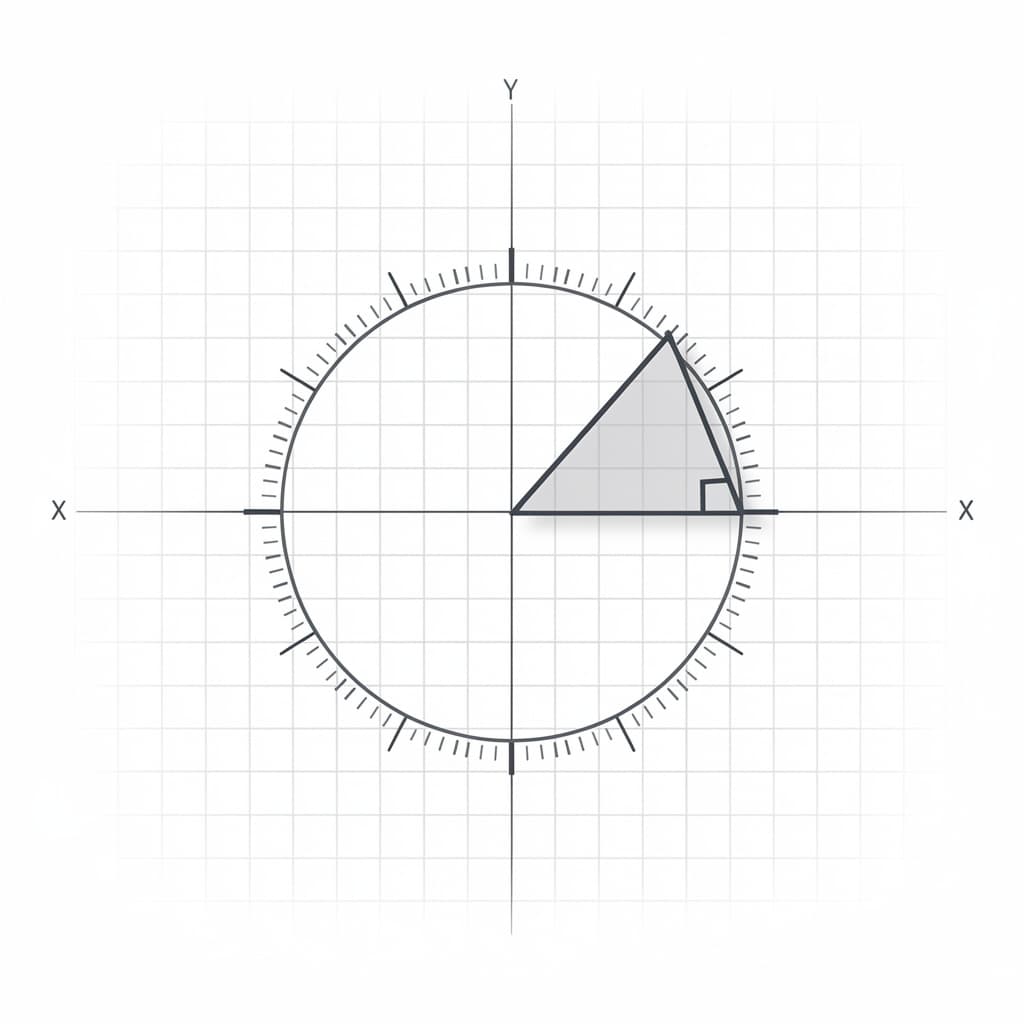
The geometric simplicity of the unit circle provides a controlled environment where the hypotenuse of any inscribed right triangle is always equal to $1$. When a ray is drawn from the origin to any point $P(x, y)$ on the circle’s circumference, it forms an angle $\theta$ with the positive x-axis. This ray effectively becomes the hypotenuse of a right triangle where the adjacent side is the x-coordinate and the opposite side is the y-coordinate. Because the hypotenuse is fixed at $1$, the traditional trigonometric ratios simplify significantly, as dividing by the hypotenuse no longer changes the numerical value of the opposite or adjacent sides. This property transforms the unit circle from a mere shape into a dynamic calculator for trigonometric outputs.
The Cartesian Plane Intersection
The integration of the unit circle into the Cartesian plane allows for the systematic categorization of angles into four distinct quadrants. Quadrant I spans from $0^\circ$ to $90^\circ$, where both x and y coordinates are positive, representing the familiar territory of acute angles in right-triangle trigonometry. As the terminal side rotates counter-clockwise into Quadrant II ($90^\circ$ to $180^\circ$), the x-coordinates become negative while y-coordinates remain positive, introducing the concept of trigonometric values for obtuse angles. Quadrant III ($180^\circ$ to $270^\circ$) sees both coordinates become negative, and Quadrant IV ($270^\circ$ to $360^\circ$) features positive x-coordinates with negative y-coordinates. This spatial organization is essential for determining the algebraic sign of sine, cosine, and tangent functions.
Defining the Radius and Origin
Defining the radius as exactly $R=1$ is a deliberate choice that standardizes the scale of trigonometric functions. In a circle of arbitrary radius $R$, the coordinates of a point are given by $(R \cos \theta, R \sin \theta)$, which requires an extra step of division to isolate the pure trigonometric ratio. By setting $R=1$, the coordinates of the point $P$ on the circumference become identical to the cosine and sine of the angle: $x = \cos \theta$ and $y = \sin \theta$. This direct correspondence is why the unit circle is the preferred medium for teaching trigonometry; it removes the "noise" of scale and focuses entirely on the relationship between the angle and the circular position. The origin $(0, 0)$ acts as the absolute reference point, ensuring that every measurement is relative to a consistent, unchanging center.
Converting Radians to Degrees and Angular Measure
The Relationship Between Pi and Degrees
While degrees are a common unit for measuring angles in daily life, radians provide a more natural and mathematically profound way to describe rotation. A radian is defined as the measure of a central angle that subtends an arc equal in length to the radius of the circle. Since the total circumference of a unit circle is given by $C = 2\pi r$, and $r=1$, the total distance around the circle is $2\pi$. This creates a direct equivalence where $360^\circ$ is equal to $2\pi$ radians, meaning that $180^\circ$ is exactly $\pi$ radians. This relationship is the cornerstone of calculus, as many derivative and integral formulas for trigonometric functions only hold true when angles are expressed in radians.
The shift from the base-60 system of degrees (inherited from ancient Babylonian astronomy) to the base-$\pi$ system of radians allows for a seamless connection between linear and angular velocity. In a unit circle, the radian measure of an angle is numerically equal to the length of the arc it intercepts. For example, an angle of $\pi/2$ radians intercepts an arc length of exactly $\pi/2$ units along the circumference. This property eliminates the need for arbitrary conversion factors when calculating physical properties like torque or centripetal acceleration. By viewing $\pi$ not just as a constant for circles, but as a representation of a half-rotation, students can begin to see the underlying rhythm of circular motion.
Formulaic Conversion for Common Angles
To master the unit circle, one must be able to switch between units rapidly using standard conversion factors. To convert from degrees to radians, one multiplies the degree measure by $\frac{\pi}{180^\circ}$, effectively cancelling the degree units and introducing the $\pi$ factor. Conversely, to convert radians to degrees, one multiplies the radian measure by $\frac{180^\circ}{\pi}$, which removes the $\pi$ and returns the value to the degree scale. For instance, a $45^\circ$ angle is converted by calculating $45 \times \frac{\pi}{180}$, which simplifies to $\pi/4$. Understanding these ratios is vital for navigating the unit circle chart, which typically displays both units for clarity.
Common reference angles appear frequently in mathematical problems and follow a predictable pattern. The most essential conversions to internalize are $30^\circ = \pi/6$, $45^\circ = \pi/4$, $60^\circ = \pi/3$, and $90^\circ = \pi/2$. These angles correspond to the symmetry of the circle and the geometry of special right triangles. Beyond the first quadrant, these values repeat with different coefficients, such as $120^\circ$ being $2\pi/3$ or $225^\circ$ being $5\pi/4$. Recognizing that the denominator of the radian measure usually indicates which reference angle is being used allows students to quickly identify the properties of an angle regardless of its quadrant.
Standard Position and Direction of Rotation
In the study of trigonometry, an angle is said to be in "standard position" when its vertex is at the origin and its "initial side" lies along the positive x-axis. The "terminal side" is the ray that results after the angle has undergone rotation. By convention, a positive angle indicates a counter-clockwise rotation from the initial side, while a negative angle indicates a clockwise rotation. This standardized orientation ensures that a $90^\circ$ angle always points "up" toward the positive y-axis, and a $180^\circ$ angle always points "left" toward the negative x-axis. It provides a consistent framework for locating coordinates and applying the unit circle table values correctly.
Mapping Trigonometric Functions to Circular Coordinates
Calculating Sine and Cosine via Coordinates
The most powerful feature of the unit circle is the direct mapping of the coordinates $(x, y)$ to the fundamental trigonometric functions. For any point on the circle reached by an angle $\theta$, the x-coordinate is defined as $\cos \theta$ and the y-coordinate is defined as $\sin \theta$. This definition is a generalization of the "SOH CAH TOA" rules taught in basic geometry. Since the hypotenuse is $1$, the ratio $\text{adjacent}/\text{hypotenuse}$ becomes $x/1$, and $\text{opposite}/\text{hypotenuse}$ becomes $y/1$. Consequently, to find the sine or cosine of an angle, one simply needs to identify the horizontal or vertical position of the point on the circle’s edge.
This coordinate-based definition allows sine and cosine to be extended to angles that cannot exist within a triangle, such as $0^\circ$, $90^\circ$, or $270^\circ$. At $90^\circ$ ($\pi/2$), the coordinate on the unit circle is $(0, 1)$, which immediately informs us that $\cos(90^\circ) = 0$ and $\sin(90^\circ) = 1$. Similarly, at $180^\circ$ ($\pi$), the point is $(-1, 0)$, meaning $\cos(180^\circ) = -1$ and $\sin(180^\circ) = 0$. By visualizing the rotation of a point around the circle, one can see how the sine and cosine values oscillate between $-1$ and $1$, forming the basis for the periodic wave functions used to model everything from sound to light waves.
Determining Tangent and Secant Values
While sine and cosine are directly tied to the coordinates, other trigonometric functions are derived from the relationship between these two primary values. The tangent of an angle, defined as $\tan \theta = \frac{\sin \theta}{\cos \theta}$, represents the slope of the terminal side ray. On the unit circle, this is the ratio of $y/x$. Because tangent involves division by the x-coordinate, it becomes undefined whenever the ray points vertically (at $90^\circ$ and $270^\circ$), as the x-coordinate at these points is zero. This explains why the graph of a tangent function contains vertical asymptotes at these specific intervals.
The reciprocal functions—secant, cosecant, and cotangent—are also easily visualized through the lens of circular coordinates. Secant is the reciprocal of cosine ($\sec \theta = 1/x$), cosecant is the reciprocal of sine ($\csc \theta = 1/y$), and cotangent is the reciprocal of tangent ($\cot \theta = x/y$). These functions provide additional ways to describe the geometry of the circle and are particularly useful in calculus when performing trigonometric substitutions. Understanding that all six functions are ultimately rooted in the $x$ and $y$ positions on the unit circle prevents them from being seen as isolated formulas and instead integrates them into a single cohesive system.
The Pythagorean Identity in Circular Terms
One of the most important identities in mathematics, the Pythagorean Identity, is a direct consequence of the unit circle's definition. Starting with the equation of the circle $x^2 + y^2 = 1$ and substituting the trigonometric definitions $x = \cos \theta$ and $y = \sin \theta$, we arrive at: $$\sin^2 \theta + \cos^2 \theta = 1$$ This identity holds true for every possible value of $\theta$, reflecting the fact that no matter how far a point rotates, it must always remain exactly one unit away from the origin. This relationship is a cornerstone for simplifying complex trigonometric expressions and solving equations in advanced algebra.
Interpreting the Standard Unit Circle Chart
Identifying Key Angles in All Four Quadrants
A unit circle chart is a visual representation that displays the most commonly used angles alongside their radian measures and coordinate pairs. These key angles are typically multiples of $30^\circ$, $45^\circ$, and $60^\circ$. In the first quadrant, these are $30^\circ$ ($\pi/6$), $45^\circ$ ($\pi/4$), and $60^\circ$ ($\pi/3$). As one moves into the other quadrants, these angles are reflected across the axes. For example, in the second quadrant, the reference angle of $30^\circ$ appears as $150^\circ$ ($5\pi/6$), maintaining the same vertical distance from the x-axis but changing its horizontal direction.
Mastering the chart requires recognizing the symmetry of these "family" angles. Every angle with a denominator of $6$ in its radian form (when simplified) will share the same absolute values for its coordinates: $(\pm \sqrt{3}/2, \pm 1/2)$. Similarly, angles with a denominator of $4$ will always involve $(\pm \sqrt{2}/2, \pm \sqrt{2}/2)$, and those with a denominator of $3$ will involve $(\pm 1/2, \pm \sqrt{3}/2)$. By identifying the "parent" reference angle in the first quadrant, a student can determine the coordinates for any related angle by simply adjusting the positive or negative signs according to the quadrant in which the angle resides.
Symmetry Across the X and Y Axes
The unit circle exhibits profound symmetry that simplifies the task of calculation. Reflection across the y-axis (from Quadrant I to Quadrant II) keeps the y-values (sine) the same while negating the x-values (cosine). This is why $\sin(60^\circ)$ and $\sin(120^\circ)$ both equal $\sqrt{3}/2$, while $\cos(60^\circ) = 1/2$ and $\cos(120^\circ) = -1/2$. Reflection across the x-axis (from Quadrant I to Quadrant IV) keeps the x-values the same while negating the y-values. This symmetry is the basis for the "even" and "odd" properties of trigonometric functions: cosine is an even function, $\cos(-\theta) = \cos(\theta)$, while sine is an odd function, $\sin(-\theta) = -\sin(\theta)$.
Labeling Coordinates for Special Right Triangles
The specific values found on a unit circle chart, such as $\sqrt{3}/2$ and $1/2$, are derived from the geometry of special right triangles. A $30-60-90$ triangle has side lengths in the ratio of $1 : \sqrt{3} : 2$. When this triangle is scaled down so that its hypotenuse is $1$, the side lengths become $1/2$ and $\sqrt{3}/2$. Therefore, for a $30^\circ$ angle, the "short" side (y-coordinate) is $1/2$ and the "long" side (x-coordinate) is $\sqrt{3}/2$. Conversely, for a $60^\circ$ angle, the x-coordinate becomes $1/2$ and the y-coordinate becomes $\sqrt{3}/2$.
For the $45-45-90$ triangle, the legs are equal, and the hypotenuse is $\sqrt{2}$ times the length of a leg. Scaling this to a unit hypotenuse of $1$ results in leg lengths of $1/\sqrt{2}$. To avoid having a radical in the denominator, this is typically rationalized to $\sqrt{2}/2$. This is why the coordinates for $45^\circ$, $135^\circ$, $225^\circ$, and $315^\circ$ always involve the $\sqrt{2}/2$ value. Recognizing these geometric origins helps students understand that the numbers on the unit circle aren't arbitrary decimals, but exact values stemming from the inherent properties of triangles and squares.
Analyzing the Detailed Unit Circle Table
Exact Values for Reference Angles
A unit circle table provides a structured reference for the exact values of sine, cosine, and tangent for standard angles. While calculators can provide decimal approximations, exact radical forms are required for precision in physics and engineering. The table below summarizes the coordinates $(x, y)$ for the primary angles in the first quadrant, which serve as the foundation for the entire circle.
| Degrees | Radians | $\cos \theta$ (x) | $\sin \theta$ (y) | $\tan \theta$ (y/x) |
|---|---|---|---|---|
| $0^\circ$ | $0$ | $1$ | $0$ | $0$ |
| $30^\circ$ | $\pi/6$ | $\sqrt{3}/2$ | $1/2$ | $\sqrt{3}/3$ |
| $45^\circ$ | $\pi/4$ | $\sqrt{2}/2$ | $\sqrt{2}/2$ | $1$ |
| $60^\circ$ | $\pi/3$ | $1/2$ | $\sqrt{3}/2$ | $\sqrt{3}$ |
| $90^\circ$ | $\pi/2$ | $0$ | $1$ | Undefined |
Handling Undefined Trigonometric Ratios
One critical aspect of the unit circle table is recognizing where certain functions fail to produce a real number. These "undefined" points occur when the denominator of a ratio becomes zero. For the tangent function ($\tan \theta = y/x$), this happens at $90^\circ$ and $270^\circ$ because the x-coordinate is $0$. Cosecant ($\csc \theta = 1/y$) becomes undefined at $0^\circ$ and $180^\circ$ because the y-coordinate is $0$. Understanding these limits is essential for identifying the domain and range of trigonometric functions and for sketching their graphs correctly. It also explains the behavior of these functions as they approach these "forbidden" angles, often shooting off toward positive or negative infinity.
Visualizing Periodicity and Function Behavior
The unit circle is inherently periodic, meaning its values repeat in a regular cycle. Since a full rotation is $360^\circ$ or $2\pi$ radians, the sine of $400^\circ$ is identical to the sine of $40^\circ$. This periodicity is the reason why trigonometric functions are used to model cyclic phenomena in nature, such as the changing of the seasons, the rise and fall of tides, and the vibration of musical strings. The table only needs to cover $0$ to $2\pi$ because every angle outside this range is "coterminal" with an angle within it. To find the value for a large angle, one simply subtracts multiples of $360^\circ$ until the value falls within the standard range of the unit circle.
Proven Methods for How to Memorize the Unit Circle
The Left-Hand Rule for Coordinate Values
One of the most effective tricks for how to memorize the unit circle is the "Left-Hand Rule." This finger-counting method allows a student to quickly derive the sine and cosine of $0^\circ, 30^\circ, 45^\circ, 60^\circ,$ and $90^\circ$ without looking at a chart. If you hold your left hand out with the palm facing you, let your pinky represent $0^\circ$, your ring finger $30^\circ$, your middle finger $45^\circ$, your index finger $60^\circ$, and your thumb $90^\circ$. To find the values for an angle, simply fold down the corresponding finger. The number of fingers remaining above the folded finger is used to calculate the cosine, while the number of fingers below is used for the sine.
The formula for both is always $\frac{\sqrt{\text{fingers}}}{2}$. For example, if you fold down your index finger ($60^\circ$), you have one finger above (thumb) and three fingers below (middle, ring, pinky). This gives you $\cos(60^\circ) = \sqrt{1}/2 = 1/2$ and $\sin(60^\circ) = \sqrt{3}/2$. This physical mnemonic removes the stress of rote memorization by providing a logical, tactile way to reconstruct the table of values on the fly. It is especially useful during timed exams where mental fatigue might cause a student to flip the coordinates of $30^\circ$ and $60^\circ$.
Pattern Recognition for Square Roots
Another powerful memorization technique is recognizing the numerical progression of the coordinates. If you look at the y-values (sine) from $0^\circ$ to $90^\circ$, they follow a clear sequence: $\sqrt{0}/2, \sqrt{1}/2, \sqrt{2}/2, \sqrt{3}/2, \sqrt{4}/2$. This simplifies to $0, 1/2, \sqrt{2}/2, \sqrt{3}/2, 1$. The x-values (cosine) follow the exact same sequence but in reverse order. By memorizing this simple "zero-to-four" count under a square root, a student can write out the entire first quadrant in seconds. This pattern highlights the mathematical elegance and continuity of the circle’s curvature.
Applying the All Students Take Calculus Mnemonic
To determine the signs of the functions in different quadrants, students use the mnemonic "All Students Take Calculus" (ASTC). Each word corresponds to a quadrant, starting from Quadrant I and moving counter-clockwise. "All" means All functions (sine, cosine, and tangent) are positive in the first quadrant. "Students" means only Sine (and its reciprocal cosecant) is positive in the second quadrant. "Take" signifies that only Tangent (and cotangent) is positive in the third quadrant. Finally, "Calculus" indicates that only Cosine (and secant) is positive in the fourth quadrant. This simple phrase ensures that once a reference value is found, the correct sign can be applied based on the angle's location.
Practical Applications in Advanced Mathematics
Harmonic Motion and Periodic Waves
The unit circle is the mathematical engine behind the study of Simple Harmonic Motion (SHM). In physics, any object that oscillates, such as a pendulum or a mass on a spring, can be described by projecting uniform circular motion onto a single axis. If a point moves around the unit circle at a constant speed, its height (the sine value) over time traces out a perfect sine wave. This allows engineers to use the unit circle to calculate the position, velocity, and acceleration of mechanical systems. Without the framework of the unit circle, analyzing the behavior of alternating current (AC) in electrical circuits would be nearly impossible, as the voltage and current themselves are oscillating functions of time.
Complex Numbers and Euler's Formula
In the realm of complex analysis, the unit circle represents the "unit circle in the complex plane," where the x-axis is real and the y-axis is imaginary. This is most famously expressed through Euler's Formula: $$e^{i\theta} = \cos \theta + i \sin \theta$$. This formula reveals that the unit circle is not just a geometric shape but a fundamental link between exponential growth and circular rotation. It allows for the rotation of complex numbers by simply adding angles, a concept that is vital in signal processing and quantum mechanics. Euler’s Identity, $e^{i\pi} + 1 = 0$, often cited as the most beautiful equation in mathematics, is essentially a statement about a point halfway around the unit circle.
Polar Coordinate Conversions
The unit circle serves as the foundation for the polar coordinate system, which describes points in terms of a radius $r$ and an angle $\theta$ rather than $(x, y)$. While the unit circle focuses on $r=1$, the principles extend to any distance. The conversion formulas $x = r \cos \theta$ and $y = r \sin \theta$ allow mathematicians to transform complicated rectangular equations into much simpler polar ones. For example, a circle centered at the origin is a complex equation in Cartesian terms ($x^2 + y^2 = 9$) but becomes the trivial $r=3$ in polar coordinates. This shift is essential for solving problems in multivariable calculus, such as calculating the area of a circular region or the volume of a cylinder, where standard coordinates would be mathematically cumbersome.
By mastering the unit circle, a student moves beyond the memorization of triangles and enters a world of continuous, oscillating functions. It provides a visual and algebraic framework that supports the vast majority of mathematical modeling used in modern science. From the patterns of the stars to the digital signals in our smartphones, the unit circle remains one of the most versatile and enduring tools in the mathematician's toolkit.