Geometry in Motion: Decoding the Unit Circle
The unit circle serves as the fundamental bridge connecting the rigid structures of Euclidean geometry with the fluid patterns of algebraic trigonometry. At its simplest, it is a circle with a radius...
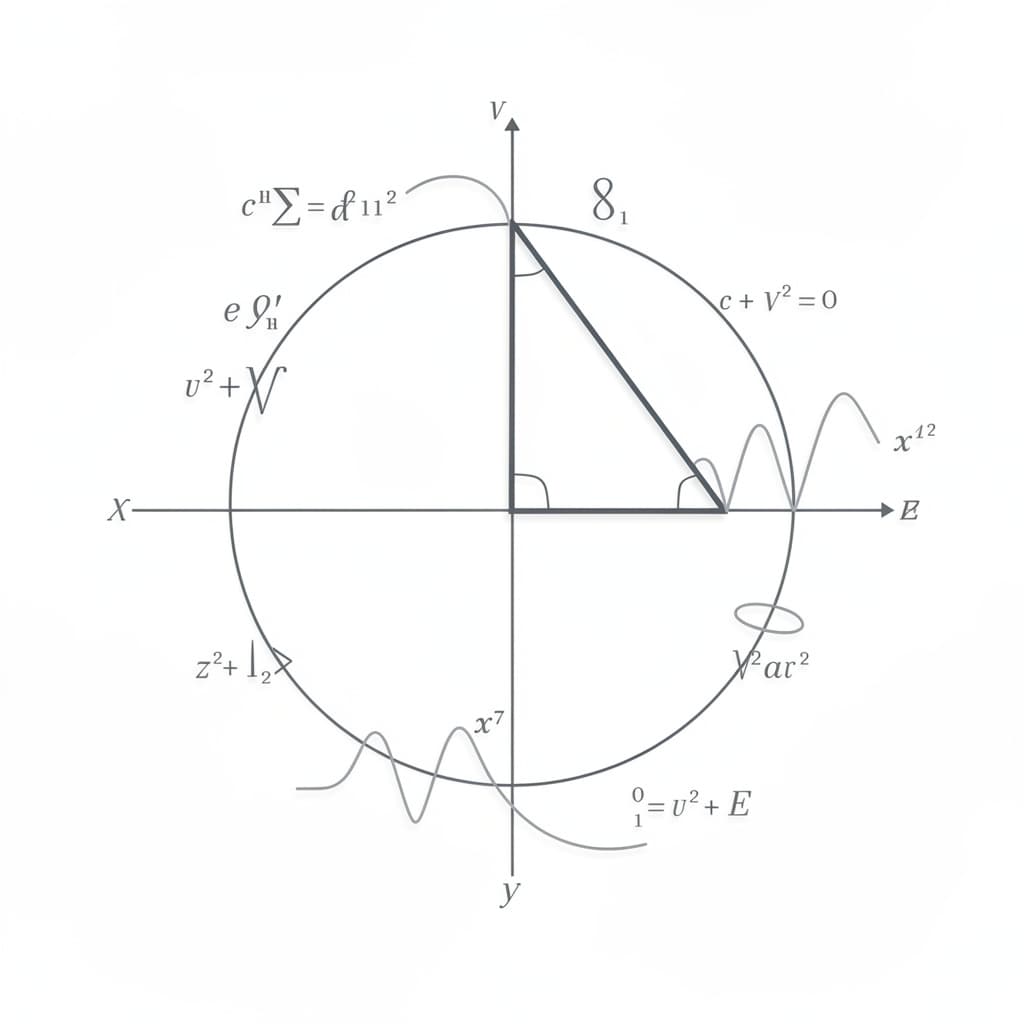
The unit circle serves as the fundamental bridge connecting the rigid structures of Euclidean geometry with the fluid patterns of algebraic trigonometry. At its simplest, it is a circle with a radius of exactly one unit, centered at the origin of a two-dimensional Cartesian plane. While this definition sounds deceptively elementary, the unit circle is the engine that drives our understanding of periodic motion, wave mechanics, and complex number theory. By constraining the radius to one, mathematicians are able to isolate the properties of angles and rotations, allowing the trigonometric functions of sine, cosine, and tangent to emerge not merely as ratios of a triangle’s sides, but as the very coordinates of space itself. Understanding this circle is the prerequisite for advancing into calculus, physics, and engineering, as it provides a universal language for describing anything that rotates, vibrates, or repeats.
Foundations of the Unit Circle
The Cartesian Plane and Radius One
The conceptual journey of the unit circle begins on the Cartesian coordinate system, a grid defined by a horizontal x-axis and a vertical y-axis that intersect at a point called the origin $(0,0)$. When we place a circle on this grid and fix its radius at precisely $r = 1$, we create a standardized environment where every point on the circumference is exactly one unit away from the center. This standardization is critical because it eliminates the variable of size, focusing our mathematical scrutiny entirely on the relationship between the angle of rotation and the resulting position. In this environment, the length of the arc along the circumference becomes directly proportional to the angle measured from the positive x-axis. Consequently, the unit circle transforms the abstract concept of an "angle" into a tangible set of coordinates, $(x, y)$, that describe a specific location in two-dimensional space.
Historically, the development of the unit circle allowed mathematicians to move away from the "right triangle" definition of trigonometry, which was limited to angles between 0 and 90 degrees. In a right triangle, sine and cosine are ratios of sides, but in the unit circle, they are redefined as the horizontal and vertical displacements of a point moving along a curve. This shift enables the study of "obtuse" angles and even negative angles, as a point can travel infinitely around the circle in either a clockwise or counter-clockwise direction. By grounding trigonometry in the Cartesian plane, we gain the ability to model continuous rotation, which is essential for understanding physical phenomena like the spinning of a turbine or the orbit of a planet. The unit circle thus acts as a coordinate map that translates rotational input into linear output.
Defining the Fundamental Circle Equation
The algebraic identity of the unit circle is captured by the elegant equation $$x^2 + y^2 = 1$$. This formula is a direct application of the Pythagorean Theorem, which states that for any right triangle, the square of the hypotenuse is equal to the sum of the squares of the other two sides. If we imagine a line segment connecting the origin $(0,0)$ to any point $(x, y)$ on the circle, that segment serves as the hypotenuse of a right triangle where the base is $x$ and the height is $y$. Since the radius (hypotenuse) of our circle is defined as 1, the relationship $x^2 + y^2 = 1^2$ must hold true for every single point on the boundary. This equation serves as a constraint; if a coordinate pair does not satisfy this equality, the point does not lie on the unit circle.
This equation also provides the mechanism for solving for one coordinate if the other is known. For instance, if we know that a point on the circle has an x-coordinate of $0.6$, we can substitute this into the equation to find that $0.36 + y^2 = 1$, leading to $y^2 = 0.64$, and thus $y = \pm 0.8$. This duality of the "plus or minus" reflects the inherent symmetry of the circle, where for every x-value, there are typically two corresponding y-values—one in the upper half and one in the lower half of the plane. The algebraic simplicity of $x^2 + y^2 = 1$ belies its power in calculus, where it is used to derive the derivatives of trigonometric functions. It remains one of the most recognizable equations in mathematics, symbolizing the perfect harmony between algebra and geometry.
Identifying Key Points on the Circumference
There are four "anchor points" on the unit circle where it intersects the axes, known as the quadrantal angles. These points occur at 0, 90, 180, and 270 degrees, corresponding to the coordinates $(1, 0)$, $(0, 1)$, $(-1, 0)$, and $(0, -1)$ respectively. These points are the easiest to identify because one of the coordinates is always zero, reflecting the fact that the point is sitting directly on an axis. These intersections serve as the boundaries for the four quadrants of the Cartesian plane and provide the "reset" points for trigonometric functions. For example, at $(1, 0)$, the angle is 0, the cosine (x) is at its maximum value of 1, and the sine (y) is at its minimum absolute value of 0.
Beyond these four cardinal points, the unit circle is populated by an infinite number of points, but certain "special angles" are prioritized in mathematics due to their frequent appearance in nature and engineering. Angles such as 30, 45, and 60 degrees produce coordinates involving square roots, such as $\frac{1}{2}$ and $\frac{\sqrt{3}}{2}$. These values are not arbitrary; they are derived from the geometric properties of equilateral and isosceles triangles. By memorizing these specific coordinate pairs, students gain the ability to perform complex calculations without the need for a calculator. These points form the skeleton of the unit circle chart, a visual tool used by students worldwide to navigate the complexities of periodic functions.
Radians and the Language of Rotation
Moving Beyond Degree Measurement
While most people are introduced to angles through degrees, where a full circle is divided into 360 parts, this system is largely a historical artifact from ancient Babylonian mathematics. Degrees are arbitrary; there is no inherent reason why a circle should be divided into 360 units other than the fact that 360 is highly divisible and close to the number of days in a year. In advanced mathematics and physics, we utilize unit circle radians, a more "natural" unit of measurement. A radian is defined by the radius of the circle itself: one radian is the angle created when the arc length along the circumference is exactly equal to the radius. Because the circumference of a circle is $2\pi r$, and $r=1$ in our case, a full trip around the unit circle is exactly $2\pi$ radians.
The transition to radians is not merely a change in units; it simplifies the calculus of trigonometric functions. For example, the derivative of $\sin(x)$ is only $\cos(x)$ when $x$ is measured in radians. If degrees were used, a messy conversion constant of $\frac{\pi}{180}$ would be required in every derivative and integral. Radians link the linear measurement of the arc to the angular measurement of the rotation, creating a seamless connection between the "outside" of the circle and the "inside" of the angle. This makes radians the standard language for scientific computation, where the relationship between circular motion and time must be expressed in the most efficient terms possible.
Calculating Arc Length and Sector Areas
One of the primary advantages of working within the unit circle is the simplification of the arc length formula. In a general circle of radius $r$, the length of an arc $s$ subtended by an angle $\theta$ is given by $s = r\theta$. However, in the trigonometry unit circle, where $r = 1$, the formula collapses to $s = \theta$. This means that the radian measure of the angle is numerically identical to the distance traveled along the edge of the circle. This elegant property allows us to treat angles as distances, which is particularly useful when modeling objects moving along a curved path, such as a car rounding a bend or a satellite in orbit.
Similarly, the formula for the area of a sector—a "slice" of the circle—becomes significantly more manageable. The general formula $A = \frac{1}{2}r^2\theta$ simplifies to $A = \frac{\theta}{2}$ on the unit circle. This direct relationship between the angle and the area it sweeps out is a foundational concept in planetary motion, specifically Kepler's Second Law, which states that a planet sweeps out equal areas in equal times. By using the unit circle as a reference, astronomers can describe the complex elliptical orbits of celestial bodies using the simplified circular logic of radians. This illustrates how the unit circle serves as a "base case" for more complex geometric phenomena.
Periodicity in Circular Motion
A defining characteristic of the unit circle is its periodicity, meaning that as you continue to add $2\pi$ (or 360 degrees) to any angle, you return to the exact same point on the circumference. This circularity implies that trigonometric functions are periodic; they repeat their values in regular intervals. For sine and cosine, this period is $2\pi$. If a point is at $\pi/2$ (90 degrees), adding $2\pi$ brings it back to the same vertical and horizontal position. This mathematical property is the reason we use the unit circle to model any phenomenon that fluctuates over time, such as sound waves, alternating current, or seasonal temperature changes.
Periodicity also introduces the concept of "coterminal angles," which are different angle measurements that land on the same spot. For instance, $-90$ degrees and $270$ degrees are coterminal because they both point to the coordinate $(0, -1)$. In the context of the unit circle, these angles are functionally identical for sine and cosine. This allows mathematicians to "wrap" the entire number line around the circle, mapping every possible real number—no matter how large or small—to a specific point on the unit circle's boundary. This "wrapping function" is the basis for the transition from geometry to the study of periodic functions in trigonometry.
Mapping Sin Cos Tan on the Unit Circle
Projecting Sine and Cosine as Coordinates
The most profound insight provided by the unit circle is the redefinition of sine and cosine. In any point $(x, y)$ on the unit circle, the x-coordinate is exactly equal to the cosine of the angle $\theta$, and the y-coordinate is exactly equal to the sine of the angle $\theta$. This can be expressed as: $$x = \cos(\theta)$$ $$y = \sin(\theta)$$ This realization is transformative because it means that when we look at the unit circle, we are literally looking at a graph of all possible values for these functions. To find the cosine of 60 degrees, we simply look at the x-coordinate of the point at the 60-degree mark.
This coordinate-based definition explains why the values of sine and cosine are always trapped between $-1$ and $1$. Since the point is on a circle with radius 1, it can never move further than one unit away from the origin in any direction. Consequently, the "amplitude" of these basic trigonometric functions is fixed. Furthermore, this mapping explains the "wave" shape of sine and cosine graphs. As a point travels around the circle at a constant speed, its height (sine) rises and falls in a smooth, rhythmic motion, while its horizontal position (cosine) shifts left and right in a similar but shifted pattern. This relationship is the core of sin cos tan unit circle logic.
Geometric Extensions of Tangent and Secant
While sine and cosine are the "internal" coordinates of the circle, the other trigonometric functions—tangent, secant, and cotangent—can be visualized as lengths of lines tangent to or secant to the circle. The tangent of an angle is defined as the ratio $\frac{y}{x}$, or $\frac{\sin(\theta)}{\cos(\theta)}$. Geometrically, if you draw a line tangent to the circle at the point $(1, 0)$ and extend the angle's terminal side until it hits this vertical line, the height of that intersection is the tangent value. This is why the function is called "tangent"—it is literally the length of a tangent segment.
Similarly, the secant is the length of the line segment from the origin to that same intersection point on the tangent line. These functions describe "external" relationships. Unlike sine and cosine, tangent and secant can grow to infinity. For example, as the angle approaches 90 degrees ($\pi/2$), the x-coordinate (cosine) approaches zero. Since tangent is $\frac{y}{x}$, and we cannot divide by zero, the tangent value shoots toward infinity, creating the vertical asymptotes seen in tangent graphs. The unit circle thus provides a visual explanation for the "undefined" values that often confuse students in trigonometry classes.
The Logic of Pythagorean Identities
Because every point on the unit circle must satisfy the equation $x^2 + y^2 = 1$, and because we have defined $x = \cos(\theta)$ and $y = \sin(\theta)$, we can derive the most famous identity in trigonometry: $$\cos^2(\theta) + \sin^2(\theta) = 1$$ This is known as the Pythagorean Identity. It is a universal truth that holds for any angle, whether it is 10 degrees or 10,000 degrees. This identity allows mathematicians to switch between sine and cosine with ease, which is a critical skill in solving trigonometric equations and simplifying complex calculus problems.
Other identities can be derived by dividing this primary equation by $\cos^2(\theta)$ or $\sin^2(\theta)$. For instance, dividing the entire equation by $\cos^2(\theta)$ yields $1 + \tan^2(\theta) = \sec^2(\theta)$. These relationships are not just abstract formulas to be memorized; they are descriptions of the geometric constraints of the circle. They remind us that the different trigonometric functions are all interconnected components of a single circular system. If you change the sine of an angle, the cosine and tangent must change in a predictable, mathematically enforced way to stay on the circle's path.
Symmetry in the Trigonometry Unit Circle
Navigating the Four Quadrants
The trigonometry unit circle is divided into four quadrants, numbered counter-clockwise starting from the top right. In Quadrant I (0 to 90 degrees), both x and y are positive, meaning both sine and cosine are positive. In Quadrant II (90 to 180 degrees), x is negative and y is positive. In Quadrant III (180 to 270 degrees), both are negative, and in Quadrant IV (270 to 360 degrees), x is positive while y is negative. This distribution of signs is often remembered using the mnemonic "All Students Take Calculus" (ASTC), which tells you which functions are positive in each quadrant: All (Q1), Sine (Q2), Tangent (Q3), and Cosine (Q4).
Understanding these signs is vital for correctly identifying the values of angles outside the first quadrant. For example, while the sine of 30 degrees is $0.5$, the sine of 210 degrees (which is in Quadrant III) must be $-0.5$. The numerical value remains the same because the "distance" from the x-axis is the same, but the sign changes to reflect the point's position in the coordinate plane. This symmetry allows us to calculate the trigonometric values for any angle in the circle by simply knowing the values for the first 90 degrees and applying the correct sign for the quadrant.
Special Right Triangle Relationships
The coordinates of the unit circle are largely derived from two special right triangles: the $45-45-90$ triangle and the $30-60-90$ triangle. In a $45-45-90$ triangle with a hypotenuse of 1, the legs are both $\frac{\sqrt{2}}{2}$. This gives us the point $(\frac{\sqrt{2}}{2}, \frac{\sqrt{2}}{2})$ at the $\pi/4$ mark. In a $30-60-90$ triangle, the side opposite the 30-degree angle is half the hypotenuse, while the side opposite the 60-degree angle is $\frac{\sqrt{3}}{2}$ times the hypotenuse. These proportions provide the coordinates $(\frac{\sqrt{3}}{2}, \frac{1}{2})$ for 30 degrees and $(\frac{1}{2}, \frac{\sqrt{3}}{2})$ for 60 degrees.
These values—$0, \frac{1}{2}, \frac{\sqrt{2}}{2}, \frac{\sqrt{3}}{2}, \text{and } 1$—are the only numbers you will see as coordinates for the standard special angles on the unit circle. They represent the "heights" and "widths" of the triangles that fit perfectly inside the circle's radius. By understanding the geometric origins of these numbers, students can move away from rote memorization and toward a spatial understanding of where these values come from. The unit circle is essentially a gallery showing how these two specific triangles rotate and reflect through space.
Reflective Properties of Reference Angles
A "reference angle" is the smallest acute angle that the terminal side of an angle makes with the x-axis. For example, the reference angle for 150 degrees is 30 degrees because 150 is 30 degrees away from the 180-degree mark on the x-axis. Because the unit circle is perfectly symmetrical across both the x and y axes, the trigonometric values of an angle are identical to the values of its reference angle, except for the possible change in sign. This means that if you know the coordinates for 30 degrees $(\frac{\sqrt{3}}{2}, \frac{1}{2})$, you instantly know the coordinates for 150, 210, and 330 degrees.
This reflective symmetry is a powerful shortcut. To find the sine of 315 degrees, you identify its reference angle as 45 degrees ($360 - 315 = 45$). You know the sine of 45 degrees is $\frac{\sqrt{2}}{2}$. Since 315 degrees is in Quadrant IV, where sine (y) is negative, the answer is $-\frac{\sqrt{2}}{2}$. This process of "reducing" an angle to its reference version in the first quadrant is the standard method for navigating the unit circle chart. It highlights the circle not as a collection of 360 separate degrees, but as four mirrored versions of a single 90-degree arc.
Structural Patterns of the Unit Circle Chart
Visualizing Essential Value Distributions
The unit circle chart is a visual representation of the most commonly used angles and their corresponding $(x, y)$ coordinates. When organized in a table or a circular diagram, a striking pattern emerges in the distribution of values. If we look at the sine values (y-coordinates) for 0, 30, 45, 60, and 90 degrees, we see a sequence that can be written as: $$\frac{\sqrt{0}}{2}, \frac{\sqrt{1}}{2}, \frac{\sqrt{2}}{2}, \frac{\sqrt{3}}{2}, \frac{\sqrt{4}}{2}$$ This simplifies to $0, \frac{1}{2}, \frac{\sqrt{2}}{2}, \frac{\sqrt{3}}{2}, \text{and } 1$. The cosine values follow the exact same sequence but in reverse order. This "square root sequence" is a beautiful example of mathematical harmony, showing that the coordinates of the circle are not random, but follow a strict, predictable progression.
Using this pattern, a student can reconstruct the entire chart from memory. The denominators are always 2, and the numerators are simply the square roots of the integers from 0 to 4. This pattern repeats in every quadrant, with only the signs changing based on the ASTC rule. Tables of these values often include the tangent, which is simply the numerator of the sine divided by the numerator of the cosine. For 30 degrees, this is $\frac{1}{\sqrt{3}}$ (or $\frac{\sqrt{3}}{3}$), and for 60 degrees, it is $\sqrt{3}$. This internal consistency is what makes the unit circle such an effective tool for learning.
Standard Multiples and Angle Increments
The unit circle is primarily divided into increments of 30 and 45 degrees (or $\pi/6$ and $\pi/4$ radians). The multiples of $\pi/6$ include $\pi/6$ (30°), $2\pi/6 = \pi/3$ (60°), $3\pi/6 = \pi/2$ (90°), and so on. The multiples of $\pi/4$ include $\pi/4$ (45°), $2\pi/4 = \pi/2$ (90°), $3\pi/4$ (135°), etc. Notice how these sequences overlap at the quadrantal angles ($90, 180, 270$). Understanding these increments is like understanding the markings on a clock; they provide the rhythmic structure that allows us to subdivide the circle accurately.
When students struggle with the unit circle, it is often because they view the angles as a list of random numbers like 120, 135, and 150. However, when viewed as $4 \times 30^\circ$, $3 \times 45^\circ$, and $5 \times 30^\circ$, the logic becomes clear. Each "stop" on the unit circle is just a specific number of steps of either 30 or 45 degrees from the starting point. This incremental thinking makes it easier to locate angles and understand their relationships. For instance, any angle with a denominator of 6 in its radian form (like $5\pi/6$ or $7\pi/6$) will always have a reference angle of 30 degrees and will share the same basic coordinates.
| Angle (Degrees) | Angle (Radians) | Sine ($y$) | Cosine ($x$) | Tangent ($y/x$) |
|---|---|---|---|---|
| 0° | 0 | 0 | 1 | 0 |
| 30° | $\pi/6$ | $1/2$ | $\sqrt{3}/2$ | $\sqrt{3}/3$ |
| 45° | $\pi/4$ | $\sqrt{2}/2$ | $\sqrt{2}/2$ | 1 |
| 60° | $\pi/3$ | $\sqrt{3}/2$ | $1/2$ | $\sqrt{3}$ |
| 90° | $\pi/2$ | 1 | 0 | Undefined |
How to Memorize the Unit Circle Effectively
The Hand Rule and Visual Mnemonics
One of the most popular methods for learning how to memorize the unit circle is the "Left Hand Rule." If you hold your left hand out with your palm facing you, your fingers can represent the standard angles in the first quadrant: the pinky is 0°, the ring finger is 30°, the middle finger is 45°, the index finger is 60°, and the thumb is 90°. To find the coordinates for an angle, fold down the corresponding finger. The number of fingers above the folded one represents the x-coordinate (numerator), and the number of fingers below represents the y-coordinate (numerator). For both, you take the square root of that number and put it over 2.
For example, to find 30 degrees, fold your ring finger. There are 3 fingers above it (index, middle, thumb), so the x-coordinate is $\sqrt{3}/2$. There is 1 finger below it (pinky), so the y-coordinate is $\sqrt{1}/2$, which is $1/2$. This physical mnemonic provides a portable reference that students can use during exams without needing to draw the entire circle. It reinforces the "square root sequence" mentioned earlier and helps anchor the abstract coordinates to a physical sensation, which is a proven method for improving long-term memory retention.
Conversion Ratios for Degrees and Pi
For many students, the hardest part of the unit circle is converting between degrees and radians. The key is to remember the fundamental equivalence: $180^\circ = \pi \text{ radians}$. This leads to two simple conversion factors: $\frac{\pi}{180}$ to go from degrees to radians, and $\frac{180}{\pi}$ to go from radians to degrees. Rather than just multiplying by these fractions blindly, it helps to think in terms of "halves" and "thirds" of the 180-degree line. If 180 is $\pi$, then 90 is half of that ($\pi/2$), 60 is a third ($\pi/3$), and 45 is a fourth ($\pi/4$).
Visualization is more effective than rote arithmetic here. Imagine the top half of the circle as a single piece of fruit, like an orange (representing $\pi$). If you cut that orange into 6 slices, each slice is $\pi/6$ (30 degrees). If you cut it into 4 slices, each slice is $\pi/4$ (45 degrees). This makes it easy to visualize $3\pi/4$ as three of those 45-degree slices, landing you at 135 degrees. By thinking of radians as "portions of the top half," students can often perform these conversions mentally in seconds, avoiding the tedious cross-multiplication that leads to errors.
Mental Estimation and Pattern Recognition
Mastering the unit circle also involves developing an intuition for the size of values. For instance, $\sqrt{2}/2$ is approximately $0.707$, and $\sqrt{3}/2$ is approximately $0.866$. If you know that 60 degrees is "tall and narrow," it makes sense that its y-value (sine) should be the larger one ($0.866$) and its x-value (cosine) should be the smaller one ($0.5$). Conversely, 30 degrees is "short and wide," so its x-value should be larger than its y-value. This mental estimation acts as a "sanity check" to ensure that you haven't swapped the coordinates accidentally.
Pattern recognition extends to the radian denominators as well. Every angle that has a "6" in the denominator when fully simplified (like $7\pi/6$ or $11\pi/6$) is a 30-degree reference angle. Every angle with a "3" in the denominator is a 60-degree reference angle. Every angle with a "4" is a 45-degree reference. Once you recognize the denominator, you instantly know the "pair" of coordinates involved ($\sqrt{3}/2$ and $1/2$ for 30/60; $\sqrt{2}/2$ and $\sqrt{2}/2$ for 45). Then, you only need to determine the quadrant to assign the correct plus or minus signs. This layered approach reduces the cognitive load of memorization.
Advanced Applications of Circular Geometry
Modeling Harmonic Motion and Oscillations
The unit circle is the mathematical foundation for Simple Harmonic Motion (SHM), a concept central to physics. When a mass on a spring bounces up and down, or a pendulum swings back and forth, its position over time follows a sine wave. This is because these objects are essentially performing "one-dimensional circular motion." If you look at a wheel spinning and track only the height of a point on its rim, that height is moving in SHM. The circle’s radius represents the maximum displacement (amplitude), and the speed of rotation represents the frequency of the oscillation.
In engineering, this logic is used to design shock absorbers, bridges, and even skyscrapers. Engineers must calculate the "natural frequency" of a structure to ensure that wind or earthquakes don't cause it to oscillate too violently. Because the unit circle provides the exact relationship between the angle (phase) and the displacement (sine/cosine), it allows for precise predictions of how a system will react to periodic forces. Without the unit circle, our ability to model and control the vibration of mechanical systems would be non-existent.
Projecting Circles into Sine Wave Graphs
There is a direct geometric link between the unit circle and the standard sine wave graph $y = \sin(x)$. Imagine "unrolling" the unit circle onto a flat x-axis. As a point travels around the circle, you plot its height (y-coordinate) against the distance it has traveled along the circumference. The result is the familiar, repeating wave that starts at zero, peaks at 1, crosses zero again, dips to $-1$, and returns to zero at $2\pi$. This transformation from circular space to linear space is what allows us to apply trigonometry to time-series data.
This projection is useful because it visualizes the concept of phase shifts. If you start tracking the point at the top of the circle (90 degrees) instead of the side (0 degrees), you get a cosine wave instead of a sine wave. This "starting position" is called the phase. In electronics, the phase difference between voltage and current in an AC circuit is measured in degrees or radians, referring back to their positions on an imaginary unit circle. This ability to map circular position to linear time is the core of modern signal analysis and electrical engineering.
Circular Logic in Signal Processing
The unit circle also plays a critical role in the world of digital signals, particularly in Fourier Analysis. The Fourier Transform is a mathematical process that breaks down any complex signal—like a human voice or a digital image—into a sum of simple sine and cosine waves. These waves are often represented as points rotating on a unit circle in the complex plane (using Euler's formula $e^{i\theta} = \cos\theta + i\sin\theta$). This allows engineers to filter out noise, compress data (like in MP3s or JPEGs), and transmit information wirelessly.
By treating signals as rotations, we can use the properties of the unit circle to manipulate them. For example, multiplying a signal by a complex number on the unit circle results in a phase shift or a frequency modulation. This "circular logic" is what allows your smartphone to distinguish your voice from background noise or your Wi-Fi router to handle multiple data streams simultaneously. The unit circle, which began as a simple geometric figure, ultimately becomes the fundamental tool for navigating the modern, data-driven world. Its simplicity provides the clarity needed to manage the most complex systems humans have ever built.
References
- Stewart, J., "Precalculus: Mathematics for Calculus", Cengage Learning, 2015.
- Euler, L., "Introduction to Analysis of the Infinite", Springer-Verlag (Reprint), 1748.
- Maor, E., "Trigonometric Delights", Princeton University Press, 2013.
- Boyer, C. B., "A History of Mathematics", John Wiley & Sons, 1991.
Recommended Readings
- The Joy of x: A Guided Tour of Math, from One to Infinity by Steven Strogatz — An incredibly accessible book that explains why the unit circle and sine waves are the "music of the spheres."
- Trigonometry by I.M. Gelfand and Mark Saul — A deep dive into the logic of trigonometric functions that prioritizes understanding over memorization.
- Visual Complex Analysis by Tristan Needham — For those who want to see how the unit circle extends into the world of complex numbers and advanced geometry.
- Measurement by Paul Lockhart — A beautiful reflection on the art of geometry that treats the circle not as a set of rules, but as a masterpiece of human thought.