The Vertical Architecture of Earth's Atmosphere
Explore the layers of the atmosphere from the troposphere to the thermosphere. Learn about temperature changes and the vital role of the ozone layer today.
In this articleDefining the Gaseous Envelope
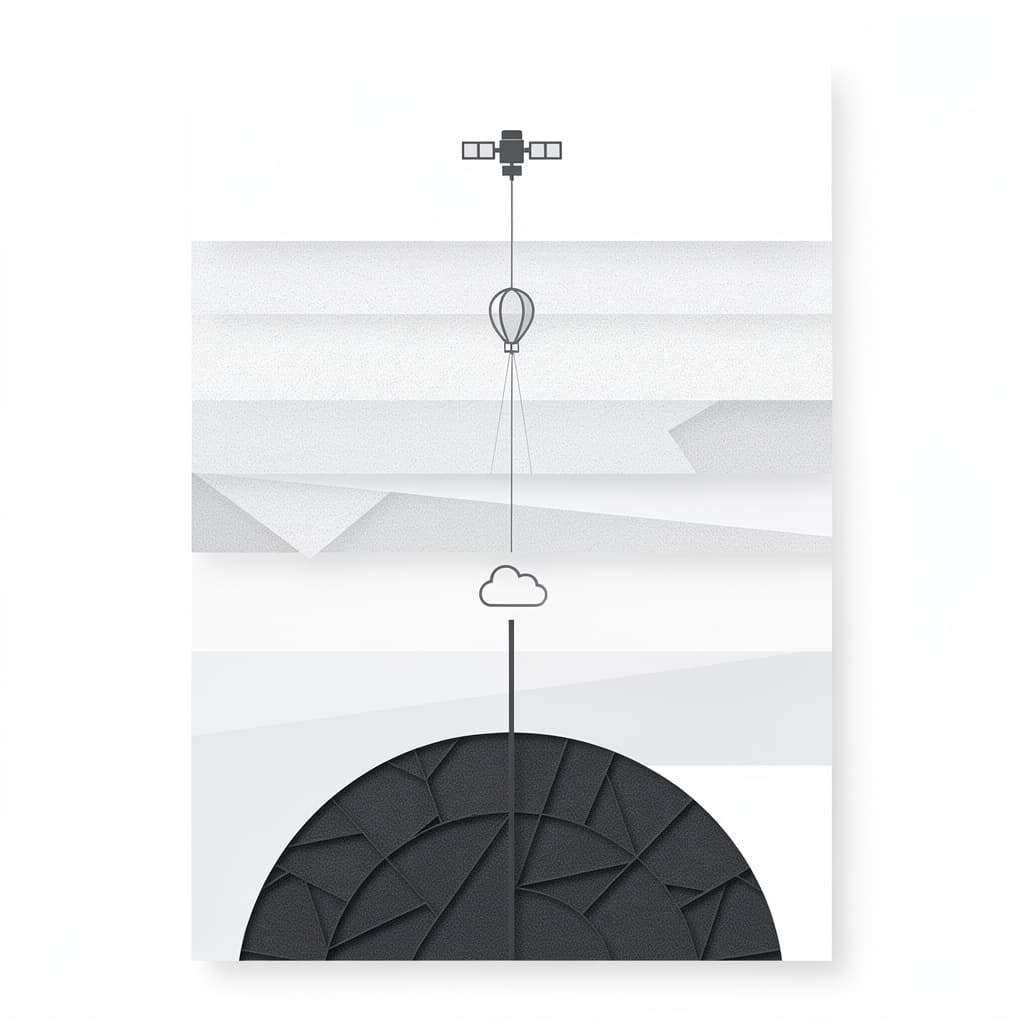
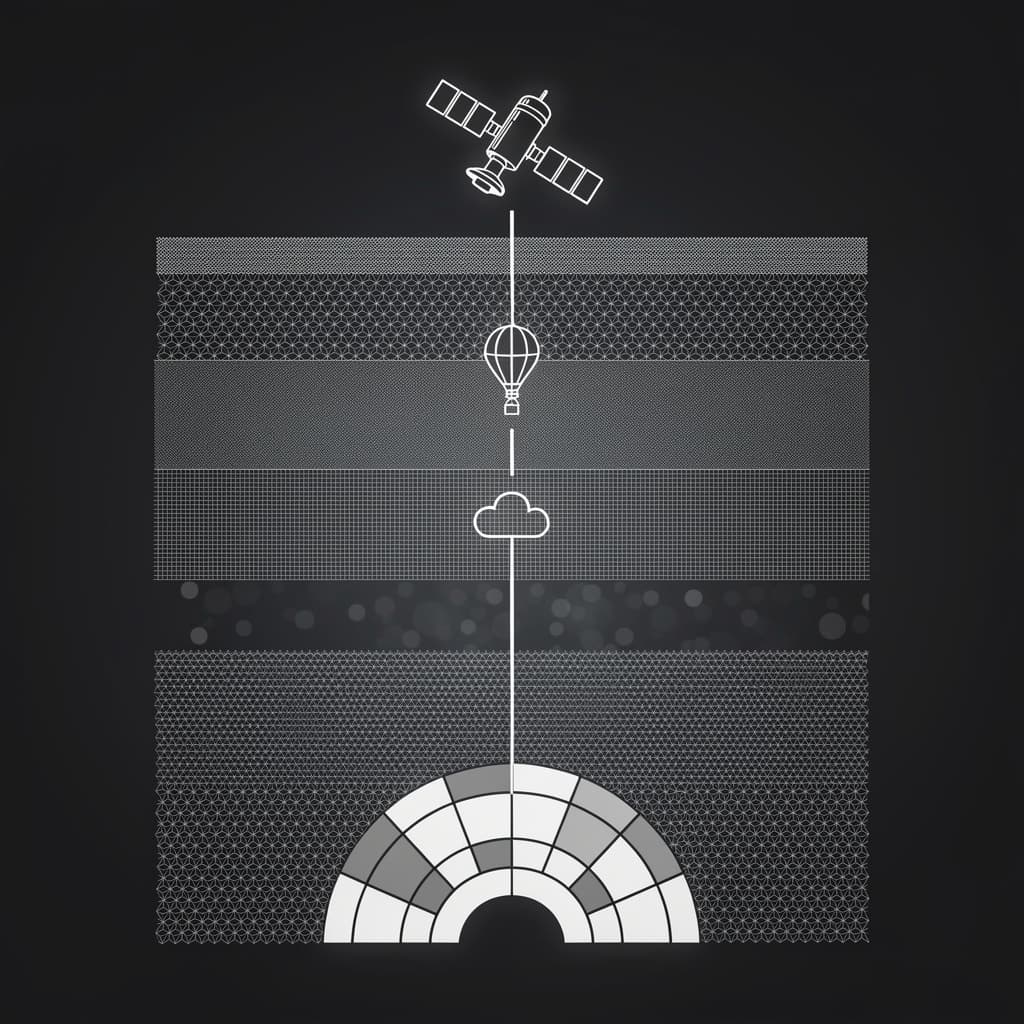
Earth’s atmosphere is a sophisticated, multi-layered gaseous envelope that serves as the planet's primary life-support system and thermal regulator. Far from being a uniform mist of air, the atmosphere is structured into distinct layers of the atmosphere defined by variations in temperature, chemical composition, and physical behavior. This vertical architecture is maintained by the relentless pull of gravity, which anchors the vast majority of atmospheric mass close to the surface, creating a steep density gradient that thins into the vacuum of space. By understanding the vertical logic of these layers, we gain insight into everything from the formation of a summer thunderstorm to the protection afforded by the ozone layer against lethal solar radiation.
Defining the Gaseous Envelope
The atmospheric structure is governed by the fundamental interplay between gravity and molecular kinetics, resulting in a distinct density gradient. Because air is compressible, the weight of the overlying columns of gas compresses the air beneath it, meaning that roughly 99 percent of the atmosphere's mass is concentrated within the first 30 kilometers above the surface. This pressure distribution follows a nearly exponential decay, where the pressure at any given altitude can be approximated by the barometric formula. As one ascends, the air becomes increasingly "thin," requiring specialized physiological or mechanical adaptations for survival and operation. This gradient ensures that the dense, life-sustaining air remains at sea level while the upper reaches facilitate the transition into the interplanetary medium.
The chemical composition of this envelope is remarkably consistent throughout the lower layers, a region known as the homosphere. In this zone, which extends up to approximately 80 kilometers, the air is composed of roughly 78 percent nitrogen, 21 percent oxygen, and nearly 1 percent argon. Beyond these major constituents, trace gases like carbon dioxide, methane, and water vapor play a disproportionately large role in regulating the planet's temperature through the greenhouse effect. Above the homosphere lies the heterosphere, where gases begin to stratify by their molecular weight due to the lack of turbulent mixing. In these distant reaches, lighter atoms like helium and hydrogen eventually dominate, reflecting the transition from a well-mixed fluid to a gravitationally sorted plasma.
The vertical logic of the atmosphere is primarily classified by its thermal profile, which exhibits a characteristic "zig-zag" pattern of temperature changes. As a traveler moves upward, they encounter regions where the air grows colder with height, followed by regions where it grows warmer. These reversals are not random; they are driven by specific physical processes, such as the absorption of solar ultraviolet radiation or the release of latent heat during cloud formation. Each transition point where the temperature trend reverses is known as a "pause," such as the tropopause or stratopause. These boundaries act as invisible ceilings, limiting the vertical movement of air and moisture and creating the stratified world we observe from the ground.
The Troposphere and Meteorological Dynamics
The troposphere is the lowest and densest of the layers of the atmosphere, extending from the Earth's surface to an average altitude of about 12 kilometers. The name itself is derived from the Greek word "tropos," meaning "turning" or "change," which perfectly describes the constant vertical mixing and turbulence found here. This is the realm where nearly all of Earth's weather occurs, driven by the heating of the surface by the sun. Because the atmosphere is largely transparent to visible light, the ground absorbs solar energy and re-radiates it as infrared heat, warming the air from the bottom up. This creates a state of instability where warm, buoyant air rises and cooler, denser air sinks, fueling the convection currents that produce clouds and wind.
The defining thermal characteristic of this layer is the environmental lapse rate, which describes how temperature decreases with increasing altitude. Under standard conditions, the temperature drops at a rate of approximately 6.5 degrees Celsius for every 1,000 meters of ascent. This cooling occurs because atmospheric pressure decreases with height, allowing rising air parcels to expand and cool through adiabatic processes. When this rising air cools to its dew point, water vapor condenses into liquid droplets or ice crystals, forming the vast array of cloud structures that define our skies. The troposphere contains about 80 percent of the total atmospheric mass and virtually all of the atmosphere's water vapor and aerosols, making it the most vital layer for terrestrial life.
At the top of the troposphere lies the tropopause, a critical boundary that acts as a thermal lid on vertical convection. The altitude of the tropopause is not constant; it is highest at the equator, where intense solar heating pushes it up to 18 kilometers, and lowest at the poles, where it may descend to 8 kilometers or less. This variation is primarily due to the differences in thermal expansion and the intensity of convective activity across different latitudes. Jet streams, which are high-speed ribbons of air, typically flow just below the tropopause, taking advantage of the sharp pressure gradients found at this interface. By capping the weather-producing processes of the troposphere, the tropopause ensures that moisture and pollutants remain concentrated in the lower atmosphere rather than escaping into the layers above.
Studying this for an exam?
Noesis builds the syllabus, notes and tests for you, and you study them with a tutor that knows your material.
Stability and the Stratospheric Shield
Above the turbulent troposphere lies the stratosphere, a layer characterized by its profound stability and lack of vertical mixing. Extending from the tropopause to about 50 kilometers, the stratosphere is defined by a temperature inversion, meaning that temperature actually increases with altitude. This warming trend is the opposite of what occurs in the troposphere and is caused by the presence of concentrated ozone molecules. Because warm air sits atop cooler air in this region, the atmosphere is "stratified" into stable horizontal layers, much like the layers of a cake. This lack of vertical motion explains why commercial pilots prefer to fly in the lower stratosphere, as it provides a smooth, cloud-free environment above the chaotic weather of the troposphere.
A frequent question in earth science is: where is the ozone layer? The answer lies within the stratosphere, specifically between 15 and 35 kilometers above the Earth's surface. This region, known as the ozonosphere, contains a relatively high concentration of molecules that perform the vital function of absorbing the sun's high-energy ultraviolet (UV) radiation. When ozone molecules absorb UV-B and UV-C rays, they convert this electromagnetic energy into kinetic energy, which manifests as heat. Without this protective shield, the Earth's surface would be bombarded by radiation levels that are lethal to most biological organisms, causing severe DNA damage and disrupting photosynthetic processes. The "hole" in the ozone layer, primarily caused by human-made chlorofluorocarbons (CFCs), was a major environmental concern because it weakened this essential thermal and biological barrier.
The stratospheric environment is extremely dry and thin, with water vapor concentrations often measured in parts per million. While common clouds like cumulus or stratus cannot form here, rare nacreous clouds, or polar stratospheric clouds, can sometimes be seen in high-latitude winters. These iridescent clouds form at extremely low temperatures and play a controversial role in the chemistry of ozone depletion by providing surfaces for chemical reactions. Because the air is so thin and stable, volcanic ash and aerosols that reach the stratosphere can remain suspended for years, reflecting sunlight and temporarily cooling the global climate. This illustrates how the stratosphere acts not just as a shield, but also as a long-term reservoir for particles that can influence the entire Earth system.
The Cold Frontier of the Mesosphere
The mesosphere represents the "middle" layer of the atmosphere, spanning from the stratopause at 50 kilometers to the mesopause at approximately 85 kilometers. It is often cited as the most mysterious and least understood region of our atmosphere because it is too high for weather balloons and jet aircraft, yet too low for most orbiting satellites. In this layer, temperatures begin to drop again as one moves higher, primarily because there is no ozone to absorb solar heat and the air is too thin to retain heat effectively. In fact, the mesosphere contains the coldest temperatures in the Earth system, with the mesopause reaching lows of nearly -90 degrees Celsius (-130 degrees Fahrenheit). This extreme cold makes the mesosphere a harsh frontier that marks the beginning of the transition into space-like conditions.
One of the most visible interactions in the mesosphere occurs when small celestial fragments, or meteors, enter the atmosphere. As these particles collide with the increasingly frequent gas molecules of the mesosphere at high velocities, the resulting friction and ram pressure generate intense heat, causing the meteors to vaporize. This phenomenon creates the "shooting stars" that are visible from the ground, serving as a reminder that the atmosphere acts as a physical barrier against cosmic debris. While the air here is far too thin for humans to breathe, it is dense enough to provide the resistance necessary to incinerate millions of tons of space dust every year. This shielding effect is crucial for protecting the Earth's surface and low-orbiting technology from constant bombardment.
Despite its dryness, the mesosphere is home to the highest clouds in the atmosphere, known as noctilucent clouds or night-shining clouds. These eerie, electric-blue wisps form near the poles during the summer months when the mesopause reaches its minimum temperatures. They are composed of tiny ice crystals that nucleate around "meteor smoke"—the microscopic debris left behind by vaporized meteors. Because they are so high, they remain illuminated by the sun long after it has set for observers on the ground, creating a haunting glow against the dark sky. Studying these clouds has become increasingly important, as some scientists believe their rising frequency and brightness may be linked to increases in atmospheric methane and global climate change.
The Thermosphere and Solar Radiance
Rising above the mesopause is the thermosphere, a vast region that extends from 85 kilometers to anywhere between 500 and 1,000 kilometers above the surface. The thermosphere is characterized by a dramatic increase in temperature, which can soar to 1,500 degrees Celsius or higher during periods of intense solar activity. This extreme heating is caused by the absorption of high-energy X-rays and short-wave ultraviolet radiation by residual oxygen and nitrogen atoms. However, there is a counterintuitive distinction between kinetic energy and sensible heat in this layer. While individual molecules are moving at incredible speeds (representing high temperature), the air is so incredibly thin that there are very few molecules to actually collide with an object and transfer that heat.
The lower part of the thermosphere coincides with the ionosphere, a region where solar radiation is so powerful that it strips electrons from atoms and molecules, creating a layer of ionized gas or plasma. This ionization process is responsible for the breathtaking aurora borealis (Northern Lights) and aurora australis (Southern Lights). When charged particles from the solar wind are funneled by Earth's magnetic field toward the poles, they collide with these ions, releasing energy in the form of vibrant curtains of light. Historically, the ionosphere has also been critical for human communication, as it reflects certain radio waves back to Earth, allowing for long-distance "shortwave" radio transmissions over the horizon. Today, it remains a vital area of study for understanding space weather and its impact on GPS and satellite systems.
The upper limit of the thermosphere is the exobase, which transitions into the exosphere, the final, outermost fringe of the atmosphere. In the exosphere, the atmosphere is so tenuous that gas molecules can travel hundreds of kilometers without ever colliding with another molecule. Some of these atoms, particularly light elements like hydrogen and helium, achieve enough velocity to escape Earth's gravitational pull entirely and leak into interplanetary space. This region does not have a well-defined outer boundary, as it gradually fades into the solar wind. For all practical purposes, however, the thermosphere and exosphere represent the domain of human spaceflight, housing the majority of artificial satellites and the International Space Station (ISS).
Atmospheric Layers in Order of Ascent
When considering atmospheric layers in order of their ascent from the surface, it is helpful to visualize them as a series of distinct thermal shells separated by transitional "pauses." These pauses represent altitudes where the lapse rate—the rate at which temperature changes with height—becomes zero before reversing its trend. This structure ensures that each layer maintains its unique physical properties while interacting with the layers immediately above and below it. The following table provides a concise comparison of the primary characteristics of atmosphere layers, highlighting the altitudes, temperature trends, and defining features of each major division.
| Layer Name | Altitude Range | Temperature Trend | Primary Characteristics |
|---|---|---|---|
| Troposphere | 0 – 12 km | Decreases with height | Contains 80% of mass; weather and clouds occur here. |
| Stratosphere | 12 – 50 km | Increases with height | Contains the ozone layer; stable, horizontal airflow. |
| Mesosphere | 50 – 85 km | Decreases with height | Coldest temperatures; meteors burn up in this layer. |
| Thermosphere | 85 – 600 km | Increases with height | High kinetic energy; location of the ionosphere and auroras. |
| Exosphere | 600 km – 10,000 km | Variable/High | Tenuous fringe; molecules escape into outer space. |
The transition zones, or "pauses," are just as significant as the layers themselves. The tropopause prevents the vertical transport of moisture into the upper atmosphere, which is why clouds rarely penetrate into the stratosphere. The stratopause marks the maximum temperature reached by the absorption of UV radiation by ozone, while the mesopause represents the absolute temperature minimum of the entire atmosphere. These boundaries are not static; they fluctuate based on the season, latitude, and solar cycle. By mapping these boundaries, meteorologists and atmospheric physicists can predict how energy and chemical constituents move through the global system, from the surface where we breathe to the edge of the void.
Temperature Changes in the Atmosphere
The complex temperature changes in the atmosphere are driven by the specific ways that different gases interact with solar and terrestrial energy. Unlike a simple fluid heated from one side, the atmosphere is heated at various altitudes by different radiative mechanisms. In the troposphere, the primary energy source is the Earth's surface, which absorbs visible sunlight and re-emits it as long-wave infrared radiation. Because the greenhouse gases (like and ) are most concentrated at low altitudes, they trap this heat close to the ground, causing the temperature to decline as you move away from the heat source. This vertical temperature gradient is fundamental to the convective processes that drive our daily weather patterns.
As we move into the stratosphere, the cooling trend is abruptly reversed by the presence of ozone (). Ozone molecules are highly efficient at absorbing ultraviolet radiation from the sun, particularly in the wavelength range of 200 to 310 nanometers. This absorption process follows a specific photochemical cycle, often described by the Chapman mechanism, which converts the UV energy into thermal energy. The temperature increases with height in the stratosphere because the upper regions of this layer receive more intense, un-attenuated solar radiation than the lower regions. This creates a permanent temperature inversion that acts as a cap on the troposphere, preventing the vertical mixing of air and locking pollutants or volcanic aerosols into stable layers for long periods.
In the mesosphere and thermosphere, the thermal logic changes once again based on molecular density and solar proximity. In the mesosphere, the lack of ozone leads to a resumption of the cooling trend, exacerbated by the radiative cooling effect of carbon dioxide molecules emitting infrared energy into space. Conversely, in the thermosphere, the air is so thin that even a small amount of high-energy solar radiation (X-rays and Extreme UV) can cause massive increases in the kinetic energy of individual atoms. This is where we see temperatures that would suggest "heat," yet the density is so low—approaching a vacuum—that the concept of temperature as we experience it at the surface becomes somewhat abstract. The molecular density is so low that the mean free path of a molecule (the distance it travels before hitting another) can be measured in kilometers rather than nanometers.
Modern Aviation and Satellite Orbits
Human technology is designed to exploit the specific characteristics of atmosphere layers to achieve different operational goals. Commercial aviation, for instance, primarily operates at the boundary between the troposphere and the stratosphere, typically between 30,000 and 42,000 feet (about 9 to 13 kilometers). At these altitudes, the air is thin enough to reduce aerodynamic drag, allowing for greater fuel efficiency, yet dense enough to provide the lift required for flight and the oxygen needed for jet engines. Furthermore, by flying just above the tropopause, aircraft avoid the majority of convective turbulence and storm systems, resulting in a safer and more comfortable journey for passengers. Specialized reconnaissance aircraft, such as the U-2, can fly much higher, reaching the middle stratosphere where the air is even thinner and detection is more difficult.
As we move higher into the thermosphere, we enter the realm of Low Earth Orbit (LEO), which is the preferred home for the International Space Station and thousands of communication satellites. Although the thermosphere is technically part of the atmosphere, the density is so low that objects can maintain orbital velocities without being immediately dragged down by atmospheric resistance. However, "orbital decay" is still a factor; even at 400 kilometers, the trace amounts of gas in the thermosphere exert a slight drag on the ISS, requiring periodic "re-boosts" to maintain its altitude. During periods of high solar activity, the thermosphere actually expands outward as it heats up, increasing the density at satellite altitudes and causing more drag, which can lead to the premature re-entry of smaller satellites.
The Karman line, situated at an altitude of 100 kilometers, is the internationally recognized boundary between the atmosphere and outer space. It lies within the lower thermosphere and represents the height where the air becomes too thin to support aeronautical flight; at this point, a vehicle must travel at orbital velocity to stay aloft rather than relying on aerodynamic lift. Beyond this line, the focus of "atmospheric" science shifts into the realm of aeronomy and space physics. Whether we are discussing the protective ozone layer that enables life to exist or the ionized paths in the thermosphere that allow us to communicate globally, the vertical architecture of our atmosphere remains a masterpiece of physical stratification that defines the limits of our world.
References
- Wallace, J. M., & Hobbs, P. V., "Atmospheric Science: An Introductory Survey", Academic Press, 2006.
- Ahrens, C. D., "Meteorology Today: An Introduction to Weather, Climate, and the Environment", Cengage Learning, 2018.
- NASA, "Earth's Atmospheric Layers", National Aeronautics and Space Administration, 2017.
- Lutgens, F. K., & Tarbuck, E. J., "The Atmosphere: An Introduction to Meteorology", Pearson, 2015.
Recommended Readings
- The Atmosphere by Lutgens and Tarbuck — A widely respected textbook that provides a clear, visual-heavy introduction to the fundamental physics and chemistry of the air.
- Fundamentals of Atmospheric Physics by Murry L. Salby — An advanced resource for those looking to understand the complex mathematical modeling of atmospheric dynamics and thermodynamics.
- The Cloudspotter's Guide by Gavin Pretor-Pinney — An engaging, less technical read that brings the layers of the atmosphere to life through the lens of cloud formation and observation.
- An Introduction to Dynamic Meteorology by James R. Holton — A foundational work for understanding how the movement of air in the troposphere and stratosphere is governed by physical laws.
Turn this topic into a full course
Noesis builds the syllabus, notes and tests for you, and you study them with a tutor that knows your material.