The Universal Logic of Newton's Laws
The publication of Isaac Newton’s Philosophiæ Naturalis Principia Mathematica in 1687 marked a definitive turning point in human history, signaling the birth of classical mechanics and the end of the...
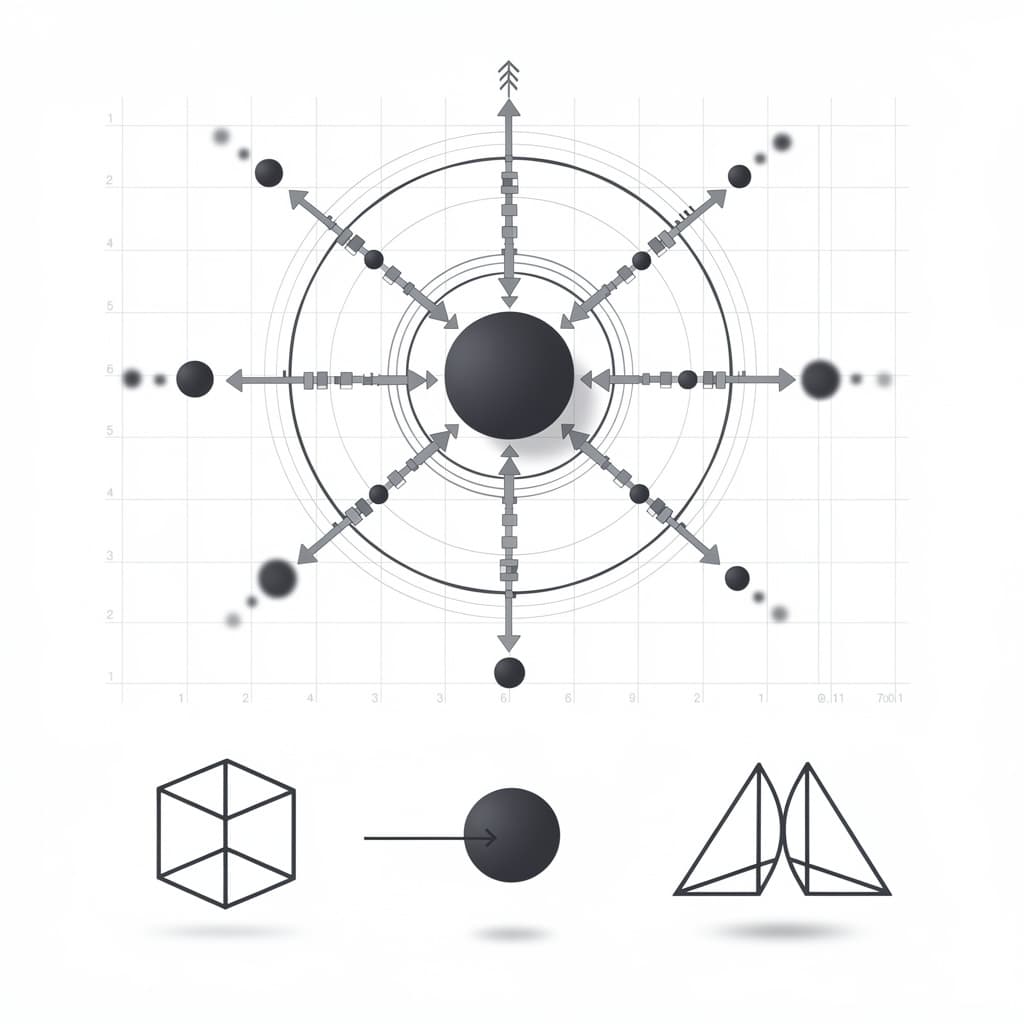
The publication of Isaac Newton’s Philosophiæ Naturalis Principia Mathematica in 1687 marked a definitive turning point in human history, signaling the birth of classical mechanics and the end of the Aristotelian worldview. By synthesizing the observations of Galileo and Kepler into a unified mathematical framework, Newton provided the first comprehensive explanation of how objects move both on Earth and in the heavens. Central to this framework are newton's laws of motion, which describe the relationship between the forces acting on a body and its resulting motion through space. These three axioms do more than provide a set of formulas; they establish a logical grammar for the physical universe, allowing us to predict the trajectory of a baseball or the orbit of a planet with identical precision. Today, these principles remain the cornerstone of engineering and physics, serving as the essential toolkit for understanding the mechanical reality of our daily lives.
The Concept of Passive Resistance
Defining the Physical State of Motion
In the centuries preceding the Enlightenment, the prevailing wisdom suggested that the natural state of an object was to be at rest. It was believed that motion required a continuous application of force, an idea derived from everyday observations where friction and air resistance eventually stop any moving object. Newton’s First Law, often called the Law of Inertia, challenged this by asserting that a body at rest stays at rest, and a body in motion stays in motion with a constant velocity unless acted upon by an external force. This shift in perspective redefined "rest" as merely one specific state of motion—where velocity equals zero—rather than a privileged or fundamental condition of matter. Inertia, therefore, is the inherent property of matter that resists changes to its current state of movement.
To understand the logic of inertia, one must view motion not as an active process that requires energy to maintain, but as a passive state that persists until interrupted. This means that if you were to slide a block across an infinite, frictionless plane, it would continue traveling forever without the need for a sustained push. The "resistance" we observe in the real world is not the object trying to return to a natural state of rest, but rather the result of hidden forces like friction or gravity acting against it. By decoupling the concept of motion from the concept of "effort," Newton allowed scientists to treat velocity as a vector quantity that remains conserved in a closed system. This conservation is fundamental to the predictive power of classical mechanics, ensuring that every change in speed or direction has a quantifiable cause.
Newton's First Law Examples in Vacuum and Air
The distinction between theoretical motion and practical observation is best illustrated through newton's first law examples across different environments. In the near-vacuum of outer space, an interstellar probe like Voyager 1 continues to travel at tens of thousands of miles per hour despite having exhausted its primary fuel decades ago. Without the molecules of an atmosphere to provide drag or the proximity of a large mass to exert significant gravitational pull, the probe’s inertia maintains its velocity indefinitely. This demonstrates the "purity" of the First Law, where the absence of external interaction results in a perfect persistence of motion. In such an environment, the logic of inertia is laid bare, proving that motion is a self-sustaining state rather than a fading impulse.
Contrast this with motion within Earth’s atmosphere, where the presence of air molecules and surface textures creates a constant "noise" of external forces. When a soccer ball is kicked across a field, it eventually slows to a stop, which might superficially appear to contradict the First Law. However, the logic holds because the ball is being bombarded by air resistance (fluid friction) and experiencing kinetic friction from the grass. Each of these interactions represents a "net force" that opposes the ball’s motion, effectively "stealing" its kinetic energy until it reaches a state of rest relative to the ground. Engineering modern vehicles requires a deep understanding of these opposing forces, as designers must minimize drag to allow inertia to do as much work as possible, thereby increasing fuel efficiency.
The Proportionality of Force and Mass
Breaking Down the F=ma Formula
If the First Law establishes that a force is required to change motion, the Second Law quantifies exactly how that change occurs. The F=ma formula is perhaps the most famous equation in all of physics, stating that the force ($F$) applied to an object is equal to the mass ($m$) of that object multiplied by its acceleration ($a$). This relationship reveals that acceleration is directly proportional to the net force and inversely proportional to the mass. In practical terms, this means that if you apply the same amount of force to a small pebble and a massive boulder, the pebble will experience a much higher acceleration. Mass, in this context, functions as a quantitative measure of inertia—the more mass an object has, the more "force" is required to change its velocity.
It is important to recognize that $F$ in the equation represents the net force, which is the vector sum of all forces acting upon the body. If two people push a car from opposite sides with equal strength, the net force is zero, and despite the "effort" being expended, the car's acceleration remains zero. The Second Law also defines the standard unit of force, the Newton (N), which is the amount of force required to accelerate one kilogram of mass at a rate of one meter per second squared ($1\text{ N} = 1\text{ kg} \cdot \text{m/s}^2$). This mathematical precision allows for the transition from qualitative descriptions of "pushes and pulls" to a rigorous calculus of motion. By isolating these variables, scientists can calculate the exact force needed to launch a satellite into a specific orbit or the braking force required to stop a high-speed train.
Variable Mass and Constant Acceleration
While the standard form of the Second Law assumes a constant mass, Newton’s original formulation was actually more comprehensive, defining force as the rate of change of momentum. This is expressed as $$F = \frac{d(mv)}{dt}$$, which becomes particularly relevant in systems where mass is not constant, such as rocketry. As a rocket ascends, it burns massive amounts of fuel, meaning its total mass decreases significantly over time. If the engine provides a constant thrust (force), the rocket’s acceleration will actually increase as it gets lighter, following the logic of the $F=ma$ relationship. This nuance is critical for aerospace engineers who must account for the changing mass-to-thrust ratio to ensure the vehicle reaches the necessary escape velocity without overstressing the airframe.
In scenarios involving constant acceleration, the Second Law allows us to predict the future state of an object with absolute certainty, provided we know its initial conditions. For instance, an object in free fall near the Earth's surface experiences a constant gravitational force, resulting in a steady acceleration of approximately $9.8\text{ m/s}^2$. Because the force of gravity scales with mass ($F = mg$), the mass term cancels out in the $F=ma$ equation ($mg = ma$), leading to the famous discovery that all objects fall at the same rate regardless of their weight (ignoring air resistance). This consistency across different scales of matter demonstrates the "universal logic" of Newton’s laws, showing how a single equation can govern the behavior of both microscopic particles and macroscopic celestial bodies. Such predictability forms the basis of the deterministic "clockwork universe" model that dominated scientific thought for over two centuries.
The Interplay of Inertia and Momentum
Defining Momentum as a Vector Quantity
To fully grasp the dynamics of motion, one must look beyond individual forces and consider the concept of inertia and momentum. While inertia is a static property related to mass, momentum—often denoted by the symbol $p$—is a measure of an object’s "quantity of motion." Defined as the product of mass and velocity ($p = mv$), momentum is a vector quantity, meaning it has both a magnitude and a direction. A slow-moving freight train and a fast-moving bullet might have the same momentum because the train's massive weight compensates for its low speed, while the bullet's high speed compensates for its tiny mass. Understanding this interplay is vital because it determines how objects interact during collisions and how they resist changes in their path.
The vector nature of momentum means that changing the direction of an object is just as significant as changing its speed. Even if an object maintains a constant speed, any change in its direction requires an external force because its momentum vector is being altered. This is why a car traveling at a constant speed around a curve still requires friction between the tires and the road; the force of friction provides the centripetal acceleration necessary to rotate the momentum vector. If that friction disappears—such as on an icy patch—the car’s inertia will cause it to continue traveling in a straight line, following the original direction of its momentum. This persistence highlights the "stubbornness" of moving matter, a principle that governs everything from the flow of fluids in pipes to the stability of spinning tops.
Persistence of Motion in Linear Systems
In linear systems where no external forces are present, the total momentum of the system remains constant, a principle known as the Law of Conservation of Momentum. This is a direct consequence of Newton's laws and serves as one of the most powerful tools in physics for analyzing complex interactions. When two billiard balls collide, the individual momentum of each ball changes, but the sum of their momenta before the collision is exactly equal to the sum after the collision. This conservation law allows physicists to solve problems involving explosions, collisions, and propulsion without needing to know the intricate details of the forces acting during the brief moment of contact. It simplifies the universe into a series of "before and after" states that are linked by rigid mathematical symmetries.
The logic of momentum persistence is also what makes safety features like airbags and crumble zones effective in modern automobiles. According to the impulse-momentum theorem, the change in momentum of an object is equal to the force applied multiplied by the time over which it acts ($F \cdot \Delta t = \Delta p$). In a car crash, the change in momentum is fixed by the car's initial speed and final stop. By increasing the time it takes for the passenger to come to a halt (via an inflating airbag), the "impact force" is significantly reduced, sparing the human body from fatal acceleration. This application of Newtonian logic saves thousands of lives annually, proving that these 17th-century laws are not just academic abstractions but essential components of modern safety engineering.
The Reciprocity of Physical Interactions
Mechanics of the Action-Reaction Principle
Newton’s Third Law is perhaps the most frequently misunderstood, yet it is the most essential for understanding how objects interact with one another. The action-reaction principle states that for every action, there is an equal and opposite reaction. Critically, these forces always act on different bodies, which is why they do not cancel each other out. When you push against a wall, the wall pushes back on you with an identical amount of force in the opposite direction. You do not move the wall because the wall is anchored and has massive inertia, but you might feel the pressure on your hand or even slide backward if you are on a low-friction surface. This reciprocity ensures that forces always exist in pairs; there is no such thing as a "lone" force in the universe.
This principle of reciprocity is what enables locomotion in any environment. To walk forward, you must push backward on the ground with your feet; the ground, in turn, pushes you forward with an equal force. Similarly, a bird flies by pushing air downward and backward with its wings, and the air responds by pushing the bird upward and forward. In the vacuum of space, where there is no ground to push against or air to move, a rocket must expel high-velocity exhaust gases out of its nozzle. The action of the engine pushing the gas backward creates the reaction of the gas pushing the rocket forward. This highlights a fundamental truth: to move in one direction, you must interact with something else and push it in the opposite direction.
Identifying Interaction Pairs in Complex Systems
Identifying these interaction pairs can be challenging in complex systems where multiple forces are at play. Consider a book resting on a table: the Earth pulls down on the book (gravity), and the book pulls up on the Earth with the same force. Simultaneously, the book pushes down on the table, and the table pushes up on the book with an equal "normal force." It is a common error to think the downward gravity and the upward normal force on the book are an action-reaction pair because they are equal and opposite. In reality, they are two different forces acting on the same body; the true reaction to the Earth's gravity on the book is the book's gravity on the Earth. Correctly identifying these pairs is essential for structural analysis and mechanical design.
In mechanical engineering, the Third Law is used to calculate the loads on joints, bearings, and supports. For example, in a bridge, every beam that supports a weight must be supported by a reaction force from the piers or the ground. If a beam exerts a force of 10,000 Newtons on a pillar, the pillar must be capable of exerting 10,000 Newtons of reaction force without failing. This internal consistency allows engineers to map out the "flow" of forces through a structure, ensuring that every action is accounted for and balanced. By viewing the world as a network of reciprocal interactions, we can build massive skyscrapers and delicate instruments that remain stable under varying conditions, all by respecting the symmetry of Newtonian mechanics.
Laws of Motion Applications in Engineering
Ballistics and Projectile Trajectories
One of the most immediate laws of motion applications is found in the field of ballistics, which studies the flight of projectiles. When a projectile is launched, it is subject to the First Law in the horizontal direction (maintaining its velocity, barring air resistance) and the Second Law in the vertical direction (accelerating downward due to gravity). This combination of independent horizontal and vertical motions results in a parabolic trajectory. By applying the formula $d = v_0 t + \frac{1}{2}at^2$, engineers can calculate exactly where a projectile will land based on its initial launch angle and velocity. This math is used not only in military applications but also in sports science to optimize the path of a basketball or a javelin.
Modern ballistics must also account for the Third Law during the launch phase. When a heavy artillery piece fires a shell, the "action" of the expanding gases pushing the shell forward creates a massive "reaction" force that pushes the gun backward. This is known as recoil, and without sophisticated damping systems to absorb this energy, the gun carriage would be destroyed or flipped over. Engineers design hydraulic buffers and muzzle brakes specifically to manage these reaction forces, redirecting the energy to ensure the stability of the platform. The ability to predict and compensate for these forces is what separates modern precision engineering from the trial-and-error methods of the pre-Newtonian era.
Structural Integrity and Static Equilibrium
Newton’s laws are just as relevant to objects that are not moving as they are to those that are. In the field of statics, engineers use the Second Law to ensure that the net force on a structure is exactly zero ($\sum F = 0$). For a building to remain standing, the upward support forces from the foundation must perfectly balance the downward forces of gravity acting on the building’s mass and the people inside it. If the net force were anything other than zero, the building would accelerate—meaning it would collapse or sink. This condition of static equilibrium is the foundational requirement for all civil engineering, from the smallest residential home to the largest suspension bridge.
Furthermore, engineers must consider the "moments" or torques acting on a structure, which is a rotational extension of Newtonian logic. Just as a net force causes linear acceleration, a net torque causes angular acceleration. To keep a crane from tipping over while lifting a heavy load, engineers calculate the counterweights needed to ensure the net torque around the pivot point is zero. This application of the Second Law to rotation ensures that structures remain balanced even when subjected to asymmetrical loads or wind pressures. By meticulously balancing actions and reactions, engineers create the "invisible stability" that allows our modern urban environments to exist in a state of permanent, safe rest.
| Law of Motion | Core Concept | Engineering Application |
|---|---|---|
| First Law (Inertia) | Objects resist changes in motion. | Spacecraft trajectory and fuel efficiency. |
| Second Law ($F=ma$) | Force equals mass times acceleration. | Automotive engine power and braking systems. |
| Third Law (Reciprocity) | Action and reaction forces are equal/opposite. | Jet propulsion and structural load balancing. |
Universal Constraints on Classical Motion
Frame of Reference and Relative Velocity
A critical but often overlooked aspect of Newton’s laws is the concept of the frame of reference. Newton assumed the existence of an "absolute space" and "absolute time," providing a fixed background against which all motion could be measured. In practical physics, we use "inertial frames of reference"—coordinates that are not themselves accelerating. For example, if you toss a ball inside a moving train, the ball follows the same $F=ma$ logic relative to you as it would if you were standing on the ground. However, an observer standing outside the train would see the ball moving at the speed of the toss plus the speed of the train. This Galilean Relativity allows us to translate motion between different perspectives without changing the underlying physical laws.
The logic remains consistent as long as the frames of reference are moving at a constant velocity. If a frame begins to accelerate—such as a car braking sharply—objects inside appear to be "pushed" by mysterious "fictitious forces" (like the force that slams you into the seatbelt). In reality, there is no new force; your inertia is simply trying to maintain your previous constant velocity while the car accelerates away from that state. Understanding these relative velocities is essential for everything from GPS satellite synchronization to the navigation of ships at sea. It reminds us that motion is always measured "relative" to something else, even if the laws governing that motion remain universal and unchanging.
The Transition to Relativistic Mechanics
While Newton's laws are remarkably accurate for the vast majority of human experiences, they are ultimately an approximation of a deeper reality. As objects approach the speed of light, Newtonian logic begins to break down, and the effects of Albert Einstein’s Special Relativity take over. In the relativistic regime, mass is not a constant; it increases with velocity, and time itself dilates, meaning that the simple $F=ma$ formula no longer provides an accurate prediction. Similarly, on the scale of atoms and subatomic particles, Quantum Mechanics replaces the deterministic paths of Newton with a landscape of probabilities and wavefunctions. Newton’s laws, therefore, describe the "middle world"—the scale of things that are not too small, not too fast, and not too massive.
Despite these limits, the transition to modern physics did not "prove Newton wrong"; rather, it defined the boundaries of where his laws apply. For building bridges, flying planes, and sending humans to the moon, the logic of Newton is more than sufficient—it is effectively perfect. Classical mechanics remains the primary language of the physical world because it is intuitive, mathematically elegant, and highly functional for the scales at which we live our lives. Newton’s laws provided the first great synthesis of physical reality, proving that the universe is not a place of chaos or divine whim, but a system of logical, predictable, and universal laws that can be understood and harnessed by the human mind. The legacy of this "universal logic" continues to drive every innovation in the physical sciences and engineering to this day.
References
- Newton, I., "Philosophiæ Naturalis Principia Mathematica", Joseph Streater, 1687.
- Halliday, D., Resnick, R., & Walker, J., "Fundamentals of Physics", Wiley, 2013.
- Feynman, R. P., Leighton, R. B., & Sands, M., "The Feynman Lectures on Physics, Vol. 1", California Institute of Technology, 1963.
- Goldstein, H., "Classical Mechanics", Addison-Wesley, 1980.
Recommended Readings
- The Principia: Mathematical Principles of Natural Philosophy by Isaac Newton — The foundational text that started it all, essential for those who want to see the original geometric proofs of motion.
- The Character of Physical Law by Richard Feynman — A series of lectures that explores the profound nature and elegance of physical laws, including why Newton's laws are so fundamental.
- Classical Mechanics by John R. Taylor — A modern, highly-regarded textbook that builds from Newton's laws into more advanced concepts like Lagrangian and Hamiltonian mechanics.
- Isaac Newton by James Gleick — A brilliant biography that provides historical and personal context to Newton's monumental scientific achievements.