earth science10 min read
The Tectonic Logic of Earth's Lithosphere
The theory of plate tectonics serves as the unifying paradigm of modern geology, providing a coherent framework for understanding the Earth’s surface dynamics, seismic activity, and the long-term...
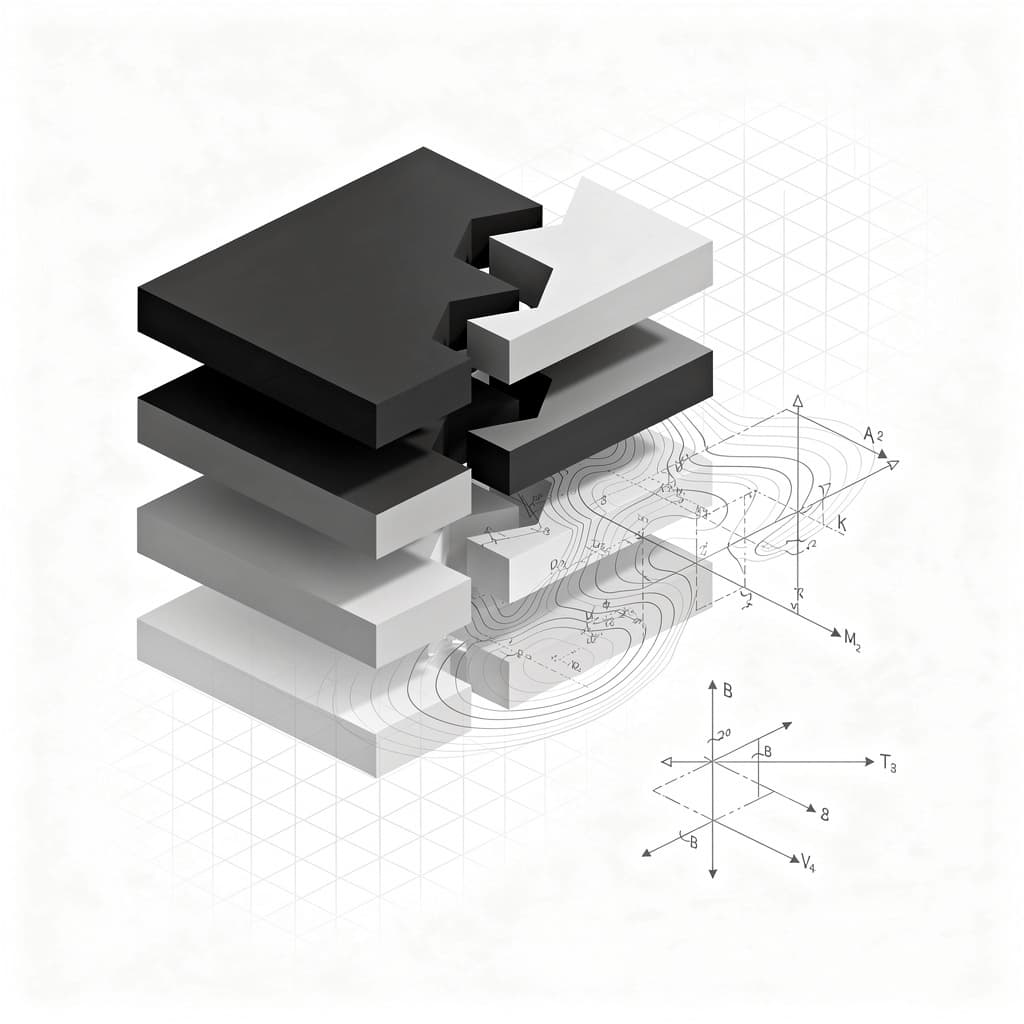
The theory of plate tectonics serves as the unifying paradigm of modern geology, providing a coherent framework for understanding the Earth’s surface dynamics, seismic activity, and the long-term evolution of continents. It posits that the Earth's rigid outer shell is divided into a mosaic of discrete plates that glide over a ductile underlying layer, driven by the internal heat of the planet. This article explores the mechanical foundations of the lithosphere, the historical evidence for continental drift, the mechanisms of seafloor spreading, and the diverse interactions at plate boundaries that sculpt the terrestrial landscape.
The Composition of the Global Lithosphere
The Earth is characterized by a distinct mechanical layering that differs significantly from its chemical layering of crust, mantle, and core. The lithosphere constitutes the planet's outermost, rigid shell, encompassing the crust and the uppermost portion of the mantle that behaves as a brittle solid. Beneath this lies the asthenosphere, a region of the upper mantle where high temperatures and pressures allow rock to behave in a plastic, semi-molten manner. This rheological transition is crucial because it allows the cooler, stronger lithospheric plates to decouple from the deeper mantle and move independently over geological timescales. The interaction between these two layers is governed by thermal and mechanical equilibrium, where the lithosphere acts as a conductive thermal boundary layer. As oceanic lithosphere ages, it cools and thickens, eventually becoming denser than the underlying asthenosphere, a factor that plays a primary role in the initiation of subduction. The global tectonic grid is comprised of approximately seven or eight major plates, such as the Pacific and African plates, alongside numerous minor plates like the Nazca and Juan de Fuca plates. These plates are not static; they are in constant, slow-motion flux, with their boundaries defined by intense geological activity including earthquakes, volcanism, and mountain building. Defining the boundaries of this tectonic grid requires precise geological mapping and seismic monitoring to identify where relative motion occurs. These boundaries are not merely lines on a map but complex zones of deformation where the mechanical strength of the lithosphere is tested by immense tectonic forces. While the interiors of plates are generally stable and geologically quiet, the margins are the primary sites of mass and energy exchange between the Earth's interior and surface. Understanding this spatial arrangement is the first step in decoding the complex logic that dictates the movement of our planet's surface.Continental Drift Theory Evidence and Origins
The origins of tectonic theory trace back to the early 20th century with Alfred Wegener’s continental drift theory evidence. Wegener, a German meteorologist, proposed in 1912 that the continents were once joined in a single supercontinent he named Pangea. His primary evidence was the striking geometric fit of the South American and African coastlines, which appeared to link together like pieces of a jigsaw puzzle. He further bolstered his hypothesis by identifying identical fossil remains, such as the freshwater reptile Mesosaurus and the fern Glossopteris, on landmasses separated by vast oceans that these organisms could not have crossed. Beyond biological clues, Wegener utilized paleoclimatic indicators to support his claims of wandering continents. He observed glacial striations—scratches in bedrock carved by moving ice—in tropical regions of India and Africa, suggesting these areas were once located near the South Pole. Conversely, he found coal deposits, which form in lush tropical swamps, in currently frigid regions of North America and Europe. These anomalies suggested that the continents had shifted their latitudinal positions significantly over hundreds of millions of years, moving through various climatic zones. Despite the compelling nature of this qualitative evidence, Wegener’s hypothesis was largely rejected by the scientific community of his time because he lacked a plausible physical mechanism for how continents could plow through the solid ocean floor. He initially suggested tidal forces or the "pole-fleeing force," both of which were mathematically proven to be far too weak to move massive crustal blocks. It was not until the mid-20th century, with the exploration of the deep sea and the discovery of the seafloor spreading mechanism, that the scientific world finally embraced the reality of a mobile lithosphere.The Seafloor Spreading Mechanism
The breakthrough that validated Wegener's intuition came from the study of the ocean floor, specifically through the discovery of paleomagnetism. Scientists discovered that the Earth’s magnetic field periodically undergoes geomagnetic reversals, where the magnetic north and south poles swap positions. As basaltic magma rises at mid-ocean ridges and cools, magnetite crystals align with the current magnetic field, "locking in" the polarity of the time. This process creates a symmetrical pattern of magnetic "stripes" on either side of the ridge, acting as a natural tape recorder of the Earth's magnetic history and confirming that new crust is being created and pushed outward. The topography of mid-oceanic ridge systems further supported the concept of a dynamic seafloor. These underwater mountain ranges, such as the Mid-Atlantic Ridge, represent the sites of divergent boundaries where the lithosphere is being pulled apart. Extensive mapping revealed that the central axes of these ridges often contain rift valleys, which are characteristic of extensional forces. This topographic data provided a physical context for the volcanic activity and hydrothermal venting observed at these sites, identifying them as the "factories" of new oceanic crust. Crucially, the age gradients in the oceanic crust provided the final confirmation of spreading. Drilling projects, such as the Glomar Challenger expeditions, revealed that the youngest rocks are always located at the ridge crests, while the rocks become progressively older as one moves toward the continental margins. No oceanic crust was found to be older than approximately 200 million years, which is remarkably young compared to the 4-billion-billion-year-old continental rocks. This age discrepancy implies that oceanic crust is continuously recycled into the mantle at subduction zones, maintaining a steady-state balance of the Earth's surface area.Dynamics of Mantle Convection Currents
The primary engine driving the movement of tectonic plates is the presence of mantle convection currents. This process is driven by the internal heat of the Earth, which originates from the decay of radioactive isotopes and primordial heat left over from the planet's formation. This heat creates a thermal gradient, causing material in the lower mantle to become less dense and rise toward the surface. As it reaches the cooler upper mantle, it spreads out laterally, loses heat, and eventually sinks back down, creating a continuous, viscous flow of solid-state rock. While convection provides the broad framework for movement, the specific physics of plate motion involve two localized forces: slab pull and ridge push. Slab pull is currently considered the more significant of the two; it occurs when the cold, dense edge of a subducting plate sinks into the asthenosphere, pulling the rest of the plate along with it due to gravity. Ridge push, conversely, is a gravitational force that occurs at mid-ocean ridges, where the elevated position of the ridge causes the lithosphere to slide "downhill" away from the axis. The net velocity of a plate can be conceptually modeled by the sum of these forces:$$V_{plate} = F_{slab\_pull} + F_{ridge\_push} - F_{mantle\_drag}$$
In addition to large-scale convection cells, the Earth's interior exhibits upwelling mantle plumes that operate independently of plate boundaries. These plumes originate from deep within the mantle, possibly as deep as the core-mantle boundary, and rise to the surface to create hotspot volcanism. Notable examples include the Hawaiian Islands and Yellowstone, where the movement of a lithospheric plate over a stationary plume creates a linear chain of volcanic centers. These hotspots provide a valuable reference frame for calculating the absolute motion of plates over long geological durations.Defining Types of Plate Boundaries
The interactions between tectonic plates occur at their margins, which are categorized into three primary types of plate boundaries: divergent, convergent, and transform. Each type is defined by the relative motion of the plates and results in distinct geological features and hazards. Divergent margins occur where plates move away from each other, leading to the formation of nascent ocean basins. This process typically begins with continental rifting, as seen in the East African Rift, where the crust thins and eventually fractures, allowing magma to reach the surface and initiate seafloor spreading. Convergent intersections occur where two plates move toward each other, resulting in the destruction or deformation of lithosphere. If at least one of the plates is oceanic, it will typically be forced beneath the other in a process known as subduction. This leads to the formation of deep-ocean trenches and volcanic arcs, such as the Aleutian Trench or the Andes mountains. In cases where two continental plates collide, neither is dense enough to subduct deeply, resulting in massive crustal thickening and the formation of high mountain ranges like the Himalayas. Transform faults represent the third type of boundary, where plates slide horizontally past one another without the creation or destruction of lithosphere. These are also known as conservative margins because the total surface area of the plates remains constant. The movement along transform faults is often characterized by a "stick-slip" behavior, where friction prevents motion until the accumulated stress exceeds the rock's strength, resulting in sudden seismic activity. The San Andreas Fault in California is the most famous example of this boundary type, facilitating the relative motion between the Pacific and North American plates.Convergent Divergent and Transform Boundaries
The study of convergent divergent and transform boundaries reveals the structural complexity of the Earth's surface. At convergent zones, orogenic belts and mountain building processes are the dominant features. When oceanic lithosphere subducts, the introduction of water into the mantle lowers the melting point of the overlying wedge, causing flux melting. This creates magma that rises to form volcanic island arcs if the overriding plate is oceanic, or continental volcanic arcs if the overriding plate is a continent. These regions are the most geologically violent on Earth, producing the largest earthquakes and most explosive volcanic eruptions. In contrast, divergent boundaries are characterized by a more constructive geological environment. As the lithosphere pulls apart, the underlying asthenosphere undergoes decompression melting, producing basaltic magma that creates new crust. This process is responsible for the formation of the world's great ocean basins over millions of years. The Atlantic Ocean, for instance, began as a rift between Pangea’s components and has been expanding for approximately 180 million years. These margins are generally associated with frequent but lower-magnitude earthquakes and relatively non-explosive, effusive volcanism. Transform boundaries are unique because they lack the significant volcanic activity found at the other two types. Instead, the primary geological expression is intense seismic activity along conservative margins. Transform faults often connect segments of mid-ocean ridges, zigzagging across the ocean floor to accommodate the geometry of a spherical Earth. When these faults occur on land, they can cut through major population centers, making the study of their slip rates and earthquake recurrence intervals a vital aspect of public safety and urban planning. The displacement along these faults can be measured in hundreds of kilometers over millions of years.Geodetic Observation and Modern Kinematics
In the modern era, our understanding of plate tectonics has transitioned from qualitative descriptions to high-precision quantitative measurements. Space geodesy, utilizing technologies such as Very Long Baseline Interferometry (VLBI) and Global Positioning Systems (GPS), allows scientists to monitor plate movements in real-time. By placing permanent GPS stations on various plates, researchers can measure relative positions with millimeter-level accuracy. These data confirm that plates move at rates typically ranging from 1 to 15 centimeters per year, roughly the speed at which human fingernails grow. These geodetic measurements are essential for calculating relative plate velocity vectors and predicting future tectonic configurations. By analyzing the current velocity and direction of plates, geophysicists can reconstruct the historical positions of continents and project their future movements. This kinematic data also helps in understanding the deformation occurring within plate interiors, which is often more complex than the rigid-body rotation assumed by early tectonic models. The relationship between plate velocity ($v$), displacement ($d$), and time ($t$) is expressed by the fundamental kinematic equation:$$v = \frac{d}{t}$$
The long-term evolution of the Earth's surface is characterized by the supercontinent cycle, also known as the Wilson Cycle. This cycle describes the periodic aggregation and dispersal of the Earth's continental crust. Over hundreds of millions of years, continents collide to form a single landmass, which eventually insulates the mantle beneath it, leading to rifting and the birth of new oceans. This cyclical process has occurred multiple times in Earth's history, with Pangea being only the most recent example. Understanding these grand patterns allows geologists to view the Earth not as a static object, but as a living, breathing system of interconnected physical processes.References
- Kearey, P., Klepeis, K. A., & Vine, F. J., "Global Tectonics", Wiley-Blackwell, 2009.
- Turcotte, D. L., & Schubert, G., "Geodynamics", Cambridge University Press, 2014.
- Wegener, A., "The Origin of Continents and Oceans", Dover Publications, 1966 (Original work published 1915).
- Hess, H. H., "History of Ocean Basins", Geological Society of America, 1962.
- Vine, F. J., & Matthews, D. H., "Magnetic Anomalies Over Oceanic Ridges", Nature, 1963.
Recommended Readings
- The Ninth Annual Report of the United States Geological Survey by John Wesley Powell — A foundational look at the early geological surveys that paved the way for modern tectonic thought.
- Annals of the Former World by John McPhee — A Pulitzer Prize-winning narrative that weaves the story of North American geology with the human history of its discovery.
- The Map That Changed the World by Simon Winchester — A fascinating account of William Smith and the birth of modern geology through the creation of the first geological map.
- Plate Tectonics: A Very Short Introduction by Peter Molnar — A concise yet technically rigorous overview of the forces and history of the tectonic theory.
plate tectonicstypes of plate boundariesconvergent divergent and transform boundariescontinental drift theory evidenceseafloor spreading mechanismmantle convection currents