The Systematic Logic of Stoichiometry
The study of stoichiometry serves as the mathematical backbone of all chemical science, providing a rigorous framework for quantifying the relationships between the substances consumed and produced...
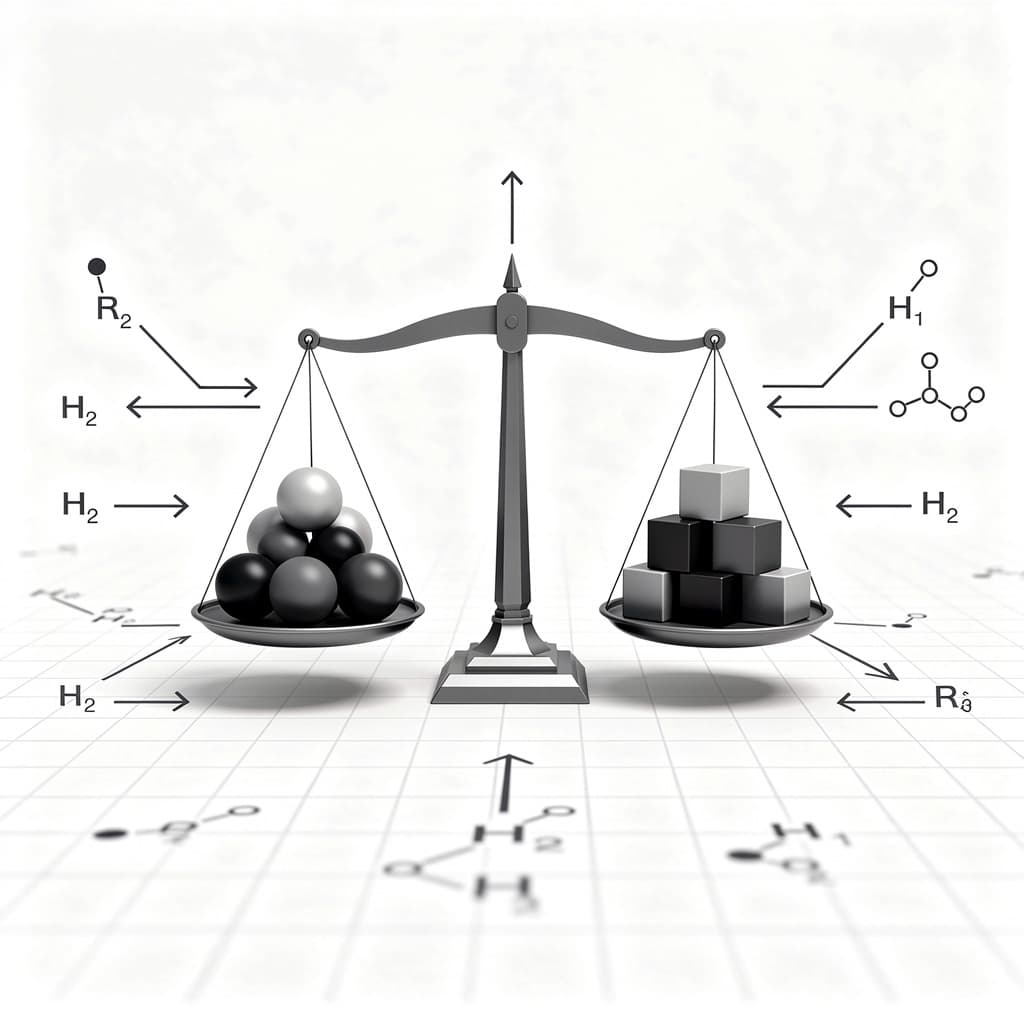
The study of stoichiometry serves as the mathematical backbone of all chemical science, providing a rigorous framework for quantifying the relationships between the substances consumed and produced during a chemical reaction. Derived from the Greek words stoicheion (element) and metron (measure), the discipline allows scientists to predict the exact quantities of matter required to achieve a desired outcome without waste. At its core, stoichiometry is a manifestation of the underlying order of the universe, demonstrating that chemical transformations are not chaotic events but are governed by precise, predictable numerical ratios. Whether one is calculating the amount of fuel needed for a spacecraft or determining the dosage of a pharmaceutical compound, the principles of stoichiometric logic remain the same. This article explores the systematic progression of these concepts, from the fundamental conservation laws to the complexities of industrial-scale efficiency and energy exchange.
The Foundation of Chemical Proportions
The intellectual genesis of stoichiometry lies in the Law of Conservation of Mass, a principle famously formalised by the French chemist Antoine Lavoisier in the late 18th century. Lavoisier demonstrated through meticulous experimentation that in a closed system, the mass of the products must exactly equal the mass of the reactants, regardless of the physical changes occurring. This fundamental truth implies that atoms are neither created nor destroyed during a reaction; they are merely rearranged into new configurations. Because the mass of an individual atom is constant, the total number of atoms of each element must be conserved, providing the essential constraint that permits chemical equations to be balanced. Understanding this conservation is the first step in moving from qualitative observation to quantitative prediction in the laboratory.
Once a chemical equation is balanced, it serves as a mathematical blueprint for the reaction, indicating the relative amounts of each substance involved. These coefficients in the balanced equation represent particles at the atomic level, but they translate directly to the macroscopic world through the concept of the mole. A balanced equation like $2\text{H}_2 + \text{O}_2 \rightarrow 2\text{H}_2\text{O}$ tells us not just that hydrogen and oxygen make water, but specifically that two units of hydrogen react with one unit of oxygen to produce two units of water. This proportionality is universal, meaning it holds true whether one is dealing with individual molecules or millions of kilograms of industrial chemicals. Consequently, the balanced equation is the indispensable starting point for any stoichiometric calculation, as it defines the stoichiometry of the entire process.
The most critical derivation from the balanced equation is the concept of mole to mole ratios. These ratios act as conversion factors that allow a chemist to bridge the gap between different substances in a reaction, converting the known quantity of one reactant into the required quantity of another. For instance, in the synthesis of ammonia ($N_2 + 3H_2 \rightarrow 2NH_3$), the ratio of hydrogen to ammonia is $3:2$. This numerical relationship dictates that for every 3 moles of hydrogen consumed, exactly 2 moles of ammonia will be produced under ideal conditions. By viewing these ratios as fixed constants of the reaction, we can manipulate them algebraically to solve complex problems involving multiple stages of chemical transformation.
The Core Mechanism of Stoichiometry
The practical application of stoichiometry requires a reliable method for converting measurable physical quantities, such as mass, into the counts of particles that participate in reactions. Because atoms are far too small to count individually, chemists use the molar mass of a substance—expressed in grams per mole—as a conversion factor to determine the number of moles present in a given sample. This step is non-negotiable because chemical reactions proceed based on the number of molecules interacting, not based on their relative weights. For example, 10 grams of lead contains significantly fewer atoms than 10 grams of lithium because lead atoms are much heavier. Therefore, the transition from mass to molar quantities is the essential bridge that brings laboratory measurements into the realm of stoichiometric ratios.
To ensure accuracy and prevent errors during these calculations, scientists employ dimensional analysis, also known as the factor-label method. This technique involves stringing together a series of conversion factors such that the units of the previous step cancel out, leaving only the desired unit for the final answer. By treating units as algebraic variables, one can verify the logic of a calculation at every stage; if the final units do not match the expected physical property, it is a clear indicator of a mistake in the setup. This systematic approach eliminates the need for memorizing dozens of specific formulas, replacing them with a single, coherent logic of unit consistency. It is the gold standard for pedagogical and professional practice in the chemical sciences.
When learning how to do stoichiometry, one should follow a standardized four-step process to ensure no variables are overlooked. First, write the correct chemical formulas for all reactants and products and balance the equation to establish the molar ratios. Second, convert the given mass or volume of the starting substance into moles using its molar mass or molar volume. Third, apply the mole-to-mole ratio from the balanced equation to find the moles of the target substance. Finally, convert the moles of the target substance back into the desired unit, such as grams, liters, or particles. By adhering to this sequence, one can navigate even the most daunting multi-step reactions with confidence and precision.
Constraints in Chemical Transformations
In a real-world setting, reactants are rarely present in the exact proportions required by the balanced equation, leading to the concept of the limiting reactant. This substance is the reactant that is entirely consumed first, thereby dictating the maximum amount of product that can be formed. Just as a sandwich shop might have 100 slices of bread but only 10 slices of cheese, the cheese limits the number of sandwiches that can be made, regardless of how much bread remains. Identifying the limiting reactant is crucial for economic efficiency in industry, as it prevents the unnecessary waste of expensive chemicals while ensuring that the intended reaction goes to completion. Without this identification, a chemist cannot accurately predict the final yield of a process.
The substances that remain after the limiting reactant is exhausted are known as excess reagents. While these surplus materials do not contribute to the final product count once the limit is reached, their presence can be strategically useful in a laboratory or industrial context. Sometimes, an excess of one reactant is used to drive a reaction faster or to ensure that every last molecule of a more expensive or toxic limiting reactant is fully consumed. Calculating the amount of excess reagent remaining after a reaction requires subtracting the amount consumed (determined by the limiting reactant) from the initial amount provided. This accounting of "surplus matter" is a vital part of mass balance calculations in chemical engineering.
Predicting reaction completion involves comparing the initial molar quantities of all reactants against their required ratios. To find the limiting reactant, one should calculate the theoretical amount of product that each reactant could produce if it were the only limiting factor. The reactant that yields the smallest amount of product is, by definition, the limiting one. This method is mathematically superior to simply looking at which reactant has the smallest mass, as mass does not account for the molar mass or the coefficients of the balanced equation. Through this quantitative analysis, chemists can troubleshoot failed reactions and optimize the loading of reactors for maximum output.
Quantifying the Limits of Efficiency
In the idealized world of a balanced equation, every atom perfectly finds its partner to create a product, a result known as the theoretical yield. This value represents the maximum possible mass of product that can be generated based on the stoichiometric calculations of the limiting reactant. It assumes that the reaction goes to 100 percent completion, that no side reactions occur, and that every milligram of product is successfully recovered during filtration or purification. While the theoretical yield serves as a vital benchmark for what is possible under perfect conditions, it is almost never achieved in a physical laboratory or industrial plant due to the inherent complexities of matter.
Realistic losses in laboratory settings occur due to a variety of mechanical and chemical factors that deviate from the stoichiometric ideal. Some reactions are "reversible," meaning they reach a state of equilibrium where products begin to turn back into reactants before the process is finished. Additionally, side reactions may occur, where the reactants combine in unintended ways to form byproducts that are not the desired goal. Mechanical loss also plays a role, as material can be left behind on the walls of beakers, trapped in filter paper, or lost during the transfer between containers. Acknowledging these discrepancies is essential for any professional chemist, as it shifts the focus from theoretical perfection to practical optimization.
To quantify how close a reaction came to its ideal outcome, scientists use the percent yield formula, which expresses the efficiency of a chemical process as a percentage. The formula is defined as:
$$\text{Percent Yield} = \left( \frac{\text{Actual Yield}}{\text{Theoretical Yield}} \right) \times 100\%$$
A high percent yield indicates a highly efficient process with minimal waste, which is the primary goal in the manufacturing of pharmaceuticals and fine chemicals where costs are significant. Conversely, a low percent yield signals that the experimental conditions—such as temperature, pressure, or catalyst choice—may need to be adjusted to favor the production of the desired substance. By consistently applying this formula, researchers can refine their techniques and improve the sustainability of chemical production over time.Advanced Gas Phase and Solution Stoichiometry
When reactions involve gases, the logic of stoichiometry expands to incorporate the physical properties of temperature and pressure. According to Avogadro's Law, equal volumes of all gases, at the same temperature and pressure, contain the same number of molecules. This principle simplifies gas stoichiometry significantly because it implies that volume ratios are equivalent to mole ratios for gaseous reactants and products. At Standard Temperature and Pressure (STP), one mole of any ideal gas occupies a molar volume of 22.4 liters. This constant allows for rapid conversion between the volume of a gas measured in the lab and the molar quantities required for stoichiometric calculations, provided the conditions are known and controlled.
In aqueous chemistry, where substances are dissolved in a solvent, stoichiometry relies on the concept of molarity (M), defined as the number of moles of solute per liter of solution. Unlike solids, which are measured by mass, liquids and solutions are measured by volume, requiring the chemist to use concentration as the bridge to molar quantities. The formula $n = M \times V$ (moles equals molarity times volume) becomes the primary tool for determining how much of a dissolved reactant is present in a given sample. This approach is fundamental to volumetric analysis, where the known concentration of one solution is used to determine the unknown concentration of another through a titration, a process governed entirely by stoichiometric proportions.
Liquid-phase stoichiometry also demands an understanding of how ions behave when ionic compounds dissolve in water. When a salt like calcium chloride ($CaCl_2$) dissolves, it dissociates into one calcium ion and two chloride ions, effectively tripling the number of particles in the solution relative to the original formula units. Stoichiometric calculations in these environments must account for this dissociation to accurately predict the formation of precipitates or the neutralization of acids and bases. Whether dealing with the vast atmosphere or the precise confines of a volumetric flask, the underlying logic of the mole remains the universal language of chemical quantity.
Thermodynamic and Energy Relationships
Stoichiometry is not limited to the conservation of mass; it also encompasses the flow of energy that accompanies every chemical change. Every balanced chemical equation can be expanded into a thermochemical equation by including the enthalpy change ($\Delta H$), which indicates the amount of heat absorbed or released during the reaction. Because enthalpy is an extensive property, the amount of energy exchanged is directly proportional to the amount of matter reacting. If the combustion of one mole of methane releases 890 kilojoules of heat, then the combustion of two moles will release exactly 1780 kilojoules. This linear relationship allows energy to be treated as a "reactant" or "product" in stoichiometric setups.
The stoichiometry of heat exchange is particularly vital in industrial settings where temperature control is necessary to prevent dangerous "runaway" reactions or to ensure energy efficiency. By calculating the expected heat output using the molar ratios of the limiting reactant, engineers can design cooling systems that precisely offset the energy released. Conversely, for endothermic reactions that require an input of heat, stoichiometry determines exactly how much fuel must be burned to provide the energy needed to drive the reaction to completion. This integration of thermodynamics into stoichiometry transforms the chemical equation from a simple list of matter into a comprehensive map of a system's energy state.
Ultimately, the systematic logic of stoichiometry links the microscopic behavior of atoms to the macroscopic realities of heat, mass, and volume. By viewing a chemical reaction as a balanced exchange of both matter and energy, scientists can predict the behavior of complex systems with remarkable accuracy. This predictive power is what allows for the creation of new materials, the development of life-saving medicines, and the management of environmental resources. Stoichiometry is more than just a set of calculations; it is the fundamental grammar of the chemical world, providing the structure through which we understand and manipulate the building blocks of reality.
References
- Zumdahl, S. S. & Zumdahl, S. A., "Chemistry, 10th Edition", Cengage Learning, 2017.
- Atkins, P. & de Paula, J., "Physical Chemistry", Oxford University Press, 2014.
- Lavoisier, A., "Elements of Chemistry", Dover Publications (Reprint), 1789/1965.
- Silberberg, M. S., "Principles of General Chemistry", McGraw-Hill Education, 2012.
Recommended Readings
- The Same and Not the Same by Roald Hoffmann — A deep dive into the dualities of chemistry that explores the philosophical and practical implications of chemical structures and reactions.
- Uncle Tungsten: Memories of a Chemical Boyhood by Oliver Sacks — A narrative-driven exploration of the history of chemistry and the joy of discovering the quantitative nature of the elements.
- Chemistry: A Very Short Introduction by Peter Atkins — A concise overview that helps build intuition for how chemists view the world through the lens of stoichiometry and thermodynamics.