The Structural Logic of Truss Analysis
Truss analysis represents a fundamental pillar of structural engineering, providing the mathematical framework necessary to understand how loads are distributed through interconnected frameworks. At...
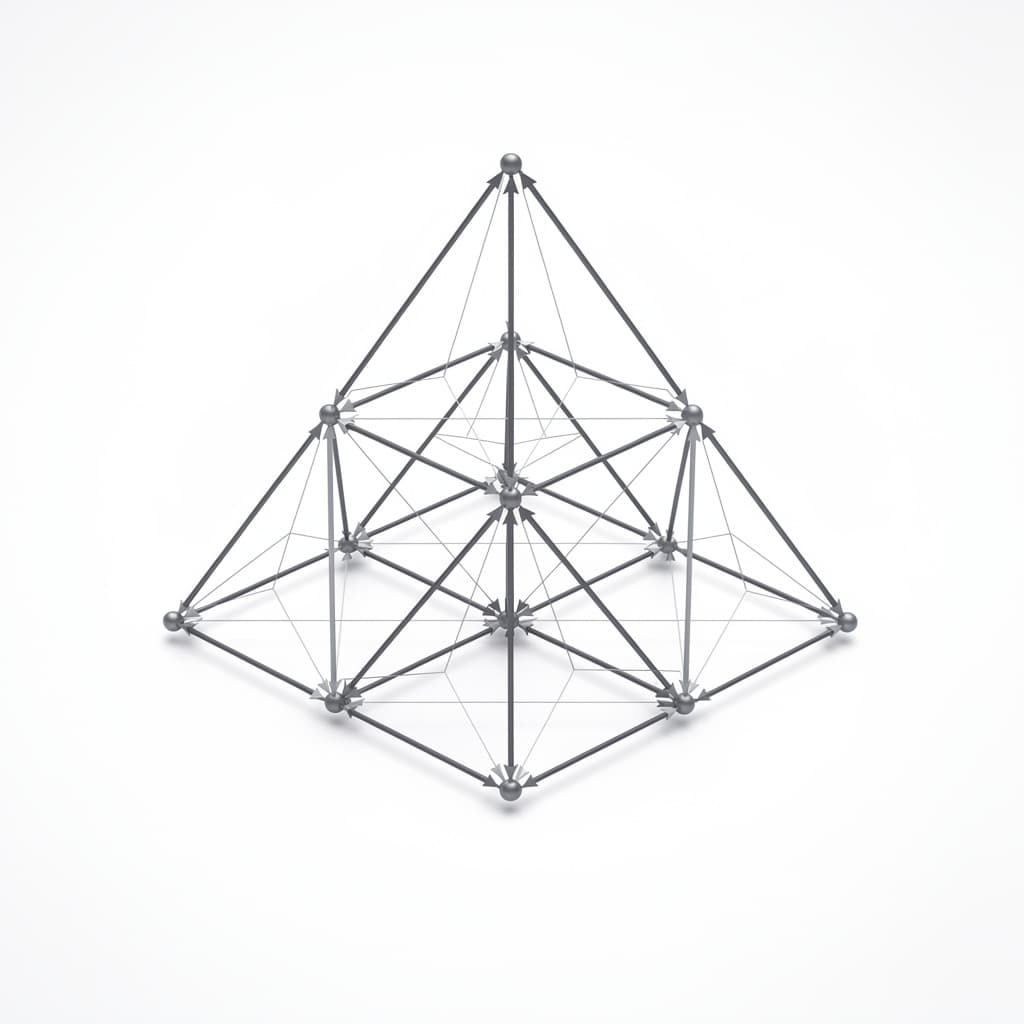
Truss analysis represents a fundamental pillar of structural engineering, providing the mathematical framework necessary to understand how loads are distributed through interconnected frameworks. At its core, the study of trusses involves decomposing complex assemblies into discrete, manageable components to determine internal forces such as tension and compression. By utilizing established techniques like the method of joints and sections, engineers can ensure that bridges, roof supports, and industrial cranes remain stable under diverse loading conditions. This article explores the logic, mathematical rigor, and practical applications of truss mechanics, moving from basic static assumptions to the sophisticated resolution of global equilibrium.
The Fundamentals of Rigid Frames
Defining the Ideal Truss
An ideal truss is a structural framework composed of straight members connected at their ends by frictionless pins, forming a series of stable triangles. The triangular geometry is essential because it is the only polygon that is inherently rigid; a triangle cannot change its shape without a change in the length of one of its sides. In engineering practice, members are often welded or bolted together with gusset plates, but for primary analysis, we model these connections as "pinned" joints that do not resist moments. This idealization simplifies the structure into a system where every member primarily experiences axial forces, resisting either being pulled apart or pushed together. By focusing on the axial behavior, analysts can quickly determine the efficiency and safety of a design before moving to more detailed finite element simulations.
Assumptions in Static Equilibrium
To perform a consistent truss analysis, several simplifying assumptions must be held as universal truths within the model. First, we assume that all members are weightless; if the self-weight is significant, it is mathematically partitioned and applied as discrete vertical loads at the connecting joints. Second, all external loads and support reactions are assumed to act only at the joints, never along the spans of the members themselves. This prevents the introduction of shear forces or bending moments within the individual components, maintaining the integrity of the axial-only model. Finally, the material is assumed to be rigid enough that deformations are negligible, allowing us to apply the equations of static equilibrium to the original, undeformed geometry of the structure.
Two-Force Member Principles
Every member in an ideal truss functions as a two-force member, a concept that is critical for reducing the number of unknowns in a system. By definition, a two-force member is subjected to forces at only two points—its ends—and is in equilibrium only if those two forces are equal in magnitude, opposite in direction, and collinear. This means the internal force must act along the longitudinal axis of the member, either pulling away from the joints (tension) or pushing toward them (compression). Because the direction of the force is pre-determined by the orientation of the member, the engineer only needs to solve for a single scalar magnitude. This reduction of complexity is what enables the rapid resolution of structures containing dozens or even hundreds of individual components.
The Mechanics of Joint Analysis
Free Body Diagrams of Individual Nodes
The method of joints begins by isolating each individual pin or "node" of the truss as a separate free body diagram. Because the joints are the points where all member forces and external loads converge, they are treated as particles in a state of concurrent force equilibrium. When drawing these diagrams, it is standard practice to assume all unknown member forces are in tension, pointing away from the joint. If the resulting calculation yields a negative value, the member is actually in compression. This consistent sign convention prevents errors during the sequential resolution of the truss and ensures that the internal stresses are mapped correctly across the entire framework.
Balancing Forces in Concurrent Systems
For a joint to be in static equilibrium, the sum of all horizontal and vertical forces acting upon it must equal zero. In a two-dimensional plane, this is expressed through two primary equations of motion: $$\sum F_x = 0$$ $$\sum F_y = 0$$ Since there are only two equations available per joint, the analysis must start at a node where there are no more than two unknown member forces. At these locations, the geometry of the members provides the necessary trigonometric components—typically expressed as sines and cosines—to resolve the force vectors into their Cartesian counterparts. By solving this system of linear equations, the magnitude of the forces in the connected members is revealed, turning previously unknown variables into known constants for the next stage of the analysis.
Sequential Resolution of Joints
Truss analysis via the method of joints is inherently an iterative process that moves from the supports toward the center of the structure. Once the forces in the members connected to the first joint are found, these values are transferred to the adjacent joints as known loads. It is vital to remember that a member in tension pulls on both of its end joints, while a member in compression pushes on both; thus, the direction of the force vector flips when moving from one end of a member to the other. This "domino effect" continues until the force in every member has been calculated. The final joint in the sequence usually serves as a check, as the known forces must satisfy the equilibrium equations at that last node to verify the mathematical accuracy of the entire solution.
Identifying Zero Force Members
Geometric Conditions for Null Loads
In many complex frameworks, certain members carry no internal load under specific loading configurations; these are known as zero force members. While it might seem counterintuitive to include members that do not carry weight, they are essential for maintaining structural stability during different loading phases or preventing the buckling of long compression members. Identifying these components at the start of an analysis can significantly simplify the manual calculation process by removing unnecessary variables. There are two primary geometric rules used to spot these members through visual inspection. By applying these rules, an engineer can "clean" the truss model, often reducing a daunting problem into a much simpler set of equations.
Simplifying Complex Frameworks
The first rule for zero force members occurs when only two non-collinear members meet at a joint that has no external load or support reaction applied to it. In this scenario, both members must have a force of zero because there is no external force to balance a component from either member. The second rule applies when three members meet at a joint where two are collinear and the third is not. If there is no external load at this joint, the third member must be a zero force member to satisfy equilibrium perpendicular to the collinear pair. Recognizing these patterns allows the analyst to essentially "delete" these members from the free body diagram for that specific load case, though they remain physically present in the actual built structure.
Visual Inspection Techniques
Proficiency in identifying zero force members comes from a deep understanding of how forces "flow" through a structure. When an engineer looks at a "T-joint" without an external force at the stem of the T, they immediately know the stem is a zero force member. Similarly, at an "L-joint" at the edge of a truss with no loads, both legs of the L are carrying nothing. It is important to note, however, that a zero force member is only "zero" for a specific set of loads. If the wind direction changes or a vehicle moves across a bridge, a previously idle member may suddenly become a critical load-bearing component. Thus, the identification of these members is a tool for simplification of statics truss problems, not a justification for their removal from the physical design.
Navigating the Method of Sections
Cutting Through the Structure
While the joint-by-joint approach is effective for small structures, the method of sections is the preferred tool for analyzing large trusses when only a few specific member forces are required. This technique involves passing an imaginary "cut" through the truss, effectively dividing it into two completely separate parts. For the cut to be valid, it must pass through the members of interest and typically should not encounter more than three members with unknown forces. By isolating one side of the cut as a free body, the internal forces of the cut members are treated as external forces that maintain the equilibrium of the isolated section. This "global" view allows for the direct calculation of forces in the middle of a bridge without solving every preceding joint.
Moment Equilibrium and Torque
The defining advantage of the method of sections over the method of joints is the availability of the moment equation. Since the isolated section is a rigid body rather than a single point, we can sum the moments about any point in the plane and set them to zero: $$\sum M_P = 0$$ By strategically choosing a point $P$ where the lines of action of two unknown forces intersect, we can eliminate those two variables from the equation. This allows the engineer to solve for the third unknown force directly in a single step. The use of torque and leverage in this manner provides a powerful shortcut, turning what would be a long sequence of trigonometric joint resolutions into a straightforward algebraic exercise. This technique is especially useful when checking for the maximum stress in the "chords" of a long-span truss.
Solving for Non-Concurrent Forces
Because the forces in the cut members are no longer concurrent (meaning they do not all meet at a single point), the three equations of equilibrium—horizontal force, vertical force, and moment—all become available.
- $\sum F_x = 0$: Balances horizontal components of diagonal and chord members.
- $\sum F_y = 0$: Typically used to find the vertical component of diagonal web members.
- $\sum M = 0$: Used to find the forces in the top or bottom chords by eliminating diagonals.
Method of Joints vs Sections
Efficiency in Global vs Local Analysis
The choice between the method of joints and sections depends largely on the scope of the required data. The method of joints is essentially a bottom-up approach; it is thorough and provides the force in every single member of the structure. This is ideal during the final design phase when every bolt and plate must be sized. Conversely, the method of sections is a top-down approach, allowing the designer to "zoom in" on a specific area of concern. It is frequently used in preliminary design to check the capacity of the most heavily loaded members, such as those at the center of a long span or near support reactions.
Choosing the Right Tool for the Job
To choose the most efficient method, one must evaluate the complexity of the truss and the specific goal of the analysis. A comparison of the two methods is summarized in the table below:
| Feature | Method of Joints | Method of Sections |
|---|---|---|
| Primary Use | Finding forces in all members | Finding forces in specific members |
| Equilibrium Equations | $\sum F_x, \sum F_y$ (2 equations) | $\sum F_x, \sum F_y, \sum M$ (3 equations) |
| Starting Point | Joint with $\leq 2$ unknowns | Any valid cut passing through $\leq 3$ unknowns |
| Complexity | Higher for large trusses (iterative) | Lower for large trusses (direct) |
Hybrid Methods for Large-Scale Frames
In practice, professional engineers often use a hybrid approach to solve how to solve trusses efficiently. They might use the method of sections to find the forces in the main chords of a bridge and then use the method of joints to resolve the smaller web members connecting them. This hybrid strategy leverages the strength of each method while minimizing the accumulation of rounding errors that can occur during a long sequence of joint calculations. Furthermore, for highly complex or redundant structures, these hand-calculation methods provide a vital "sanity check" for the results produced by computer-aided engineering software. Understanding both methods ensures that the engineer retains a physical intuition for the structure's behavior.
Solving Statics Truss Problems
Calculating External Support Reactions
The first step in solving nearly all statics truss problems is to treat the entire truss as a single rigid body to find the external support reactions. Most trusses are supported by a combination of a "pin" (which provides both vertical and horizontal resistance) and a "roller" (which provides only vertical resistance). By applying the three global equilibrium equations to the entire structure, the forces exerted by the ground or the piers are determined. This step is critical because any error in the reaction forces will propagate through every subsequent calculation, leading to an entirely incorrect internal force map. Once the reactions are known, the truss is "grounded," and the internal analysis can begin with a complete set of known boundary conditions.
Determining Internal Member Tensions
With the reactions in hand, the analyst then transitions to internal member forces using the method of joints and sections. For each member, the goal is to determine the magnitude of the force and its state—tension or compression. It is helpful to visualize the members as springs; a tension member is being stretched and "wants" to pull back on the joints, while a compression member is being squeezed and "wants" to push out. Mathematically, these are treated as vectors. The use of clear, labeled free body diagrams at this stage cannot be overstated, as they serve as the primary visual accounting system for the forces being balanced.
Compression and Tension Conventions
Consistent labeling of tension and compression is essential for avoiding sign errors that could lead to structural failure in a real-world scenario. In truss analysis, a positive result typically denotes tension (T), indicating the member is being pulled. A negative result denotes compression (C), indicating the member is being squashed. This distinction is physically significant because compression members are susceptible to buckling—a sudden failure mode where the member bows outward under load—whereas tension members are limited only by the material's tensile strength. Consequently, compression members often require a larger cross-sectional area or a different shape (like an I-beam or tube) to resist buckling, making the correct identification of these forces a matter of safety.
Practical Truss Analysis Examples
The Simple Warren Truss Configuration
One of the most common truss analysis examples is the Warren truss, characterized by its series of equilateral or isosceles triangles. In a Warren truss, the diagonal members alternate between tension and compression as one moves along the span, efficiently spreading the load across the entire framework. Because of its repetitive and symmetric nature, the analysis of a Warren truss is often straightforward, making it a favorite for pedagogical purposes and industrial applications. In a bridge setting, the top chord of a Warren truss is usually in compression, while the bottom chord is in tension, acting much like the top and bottom flanges of a massive I-beam.
Pratt and Howe Roof Truss Mechanics
The Pratt and Howe trusses are the workhorses of roof design, each optimized for different material strengths. In a Pratt truss, the diagonal members are oriented so that they are primarily in tension under gravity loads, while the shorter vertical members handle the compression. This is advantageous because tension members can be thinner and lighter, saving on material costs. Conversely, the Howe truss reverses this orientation, placing the diagonals in compression. While less common in modern steel construction, the Howe truss was popular in timber construction, where the vertical members were often made of iron rods to handle the tension while the heavy timber diagonals handled the compression.
Bridge Truss Load Distribution
Bridge trusses, such as the Baltimore or Pennsylvania variations, often include sub-struts and additional sub-ties to handle the massive concentrated loads of locomotives or heavy trucks. These complex designs require a sophisticated application of the method of joints and sections to ensure that local loads at the deck level are properly transferred to the primary load-bearing chords. Analysis of these structures often reveals that the diagonal members near the supports experience the highest shear-like forces, while the chords near the center of the span experience the highest bending-like axial forces. By studying these load paths, engineers can optimize the thickness of each member, placing more material only where the stress is highest.
Constraints and Determinacy
Mathematical Consistency in Equilibrium
For a truss to be solvable using basic statics, it must be statically determinate. This means that the number of unknown forces (members plus support reactions) must be exactly equal to the number of available equilibrium equations. In a 2D truss with $b$ members, $r$ reaction forces, and $j$ joints, the relationship for determinacy is: $$b + r = 2j$$ If the left side is less than the right, the truss is unstable and will collapse under its own weight. If the left side is greater than the right, the truss is statically indeterminate, meaning there are more unknowns than equations, and the internal forces depend on the material properties and stiffness rather than just geometry.
Stability and Structural Integrity
Beyond the basic count of members and joints, a truss must be geometrically stable to function. Even if the equation $b+r=2j$ is satisfied, a truss can still be unstable if the members are arranged in a way that allows for "mechanisms" or movement. For example, if all the support reactions are parallel, the truss can move horizontally like a car on tracks, making it unstable. Similarly, if the internal members do not form a contiguous series of triangles, the structure may fold or "rack" under load. Structural integrity requires both mathematical determinacy and a geometric arrangement that locks every joint in place relative to the others.
Degrees of Freedom in Frames
The concept of degrees of freedom (DOF) describes the number of independent ways a structure can move. A single point in a 2D plane has two degrees of freedom: horizontal and vertical translation. A rigid truss attempts to remove all these degrees of freedom through its members and supports. In more advanced structural mechanics, engineers must account for rotations, leading to the study of "frames" where joints are rigid rather than pinned. While truss analysis is a subset of this broader field, it remains the most critical starting point for understanding how humanity builds upwards and outwards, turning the simple logic of the triangle into the skeletons of our modern civilization.
References
- Hibbeler, R. C., "Engineering Mechanics: Statics", Pearson, 2022.
- Beer, F. P., Johnston, E. R., & Mazurek, D. F., "Vector Mechanics for Engineers: Statics", McGraw-Hill Education, 2018.
- Meriam, J. L., & Kraige, L. G., "Engineering Mechanics: Statics", Wiley, 2014.
- Kassimali, A., "Structural Analysis", Cengage Learning, 2019.
Recommended Readings
- The Tower and the Bridge by David P. Billington — An insightful look at the history and aesthetics of structural engineering, focusing on how truss and arch designs evolved.
- Why Buildings Stand Up by Mario Salvadori — An accessible introduction to structural principles that explains the physics of trusses and other supports in a narrative style.
- Structures: Or Why Things Don't Fall Down by J.E. Gordon — A classic text that provides deep intuition into the nature of tension, compression, and material science without overly complex math.