The Structural Logic of the OSI Model
The Open Systems Interconnection (OSI) model serves as the foundational blueprint for how modern digital communication occurs across a network. Developed during an era when proprietary hardware often...
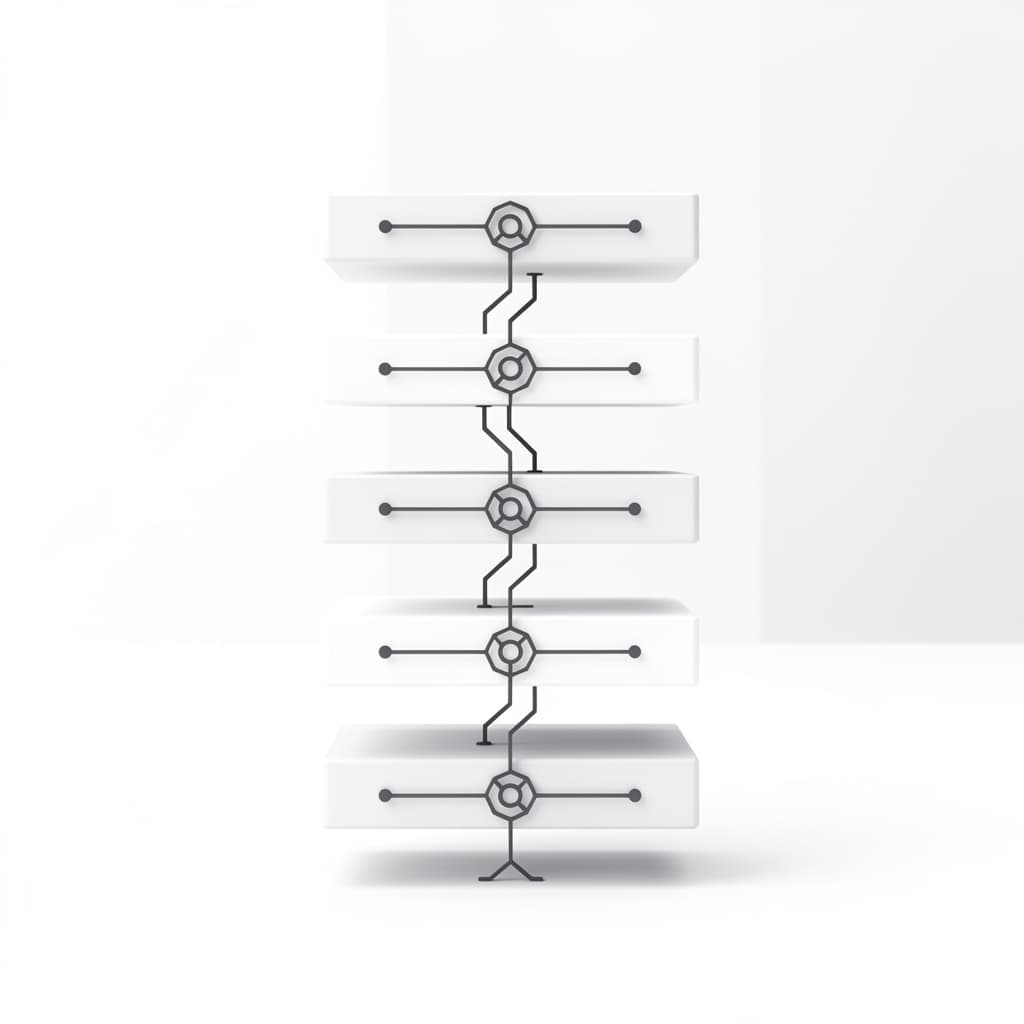
The Open Systems Interconnection (OSI) model serves as the foundational blueprint for how modern digital communication occurs across a network. Developed during an era when proprietary hardware often could not communicate with systems from different manufacturers, this seven-layer framework revolutionized the computing industry by introducing a modular, standardized approach to networking. To understand what is the OSI model, one must view it not merely as a list of protocols, but as a logical map that partitions the immense complexity of data transmission into manageable, discrete functions. This structural logic ensures that engineers can design hardware and software that interact seamlessly, regardless of the underlying vendor or technology, by adhering to a universal language of interconnection.
The Evolution of Network Standardization
The history of digital networking was initially characterized by fragmentation and vendor lock-in. In the 1970s, major technology corporations like IBM and Digital Equipment Corporation (DEC) developed their own proprietary networking architectures, such as SNA and DECnet. These systems were often incompatible, meaning that a company invested in IBM hardware could not easily transmit data to a system built by another manufacturer. This "Babel" of networking created significant barriers to global interconnectivity, prompting the International Organization for Standardization (ISO) to begin developing a universal framework in the late 1970s. The result, published in 1984 as the ISO 7498 standard, became the definitive reference model for how open systems should communicate.
The core philosophy behind the OSI model is the principle of layered architecture. By dividing the communication process into seven distinct layers, the model ensures that a change in one layer does not necessitate a complete overhaul of the others. For example, an upgrade from copper wiring to fiber optics at the lowest layer should not require a redesign of the web browser operating at the highest layer. This modular abstraction allows developers to focus on specific problems within a single domain, such as error correction or routing, while relying on the layers above and below to handle their respective responsibilities. This separation of concerns is the hallmark of robust systems engineering and remains the primary reason the model is still taught in computer science today.
When asking what is the OSI model in a modern context, it is important to recognize it as a "reference" model rather than a strict implementation. While the TCP/IP suite eventually became the dominant practical protocol for the internet, the OSI model remains the superior pedagogical tool for understanding the "logic" of a network. It provides a common vocabulary that allows network engineers to troubleshoot complex issues by isolating the layer where a failure occurs. If a technician says a problem is a "Layer 3 issue," they are immediately communicating that the fault lies with logical addressing or routing, rather than a broken cable or a software bug. This clarity is the enduring legacy of the ISO’s standardization efforts.
The Physical and Data Link Foundations
Layer 1: Transmission of Raw Bitstreams
At the very base of the stack sits Layer 1, the Physical Layer. This layer is strictly concerned with the mechanical, electrical, and functional specifications for activating, maintaining, and deactivating the physical link between devices. It deals with the raw bitstream—sequences of 1s and 0s—and how they are converted into physical signals such as electrical voltages, radio waves, or pulses of light. Specifications at this level include everything from pin layouts on a RJ45 connector to the frequency ranges used in Wi-Fi transmissions. The Physical Layer does not understand the "meaning" of the data it carries; its only goal is to move bits from point A to point B with as much fidelity as possible.
Signal encoding is a critical function of the Physical Layer, where digital data is mapped onto a physical carrier. For instance, in Manchester encoding, a transition in the middle of a bit period represents the value of the bit, which helps the receiver maintain synchronization with the sender's clock. The throughput of this layer is often measured by the Shannon-Hartley theorem, which defines the maximum rate at which information can be transmitted over a communication channel with a specific bandwidth $B$ and signal-to-noise ratio $S/N$: $$C = B \log_2(1 + \frac{S}{N})$$ This formula highlights the physical constraints that Layer 1 must navigate, such as attenuation, distortion, and electromagnetic interference, which can corrupt the raw signal before it reaches its destination.
Layer 2: Error Correction and Media Access
Directly above the physical medium is Layer 2, the Data Link Layer. While Layer 1 moves bits, Layer 2 organizes those bits into meaningful groups called frames. This layer provides the first level of "intelligence" in the stack, ensuring that the data transmitted over the physical link is free of basic errors. It utilizes a Cyclic Redundancy Check (CRC) or checksum to detect if bits were flipped during transmission. If a frame arrives at the destination and the calculated checksum does not match the one included in the frame header, the Data Link Layer may request a retransmission or simply discard the corrupted data, depending on the protocol in use.
The Data Link Layer is further divided into two sublayers: Logical Link Control (LLC) and Media Access Control (MAC). The LLC sublayer handles flow control and identifies the network layer protocol being used, while the MAC sublayer governs how multiple devices share a single physical medium. In an Ethernet environment, the MAC layer uses MAC addresses—unique 48-bit identifiers burned into hardware—to ensure that data reaches the correct physical machine on a local segment. This layer is also where switches operate, using their internal MAC tables to intelligently forward frames only to the port where the destination device is connected, rather than broadcasting it to the entire network.
The Network Layer and Global Routing
The Network Layer, or Layer 3, is the architect of wide-area connectivity. Its primary responsibility is logical addressing and path determination. Unlike Layer 2, which only understands how to get data to a neighbor on the same local segment, Layer 3 understands how to move data across multiple interconnected networks. This is where the Internet Protocol (IP) resides. Every device on a global network is assigned a logical IP address, which allows routers to build "maps" of the digital world. When a packet is sent from a computer in New York to a server in London, Layer 3 is responsible for deciding which series of intermediate hops (routers) will be the most efficient path for that data to travel.
The logic of the Network Layer is encapsulated in the concept of routing. Routers maintain routing tables that store information about network topology; they use algorithms like OSPF (Open Shortest Path First) or BGP (Border Gateway Protocol) to calculate the best route for a packet. When a packet arrives at a router, the device strips off the Layer 2 frame to inspect the Layer 3 header. It looks at the destination IP address, consults its table, wraps the packet in a new Layer 2 frame appropriate for the next leg of the journey, and sends it out. This process of encapsulation and forwarding is what allows the internet to function as a "network of networks," bridging different technologies like Wi-Fi, fiber, and satellite links.
Another vital function of Layer 3 is fragmentation and reassembly. Different physical networks have different limits on the maximum size of a data unit they can carry, known as the Maximum Transmission Unit (MTU). If a router receives a packet that is too large for the next network segment, it must break the packet into smaller fragments. The Network Layer header includes identification and offset fields that allow the destination device to put these pieces back together in the correct order. This ensures that data can flow across a heterogeneous landscape of networking hardware without being blocked by varying physical constraints.
Transport Layer Reliability and Flow Control
While the Network Layer handles the "postal service" of moving packets between houses, Layer 4, the Transport Layer, is responsible for the "conversation" between the individuals inside those houses. It focuses on end-to-end communication, ensuring that the data sent by an application on one host is received correctly by the application on the other. This layer introduces the concept of port numbers, which allow a single IP address to support multiple simultaneous connections—such as a web browser (port 80) and an email client (port 25) running on the same machine. The Transport Layer takes the large streams of data from the upper layers and breaks them into smaller units called segments.
There are two primary ways the Transport Layer handles data: connection-oriented and connectionless. The Transmission Control Protocol (TCP) is the connection-oriented standard, providing a "reliable" service. Before data is sent, TCP performs a three-way handshake (SYN, SYN-ACK, ACK) to establish a virtual connection. It uses sequence numbers to ensure that segments arriving out of order can be reassembled correctly and acknowledgment messages to confirm that each segment was received. If a segment is lost, TCP automatically triggers a retransmission. In contrast, the User Datagram Protocol (UDP) is connectionless and "unreliable," meaning it sends data without verifying its receipt. UDP is preferred for real-time applications like video streaming or gaming, where speed is more critical than 100 percent accuracy.
Flow control and congestion avoidance are also critical Layer 4 functions. If a fast server sends data more quickly than a slow receiver can process it, the receiver's buffer will overflow, leading to dropped packets. The Transport Layer prevents this using techniques like the sliding window, where the receiver tells the sender how much data it is willing to accept before an acknowledgment is required. Furthermore, protocols like TCP can detect network congestion by observing packet loss and respond by slowing down the transmission rate. This "socially responsible" behavior prevents the network from collapsing under heavy load and ensures a fair distribution of bandwidth among all users.
Upper Layers: Session, Presentation, and Application
The upper three layers of the OSI model are often grouped together in modern practical networking because they deal primarily with software-level logic rather than the mechanics of data transport. Layer 5, the Session Layer, acts as a "dialogue controller." It manages the establishment, maintenance, and termination of sessions between applications. Its role is to keep different data streams separate and to provide check-pointing. If a large file transfer is interrupted at the 90 percent mark, the Session Layer can use checkpoints to resume the transfer from the last known good state rather than starting over from the beginning. This layer is essential for managing the state of a conversation in complex, multi-transaction environments.
Layer 6, the Presentation Layer, serves as the "translator" of the network. Different computer systems use different methods for representing data; for instance, one might use ASCII while another uses EBCDIC for character encoding. The Presentation Layer ensures that the data is in a format that the receiving application can understand. It also handles data compression to reduce bandwidth usage and encryption/decryption for security. While modern security protocols like TLS often blur the lines between layers, their fundamental task of transforming data from a "network format" to an "application format" is the essence of Layer 6's logical purpose.
Finally, Layer 7, the Application Layer, is the layer closest to the end-user. It is important to clarify that this layer is not the software application itself (like Google Chrome or Outlook), but rather the protocol that the application uses to interact with the network. Examples include HTTP for web browsing, FTP for file transfers, and SMTP for email. This layer provides the interface through which software identifies communication partners, determines resource availability, and synchronizes communication. It is the culmination of the entire OSI stack, where the abstract electrical signals of Layer 1 have finally been transformed into meaningful information that a human can interact with.
The Encapsulation and De-encapsulation Process
The physical movement of data through the OSI model is governed by the processes of encapsulation and de-encapsulation. When an application sends data, it travels down the stack from Layer 7 to Layer 1. At each layer, the protocol adds its own header (and sometimes a trailer) to the data it received from the layer above. This header contains the metadata necessary for that layer to perform its job at the receiving end. For example, the Transport Layer adds a header containing port numbers, and the Network Layer adds a header containing IP addresses. These wrapped units of data are formally known as Protocol Data Units (PDUs).
The naming convention for PDUs changes as the data moves through the stack, which is a key concept for anyone learning what is the OSI model. In the upper layers (7, 6, and 5), the data is simply called Data. Once it reaches the Transport Layer (Layer 4), it becomes a Segment. At the Network Layer (Layer 3), it is a Packet. At the Data Link Layer (Layer 2), it is a Frame, and finally, at the Physical Layer (Layer 1), it is a stream of Bits. This "nesting" of headers is analogous to a letter (data) being placed in an envelope (segment), which is then placed in a larger mailing pouch (packet), and finally loaded onto a delivery truck (frame).
When the bits reach the destination device, the process is reversed. This is called de-encapsulation. The Physical Layer receives the bits and passes the resulting frame up to Layer 2. The Data Link Layer checks the MAC address and error-check bits; if everything is correct, it "strips" the Layer 2 header and passes the packet up to Layer 3. This continues until only the original data remains for the application at Layer 7. Each layer on the receiving machine only interacts with the corresponding header added by the same layer on the sending machine. This peer-layer communication is a logical abstraction that allows the Transport Layer on one host to "talk" to the Transport Layer on another, even though the data must physically pass through all the layers in between.
Architectural Comparison: OSI vs TCP/IP
While the OSI model is the gold standard for networking education, the TCP/IP model (also known as the Internet Protocol Suite) is the actual architecture of the modern internet. Developed by the Department of Defense (DoD) before the OSI model was finalized, TCP/IP is a more streamlined, four-layer framework. It consists of the Network Access Layer (mapping to OSI Layers 1 and 2), the Internet Layer (mapping to OSI Layer 3), the Transport Layer (mapping to OSI Layer 4), and the Application Layer (mapping to OSI Layers 5, 6, and 7). The divergence between these two models represents the classic tension between theoretical idealism and practical implementation.
| OSI Layer | TCP/IP Layer | Function/Protocols |
|---|---|---|
| Application (7), Presentation (6), Session (5) | Application | User interface, encryption, HTTP, DNS |
| Transport (4) | Transport | End-to-end reliability, TCP, UDP |
| Network (3) | Internet | Routing, logical addressing, IP, ICMP |
| Data Link (2), Physical (1) | Network Access | Hardware interface, Ethernet, Wi-Fi |
The primary reason TCP/IP "won" in the marketplace is its pragmatism. During the 1980s, the OSI protocols were seen as overly complex and slow to be standardized, while TCP/IP was already being implemented in the ARPANET and early UNIX systems. Many of the functions in the OSI Session and Presentation layers were eventually absorbed into the applications themselves or into the Transport Layer (such as TLS/SSL). Consequently, the seven-layer OSI model remains a conceptual framework used for troubleshooting and standardization, while the four-layer TCP/IP model is the functional framework that moves the world’s data.
Ultimately, understanding the structural logic of the OSI model is essential for any technologist. It provides a universal blueprint that transcends specific brands or eras of technology. By compartmentalizing the staggering complexity of global communication into seven logical steps, the OSI model allows us to build, maintain, and secure the digital infrastructure that defines modern life. Whether you are debugging a local Wi-Fi connection or designing a global cloud architecture, the logic of the layers remains the same: a testament to the power of standardized, modular thinking in the face of infinite complexity.
References
- International Organization for Standardization, "ISO/IEC 7498-1:1994 - Information technology — Open Systems Interconnection — Basic Reference Model", ISO, 1994.
- Tanenbaum, A. S., & Wetherall, D. J., "Computer Networks", Prentice Hall, 2011.
- Kurose, J. F., & Ross, K. W., "Computer Networking: A Top-Down Approach", Pearson, 2017.
- Zimmermann, H., "OSI Reference Model—The ISO Model of Architecture for Open Systems Interconnection", IEEE Transactions on Communications, 1980.
Recommended Readings
- TCP/IP Illustrated, Volume 1: The Protocols by W. Richard Stevens — A deep dive into how the protocols of the internet work in practice, providing a technical bridge between OSI theory and TCP/IP reality.
- Computer Networks: A Systems Approach by Larry Peterson and Bruce Davie — This resource explains networking from a systems design perspective, helping readers understand the trade-offs involved in building complex communication stacks.
- The All-New Switch Book by Rich Seifert and James Edwards — An excellent exploration of Layer 2 and Layer 3 hardware logic, detailing how frames and packets move through real-world switches and routers.