The Statics of Shear and Bending Moments
The fundamental goal of structural engineering is to ensure that a physical system can withstand applied loads without failure or excessive deformation. To achieve this, engineers must look beyond...
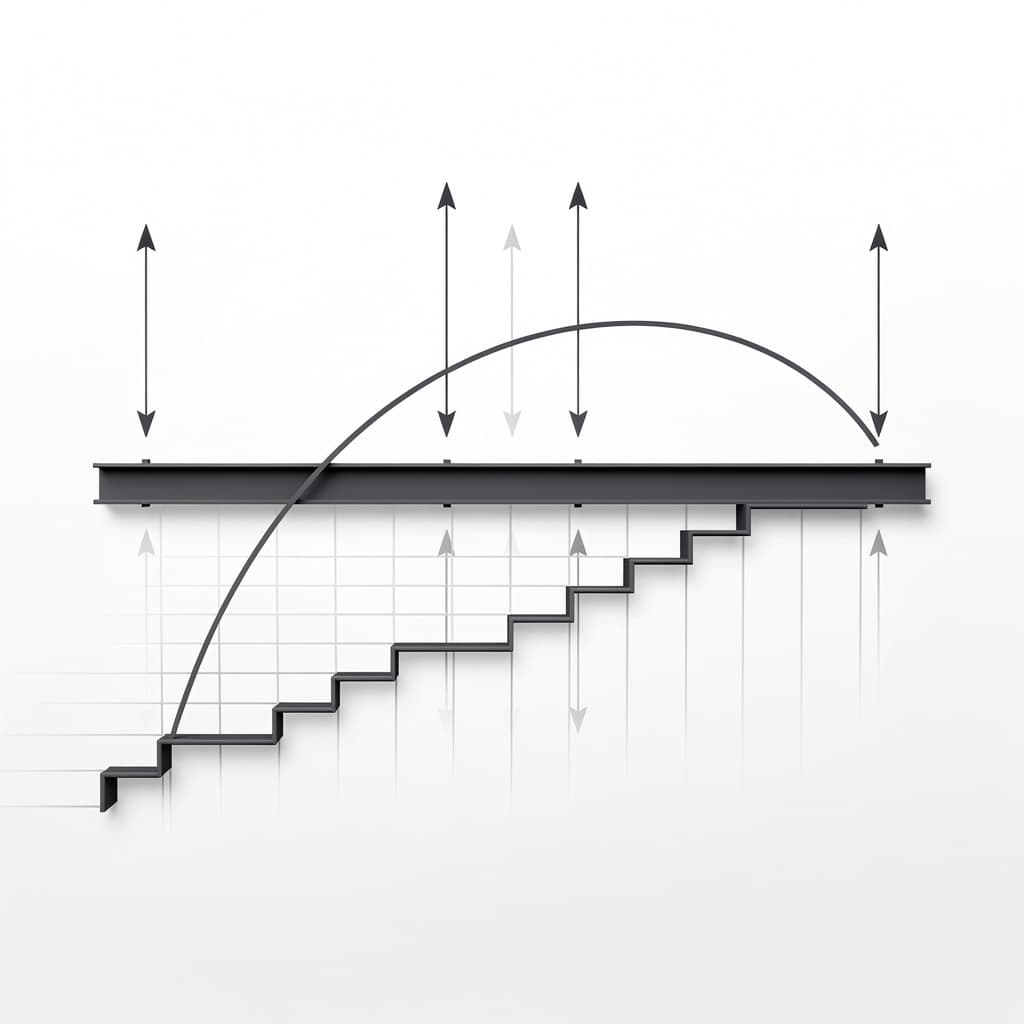
The Nature of Internal Forces in Structures
When an external load is applied to a rigid body, such as a bridge girder or a floor joist, the material within that body must generate internal resistance to maintain its integrity. These internal forces are essentially the macroscopic manifestation of atomic and molecular bonds resisting displacement. In a three-dimensional structural member, these internal effects are typically categorized into four types: axial force, shear force, bending moment, and torsional moment. In the context of planar beam theory, we primarily focus on the axial component, which acts along the longitudinal axis, and the shear component, which acts perpendicular to that axis. The equilibrium of the entire structure is only possible if every infinitesimal segment within the structure is also in a state of balance between the external loads and these internal resistances.
To visualize and calculate these internal forces, engineers employ a conceptual tool known as the imaginary cut. By mathematically "slicing" a beam at a specific location, one can isolate a portion of the structure as a free-body diagram. For this isolated segment to remain in equilibrium, the external forces acting on it must be perfectly countered by internal forces at the exposed face of the cut. This methodology allows us to transform "hidden" internal stresses into "visible" external forces that can be solved using the standard equations of statics: the summation of forces in the vertical and horizontal directions and the summation of moments about a point. This technique is the cornerstone of structural analysis, providing a bridge between the external environment and the internal state of the material.
The transmission of these forces through a solid body is a continuous process, though it may be interrupted by points of concentrated loading or changes in geometry. As one moves along the length of a beam, the internal force required to maintain equilibrium changes depending on the proximity to supports and the distribution of the load. In a well-designed structure, the material is distributed such that it can efficiently transfer these forces from the point of application to the foundations. If the internal forces exceed the capacity of the material at any single point, localized failure—such as yielding, cracking, or buckling—will occur, potentially leading to a catastrophic collapse of the entire system. Therefore, the study of internal force transmission is not merely an academic exercise but a critical safety requirement in civil and mechanical engineering.
Defining the Shear Force and Bending Moment
The shear force at any given section of a beam is defined as the algebraic sum of all vertical forces acting on one side of that section. Physically, shear represents the tendency of one part of the beam to slide vertically relative to the adjacent part, much like the action of a pair of scissors cutting through paper. Mathematically, if we consider a beam aligned along the $x$-axis, the shear force $V$ at a position $x$ must satisfy the vertical equilibrium of the segment. Because shear is a force, it is measured in units of Newtons ($N$) or pounds-force ($lbf$). High shear forces are particularly dangerous in materials with low shear strength, such as timber or unreinforced concrete, where they can cause diagonal tension cracks.
The bending moment is a measure of the internal tendency of a beam to bend or flex under the influence of external loads. It is defined as the algebraic sum of the moments of all forces acting on one side of a section about that section's centroid. While shear force attempts to "slice" the beam, the bending moment attempts to curve it, creating a gradient of stress across the depth of the member. This results in compression on one side of the neutral axis and tension on the other. The standard bending moment formula for beams relates this internal moment to the resulting stress: $$\sigma = \frac{My}{I}$$, where $M$ is the moment, $y$ is the distance from the neutral axis, and $I$ is the second moment of area. This relationship highlights why the bending moment is often the primary factor in determining the required size of a beam.
To ensure consistency in analysis, engineers use a standardized sign convention for these internal forces. For shear force, the convention typically dictates that a force tending to rotate a beam element clockwise is positive. For bending moments, the convention is based on the physical deformation of the beam: a moment that causes the beam to "smile" (concave up, creating tension in the bottom fibers) is considered positive, or sagging. Conversely, a moment that causes the beam to "frown" (concave down, creating tension in the top fibers) is considered negative, or hogging. Adhering to these conventions is vital when constructing shear force and bending moment diagrams, as they ensure that the mathematical results correctly reflect the physical behavior of the structure.
The Differential Relationship Between Load and Force
The relationship between the external load, internal shear, and the bending moment is not arbitrary; it is governed by precise differential equations derived from the equilibrium of an infinitesimal element. Consider a small segment of a beam with a length $dx$ subjected to a distributed load density $w(x)$. By applying the equilibrium of vertical forces to this tiny element, we derive the first fundamental relationship: the rate of change of shear force with respect to position is equal to the negative of the load intensity. This is expressed as $$\frac{dV}{dx} = -w(x)$$. This derivative implies that the slope of the shear force diagram at any point is determined by the magnitude and direction of the external load at that same point.
Building upon this, we can analyze the rotational equilibrium of the same infinitesimal element to find the relationship between shear and moment. By summing the moments about one end of the segment and neglecting higher-order terms, we find that the rate of change of the bending moment is equal to the shear force. The mathematical expression is $$\frac{dM}{dx} = V(x)$$. This is a profound insight in structural mechanics: the shear force is the derivative of the bending moment. Consequently, the bending moment at any point can be viewed as the integral of the shear force up to that point. This calculus-based perspective allows engineers to move between load, shear, and moment distributions using simple integration and differentiation techniques.
These differential relationships provide a powerful set of rules for checking the accuracy of shear force and bending moment diagrams. For instance, if the shear force is zero at a particular location, the derivative of the bending moment is also zero, indicating that the moment has reached a local maximum or minimum. Similarly, if a beam is subjected to a constant distributed load, the shear diagram will be linear (a first-degree polynomial), and the bending moment diagram will be parabolic (a second-degree polynomial). Understanding these geometric transitions allows for the rapid sketching of diagrams and the identification of critical values without performing exhaustive calculations at every point along the beam's span.
Methodologies for Constructing Force Diagrams
The most traditional approach to determining internal forces is the Method of Sections. This process involves four distinct steps: calculating the global support reactions, "cutting" the beam at an arbitrary distance $x$, drawing a free-body diagram of the isolated segment, and applying the equations of equilibrium to solve for $V(x)$ and $M(x)$. This method is highly rigorous and provides explicit mathematical functions for the shear and moment across different intervals of the beam. It is particularly useful when the beam is subjected to multiple different types of loads, as the functions can be defined piecewise to account for changes in the loading environment.
An alternative and often faster approach is the graphical integration method, which relies on the area principles derived from calculus. Since the change in shear between two points is the area under the load diagram, and the change in moment is the area under the shear diagram, one can "build" the diagrams sequentially from one end of the beam to the other. For example, to find the change in moment between point A and point B, one simply calculates the area of the shear force diagram between those two locations. This method is intuitive and minimizes the need for complex algebra, making it a favorite for quick hand calculations during the preliminary stages of structural design.
When constructing these diagrams, it is crucial to identify and account for singularities and points of discontinuity. A concentrated point load causes an instantaneous "jump" in the shear force diagram equal to the magnitude of the load. Similarly, a concentrated external moment causes an instantaneous jump in the bending moment diagram. Identifying these points is the first step in any analysis, as they define the boundaries of the intervals over which the shear and moment functions are continuous. Failure to recognize these discontinuities can lead to significant errors in the final diagrams and, more importantly, an underestimation of the stresses at those specific locations.
Analyzing Common Beam Loading Scenarios
One of the most frequent scenarios in structural engineering is the simply supported beam carrying a single concentrated load at its center. In this case, the shear force diagram consists of two rectangular blocks: a positive rectangle from the left support to the load and a negative rectangle from the load to the right support. The bending moment diagram for this setup is a simple triangle, with the peak moment occurring directly under the point load. The value of this maximum moment is given by $$M_{max} = \frac{PL}{4}$$, where $P$ is the load and $L$ is the span. This basic model serves as the foundation for understanding how more complex point-load systems behave.
Another common scenario involves uniformly distributed loads (UDL), which represent weights like the self-weight of the beam or a uniform layer of snow. Under a UDL of intensity $w$, the shear force diagram is a straight line with a constant negative slope, crossing the zero-axis at the center of the span. Because the shear is linear, the bending moment diagram follows a parabolic geometry. The maximum moment for a simply supported beam under a UDL occurs at the center and is calculated as $$M_{max} = \frac{wL^2}{8}$$. The parabolic shape is characteristic of distributed loading and demonstrates how the internal resistance must grow non-linearly to counter the accumulating effects of the distributed weight.
Cantilever systems present a different set of boundary conditions because they are fixed at one end and free at the other. In a cantilever beam with a point load at the free end, the shear force is constant throughout the length, but the bending moment increases linearly from zero at the free end to a maximum at the fixed support. If the cantilever is subjected to an external moment at its tip, the shear force remains zero (assuming no vertical loads), while the bending moment remains constant across the entire span. These examples highlight how the type of support—whether it be a pin, a roller, or a fixed connection—fundamentally dictates the shape and magnitude of the internal force distributions.
Geometric Properties and Diagram Interpretation
The utility of shear force and bending moment diagrams lies in their ability to pinpoint critical locations within a structure. The most significant of these is the location of maximum bending moment, as this usually dictates the beam's cross-sectional requirements. Because $V = dM/dx$, the maximum moment must occur where the shear force is zero or where the shear force crosses the horizontal axis. By locating these "zero-shear" points, an engineer can instantly identify where the beam is most likely to fail in flexure. This relationship holds true regardless of the complexity of the loading, providing a reliable shortcut for finding extrema in the moment function.
Another important geometric feature is the point of contraflexure (or inflection point), which is the location where the bending moment changes sign. At this point, the internal moment is zero, and the curvature of the beam switches from sagging to hogging (or vice versa). In continuous beams that span over multiple supports, identifying points of contraflexure is essential for the placement of reinforcement in concrete structures. Since concrete is strong in compression but weak in tension, steel reinforcing bars must be placed on the side of the beam that is experiencing tension. The points of contraflexure tell the engineer exactly where to shift the reinforcement from the bottom of the beam to the top.
The slopes of the diagrams also offer valuable qualitative information about the loading environment. A constant slope in the shear diagram indicates a uniform distributed load, while a sudden change in slope (a "kink") in the moment diagram indicates a concentrated point load. Furthermore, the magnitude of the slope in the moment diagram is directly proportional to the magnitude of the shear force at that location. By training the eye to recognize these geometric cues, a structural analyst can quickly verify if a diagram "looks right" before proceeding with detailed stress calculations. This intuitive grasp of diagram geometry is what separates an experienced engineer from a novice practitioner.
Advanced Loading and Complex Force Systems
In real-world engineering, loading is rarely as simple as a single point load or a uniform distribution. Non-uniformly distributed loads, such as hydrostatic pressure on a dam or wind loads on a tapered chimney, often result in higher-order polynomial distributions. For a triangularly distributed load, the shear force diagram becomes a second-degree parabola, while the bending moment diagram becomes a third-degree cubic curve. Analyzing these systems requires a more rigorous application of integration techniques, but the underlying differential relationships remain the same. The complexity of the math increases, but the physical principles of equilibrium and continuity do not change.
The introduction of internal hinges adds another layer of complexity to structural diagrams. An internal hinge is a connection that cannot transmit a bending moment; therefore, the moment at a hinge must always be zero. When constructing a bending moment diagram for a system with a hinge, the curve must pass through the zero-axis at the hinge's location, regardless of the loading. This provides an additional "known" point that can be used to solve for support reactions in statically determinate structures. Hinges are often used in long-span bridges (Gerber beams) to allow for thermal expansion and to simplify the internal force distribution.
Finally, the principle of superposition is a vital tool for handling complex force systems in linear-elastic structures. This principle states that the total shear force or bending moment at any point in a beam subjected to multiple loads is the algebraic sum of the forces or moments produced by each load acting independently. Instead of solving a single, massive equilibrium problem, an engineer can break the system down into simpler, recognizable cases—such as a UDL and a point load—and then sum their individual diagrams. This modular approach is not only more efficient but also reduces the likelihood of calculation errors, allowing for the rapid analysis of sophisticated modern structures.
References
- Hibbeler, R. C., "Structural Analysis", Pearson, 2017.
- Beer, F. P., Johnston, E. R., DeWolf, J. T., & Mazurek, D. F., "Mechanics of Materials", McGraw-Hill Education, 2020.
- Timoshenko, S. P., & Gere, J. M., "Mechanics of Materials", Van Nostrand Reinhold Co., 1972.
- Kassimali, A., "Structural Analysis", Cengage Learning, 2014.
Recommended Readings
- Understanding Structures: An Introduction to Structural Analysis by Derek Seward — A highly accessible text that focuses on the conceptual understanding of how structures work before diving into the mathematics.
- The Science of Structures and Materials by J.E. Gordon — A classic work that explains the physical principles of strength and stiffness in a narrative style that is both engaging and technically deep.
- Roark's Formulas for Stress and Strain by Warren C. Young — The definitive reference manual for engineers looking for standardized formulas for shear, moment, and deflection in almost any conceivable beam configuration.