The Quantitative Logic of Conservation of Momentum
The study of motion often begins with the observation of objects in transit, yet the underlying principles that govern these interactions are far more profound than simple displacement. At the heart...
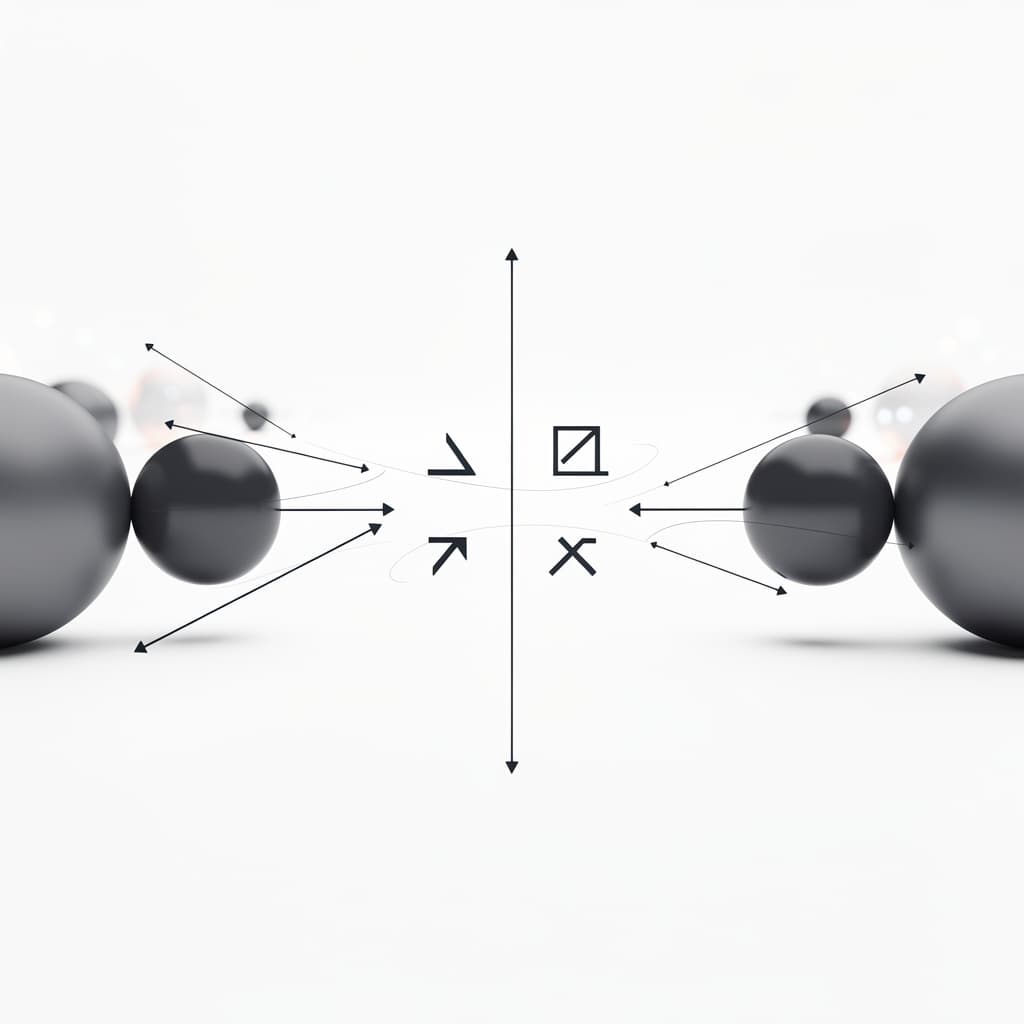
Defining the Fundamental Vector Quantity
In the lexicon of physics, momentum is frequently described as the "quantity of motion" possessed by an object, a term famously coined by Isaac Newton. Quantitatively, the momentum formula physics utilizes is expressed as the product of an object's mass and its velocity, typically denoted by the symbol $p$. Because velocity is a vector—having both magnitude and direction—momentum is also a vector quantity, meaning that the direction in which an object travels is just as critical as its speed. This directional nature allows physicists to use vector addition to determine the total momentum of a system containing multiple moving parts, ensuring that opposing motions can effectively cancel each other out in the mathematical ledger.
The calculation of linear momentum is straightforward in its basic form, yet it reveals deep insights into the behavior of matter. For any object with a constant mass $m$ moving at a velocity $v$, the momentum is calculated as: $$p = m \cdot v$$ In the International System of Units (SI), this is measured in kilogram-meters per second (kg·m/s). This formula implies that a massive, slow-moving object, such as a cargo ship, can possess the same momentum as a light, fast-moving object, such as a bullet. Understanding this relationship is vital for engineering safety systems and transport mechanisms where the "stopping power" of an object is more dependent on its momentum than its individual mass or speed alone.
It is essential to distinguish momentum from kinetic energy, as the two are often conflated in casual conversation despite their distinct physical roles. While both involve mass and velocity, kinetic energy is a scalar quantity proportional to the square of the velocity ($K = \frac{1}{2}mv^2$), whereas momentum is a vector quantity linearly proportional to velocity. This means that if an object's velocity doubles, its momentum doubles, but its kinetic energy quadruples. Furthermore, while kinetic energy can be converted into thermal energy or sound during a collision, the total momentum of an isolated system is always preserved, making it a more robust "bookkeeping" tool in many mechanical analyses.
The Law of Conservation of Momentum
The law of conservation of momentum states that the total momentum of a closed system remains constant provided that no external forces act upon it. In this context, a "system" is a collection of objects under study, and "internal forces" are the interactions occurring between those objects, such as collisions or gravitational pulls. According to Newton’s Third Law, every action has an equal and opposite reaction; therefore, when two objects within a system exert forces on one another, the resulting changes in momentum are equal in magnitude and opposite in direction. This internal symmetry ensures that the net change for the entire system is zero, effectively keeping the total "pool" of momentum unchanged.
From a more advanced perspective, this conservation law is not merely an empirical observation but a result of the fundamental symmetries of the universe. Emmy Noether, a pioneering mathematician, demonstrated that every conservation law corresponds to a specific symmetry in the laws of physics. Momentum conservation is the direct consequence of translational symmetry, which posits that the laws of physics do not change based on your location in space. Because the universe does not have a "preferred" spot that alters the behavior of force and motion, the total momentum of any isolated system must remain invariant over time. This connection between space and motion provides the theoretical bedrock for all of classical and modern mechanics.
To express this mathematically, we consider the sum of momenta for all particles in a system before and after an event. If we have two objects with masses $m_1$ and $m_2$ and initial velocities $u_1$ and $u_2$, their total initial momentum must equal their total final momentum after they interact, represented by velocities $v_1$ and $v_2$. The equation is written as: $$m_1u_1 + m_2u_2 = m_1v_1 + m_2v_2$$ This continuity allows scientists to solve for unknown variables, such as the final velocity of a planet after a meteor impact or the recoil speed of a launching rocket. As long as the system is isolated from external friction or air resistance, this balance remains perfect and unbreakable.
Mechanics of Elastic and Inelastic Collisions
In the study of elastic and inelastic collisions, the conservation of momentum serves as the primary governing rule, but the behavior of kinetic energy varies between the two. In an elastic collision, both momentum and kinetic energy are conserved, meaning the objects bounce off each other without any permanent deformation or generation of heat. These collisions are rare in the macroscopic world due to friction and sound, but they are common at the atomic and molecular levels. A classic example of a nearly elastic collision is the interaction between two high-quality billiard balls or the scattering of subatomic particles in a vacuum.
Conversely, inelastic collisions occur when a portion of the system's kinetic energy is converted into other forms of energy, such as heat, sound, or the work required to deform the objects. While kinetic energy is lost to the environment, the total momentum of the system still remains conserved. In a "perfectly inelastic" collision, the participating objects stick together after the impact and move as a single combined mass. This occurs when a piece of putty is thrown against a wall or when two cars lock bumpers during an accident. The loss of kinetic energy in these events is often calculated to determine the severity of an impact or the amount of structural damage sustained.
To quantify the "bounciness" of a collision, physicists use the coefficient of restitution (denoted as $e$). This dimensionless value is the ratio of the relative final velocity to the relative initial velocity of the colliding objects. The following table summarizes the differences between these collision types:
| Feature | Elastic Collision | Inelastic Collision | Perfectly Inelastic |
|---|---|---|---|
| Momentum Conserved? | Yes | Yes | Yes |
| Kinetic Energy Conserved? | Yes | No (Lost to heat/sound) | No (Maximum loss) |
| Objects Stick Together? | No | No | Yes |
| Coefficient of Restitution ($e$) | $e = 1$ | $0 < e < 1$ | $e = 0$ |
The Impulse Momentum Theorem and Impact Force
While conservation laws describe the "before" and "after" of a system, the impulse momentum theorem describes the process of change during the interaction itself. Impulse, denoted by $J$, is defined as the integral of force over the time interval during which it acts. Essentially, it represents the total change in momentum experienced by an object. When a tennis racket hits a ball, the force is not instantaneous; it builds up and then subsides as the strings compress and expand. The theorem establishes that the impulse applied to an object is exactly equal to its change in momentum, providing a direct link between dynamics and kinematics.
The mathematical representation of impulse is given by the formula: $$J = \Delta p = F_{avg} \cdot \Delta t$$ Where $F_{avg}$ is the average force applied and $\Delta t$ is the duration of the impact. This relationship is critical in safety engineering, particularly in the design of automotive crumple zones and airbags. By increasing the time ($\Delta t$) it takes for a passenger's momentum to reach zero during a crash, the peak force experienced by the human body is significantly reduced. This principle explains why jumping onto a padded mat is safer than jumping onto concrete; the change in momentum is the same, but the extended time interval lowers the force to survivable levels.
In scenarios where the force varies over time, such as a rocket engine firing, we use calculus to find the total impulse. For a programmer or engineer simulating these forces, the calculation might involve summing discrete force measurements over small time steps. The following Python snippet demonstrates a basic numerical integration of force to find the total change in momentum:
def calculate_impulse(force_samples, delta_t):
    # force_samples is a list of force values (N)
    # delta_t is the time interval between samples (s)
    total_impulse = sum(f * delta_t for f in force_samples)
    return total_impulse

# Example: Force spikes then drops
forces = [0, 10, 50, 100, 50, 10, 0]
time_step = 0.01  # 10 milliseconds
change_in_momentum = calculate_impulse(forces, time_step)
print(f"Total change in momentum: {change_in_momentum} kg*m/s")
Law of Conservation of Momentum Examples
One of the most striking law of conservation of momentum examples is found in the propulsion of rockets in the vacuum of space. Unlike a car that pushes against the road, a rocket has nothing to push against in a vacuum. Instead, it relies on the conservation of momentum by ejecting high-velocity exhaust gases in one direction, which necessitates that the rocket body move in the opposite direction to keep the system's total momentum constant. Even though the mass of the expelled gas is small, its extremely high velocity provides enough "recoil" to accelerate the massive spacecraft, illustrating that propulsion is essentially a continuous, controlled explosion governed by momentum balance.
In the realm of subatomic physics, momentum conservation led to the discovery of the neutrino. During experiments involving beta decay, physicists noticed that the momentum of the electron and the recoiling nucleus did not add up to the momentum of the original neutron. Rather than abandoning the conservation law, Wolfgang Pauli postulated in 1930 that an invisible, neutral particle must be carrying away the "missing" momentum. Decades later, the detection of the neutrino confirmed this hypothesis, proving that the logic of momentum conservation is so reliable that it can be used to predict the existence of entirely new forms of matter.
Ballistic recoil provides a practical, everyday example of these principles in action. When a rifle fires a bullet, the forward momentum of the projectile must be balanced by an equal and opposite backward momentum of the firearm. Because the rifle is much more massive than the bullet, its velocity is significantly lower, resulting in a "kick" rather than a dangerous flight backward. Shooters are taught to brace the rifle against their shoulder to effectively increase the mass of the recoiling object to include their own body weight, further reducing the recoil velocity and improving stability through the quantitative logic of mass-velocity distribution.
Trajectories in Multi-Dimensional Space
In the real world, collisions rarely happen in a perfectly straight line; instead, they occur in two or three dimensions. Analyzing these events requires the orthogonal decomposition of momentum vectors into their constituent $x$, $y$, and $z$ components. The beauty of the conservation of momentum is that it applies independently to each dimension. If no external force acts in the horizontal direction, the total horizontal momentum is conserved, even if gravity is simultaneously acting in the vertical direction to change the vertical momentum. This allows forensic investigators to reconstruct car accidents by analyzing skid marks and the final resting positions of vehicles to determine their pre-impact speeds.
When analyzing an oblique collision—such as a cue ball hitting a target ball at an angle—the total momentum vector before the hit must be identical to the vector sum of the two balls' momenta after the hit. If the target ball is initially at rest and the collision is elastic, the two balls will actually move away from each other at a 90-degree angle (neglecting spin). This geometric result is a direct consequence of the simultaneous conservation of momentum and kinetic energy, which forces the velocity vectors to satisfy the Pythagorean theorem. Such interactions are modeled using trigonometry to ensure that the sum of the sine and cosine components of the momenta remains constant.
Complex multibody systems, such as a solar system or a cluster of stars, also adhere to these rules through the concept of the center of mass. The total momentum of a system is equal to its total mass multiplied by the velocity of its center of mass. As long as there are no external galactic forces, the center of mass of our solar system moves at a constant velocity through space, regardless of the chaotic orbits and collisions of the planets and asteroids within it. This higher-level application of momentum logic allows astronomers to simplify the motion of entire galaxies into a single point-mass calculation, proving that the conservation of momentum is a universal law that scales from the smallest particles to the largest structures in the cosmos.
References
- Newton, I., "Philosophiæ Naturalis Principia Mathematica", Royal Society, 1687.
- Halliday, D., Resnick, R., & Walker, J., "Fundamentals of Physics", Wiley, 2013.
- Taylor, J. R., "Classical Mechanics", University Science Books, 2005.
- Noether, E., "Invariante Variationsprobleme", Nachrichten von der Gesellschaft der Wissenschaften zu Göttingen, 1918.
Recommended Readings
- The Feynman Lectures on Physics by Richard Feynman — An unparalleled deep dive into the intuition behind momentum and its role in the symmetry of physical laws.
- The Fabric of the Cosmos by Brian Greene — Explores the relationship between space, time, and conservation laws in a way that connects classical mechanics to modern string theory.
- Introduction to Quantum Mechanics by David J. Griffiths — Provides the necessary context for how momentum conservation translates from the macroscopic world to the wave-particle duality of the microscopic world.
- Thinking Physics by Lewis Carroll Epstein — A unique resource that uses conceptual puzzles to build a "gut-level" understanding of momentum and impulse without getting bogged down in jargon.