The Parabolic Logic of Projectile Motion
The study of projectile motion represents one of the most fundamental pillars of classical mechanics, providing a bridge between simple linear kinematics and the complex, multi-dimensional dynamics...
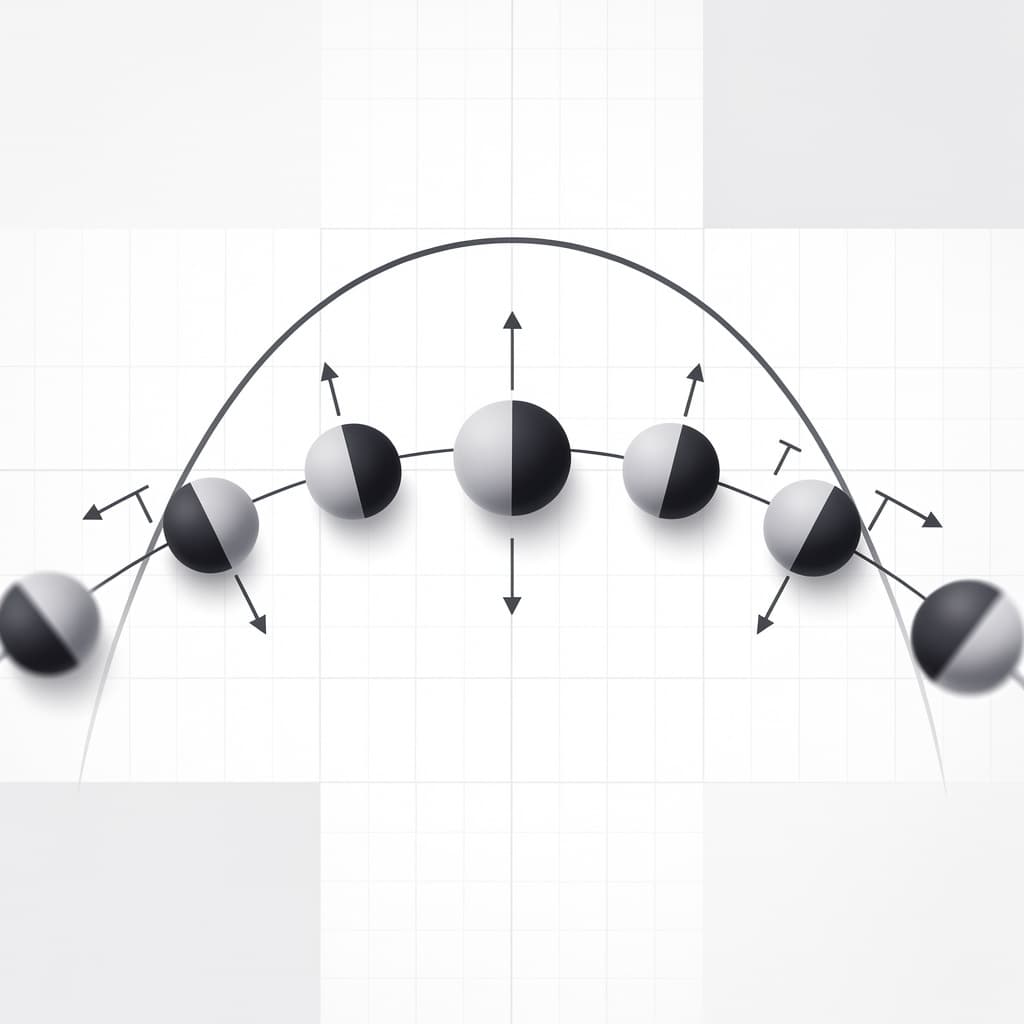
The study of projectile motion represents one of the most fundamental pillars of classical mechanics, providing a bridge between simple linear kinematics and the complex, multi-dimensional dynamics of the physical world. At its core, projectile motion describes the path of an object—referred to as a projectile—that is launched into a medium (typically the atmosphere) and subsequently influenced only by the initial velocity and the constant pull of gravity. While the real-world flight of a baseball, an arrow, or a satellite is influenced by varying factors such as air resistance and the Earth's rotation, the theoretical framework of projectile motion assumes an idealized vacuum to reveal the underlying mathematical elegance. By stripping away these complexities, physicists can demonstrate how two independent perpendicular motions combine to create the characteristic curved path known as a trajectory.
1. The Core Principles of Kinematics
Defining the Ideal Projectile System
To understand the fundamental nature of projectile motion, physicists begin with an idealized model that simplifies the object into a point mass. In this conceptual framework, the projectile is considered to have no internal structure, no rotation, and most importantly, it moves through a vacuum where air resistance is non-existent. This simplification is not merely a convenience; it allows for the precise application of Newton’s laws of motion without the non-linear interference of fluid dynamics. By treating the object as a point mass, we can focus entirely on the displacement of its center of gravity, which follows a predictable path determined solely by its launch conditions and the local gravitational field.
The system is further defined by the assumption that the Earth is a flat plane and that the acceleration due to gravity remains perfectly constant throughout the flight. While we know that gravity weakens as an object moves further from the Earth’s center, the heights reached by most terrestrial projectiles are negligible compared to the radius of the planet, making the variation in gravitational force functionally irrelevant. This constant acceleration, denoted as $g$, is approximately $9.81 m/s^2$ in a downward direction. Within these parameters, the behavior of the projectile becomes a deterministic mathematical problem, where knowing the initial state allows for the perfect prediction of every future position and velocity.
The Principle of Independence of Motion
Perhaps the most profound insight in the study of projectile motion is the principle of the independence of horizontal and vertical components. First articulated clearly by Galileo Galilei in his seventeenth-century work "Two New Sciences," this principle states that a force acting in one dimension does not affect the motion of an object in a perpendicular dimension. For a projectile, this means that while gravity is constantly pulling the object downward, it has absolutely no effect on how fast the object moves forward horizontally. This concept is often demonstrated in physics classrooms by showing that a ball dropped vertically and a ball launched horizontally from the same height will strike the level ground at the exactly same time.
Understanding this independence is crucial for decomposing complex 2D motion into two simpler 1D problems that can be solved using standard kinematic equations. The horizontal motion is treated as a state of constant velocity because there are no horizontal forces acting on the projectile once it has been launched. Simultaneously, the vertical motion is treated as a state of constant acceleration, identical to that of a free-falling body. By solving these two components separately and then recombining them through vector addition, we can describe the position and velocity of the projectile at any given moment in its flight with absolute mathematical certainty.
Gravity as a Constant Downward Force
In the context of projectile motion, gravity serves as the sole external influence that dictates the shape of the object's path. Unlike a rocket, which possesses its own internal propulsion system, a projectile is "given" its energy at the moment of launch and is thereafter at the mercy of the gravitational field. This force acts purely in the vertical direction, which is why the vertical velocity changes over time while the horizontal velocity remains stagnant. As the projectile rises, gravity acts in opposition to the upward component of the velocity, causing the object to slow down until it reaches a momentary state of vertical rest at the peak of its flight.
Once the projectile begins its descent, gravity acts in the same direction as the vertical motion, accelerating the object downward at the same constant rate of $9.81 m/s^2$. This symmetry is a hallmark of motion in a vacuum, where the time taken to reach the peak is identical to the time taken to fall back to the original launch height. Because gravity is a conservative force in this model, the kinetic energy lost during the ascent is perfectly recovered during the descent. This ensures that, in the absence of air resistance, the object will strike the ground with the same speed it possessed at launch, albeit with a velocity vector pointing downward rather than upward.
2. Dynamics of Horizontal and Vertical Motion
Uniform Rectilinear Motion on the X-Axis
The horizontal component of projectile motion is remarkably simple because, in an ideal system, there is no force to change the object's speed in the x-direction. This leads to what is known as uniform rectilinear motion, where the horizontal velocity, $v_x$, remains constant throughout the entire duration of the flight. If an object is launched with a horizontal velocity component of $20 m/s$, it will continue to cover exactly $20$ meters of horizontal distance every second until it hits the ground. This lack of horizontal acceleration is the reason why the horizontal displacement is a linear function of time, described by the simple relation $x = v_{0x} \cdot t$.
This constancy has significant implications for how we calculate the "range" or the total horizontal distance covered by a projectile. Since the horizontal speed never changes, the only factor that limits the range is the amount of time the projectile remains in the air, which is dictated entirely by its vertical motion. This creates a fascinating interplay where the horizontal "engine" of the motion is constant, but its "fuel" (the time of flight) is determined by a completely different set of vertical forces. Consequently, to maximize the distance a projectile travels, one must find the perfect balance between high horizontal speed and sufficient vertical flight time.
Constant Acceleration on the Y-Axis
In contrast to the horizontal axis, the vertical axis (y-axis) of projectile motion is characterized by constant acceleration due to gravity. This motion is governed by the second of Newton's laws and the standard kinematic formulas for constant acceleration, specifically $y = v_{0y} \cdot t - \frac{1}{2}gt^2$. Because the acceleration is downward, the vertical velocity decreases linearly as time passes, eventually crossing through zero at the highest point of the trajectory. This change in velocity is what creates the "curve" in the projectile's path, as the ratio of vertical to horizontal displacement is constantly shifting throughout the flight.
The vertical dynamics are responsible for defining the "lifespan" of the projectile's journey from launch to impact. Regardless of how fast a projectile is moving horizontally, it is the vertical initial velocity and the force of gravity that determine when the object will return to Earth. In practical terms, this means that an object launched with a high vertical velocity will spend more time in the air, allowing its horizontal velocity more time to cover ground. Understanding the vertical component as an independent free-fall problem is the key to mastering the complex mathematical models used in ballistics and athletic training.
Vector Decomposition of Initial Velocity
Before any calculations can begin, the initial launch velocity must be broken down into its constituent parts using trigonometry, a process known as vector decomposition. If a projectile is launched with an initial velocity $v_0$ at an angle $\theta$ relative to the horizontal, it possesses both horizontal and vertical "intent." Using the right-triangle relationships of sine and cosine, we can determine the magnitude of these components: the horizontal component is $v_{0x} = v_0 \cos \theta$, and the vertical component is $v_{0y} = v_0 \sin \theta$. These two values serve as the initial conditions for the two independent motions described previously.
The choice of launch angle $\theta$ is the primary tool for controlling the behavior of the trajectory of a projectile. A low launch angle prioritizes horizontal velocity but results in a short flight time because the object is barely "pushed" away from the ground. Conversely, a high launch angle results in a high peak and a long flight time, but the horizontal velocity is so low that the object does not travel very far from its starting point. Mastery of these vector components is essential for everything from aiming a medieval trebuchet to calculating the necessary launch parameters for a modern space-bound rocket.
3. Mathematical Models and Projectile Motion Formulas
The Time of Flight Equation Explained
Determining the time of flight equation is a critical step in solving any projectile problem, as time is the "bridge" variable that connects the horizontal and vertical components. For a projectile launched from and returning to the same horizontal level, the total time of flight, $T$, is found by setting the vertical displacement equation to zero. Since $y = v_{0y} \cdot t - \frac{1}{2}gt^2$, and we want to find the time when the object returns to $y=0$, we can factor the equation to find the two roots: $t = 0$ (the moment of launch) and $t = \frac{2v_{0y}}{g}$. Replacing the vertical component with its trigonometric equivalent gives us the standard formula:
$$T = \frac{2v_0 \sin \theta}{g}$$
This equation reveals that the time an object spends in the air is directly proportional to its initial vertical velocity and inversely proportional to the strength of gravity. On the Moon, where gravity is much weaker than on Earth, the same launch velocity would result in a significantly longer time of flight. This formula also demonstrates that the maximum time of flight is achieved when the launch angle is $90$ degrees (directly upward), which makes intuitive sense as this configuration maximizes the vertical component of the initial velocity vector at the expense of all horizontal motion.
Calculating Instantaneous Velocity Vectors
While the horizontal velocity remains constant, the total velocity of a projectile is constantly changing in both magnitude and direction. At any time $t$, the instantaneous vertical velocity is given by $v_y(t) = v_{0y} - gt$. To find the total speed of the projectile at any specific moment, we must use the Pythagorean theorem to combine the horizontal and vertical velocity components. The magnitude of the instantaneous velocity is expressed as:
$$v = \sqrt{v_x^2 + v_y(t)^2}$$
Furthermore, the direction of the motion at any given moment—the angle of the tangent to the path—is found using the inverse tangent function, $\phi = \arctan(v_y / v_x)$. This is particularly important for understanding the impact conditions of a projectile. Because of the symmetry inherent in parabolic motion, the angle of impact with the ground is equal in magnitude but opposite in direction to the angle of launch, provided the landing surface is at the same elevation as the launch point. This mathematical symmetry is one of the most elegant features of classical kinematic models.
Displacement as a Function of Time
To track the exact location of a projectile in a two-dimensional coordinate system, we use parametric equations where both $x$ and $y$ are functions of $t$. The horizontal position is simply the product of constant velocity and time, while the vertical position accounts for the constant deceleration of gravity. These projectile motion formulas are essential for computer simulations and engineering designs, as they allow for the plotting of the object's coordinates at microsecond intervals. The equations for position are defined as follows:
$$x(t) = (v_0 \cos \theta)t$$ $$y(t) = (v_0 \sin \theta)t - \frac{1}{2}gt^2$$
By plugging in different values for $t$, we can map out the entire flight path. For example, if we want to know if a projectile will clear a wall of a certain height located at a specific distance, we first use the $x(t)$ equation to find the time $t$ at which the projectile reaches that distance. Then, we substitute that time into the $y(t)$ equation to find the projectile's height at that exact moment. This methodology is the foundation of ballistic targeting and is used in various fields ranging from forensic ballistics to the design of safety barriers in sports stadiums.
4. Geometry and the Trajectory of a Projectile
Deriving the Mathematical Parabola
The trajectory of a projectile is famously described as a parabola, but this is not merely an observation; it is a mathematical necessity derived from the motion equations. By taking the horizontal displacement equation $x = (v_0 \cos \theta)t$ and solving it for $t$, we get $t = x / (v_0 \cos \theta)$. When this expression for $t$ is substituted into the vertical displacement equation, we eliminate the time variable entirely. The resulting equation expresses $y$ directly as a function of $x$:
$$y = (\tan \theta)x - \frac{g}{2v_0^2 \cos^2 \theta}x^2$$
This equation takes the standard form of a quadratic function, $y = ax^2 + bx + c$, where $a$ is negative. In geometry, a quadratic equation with a negative leading coefficient always describes a parabola that opens downward. This derivation proves that as long as gravity is constant and air resistance is ignored, every object thrown on Earth will follow a path that is geometrically identical to a section of a parabola. This consistency allows for the application of geometric properties, such as the axis of symmetry and the vertex, to physical motion problems.
Symmetry and Vertex Properties in Flight
The parabola that defines parabolic motion is perfectly symmetrical around its peak, also known as the vertex. This symmetry implies that for every point on the upward trajectory, there is a corresponding point on the downward trajectory at the same height with the same vertical speed. If a projectile takes three seconds to reach its maximum height, it will take exactly another three seconds to return to its original launch elevation. Furthermore, the horizontal distance from the launch point to the peak is exactly half of the total horizontal range, provided the launch and impact points are at the same height.
The vertex of the parabola represents the maximum height and range transition point, where the vertical velocity is zero. At this singular moment, the projectile is moving entirely horizontally. Understanding this point is vital for applications requiring the projectile to "hover" or pass through a specific high-altitude window. Because the slope of the trajectory at the vertex is zero, the projectile spends more time at altitudes near its peak than at any other height of the same interval during its flight. This "hang time" near the apex is a critical concept in sports like basketball and volleyball, where athletes utilize the flat part of the parabola to perform actions mid-air.
The Influence of Launch Height on Path
While the classic symmetric parabola assumes the projectile starts and ends at the same vertical level, real-world scenarios often involve a launch height ($h_0$) that is different from the landing height. When a projectile is launched from a cliff or an elevated platform, the symmetry of the path is broken. The object must travel through the standard parabolic arc and then continue its descent for an additional distance until it strikes the lower ground. This added vertical distance increases the time of flight, which in turn allows the constant horizontal velocity to carry the object even further than the standard range formula would suggest.
Conversely, launching a projectile at an upward-sloping target curtails the flight time, resulting in a shorter range. In these cases, the kinematic equations must be adjusted to include the initial height in the vertical position equation: $y(t) = h_0 + v_{0y}t - \frac{1}{2}gt^2$. Solving for the time of flight then requires the use of the quadratic formula, as the final $y$ position is usually zero. This complexity is handled daily by civil engineers and military ballistics experts who must account for varying terrain elevations when calculating the necessary launch angles to reach a target accurately.
5. Optimizing Maximum Height and Range
Mathematical Determination of Peak Altitude
The maximum height reached by a projectile is a function of its initial vertical velocity and the strength of gravity. At the highest point of the flight, the vertical velocity $v_y$ is exactly zero. By using the kinematic relation $v_y^2 = v_{0y}^2 - 2g \Delta y$ and setting $v_y$ to zero, we can solve for the peak altitude, $H$. This calculation is independent of the horizontal motion, emphasizing once again the independence of the two axes. The resulting formula for maximum height is:
$$H = \frac{v_0^2 \sin^2 \theta}{2g}$$
This relationship shows that height is proportional to the square of the initial velocity. Doubling the launch speed will not just double the height; it will quadruple it. This quadratic relationship explains why high-velocity projectiles, such as those fired from modern firearms or high-power water jets, can reach such staggering altitudes compared to hand-thrown objects. In engineering, this formula is used to ensure that fountains, fireworks, or flares reach the desired visibility heights while staying within safety margins.
Calculating Horizontal Displacement Limits
The total horizontal distance covered by a projectile, commonly called the range, is the product of the horizontal velocity and the total time of flight. For a projectile returning to its original launch height, we substitute the time of flight $T = \frac{2v_0 \sin \theta}{g}$ into the horizontal displacement equation $R = v_{0x} \cdot T$. Using the trigonometric identity $2 \sin \theta \cos \theta = \sin 2\theta$, we arrive at the elegant and widely used range formula:
$$R = \frac{v_0^2 \sin 2\theta}{g}$$
This equation is a powerful tool for predicting where an object will land based on its launch parameters. Like the height formula, the range is proportional to the square of the initial velocity, making speed the most significant factor in increasing distance. However, unlike height, the range is also dependent on the doubled angle $\sin 2\theta$. This mathematical structure implies that for any given launch speed, there is a maximum possible range that can be achieved by selecting the optimal launch angle, a fact that has been exploited by artillerymen and athletes for centuries.
The Significance of the Forty-Five Degree Angle
By examining the range formula $R = \frac{v_0^2 \sin 2\theta}{g}$, it becomes clear that the range is maximized when the value of $\sin 2\theta$ is at its maximum. The maximum value for the sine of any angle is $1$, which occurs when the angle itself is $90$ degrees. Therefore, the range is maximized when $2\theta = 90^{\circ}$, which means the optimal launch angle is exactly $45^{\circ}$. At this angle, the projectile achieves the perfect compromise between a high horizontal velocity and enough vertical velocity to keep it in the air for a substantial amount of time.
Interestingly, the range formula also reveals a property of "complementary angles." Because $\sin(180 - A) = \sin A$, it follows that $\sin 2\theta$ will yield the same result for any two angles that sum to $90$ degrees. For example, a projectile launched at $30$ degrees will have the same horizontal range as one launched at $60$ degrees, assuming the same initial velocity. The only difference is the shape of the path: the $60$-degree launch will go higher and stay in the air longer, while the $30$-degree launch will follow a lower, flatter trajectory. This principle is often used in sports like golf or football to avoid obstacles while still reaching a specific target distance.
6. Advanced Applications in Classical Mechanics
Ballistic Motion in Atmospheric Research
While the idealized projectile motion model is a valuable teaching tool, real-world atmospheric research must account for the presence of air. In the atmosphere, a projectile experiences drag, a force that acts in the opposite direction of the velocity vector and increases with the square of the speed. This drag force reduces both the horizontal and vertical velocity components, causing the trajectory to deviate from a perfect parabola into what is known as a ballistic curve. This curve is characterized by a steeper descent than ascent and a significantly shorter range than predicted by the vacuum model.
Meteorologists and aerospace engineers use advanced versions of the kinematic equations that incorporate air density, the projectile's shape (drag coefficient), and even wind speed. These models are essential for the accurate deployment of weather balloons or the calculation of debris fall zones for re-entering spacecraft. Despite these complexities, the fundamental logic of separating motion into components remains the starting point for even the most advanced computational fluid dynamics simulations. Understanding the "base case" of parabolic motion allows scientists to quantify exactly how much the atmosphere is influencing the system.
Orbital Insertion and the Curvature Limit
One of the most profound applications of projectile logic is the theory of orbital mechanics, famously illustrated by "Newton's Cannonball." If a projectile is launched horizontally from a high mountain at a low speed, it falls to Earth in a parabolic arc. However, as the initial velocity increases, the range extends further across the Earth's surface. Because the Earth is curved, there exists a specific speed—roughly $7.9$ kilometers per second—where the rate at which the projectile "falls" matches the rate at which the Earth's surface curves away from it. At this point, the projectile enters a state of perpetual fall known as a circular orbit.
This realization transformed projectile motion from a terrestrial study into the foundation of space exploration. An orbiting satellite is essentially a projectile that has been given so much horizontal velocity that it never reaches the ground. The math remains the same: the satellite is still accelerating toward the Earth at the rate of gravity, but its forward momentum is so great that it continually misses the planet. This principle governs the motion of the International Space Station, the Moon, and every artificial satellite currently providing GPS and communication services to the world below.
Precision Dynamics in Sports and Engineering
In the realm of human competition, the principles of parabolic motion are applied instinctively by athletes and precisely by engineers. In basketball, a player seeks to maximize the entry angle of the ball into the hoop, which requires a higher-than-average launch angle to create a steeper parabola. In the shot put or javelin throw, athletes must account for the fact that they are launching the object from above the ground (shoulder height), meaning their optimal launch angle is actually slightly less than $45$ degrees to maximize their total range. These subtle adjustments illustrate how deep the logic of projectile mechanics is embedded in physical achievement.
Engineering applications are equally diverse, ranging from the design of irrigation sprinklers that must distribute water evenly across a field to the safety planning of "splash zones" at water parks. Civil engineers must calculate the trajectory of a projectile when designing highway overpasses to ensure that debris from a vehicle accident won't be launched into oncoming traffic below. By mastering the mathematical models of displacement, velocity, and acceleration, engineers can create safer environments and more efficient machines that harness the predictable, parabolic nature of the physical world.
References
- Halliday, D., Resnick, R., & Walker, J., "Fundamentals of Physics", Wiley, 2021.
- Galilei, G., "Dialogues Concerning Two New Sciences", Translated by Henry Crew and Alfonso de Salvio, Macmillan, 1914 (Original Work Published 1638).
- Young, H. D., & Freedman, R. A., "Sears and Zemansky's University Physics", Pearson Education, 2019.
- Hibbeler, R. C., "Engineering Mechanics: Dynamics", Prentice Hall, 2015.
Recommended Readings
- The Mechanical Universe: Mechanics and Heat by Richard P. Olenick, Tom M. Apostol, and David L. Goodstein — An excellent deep-dive into the history and mathematics of classical mechanics with a focus on intuitive derivations.
- Newton's Principia for the Common Reader by S. Chandrasekhar — A rigorous look at the foundational principles of motion and gravity as originally set forth by Isaac Newton.
- Ballistics: Theory and Design of Guns and Ammunition by Donald E. Carlucci and Sidney S. Jacobson — For readers interested in the practical, high-stakes application of projectile motion where air resistance and rotation cannot be ignored.