chemistry13 min read
The Mathematical Logic of Gas Laws
The study of gas laws represents a cornerstone of classical chemistry and thermodynamics, providing a mathematical bridge between the microscopic world of atoms and the macroscopic world we observe....
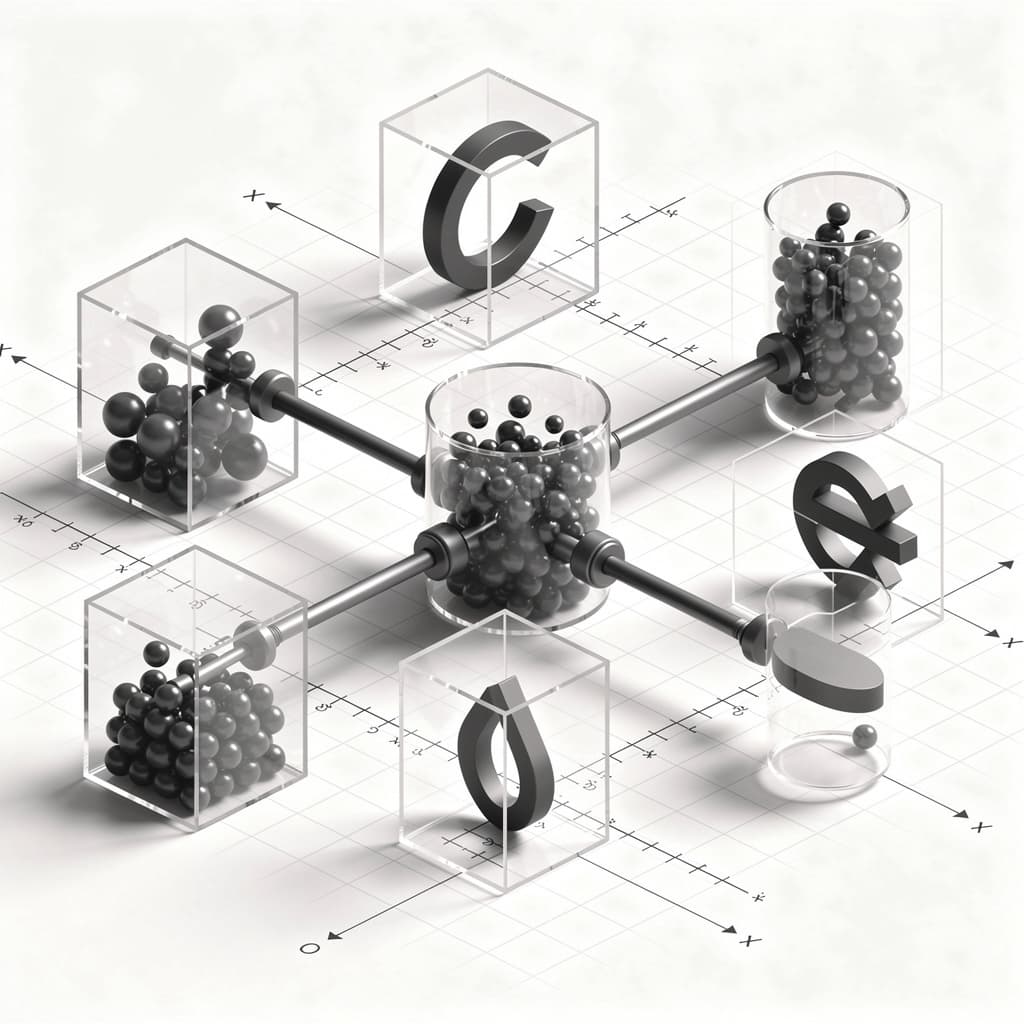
The study of gas laws represents a cornerstone of classical chemistry and thermodynamics, providing a mathematical bridge between the microscopic world of atoms and the macroscopic world we observe. These laws describe how physical properties such as pressure, volume, temperature, and quantity of matter interact to determine the state of a gaseous substance. By treating gases as collections of rapidly moving particles, scientists like Robert Boyle, Jacques Charles, and Joseph Louis Gay-Lussac derived empirical relationships that eventually culminated in the synthesis of the Ideal Gas Law formula. Understanding these laws is not merely an exercise in algebraic manipulation; it is an exploration into the kinetic nature of matter and the predictable logic of physical systems under varying environmental constraints.
The Kinetic Molecular Theory Framework
The Kinetic Molecular Theory (KMT) serves as the theoretical bedrock upon which all gas behavior is interpreted, offering a microscopic explanation for macroscopic observations. This framework posits that gases consist of large numbers of tiny particles that are in constant, random motion, colliding with each other and the walls of their container. In this idealized model, the actual volume of the gas particles themselves is considered negligible compared to the vast empty space between them. Furthermore, it is assumed that there are no attractive or repulsive forces between the particles, meaning they move independently unless a collision occurs. This simplification allows for a direct mathematical treatment of gas behavior, where the physical state is defined by the energy and frequency of molecular interactions rather than the chemical identity of the gas. Within the logic of KMT, the primary variables of state—pressure, volume, and temperature—receive precise physical definitions based on particle motion. Pressure is defined as the average force exerted by gas particles per unit area as they collide with the boundaries of their container. Volume represents the three-dimensional space in which these particles are free to move, while temperature is a direct measure of the average kinetic energy of the particles. The relationship between these variables is governed by the logic of elastic molecular collisions, where no total kinetic energy is lost during an impact. As particles move faster due to increased thermal energy, they strike the container walls more frequently and with greater force, providing the fundamental explanation for why pressure increases with temperature in a fixed volume. The mathematical elegance of the gas laws emerges from the assumption that these collisions are perfectly elastic and the particles occupy no space. Under these conditions, the behavior of any gas becomes predictable regardless of its chemical composition, leading to the "ideal" gas behavior. While no real gas perfectly matches these assumptions, the KMT provides a remarkably accurate approximation for most gases at standard temperatures and pressures. By framing gases as kinetic systems, the theory allows us to derive the proportionality constants that link pressure to volume or temperature to volume. This microscopic perspective is essential for grasping why a gas expands when heated or why it exerts more pressure when compressed into a smaller space.Boyle's Law and Inverse Proportionality
Established in 1662 by Robert Boyle, Boyle's Law was the first of the gas laws to be mathematically formalized, describing the inverse relationship between the pressure and volume of a gas at a constant temperature. Boyle used a J-shaped glass tube partially filled with mercury to trap a fixed amount of air, observing that as he added more mercury to increase the pressure, the volume of the trapped air decreased proportionally. This discovery led to the realization that for a fixed amount of gas at a constant temperature, the product of pressure ($P$) and volume ($V$) remains constant. Mathematically, this is expressed as $P \times V = k$, or more commonly for changing states:$$P_1V_1 = P_2V_2$$
This equation dictates that if the volume of a container is halved, the pressure exerted by the gas will exactly double, provided the temperature remains unchanged. This inverse proportionality is characteristic of isothermal processes, where the system remains in thermal equilibrium with its surroundings. When visualized on a graph where pressure is plotted against volume, the resulting curve is a hyperbola known as an isotherm. The physical logic behind this curve lies in the density of the gas particles; as the volume decreases, the number of particles per unit of space increases. Because there are more particles in a smaller area, the frequency of collisions with the container walls increases, resulting in a higher measured pressure. Boyle’s findings were revolutionary because they provided a quantitative method for predicting how a system would respond to physical compression, a concept fundamental to the operation of modern technology like bicycle pumps and internal combustion engines. To visualize this molecular density under compression, one might imagine a piston-cylinder assembly. If the piston is pushed downward, the space available for the gas molecules is restricted, yet their average speed remains the same because the temperature is constant. Consequently, the molecules strike the walls more often simply because they have less distance to travel between collisions. The mathematical logic of Boyle's Law ensures that this relationship is perfectly balanced; the decrease in space is exactly compensated for by the increase in collision frequency. This predictability allows engineers to calculate the mechanical work required for compression and the resulting force exerted by the gas, forming the basis of pneumatic systems and the initial stages of the thermodynamic cycles used in refrigeration.The Linear Expansion of Charles's Law
While Boyle focused on the relationship between pressure and volume, Jacques Charles investigated the effects of temperature on gas volume in the late 18th century. Charles's Law states that for a fixed mass of gas at a constant pressure, the volume of the gas is directly proportional to its absolute temperature. This means that as the temperature of a gas increases, its volume expands linearly, provided the pressure remains fixed. The mathematical expression for this relationship is $V / T = k$, which leads to the useful comparison formula for changing conditions:$$\frac{V_1}{T_1} = \frac{V_2}{T_2}$$
Crucially, this law only functions correctly when temperature is measured on an absolute scale, such as the Kelvin scale, where zero represents the total absence of molecular kinetic energy. The requirement for the Kelvin scale arises from the observation that the volume-temperature graph for any gas, when extrapolated to zero volume, always intersects the temperature axis at approximately $-273.15$ degrees Celsius. This point, known as absolute zero, is the theoretical floor of the universe's temperature range where molecular motion would cease. If one were to use the Celsius scale in the Charles's Law formula, the math would fail as soon as temperatures dropped to zero or became negative, implying impossible "zero" or "negative" volumes. By using the Kelvin scale ($K = ^\circ C + 273.15$), the direct proportionality is maintained, ensuring that doubling the Kelvin temperature of a gas results in a doubling of its volume. This linear expansion is the principle behind the operation of hot air balloons, where heating the air increases its volume and decreases its density relative to the surrounding atmosphere. In thermodynamic systems, these transitions are referred to as isobaric processes, occurring at constant pressure. As heat is added to a gas in a flexible container, the particles gain kinetic energy and move faster, hitting the interior walls with greater force. To maintain a constant pressure against the external environment, the container must expand, increasing the surface area and reducing the collision frequency back to the original equilibrium level. The logic of Charles's Law thus describes a dynamic balance between thermal energy and spatial occupation. Whether it is the expansion of air in a car tire on a hot day or the precise calibration of laboratory equipment, the linear relationship between heat and volume remains a fundamental rule of chemical physics.Pressure Dynamics in Gay-Lussac's Law
Gay-Lussac's Law, often attributed to Joseph Louis Gay-Lussac in the early 1800s, explores the relationship between pressure and temperature when the volume of the gas is held constant. This law posits that the pressure of a given mass of gas is directly proportional to its absolute temperature. In a rigid container where the volume cannot change, increasing the temperature causes the gas particles to move more rapidly, leading to more frequent and more energetic collisions with the walls. The mathematical representation is $P / T = k$, which is typically applied as:$$\frac{P_1}{T_1} = \frac{P_2}{T_2}$$
Similar to Charles's Law, this relationship necessitates the use of the Kelvin scale to maintain mathematical consistency and physical accuracy across the entire range of thermal states. The fixed volume constraint in Gay-Lussac's Law leads to isochoric (or isovolumetric) transitions, which are critical in understanding the safety and performance of pressurized systems. For example, if a sealed aerosol can is thrown into a fire, the temperature of the trapped gas rises rapidly. Since the metal can prevents the gas from expanding (fixed volume), the kinetic energy of the particles translates entirely into an increase in internal pressure. Eventually, the pressure exceeds the structural integrity of the container, leading to an explosion. This relationship provides the quantitative logic for setting safety standards in the manufacturing of pressure cookers, scuba tanks, and industrial boilers, where monitoring temperature is synonymous with monitoring internal stress on the vessel. The kinetic energy and absolute temperature ratios involved in this law reveal a deep truth about the nature of heat. When we say a gas is "hotter," we are mathematically stating that its molecules possess a higher average velocity. Because pressure is the product of the frequency of collisions and the force of each collision, and both of these factors are increased by higher molecular speeds, pressure must rise. This explains why the gas laws are so interconnected; Gay-Lussac's Law is essentially the pressure-based counterpart to Charles's volume-based law. Together, they describe how the energy of a system is distributed between the force exerted on boundaries and the space occupied by the matter.The Synthesis of the Ideal Gas Law Formula
The integration of the individual observations made by Boyle, Charles, Gay-Lussac, and Avogadro resulted in the unified Ideal Gas Law formula, which provides a complete description of a gas sample's state. Amadeo Avogadro’s contribution was the realization that equal volumes of gases, at the same temperature and pressure, contain an equal number of molecules ($V \propto n$). By combining the three proportionalities—$V \propto 1/P$, $V \propto T$, and $V \propto n$—chemists derived a single equation that relates pressure, volume, temperature, and the number of moles ($n$). This synthesis is expressed as:$$PV = nRT$$
In this equation, $R$ is the Universal Gas Constant, a proportionality factor that bridges the units of energy, temperature, and amount of substance. The value of the gas constant $R$ depends on the units used for pressure and volume, with common values being $0.0821\text{ L}\cdot\text{atm}/(\text{K}\cdot\text{mol})$ or $8.314\text{ J}/(\text{K}\cdot\text{mol})$. The derivation of this constant was a significant milestone in thermodynamics because it allowed scientists to calculate any one of the four variables if the other three were known. It moved chemical inquiry from observing changes in state to predicting the absolute state of a system. The Ideal Gas Law formula essentially treats the gas as a collection of point-masses that interact only through collisions, providing a remarkably simple yet powerful tool for calculating gas behavior in everything from respiratory physiology to the synthesis of industrial fertilizers. However, it is important to recognize the limitations of the ideal approximation. The law assumes that gas particles have zero volume and no intermolecular forces, conditions that are only closely met at high temperatures and low pressures. When a gas is cooled or compressed significantly, the particles slow down and move closer together, allowing attractive forces like London dispersion forces or dipole-dipole interactions to become significant. Under these extreme conditions, the "ideal" logic begins to break down, as the gas may condense into a liquid or deviate from the predicted pressure. Despite these limitations, the Ideal Gas Law remains the primary analytical framework for introductory chemistry and engineering, serving as the baseline from which more complex "real gas" equations are derived.Calculating States with PV=nRT Logic
One of the most practical applications of the gas laws is manipulating ratios to predict the final state of a system when initial conditions are altered. By rearranging the Ideal Gas Law formula into the Combined Gas Law, researchers can account for simultaneous changes in pressure, volume, and temperature. This is represented by the formula $(P_1V_1)/T_1 = (P_2V_2)/T_2$, which assumes the amount of gas ($n$) remains constant. For instance, a meteorologist might use this logic to predict how the volume of a weather balloon will change as it rises from the Earth's surface, where pressure is high and temperature is moderate, into the upper atmosphere where both pressure and temperature drop significantly. Beyond simple state changes, the logic of the gas laws extends to mixtures of different gases through John Dalton’s contribution, known as Dalton’s Law of Partial Pressures. Dalton observed that in a mixture of non-reacting gases, the total pressure exerted is equal to the sum of the partial pressures of the individual gases. This is mathematically expressed as:$$P_{\text{total}} = P_1 + P_2 + P_3 + \dots$$
This principle relies on the idea that in an ideal gas, particles are so far apart that they act independently. Therefore, each gas in a mixture contributes to the total pressure as if it were the only gas present in the container. This is vital in fields like deep-sea diving, where the partial pressure of oxygen must be carefully managed to prevent toxicity while maintaining enough pressure to allow for breathing at depth. Predicting final states from initial conditions requires a disciplined approach to unit conversion and algebraic manipulation. Because the gas constant $R$ is fixed, all variables must be in consistent units—usually Liters for volume, Atmospheres or Pascals for pressure, and always Kelvin for temperature. A common worked example involves calculating the number of moles of gas in a container of known volume and pressure at a specific temperature. By rearranging the formula to $n = PV / RT$, one can determine the precise amount of substance without ever having to weigh it on a scale. This ability to "count" molecules by measuring physical properties like pressure and temperature is one of the most powerful utilities of gas laws in laboratory settings.Real Gases and Deviations from Ideality
While the ideal gas model is highly effective for many applications, real gases often deviate from these mathematical predictions under conditions of high pressure or low temperature. At high pressures, the volume occupied by the gas molecules themselves becomes a significant fraction of the total container volume, contradicting the KMT assumption that particles are point-masses. Similarly, at low temperatures, the kinetic energy of the particles decreases to the point where intermolecular attractive forces—which the ideal model ignores—begin to pull the particles together. These factors cause the measured pressure and volume to differ from the values predicted by the Ideal Gas Law formula, necessitating a more complex mathematical treatment. To account for these deviations, Johannes Diderik van der Waals proposed a correction to the ideal gas equation in 1873. The Van der Waals equation introduces two empirical constants, $a$ and $b$, which are specific to each gas. The constant $a$ accounts for the intermolecular forces that reduce the effective pressure, while $b$ accounts for the finite volume occupied by the gas molecules. The modified equation is:$$\left(P + \frac{an^2}{V^2}\right)(V - nb) = nRT$$
This correction allows for a much more accurate description of gas behavior near the point of liquefaction. The term $an^2/V^2$ adds a "correction" to the pressure because real molecules attract each other, hitting the walls with slightly less force than ideal particles. The term $nb$ subtracts the volume of the molecules from the total volume, acknowledging that the particles are not actually zero-sized points. Understanding the logic of the Van der Waals correction is essential for industrial processes that operate at high pressures, such as the Haber-Bosch process for ammonia synthesis. Engineers must use compressibility factors ($Z = PV/nRT$) to measure how much a real gas deviates from ideal behavior ($Z=1$). When $Z$ is less than 1, attractive forces dominate; when $Z$ is greater than 1, the finite volume of the particles dominates. By mapping these phase boundaries and compressibility factors, scientists can predict when a gas will condense into a liquid or how it will behave under the extreme conditions found in planetary atmospheres or deep-earth reservoirs. The transition from ideal to real gas logic represents the maturation of chemical theory, moving from elegant simplifications to rigorous, empirical reality.References
- Atkins, P., & de Paula, J., "Atkins' Physical Chemistry", Oxford University Press, 2017.
- Boyle, R., "New Experiments Physico-Mechanicall, Touching the Spring of the Air, and its Effects", H. Hall, 1660.
- Zumdahl, S. S., & Zumdahl, S. A., "Chemistry", Cengage Learning, 2014.
- Van der Waals, J. D., "Over de Continuïteit van den Gas- en Vloeistoftoestand" (On the Continuity of the Gaseous and Liquid States), University of Leiden, 1873.
Recommended Readings
- The Properties of Gases and Liquids by Bruce E. Poling — An advanced resource that provides detailed methods for estimating and correlating the physical properties of real gases and liquids.
- A History of Thermodynamics: The Doctrine of Energy and Entropy by Ingo Müller — A fascinating look at the historical development of the laws of thermodynamics, including the evolution of gas law theories.
- The Periodic Kingdom by P.W. Atkins — A metaphorical journey through the chemical world that explains the behavior of elements and gases with profound intuition and clarity.
- Six Easy Pieces by Richard P. Feynman — While covering broader physics, this book offers an unparalleled explanation of atomic motion and the kinetic theory that underpins gas behavior.
gas lawsBoyle's LawCharles's LawIdeal Gas Law formulaPV=nRTGay-Lussac's Law