The Linear Logic of Slope-Intercept Form
Explore the logic of slope intercept form. Master the y=mx+b formula, learn graphing linear equations, and find the y-intercept with this deep tutorial.
In this articleThe Fundamental Anatomy of Linear Equations

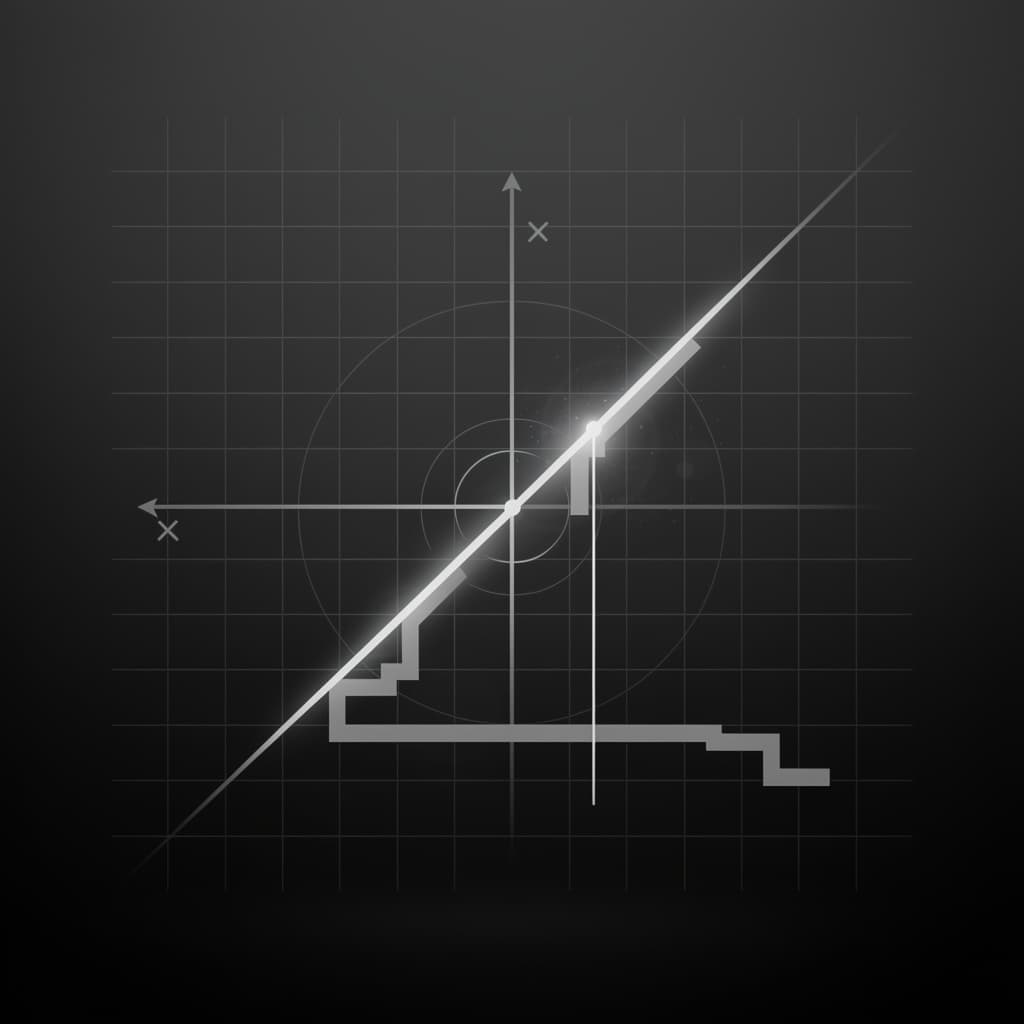
The slope intercept form, represented by the iconic equation , serves as the bedrock of coordinate geometry and introductory algebra. This formula provides a direct bridge between algebraic manipulation and visual representation on the Cartesian plane, which was first popularized by René Descartes in the 17th century. By isolating the dependent variable , the equation reveals the predictable relationship between inputs and outputs in a linear system with remarkable clarity. Every component of the expression—the variables and , the coefficient , and the constant —communicates a specific geometric instruction that dictates how a line behaves in infinite space. This structure allows mathematicians and scientists to predict future states of a system based on its current rate of change and initial starting conditions.
At its heart, the slope intercept form is more than just a method for drawing lines; it is a logical framework for understanding proportionality and constant change. In a world where many phenomena do not change at erratic rates, the linear model provides a simplified but powerful lens through which we can view reality. Whether one is calculating the steady depreciation of an asset, the constant velocity of an object in a vacuum, or the accumulation of interest in a bank account, the structure remains the primary tool for modeling these behaviors. By mastering the anatomy of this equation, one gains the ability to translate abstract numerical data into a spatial narrative that can be graphed, analyzed, and projected into the future.
The utility of this form lies in its "explicit" nature, meaning that the value of is determined directly by the value of . This differs from the Standard Form (), where the relationship between the two variables is obscured by their placement on the same side of the equality sign. In the slope-intercept orientation, the equation acts as a function, , which defines a unique output for every possible input. This functional perspective is what makes the slope-intercept form the preferred choice for computer scientists and data analysts who need to program linear regressions or algorithmic trends. It transforms a static line into a dynamic rule that can be applied across an infinite domain of numbers.
The Fundamental Anatomy of Linear Equations
Deconstructing the y=mx+b Formula
To understand the slope intercept form, one must first deconstruct the individual roles of its four primary components. The variable represents the dependent variable, or the vertical coordinate on a graph, which changes in response to the input. The variable serves as the independent variable, representing the horizontal position or the primary input of the function. The coefficient is perhaps the most critical element, as it defines the "slope" or the steepness of the line, acting as a multiplier for every unit of . Finally, the constant represents the y-intercept, which is the specific point where the line crosses the vertical axis when is equal to zero. Together, these elements form a complete set of instructions for the trajectory of a line.
The interaction between and is what creates the unique signature of any specific linear equation. While determines the angle and direction of the line—whether it ascends, descends, or stays flat— determines its vertical position on the Cartesian grid. If you change while keeping constant, the line will rotate around the y-intercept like a propeller. Conversely, if you keep constant while changing , the line will slide up or down the graph while maintaining the exact same angle. This separation of "tilt" and "position" is what makes the y=mx+b formula so intuitive for students and professionals alike, as it isolates the two fundamental ways a line can be modified.
Variables and Constants in Coordinate Space
In the context of coordinate geometry, and are not merely abstract symbols but represent locations in a two-dimensional space. The -axis generally represents a progression of time, distance, or quantity, while the -axis represents the resulting value or state. Because the equation contains two variables, it produces an infinite number of solutions that appear as a continuous path when plotted. Each solution is an ordered pair that satisfies the logical equality established by the formula. The constants and are "parameters" because they remain fixed for a specific line, providing the "DNA" that distinguishes one linear path from another in the infinite field of the coordinate plane.
Understanding the distinction between these variables and constants is essential for graphing linear equations effectively. The parameters and are known as the "structural" elements of the line, while and are the "relational" elements. In physical sciences, these parameters often have physical meanings; for example, might represent the density of a material while represents its volume, making the total mass. By keeping the structural parameters constant, we can observe how the relational variables interact across different quadrants of the graph. This consistency allows for the standardization of linear models, making it possible to compare different datasets by simply looking at their respective and values.
The Geometric Meaning of the Equality Sign
The equality sign in represents a state of perfect balance and constraint within the coordinate system. It dictates that for any chosen value along the horizontal axis, there is exactly one corresponding value on the vertical axis that will keep the equation true. Geometrically, this constraint is what forces the points to align in a perfectly straight path rather than scattering across the plane. If the relationship were an inequality, such as , it would represent a whole region or "half-plane" of space. However, the strict equality ensures that we are looking at a one-dimensional object—a line—existing within a two-dimensional world.
This logical constraint is also what allows us to solve for unknowns within linear functions. If we know the slope and the intercept, we can find the -value for any , and if we know a point and the slope, we can work backward to find the intercept. The equality sign acts as a gatekeeper that ensures the "rate of change" is always consistent regardless of where you are on the line. In more advanced mathematics, this property is known as linearity, which implies that the relationship between change in and change in is additive and homogeneous. This predictability is why the slope intercept form is the first major milestone in a student's journey toward understanding the broader world of mathematical modeling and calculus.
Quantifying Vector Dynamics and Slope
The Algebraic Method of How to Find Slope
The concept of "slope" is a numerical measure of a line's inclination relative to the horizontal -axis. To master how to find slope, one must use the formula for the "average rate of change," which is the ratio of the change in to the change in . Given any two points on a line, and , the slope is calculated using the following LaTeX expression: This calculation is often referred to as "rise over run," where the "rise" is the vertical displacement and the "run" is the horizontal displacement. It is crucial to maintain a consistent order of points during subtraction to ensure the correct sign (positive or negative) of the slope is preserved.
When calculating , the resulting value tells us how much the variable increases or decreases for every single unit that moves to the right. For instance, a slope of 3 means that for every 1 unit of horizontal movement, the line climbs 3 units vertically. Conversely, a slope of -1/2 indicates that for every 2 units of horizontal movement, the line drops by 1 unit. This ratio remains constant for the entire length of a straight line, which is the defining characteristic of a linear function. If the slope were to change at any point, the line would become a curve, and the simple formula would no longer apply, requiring the more complex tools of differential calculus to analyze.
Interpreting Rate of Change Across Quadrants
The sign and magnitude of the slope provide immediate visual cues about the line's behavior across the four quadrants of the Cartesian plane. A positive slope () describes an "increasing" function, where the line moves from the bottom-left toward the top-right. A negative slope () describes a "decreasing" function, moving from the top-left toward the bottom-right. The magnitude of determines the steepness; as the absolute value of increases, the line becomes more vertical, and as it approaches zero, the line becomes more horizontal. This visual shorthand allows mathematicians to instantly categorize the relationship between variables without needing to plot a full table of values.
Special cases of slope include zero and undefined values, which represent perfectly horizontal and vertical lines, respectively. A slope of results in an equation of the form , indicating that is constant and does not depend on at all. In physical terms, this represents a state of no change, such as a car parked at a specific distance from home over a period of time. An undefined slope occurs when the "run" () is zero, leading to a vertical line represented by the equation . Because a vertical line fails the "vertical line test" (one value having multiple values), it is not considered a function, though it remains a vital component of coordinate geometry and spatial analysis.
Studying this for an exam?
Noesis builds the syllabus, notes and tests for you, and you study them with a tutor that knows your material.
Deciphering the Vertical Anchor
Calculating y-intercept via Algebraic Substitution
The y-intercept, represented by the variable in the slope intercept form, is the point where the line intersects the vertical -axis. Mathematically, this occurs when the horizontal coordinate is equal to zero. To find this value when it is not explicitly given, one can use the process of algebraic substitution. If you are provided with the slope and a single point that lies on the line, you can plug these three values into the equation and solve for . This technique is fundamental for deriving equations from raw data points or experimental observations where the "starting point" may not have been measured directly.
For example, if a line has a slope of 2 and passes through the point , the substitution would look like this: . Simplifying the right side gives , and subtracting 6 from both sides reveals that . Therefore, the full slope intercept form for this line is . This ability to reconstruct the entire rule for a line from just a single point and a rate of change is a powerful tool in predictive modeling. It allows us to "anchor" our rate of change to a specific vertical position, ensuring the line passes exactly where it is supposed to in the coordinate space.
The Point of Origin and Initial Values
In many real-world applications, the -intercept represents the "initial value" or "starting state" of a system at "time zero." For a business, might represent the initial capital investment before any sales occur. In physics, if represents time and represents displacement, represents the starting position of an object. When , the line passes through the point of origin , and the relationship is described as "proportional." These lines are the simplest form of linear equations, often written as , and they represent scenarios where there is no "offset" or "overhead" to consider.
Understanding the y-intercept is also crucial for determining the "practical domain" of a linear model. While a mathematical line extends infinitely in both directions, a real-world scenario might only make sense for positive values of and . In such cases, the y-intercept serves as the boundary of the model. For instance, if you are calculating the amount of water in a leaking tank, the -intercept is the initial volume of water. The model only "works" from the y-intercept () until the point where the line hits the -axis (the x-intercept), representing the moment the tank is empty. Thus, the value provides the necessary context for the entire linear narrative.
Visualizing Logic through Graphing Linear Equations
The Procedural Movement of Rise Over Run
The process of graphing linear equations using the slope-intercept form is a procedural exercise that minimizes the need for complex calculations. The first step is always to plot the y-intercept on the vertical axis, as this provides a definitive starting point for the line. From there, the slope acts as a set of navigational directions to find the next point. If the slope is written as a fraction , the "rise" tells the drawer how many units to move up or down, and the "run" tells them how many units to move to the right. This "staircase" method is highly efficient and significantly reduces the risk of error compared to plotting multiple random values.
Consider the equation . To graph this, a student would first place a dot at 5 on the -axis. Because the slope is -2/3, they would then "rise" down 2 units (since it is negative) and "run" right 3 units, placing a second dot at . This process can be repeated—down 2 more and right 3 more—to create a series of perfectly aligned dots. Connecting these dots with a straightedge produces the complete line. This geometric visualization reinforces the idea that the slope is a constant ratio; the "stairs" are the same size no matter where you are on the line, which is why the path remains straight.
Constructing Lines from the Intercept Outward
While the standard "rise over run" moves to the right, it is equally possible to move to the left by reversing both directions. For a slope of 2/1, moving "up 2 and right 1" is logically identical to moving "down 2 and left 1" because the ratio of two negative numbers () is still positive. This allows for the construction of a line across all relevant quadrants of a graph, ensuring that the visual representation covers the necessary area of interest. This symmetry is a key property of linear functions, illustrating that the relationship between and is consistent regardless of whether we are looking at positive or negative inputs.
When the slope is an integer, such as , it is helpful to remember that it can be written as the fraction . This means the "run" is always 1 unit to the right for every 4 units of "rise." In cases where the y-intercept is a fraction or a decimal, the graph can be more difficult to draw by hand, but the logic remains identical. Professional draftsmen and software programs use these same procedural steps, though with much higher precision, to render linear data. The graphing linear equations process effectively turns the abstract y=mx+b formula into a concrete visual shape that is much easier for the human brain to interpret and analyze.
Interpreting Zero and Undefined Slopes Graphically
Graphing lines with zero or undefined slopes requires a departure from the standard "rise over run" procedure because one of the dimensions becomes stagnant. For an equation like , the slope is 0, which means there is no "rise" regardless of how much you "run." This results in a horizontal line that is perfectly parallel to the x-axis, crossing through the point . On the other hand, a vertical line like cannot be expressed in slope intercept form because its slope is undefined (you cannot divide by a "run" of zero). Graphing these lines involves identifying the single constant value and drawing a straight line through all points that share that value.
These "extreme" cases of slope are vital for representing boundaries in geometry and physics. A horizontal line often represents a "ceiling" or a "floor" in an optimization problem, or a constant speed in a motion graph. A vertical line might represent a specific moment in time when multiple things happen simultaneously, or a physical wall in a spatial model. Understanding how these lines look and how they differ from standard diagonal lines helps students avoid common pitfalls, such as confusing the equations for horizontal and vertical lines. It also clarifies why the slope intercept form is specifically designed for functions where changes in a predictable, non-infinite way relative to .
Transforming Standard Expressions into Slope-Intercept
Manipulation of the Ax + By = C Format
In many algebraic problems, equations are initially presented in Standard Form (), where and are integers. While this form is useful for finding intercepts quickly (by setting one variable to zero), it is not particularly helpful for visualizing the slope or the specific y-intercept. To transform this into slope intercept form, one must perform a series of algebraic steps to isolate the variable. This usually involves subtracting the term from both sides and then dividing every term in the equation by . The resulting coefficients then reveal the slope () and the intercept ().
For example, given the equation , the transformation process would be as follows:
- Subtract from both sides:
- Divide every term by 2:
Algebraic Benefits of the Solved Variable
The primary benefit of having isolated is the ease of computation. When an equation is in slope intercept form, calculating the value for any given becomes a simple matter of multiplication and addition. This is particularly useful in "input-output" scenarios, such as programming a spreadsheet to calculate costs based on quantity. If is isolated, you can simply plug in a list of values and get your results instantly. In contrast, using the Standard Form would require you to re-solve the entire equation for every single new value of , which is inefficient and prone to calculation errors.
Furthermore, having the variable isolated allows for easy comparison between multiple lines. If you have two equations in slope-intercept form, you can instantly tell if they are parallel (they will have the same ), perpendicular (their slopes will be negative reciprocals), or if they intersect. This explicit clarity is why most graphing calculators and software packages require equations to be entered in the "y=" format. By solving for the variable, we move from an implicit relationship to a clear, directional rule of logic that can be utilized in more complex systems of equations.
Contextual Slope Intercept Form Examples
Translating Physical Phenomena into Linear Models
The real-world utility of the slope intercept form is best demonstrated through concrete slope intercept form examples. Consider a taxi service that charges a flat fee of 5 dollars to pick up a passenger, plus 2 dollars for every mile driven. In this scenario, the flat fee is the y-intercept () because it is the cost at zero miles. The rate per mile is the slope () because it is the constant rate of change. The equation for the total cost based on miles is . This model allows the passenger to calculate their fare for any distance before they even enter the car.
Another classic example involves temperature conversion. The relationship between Celsius () and Fahrenheit () is linear. The formula is written exactly in slope intercept form. Here, 32 is the y-intercept, which is the temperature in Fahrenheit when Celsius is zero (the freezing point of water). The slope is 9/5, meaning that for every 5-degree increase in Celsius, there is a 9-degree increase in Fahrenheit. These examples show how the structure is not just a school exercise, but a fundamental way of organizing the rules that govern the physical and economic world.
Scenario-Based Derivations of Linear Paths
Linear models are also used extensively in biology and environmental science to track growth and decay. Suppose a scientist is monitoring a forest where the tree canopy is decreasing by 3 percent each year due to a specific invasive species, starting from an initial coverage of 80 percent. The equation would be , where is the number of years. This allows researchers to predict exactly when the canopy might reach a critical threshold, such as 20 percent, by setting to 20 and solving for . Such derivations are essential for policy-making and conservation efforts.
In the realm of finance, slope intercept form is used to calculate "straight-line depreciation." If a company buys a piece of machinery for 50,000 dollars and it loses 5,000 dollars in value every year, the value of the machine after years is . The -intercept is the purchase price, and the negative slope is the annual depreciation rate. Accountants use these linear paths to determine tax deductions and the "book value" of assets over time. These scenarios highlight how the logic of the line provides a clear, defensible method for making predictions and managing complex resources.
Geometric Relations and Line Interactions
The Calculus of Parallel and Perpendicular Gradients
The relationship between two or more lines is determined entirely by their slopes. Parallel lines are defined as lines that never intersect, which in coordinate geometry means they must have the exact same slope () but different y-intercepts (). If they had the same value as well, they would be the same line. This principle is used in architecture and engineering to ensure that structures are aligned correctly and that paths, such as railroad tracks, remain a constant distance apart. In the slope intercept form, parallel lines are instantly recognizable because the coefficient of is identical across both equations.
Perpendicular lines, which meet at a perfect 90-degree angle, have a more complex relationship. Their slopes are "negative reciprocals" of each other (). For example, if one line has a slope of , any line perpendicular to it must have a slope of . This geometric fact is essential for creating grids, frames, and any design that requires right angles. When you multiply the slopes of two perpendicular lines together, the result is always -1. This property allows mathematicians to find the shortest distance from a point to a line, as the shortest path is always a perpendicular segment.
Intersection Points and Functional Equality
When two lines are not parallel, they will intersect at exactly one point in the Cartesian plane. To find this point algebraically using slope intercept form, we use the principle of functional equality. If and , then at the point of intersection, the two values must be equal. Therefore, we can set the two right sides of the equations equal to each other: . Solving this new equation for gives us the horizontal coordinate of the intersection, which can then be plugged back into either original equation to find the coordinate.
This method of solving "systems of linear equations" is a cornerstone of economic analysis, specifically in finding the "equilibrium point" between supply and demand. If the supply of a product is modeled by one linear equation and the demand by another, the point where they cross represents the ideal price and quantity for a stable market. This intersection represents a moment of simultaneous truth—the only point where both logical rules are satisfied at the same time. The ability to find these points is what allows us to solve complex problems involving competing interests or multiple constraints.
Applications in Multi-Variable Systems
While the slope intercept form is a two-dimensional tool, the logic it establishes serves as the foundation for multi-variable mathematics. In three dimensions, the equivalent of a line is a plane, which is represented by the equation . This is essentially an extension of the format, where we add another independent variable and another slope (or partial derivative). The concepts of "rate of change" and "starting value" remain the same, even as the geometry becomes more difficult to visualize. Mastering the two-variable linear model is an absolute prerequisite for moving into the realms of multivariable calculus and linear algebra.
In data science, the slope intercept form is used in simple linear regression to find the "line of best fit" for a scatter plot of data. Even when the data points do not form a perfectly straight line, statisticians use algorithms to find the and values that minimize the distance between the line and all the points. This "best fit" line allows for predictions about trends, such as how height might correlate with weight or how education level might correlate with income. Thus, the linear logic of the slope intercept form extends far beyond the classroom, acting as a primary tool for human beings to find order and meaning in a sea of complex information.
References
- Stewart, James, "Calculus: Early Transcendentals, 8th Edition", Cengage Learning, 2015.
- Larson, Ron and Boswell, Laurie, "Big Ideas Math: Algebra 1", Big Ideas Learning, 2014.
- Descartes, René, "The Geometry of René Descartes" (Translated by David Eugene Smith and Marcia L. Latham), Dover Publications, 1954.
- Stroud, K.A. and Booth, Dexter J., "Engineering Mathematics", Palgrave Macmillan, 2013.
Recommended Readings
- Infinite Powers by Steven Strogatz — A brilliant exploration of how calculus and linear modeling changed the world, written for a general audience.
- A History of Mathematics by Carl B. Boyer — This text provides the historical context of how the coordinate system and linear equations evolved from ancient Greek geometry to modern algebra.
- Introduction to Linear Algebra by Gilbert Strang — For those who want to see how the logic of scales into higher dimensions and complex vector spaces.
- Flatland: A Romance of Many Dimensions by Edwin A. Abbott — A classic satirical novella that helps readers visualize geometric concepts and the limitations of different dimensional perspectives.
Turn this topic into a full course
Noesis builds the syllabus, notes and tests for you, and you study them with a tutor that knows your material.