The Kinematic Logic of Projectile Motion
The study of projectile motion serves as a foundational pillar of classical mechanics, offering a window into how objects traverse space under the influence of uniform gravitational fields. By...
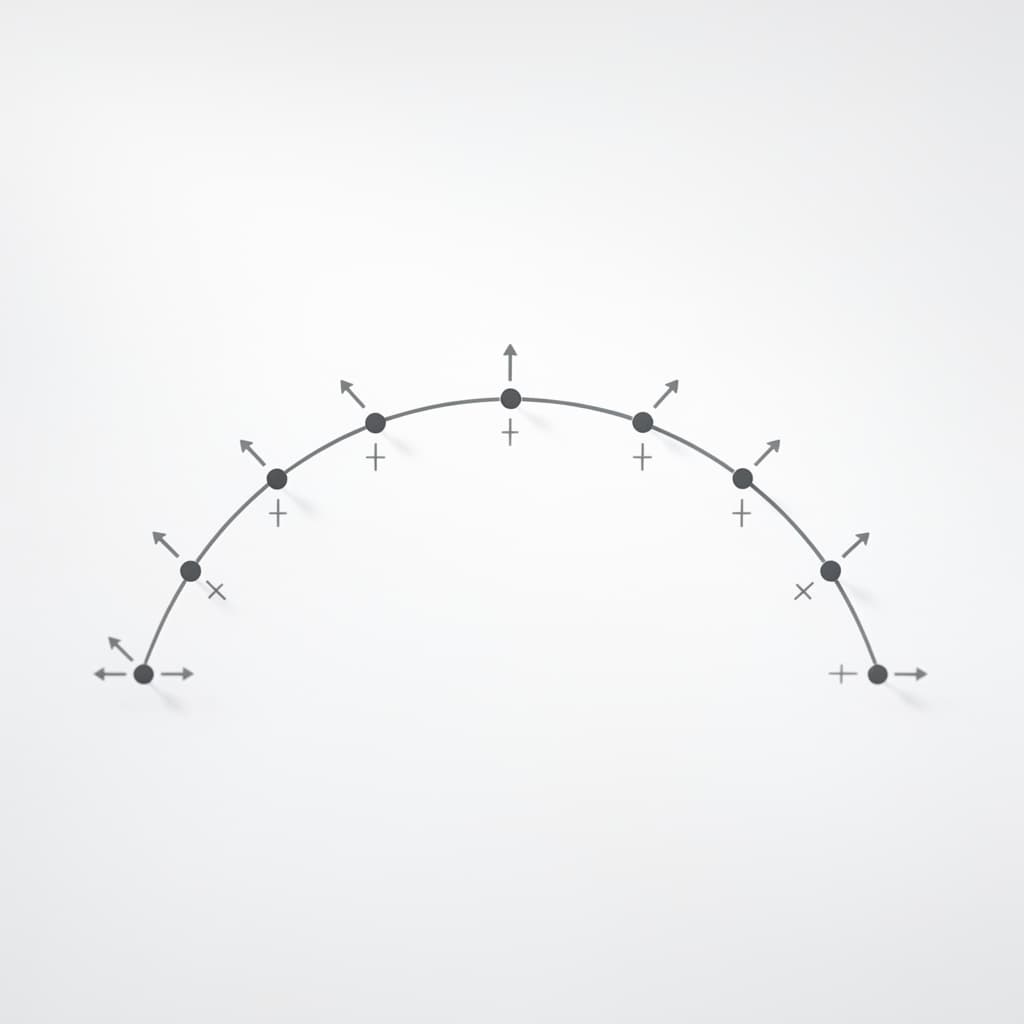
The study of projectile motion serves as a foundational pillar of classical mechanics, offering a window into how objects traverse space under the influence of uniform gravitational fields. By definition, a projectile is any object that is launched into the air and continues in motion by its own inertia, influenced only by the downward pull of gravity and, in more complex models, the resistance of the atmosphere. The "logic" of this motion is rooted in the decoupling of horizontal and vertical dimensions, allowing for a predictable and mathematically elegant analysis of flight. This conceptual framework not only explains the trajectory of a thrown stone but also underpins modern ballistics, aerospace engineering, and even the biological mechanics of jumping animals. Understanding these principles requires a transition from simple linear thinking to a two-dimensional perspective where time acts as the sole bridge between two independent directions of travel.
Defining Motion in Two Dimensions
The most critical breakthrough in understanding projectile motion is the principle of orthogonal independence, which states that motion in the horizontal direction does not affect motion in the vertical direction. When an object is projected, its horizontal velocity remains constant throughout its flight, assuming the absence of air resistance, because there are no horizontal forces acting upon it. Conversely, the vertical component is subject to a constant acceleration due to gravity, which continuously alters the vertical velocity. This separation allows physicists to treat a single complex flight path as two simultaneous yet distinct linear motions. By solving for these components separately, one can reconstruct the exact position of the object at any infinitesimal moment in time.
The constant influence of gravitational acceleration is the primary force that shapes the path of a projectile. On Earth, this acceleration is approximately $9.81 m/s^2$ directed toward the center of the planet, which causes the vertical velocity to decrease as the object rises and increase as it falls. Because this force acts exclusively in the vertical axis, it has no power to speed up or slow down the horizontal progress of the projectile. This leads to the observation that a ball dropped vertically and a ball thrown horizontally from the same height will strike the level ground at the identical moment. This counterintuitive reality highlights the fact that vertical "falling" is entirely independent of horizontal "traveling."
To begin any formal analysis of such motion, one must establish the initial conditions through velocity decomposition. Every launch occurs at a specific initial velocity, $v_0$, and at a specific angle relative to the horizontal, $\theta$. Using basic trigonometry, the initial velocity is split into its x and y components: $v_{0x} = v_0 \cos \theta$ and $v_{0y} = v_0 \sin \theta$. These components serve as the starting parameters for the kinematic equations that govern each axis. While the initial vertical velocity determines how high the object will climb, the initial horizontal velocity determines how much ground it will cover during its time in the air.
The Derivation of the Trajectory Formula
The mathematical heart of projectile motion is the trajectory formula, which describes the spatial path of the object without explicit reference to time. To derive this, we start with the basic displacement equations for both axes: $x(t) = v_{0x}t$ and $y(t) = v_{0y}t - \frac{1}{2}gt^2$. By rearranging the horizontal equation to solve for time, $t = \frac{x}{v_0 \cos \theta}$, we can substitute this expression into the vertical displacement equation. This substitution merges the two dimensions into a single relationship between the vertical height $y$ and the horizontal distance $x$. This process effectively "eliminates" the temporal variable to reveal the geometric skeleton of the flight path.
The resulting expression, $y = x \tan \theta - \frac{gx^2}{2v_0^2 \cos^2 \theta}$, takes the form of a quadratic equation, $y = ax^2 + bx + c$, which mathematically defines a parabola. The parabolic nature of the path is not accidental; it is the inevitable result of a constant horizontal velocity combined with a constant vertical acceleration. In this geometric view, the "a" coefficient is negative, confirming that the parabola opens downward, reflecting the pull of gravity. This parabolic curve is perfectly predictable and symmetrical, assuming a level launch and landing surface, which allows for precise calculations of how the path changes with different launch parameters.
Predicting the point of impact involves solving this trajectory equation for $y = 0$, representing the moment the projectile returns to the ground level. For a launch from the origin $(0,0)$, the roots of the quadratic equation provide two points: the starting location and the final range. This calculation is essential in fields ranging from golf to military ballistics, where the objective is to hit a target at a specific distance. By adjusting the initial velocity or the launch angle, an operator can shift the "roots" of this parabola to intersect with the desired impact point. This logic serves as the basis for all predictive targeting systems used in modern technology.
Principles of Horizontal Projectile Motion
A specific and simplified case of these dynamics is horizontal projectile motion, where an object is launched with an initial angle of zero degrees. In this scenario, the initial vertical velocity component, $v_{0y}$, is zero, meaning the object begins its flight moving only sideways. Despite this lack of initial upward or downward movement, the object begins to accelerate downward immediately upon release due to gravity. The resulting path is a semi-parabola, or the "right half" of a full parabolic arc. This specific case is frequently used in introductory physics to demonstrate the basic mechanics of falling without the complexity of upward ascent.
The analysis of the vertical drop in horizontal launches is straightforward because the time of flight depends solely on the initial height from which the object is released. Since $v_{0y} = 0$, the vertical displacement equation simplifies to $h = \frac{1}{2}gt^2$, which can be rearranged to find time as $t = \sqrt{\frac{2h}{g}}$. This reveals that the horizontal velocity has absolutely no impact on how long the object stays in the air. Whether a stone is dropped or fired from a high-powered rifle horizontally, both will hit the ground at the same time if they start from the same height. This emphasizes the role of gravity as a "constant clock" that dictates the duration of the flight regardless of horizontal speed.
Maintaining a constant horizontal velocity is the other defining characteristic of this motion type. Because we ignore air resistance in the ideal model, the horizontal acceleration is zero, and thus $v_x$ remains equal to $v_0$ throughout the entire duration of the drop. The distance covered horizontally, known as the range, is simply the product of this constant velocity and the time of flight calculated from the height. This relationship allows engineers to predict where a package dropped from a moving aircraft will land relative to the point of release. Understanding this constant velocity is fundamental to navigating the relative motion problems often encountered in naval and aerial logistics.
Application of Projectile Motion Equations
To fully describe the life cycle of a projectile, one must employ specific projectile motion equations to calculate the peak of the flight. The maximum height is reached at the exact moment when the vertical velocity, $v_y$, becomes zero as it transitions from rising to falling. Using the kinematic equation $v_y^2 = v_{0y}^2 - 2g(h_{max})$, we can derive that $h_{max} = \frac{v_0^2 \sin^2 \theta}{2g}$. This formula shows that the height is proportional to the square of the initial velocity, meaning that doubling the launch speed will result in four times the maximum height. Understanding this relationship is vital for athletes like high jumpers or basketball players seeking to optimize their vertical reach.
The total horizontal range is perhaps the most sought-after value in projectile problems, representing the displacement from launch to impact on level ground. The range formula is derived by multiplying the constant horizontal velocity by the total time of flight, resulting in $R = \frac{v_0^2 \sin(2\theta)}{g}$. This equation highlights a fascinating trigonometric property: the range is maximized when $\sin(2\theta)$ is at its maximum value of one. This occurs when $2\theta = 90$ degrees, or when the launch angle is exactly 45 degrees. Consequently, any deviation from this optimal angle, whether steeper or shallower, will result in a shorter horizontal distance for a given launch speed.
Finally, solving for the final impact velocity requires recombining the horizontal and vertical components at the moment of landing. While the horizontal component remains $v_{0x}$, the vertical component will have increased to $v_y = v_{0y} - gt$. The magnitude of the final velocity is found using the Pythagorean theorem, $\sqrt{v_x^2 + v_y^2}$, and the final impact angle is determined by the inverse tangent of the ratio between these components. This calculation is critical for safety assessments in construction or for determining the kinetic energy of a falling object upon impact. By understanding the velocity at every point, scientists can assess the potential damage or work that a projectile can perform upon reaching its destination.
Factors Governing Flight Performance
The mathematics of the optimal launch angle reveals that while 45 degrees is theoretically perfect on a level plane, real-world conditions often shift this requirement. If the launch point is higher than the landing point, such as a shot putter throwing from shoulder height, the optimal angle actually drops below 45 degrees. Conversely, if the target is elevated above the launch point, a steeper angle is required to clear the height and reach the destination. These adjustments are second nature to skilled athletes, who intuitively modify their release angles based on their height and the position of the goal. Mathematically, these shifts occur because the symmetry of the parabola is "cut off" or "extended" by the difference in elevation.
The effect of the initial launch height, $h_0$, adds a constant term to the vertical displacement equation, transforming it into $y = h_0 + v_{0y}t - \frac{1}{2}gt^2$. This initial height provides the projectile with extra "potential time" in the air, allowing it to travel further horizontally even with a lower initial vertical velocity. This is why aircraft can drop supplies that glide over massive distances or why a defender in soccer can clear the ball further by kicking it while it is still high in its bounce. Height effectively acts as a buffer against gravity, delaying the inevitable moment of impact and allowing horizontal inertia to carry the object further across the landscape.
From the perspective of energetics, projectile motion is a continuous transformation between kinetic and potential energy. At the moment of launch, the object possesses its maximum kinetic energy, which is partially converted into gravitational potential energy as it climbs toward the apex. At the highest point, the potential energy is at its peak, and the kinetic energy is at its minimum—though never zero, as the horizontal velocity persists. As the object descends, this potential energy is converted back into kinetic energy, resulting in the object regaining its original speed as it passes the original launch height. This conservation law ensures that, in a vacuum, the speed at which a projectile is launched is identical to the speed at which it returns to that same elevation.
Observing Projectile Motion Examples
Classical ballistics provides some of the most historic projectile motion examples, dating back to the work of Niccolò Tartaglia and later refined by Galileo. Early artillerymen struggled with the "logic" of cannonballs, often believing they traveled in straight lines before falling vertically—a theory known as "impetus." It was the application of kinematic principles that allowed for the creation of firing tables, which told soldiers exactly what angle to set their cannons to hit a fortress at a specific distance. Today, these same principles are used in modern engineering to calculate the trajectories of satellites being placed into orbit or the path of suborbital rockets.
In the natural world, biological adaptations have evolved to exploit these kinematic laws with startling precision. The archerfish, for example, "fires" droplets of water at insects on overhanging branches, correcting for both the refraction of light at the water's surface and the parabolic drop of the water projectile. Similarly, the jumping mechanisms of fleas and grasshoppers are optimized to produce specific launch velocities and angles that maximize either distance for escape or height for clearing obstacles. These natural examples demonstrate that the "logic" of motion is so fundamental that it has been "programmed" into the survival strategies of diverse species over millions of years of evolution.
Competitive sports offer perhaps the most visible daily application of two-dimensional motion. A quarterback throwing a "hail mary" pass must calculate the perfect balance of launch speed and angle to ensure the ball arrives at the receiver's location at the same time the receiver does. In golf, the spin of the ball adds the complexity of lift (the Magnus effect), but the underlying parabolic logic still dictates the primary trajectory. Even in games like basketball, the "arc" of a shot is a deliberate use of high-angle projectile physics to increase the "effective area" of the rim, making it more likely for the ball to fall through the hoop rather than bounce off the back iron.
Symmetry Within the Parabolic Arc
One of the most elegant features of a projectile's path is the temporal symmetry of its ascent and descent. For a projectile launched and landed at the same elevation, the time it takes to reach the apex is exactly equal to the time it takes to fall from the apex back to the ground. This occurs because gravity acts with the same constant acceleration regardless of whether the object is moving upward or downward. If it takes three seconds for a ball to stop rising, it will take exactly three seconds for it to fall back to its starting height. This symmetry simplifies many complex problems, as solving for one half of the flight automatically provides information about the other half.
Velocity inversion is another fascinating property of the parabolic arc that occurs at impact. On level ground, the projectile will strike the surface with a vertical velocity that is equal in magnitude but opposite in direction to its initial vertical velocity. If it was launched with $v_{0y} = 20 m/s$, it will land with $v_y = -20 m/s$. The horizontal velocity remains unchanged, meaning the overall speed at impact is identical to the launch speed. This inversion is a direct consequence of the conservation of energy and the uniform nature of gravitational acceleration, creating a "mirror image" of the launch conditions at the point of landing.
The apex of the flight path represents a unique geometric and kinematic state where the vertical velocity is momentarily zero. At this point, the projectile's movement is purely horizontal, and it has reached its maximum gravitational potential energy. The apex also serves as the line of symmetry for the parabola; if the path were folded along a vertical line through the apex, the two halves would overlap perfectly. Understanding the properties of the apex is crucial for any application where "clearing" an obstacle is required, as the peak must be higher than the obstacle's tallest point. This geometric consistency is what makes projectile motion one of the most reliable and predictable phenomena in all of physical science.
References
- Halliday, D., Resnick, R., & Walker, J., "Fundamentals of Physics", John Wiley & Sons, 2021.
- Galilei, G., "Dialogues Concerning Two New Sciences", Translated by Henry Crew and Alfonso de Salvio, Macmillan, 1914 (Original Work Published 1638).
- Serway, R. A., & Jewett, J. W., "Physics for Scientists and Engineers", Cengage Learning, 2018.
- Knight, R. D., "Physics for Scientists and Engineers: A Strategic Approach", Pearson, 2016.
Recommended Readings
- The Feynman Lectures on Physics by Richard Feynman — Specifically Volume I, which offers an unparalleled conceptual deep dive into the nature of vectors and motion.
- Thinking Physics: Understandable Practical Reality by Lewis Carroll Epstein — A book filled with conceptual puzzles that challenge and refine your intuition about projectile motion and other physical laws.
- Classical Mechanics by John R. Taylor — An advanced textbook that provides a rigorous mathematical treatment of trajectories, including the effects of air resistance and the Coriolis force.