The Kinematic Logic of Projectile Motion
The study of projectile motion represents one of the most fundamental intersections between abstract mathematics and the physical world. It describes the motion of an object—a projectile—that is...
The study of projectile motion represents one of the most fundamental intersections between abstract mathematics and the physical world. It describes the motion of an object—a projectile—that is launched into the air and thereafter influenced only by the force of gravity and, in real-world scenarios, air resistance. By examining the kinematic logic behind these paths, physicists can predict the exact landing point of a long-range artillery shell, the peak height of a soaring soccer ball, or the necessary release angle for a basketball free-throw. Understanding this behavior requires a conceptual shift from seeing motion as a single, unified path to viewing it as a combination of independent events occurring simultaneously along different spatial axes. This decoupling of movement is the cornerstone of classical mechanics and serves as the gateway to more complex topics in dynamics and orbital physics.
The Fundamental Framework of Two-Dimensional Flight
Decoupling Motion into Independent Axes
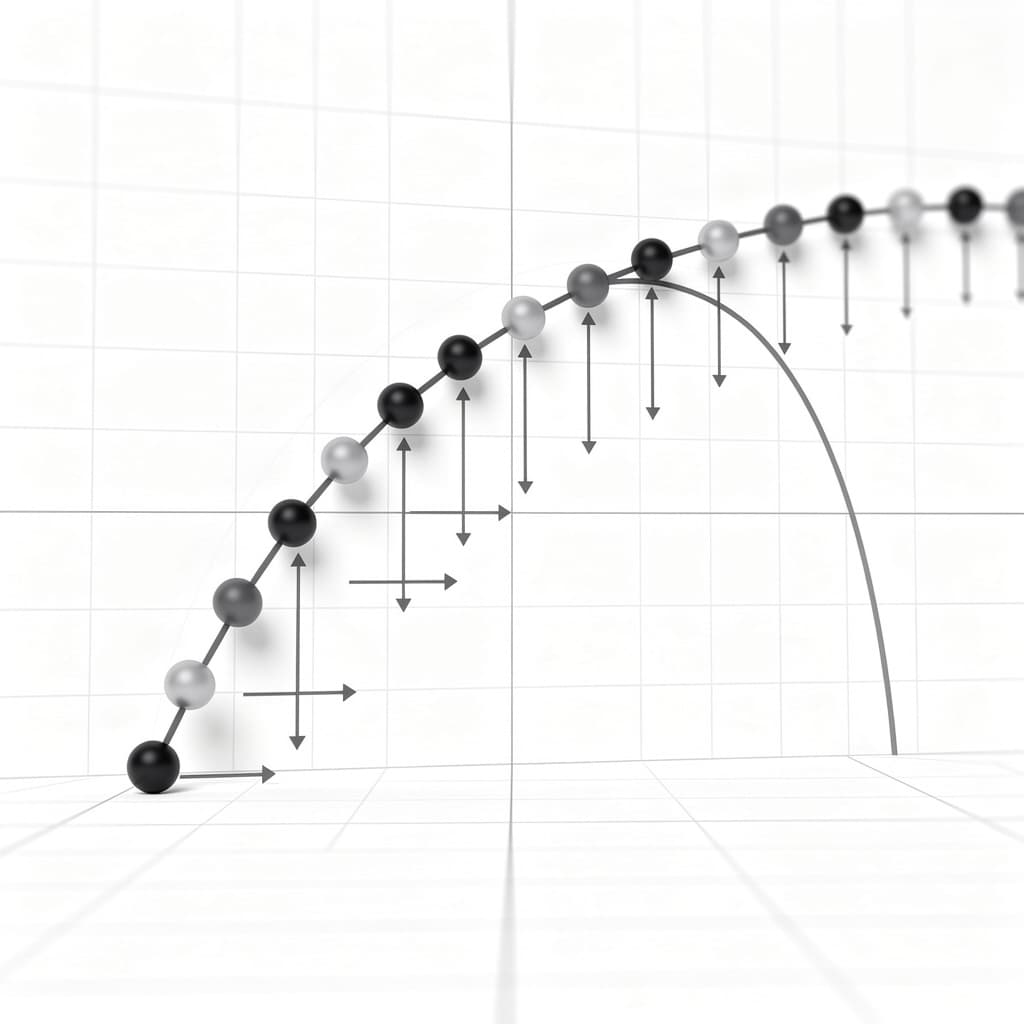
The most profound insight in the history of kinematics, largely credited to Galileo Galilei in the early 17th century, is the principle of the independence of motion. This principle asserts that a projectile's horizontal movement does not affect its vertical movement, and vice versa. Imagine two identical spheres: one dropped vertically from a height and the other fired horizontally from the same height at the same moment. Despite their vastly different paths, both spheres will strike the ground simultaneously because the force of gravity acts identically on both, regardless of their horizontal speed. This conceptual decoupling allows us to treat a complex two-dimensional trajectory as two simple, one-dimensional problems happening at the same time.
The Role of Gravity in Vertical Displacement
In the vertical dimension, a projectile is in a state of constant acceleration, specifically the acceleration due to gravity, denoted as $g$. On Earth, this value is approximately $9.81 \, m/s^2$ directed downward toward the center of the planet. As the projectile rises, gravity works against its upward velocity, slowing it down until it reaches a momentary standstill at its peak height. Once the descent begins, gravity accelerates the object downward, increasing its speed until the moment of impact. This constant change in vertical velocity creates the characteristic symmetrical arc seen in ideal flight paths, governed entirely by the relentless pull of the Earth's mass.
Constant Velocity in the Horizontal Dimension
Contrasting sharply with the vertical component, the horizontal dimension of projectile motion is characterized by a total lack of acceleration in an idealized vacuum. According to Newton’s First Law of Motion, an object in motion will maintain its velocity unless acted upon by an external force. Since gravity only acts vertically, there is no force to change the projectile's horizontal speed once it has left the launcher. Consequently, the horizontal velocity remains constant throughout the entire flight. This means that if a projectile travels 10 meters in its first second of flight, it will travel exactly 10 meters in every subsequent second until it hits the ground, regardless of how high or low it happens to be at that moment.
Essential Horizontal and Vertical Components
Calculating Initial Velocity Vectors
To analyze any flight, one must first break down the initial launch velocity, often denoted as $v_0$, into its constituent parts. When a projectile is launched at an angle, its total speed is shared between the horizontal and vertical axes. We use trigonometry to resolve this single vector into a horizontal component, $v_{0x}$, and a vertical component, $v_{0y}$. This step is critical because all subsequent projectile motion formulas rely on these isolated values rather than the total initial speed. Without this initial decomposition, it is impossible to apply the laws of kinematics accurately to the two separate dimensions of the object's travel.
Impact of Launch Angles on Component Magnitude
The launch angle, $\theta$, serves as the primary regulator of how much energy is allocated to "distance" versus "hang time." A shallow launch angle, such as 15 degrees, results in a high horizontal component but a very low vertical component, meaning the object moves fast across the ground but falls quickly. Conversely, a steep angle like 75 degrees provides significant vertical lift but very little forward progress. In the idealized physics of a vacuum, an angle of 45 degrees provides the perfect balance between these two components, yielding the maximum possible horizontal range for a given initial velocity. Understanding this trade-off is essential for engineers designing everything from irrigation sprinklers to athletic techniques.
Trigonometric Relations in Projectile Vectors
The relationship between the launch speed, the angle, and the components is governed by the sine and cosine functions. Specifically, the horizontal component is calculated as the product of the total velocity and the cosine of the angle, while the vertical component uses the sine function. These relationships are derived from the right-angled triangle formed by the velocity vector and the axes. By consistently using these trigonometric foundations, physicists can maintain mathematical rigor when moving from the initial launch state to the dynamic state of flight. The following table illustrates how the components change for a projectile launched at $100 \, m/s$ at different angles:
| Launch Angle ($\theta$) | Horizontal Component ($v_{0x}$) | Vertical Component ($v_{0y}$) |
|---|---|---|
| 30 Degrees | $86.6 \, m/s$ | $50.0 \, m/s$ |
| 45 Degrees | $70.7 \, m/s$ | $70.7 \, m/s$ |
| 60 Degrees | $50.0 \, m/s$ | $86.6 \, m/s$ |
Governing Physics Equations of Motion
Linear Kinematics Applied to Free Fall
The physics equations of motion, often referred to as SUVAT equations, provide the mathematical engine for predicting projectile behavior. In the vertical direction, the displacement $y$ at any time $t$ can be found using the second kinematic equation: $y = y_0 + v_{0y}t - \frac{1}{2}gt^2$. This equation accounts for the initial height, the initial upward velocity, and the continuous downward "tax" imposed by gravity. By manipulating this formula, one can determine not just where the object is, but also its instantaneous vertical velocity at any point in time using $v_y = v_{0y} - gt$. These equations turn the abstract concept of falling into a precise, predictable science.
Integrating Time as the Universal Parameter
In two-dimensional kinematics, time is the "bridge" variable that connects the horizontal and vertical worlds. While the $x$ and $y$ coordinates are independent in terms of forces, they are strictly linked by the clock; a projectile cannot be at one horizontal position at 2 seconds and a vertical position at 3 seconds simultaneously. Therefore, solving for $t$ in one dimension usually provides the key to solving the other. For instance, if you know how long it takes for an object to hit the ground based on its vertical fall, you can immediately calculate how far it traveled horizontally by multiplying that time by the constant horizontal velocity. This temporal link is the secret to mastering complex multi-stage physics problems.
Solving for Displacement with Acceleration
Horizontal displacement, or range, is the simplest part of the calculation because there is no acceleration to consider ($a_x = 0$). The equation simplifies to $x = v_{0x}t$, where $x$ is the total distance covered. However, real complexity arises when the projectile is launched from a height, such as a cliff, rather than from level ground. In these cases, the displacement equations must be solved as a quadratic system. Using the quadratic formula allows us to find the exact moment the projectile’s vertical displacement reaches the ground level, which then informs us of the total horizontal distance covered during that specific duration of flight.
Calculating the Time of Flight Formula
Determining Total Duration in the Air
The time of flight formula is essential for determining how long a projectile remains an active participant in its environment. For a projectile launched from and landing on the same horizontal plane, the total time in the air is exactly twice the time it takes to reach its peak. Since the velocity at the peak is zero, we can find the time to the vertex by setting $v_y = 0$ in the equation $v_y = v_{0y} - gt$. Solving for $t$ gives us $t_{peak} = v_{0y} / g$. Consequently, the total time of flight for a level-ground launch is expressed as:
$$t_{total} = \frac{2v_0 \sin(\theta)}{g}$$
This formula reveals that the duration of flight is entirely dependent on the vertical component of the launch and the strength of the local gravitational field.
Factors Influencing Ascent and Descent Symmetry
In an ideal vacuum, the ascent of a projectile is a perfect mirror image of its descent. It takes exactly as long to climb to the maximum height as it does to fall back to the original launch altitude. This symmetry exists because gravity removes velocity during the rise at the same rate it adds it during the fall. If a ball is thrown upward at $20 \, m/s$, it will be moving at $20 \, m/s$ downward the moment it returns to the thrower’s hand. This geometric and temporal balance allows physicists to simplify many problems by only calculating half of the flight and then doubling the result, provided the start and end heights are equal.
Temporal Constraints on Horizontal Range
The time of flight acts as a hard limit on the horizontal range of any projectile. Because the horizontal velocity is constant, the only way to increase the distance traveled is to either increase the horizontal speed or increase the time the object spends in the air. This creates a fascinating tension in ballistics: to get more time, you must launch at a steeper angle, but doing so reduces your horizontal speed. The mathematical resolution of this tension is why the 45-degree angle is the most efficient for distance; it optimizes the product of the horizontal speed and the time of flight, ensuring the object travels as far as possible before gravity brings the journey to an end.
Mapping the Trajectory of a Projectile
The Parabolic Nature of Flight Paths
When the horizontal and vertical displacement equations are combined to eliminate the variable of time, the resulting "trajectory equation" takes the form of a mathematical parabola. The trajectory of a projectile follows the general quadratic form $y = ax^2 + bx + c$. Specifically, the path is described by the equation:
$$y = x \tan(\theta) - \frac{gx^2}{2v_0^2 \cos^2(\theta)}$$
This equation proves that any object moving under the influence of constant gravity and constant horizontal velocity must follow a parabolic arc. This shape is universal, appearing in the path of a leaping dolphin, the spray of a water fountain, and the flight of a home run in baseball, provided we ignore the distorting effects of the atmosphere.
Vertex Identification and Maximum Height
The vertex of the parabola represents the point of maximum height, a critical value in many practical applications. At this point, the projectile has exhausted its upward vertical velocity and is about to begin its descent. Mathematically, this occurs at exactly half of the total time of flight for a level-ground launch. The maximum height $H$ can be calculated using the formula $H = (v_0^2 \sin^2 \theta) / 2g$. Understanding the maximum height is vital for scenarios such as clearing an obstacle or ensuring a firework reaches a safe altitude before exploding. It is also the point where the projectile's kinetic energy is at its minimum and its gravitational potential energy is at its maximum.
Mathematical Modeling of the Range Equation
The horizontal range $R$ is the total distance traveled along the $x$-axis from the launch point to the point of return to the same initial height. By substituting the total time of flight into the horizontal displacement equation and using the trigonometric identity $2 \sin \theta \cos \theta = \sin(2\theta)$, we derive the classic range equation:
$$R = \frac{v_0^2 \sin(2\theta)}{g}$$
This formula highlights that the range is proportional to the square of the initial velocity, meaning that doubling the launch speed will quadruple the distance covered. It also confirms that the range is maximized when $\sin(2\theta)$ equals 1, which occurs at a launch angle of 45 degrees. However, it is important to note that this specific range equation only applies when the launch and landing heights are identical.
Advanced Applications of Projectile Motion Formulas
Ballistic Flight and Orbital Transitions
While standard projectile motion formulas assume a flat Earth and a constant gravitational field, they serve as the foundation for the study of ballistics and orbital mechanics. For very long-range projectiles, such as intercontinental missiles, the curvature of the Earth must be taken into account. If a projectile is launched with enough horizontal velocity—approximately $7,900 \, m/s$—the rate at which it falls due to gravity matches the rate at which the Earth’s surface curves away from it. At this point, the projectile enters orbit, effectively falling forever without ever hitting the ground. This transition from a simple parabolic arc to a circular or elliptical orbit is the basis for all satellite and space station technology.
Navigating Motion with Varying Launch Heights
In many real-world cases, a projectile is launched from an elevated position, such as a shot putter releasing a metal ball from shoulder height. This change in initial conditions breaks the symmetry of the flight path. The projectile will spend more time in its descent than it did in its ascent, resulting in a longer total time of flight and a greater horizontal range than a level-ground launch would suggest. In these scenarios, the optimal launch angle for maximum range is actually slightly less than 45 degrees. Calculating these paths requires the full use of the quadratic displacement formula to solve for the moment of impact with the ground at $y = 0$, where $y_0$ is the starting height.
Geometric Analysis of Impact Velocity
The final velocity of a projectile at the moment of impact is a vector quantity that includes both magnitude and direction. To find the impact speed, one must calculate the final vertical velocity using $v_y = v_{0y} - gt$ and combine it with the unchanging horizontal velocity $v_x$ using the Pythagorean theorem: $v_{final} = \sqrt{v_x^2 + v_y^2}$. The angle of impact can then be found using the inverse tangent of the ratio of the components. This information is crucial in fields like forensic science and structural engineering, as it determines the force and energy transferred to the target upon collision.
Environmental Influences on Ideal Paths
Deviations from Theoretical Models
In a laboratory vacuum, the parabolic model is perfect, but the Earth’s atmosphere introduces significant deviations. Air resistance, or drag, acts as a force opposing the motion of the projectile, affecting both the horizontal and vertical components. Unlike the ideal model, where horizontal velocity is constant, drag causes the horizontal speed to decrease throughout the flight. This results in a trajectory that is no longer a perfect parabola; instead, it is a skewed curve that is steeper during the descent than the ascent. This real-world path is often called a ballistic curve, and it is the reason why golfers and snipers must account for wind and air density.
The Dynamics of Air Resistance
Air resistance is not a constant force; it increases as the square of the projectile's velocity. This means that faster-moving objects experience disproportionately more drag than slower ones. Additionally, factors such as the object’s cross-sectional area, its shape (drag coefficient), and the density of the air play vital roles. In the presence of air resistance, the maximum range is achieved at a launch angle significantly lower than 45 degrees—often around 35 to 40 degrees for many sports balls. High-performance projectiles, like bullets, are designed with aerodynamic shapes to minimize this effect and maintain their speed over long distances.
Limitations of Vacuum-Based Kinematics
While vacuum-based kinematics provide an excellent introductory framework, they represent a simplified version of reality. They ignore not only air resistance but also the Coriolis effect—a deflection caused by the Earth’s rotation—and the fact that gravity decreases slightly with altitude. For short-range applications, such as tossing a ball or calculating the path of a stream of water, the ideal formulas are highly accurate. However, for modern military applications or aerospace engineering, sophisticated computer models are required to integrate these environmental variables. Despite these complexities, the core kinematic logic remains the same: the motion is the sum of its parts, and understanding those parts is the key to mastering the physical world.
References
- Young, H. D., & Freedman, R. A., "University Physics with Modern Physics", Pearson, 2020.
- Galilei, G., "Dialogues Concerning Two New Sciences", Elsevier, 1638 (Trans. Crew & de Salvio, 1914).
- Knight, R. D., "Physics for Scientists and Engineers: A Strategic Approach", Pearson, 2016.
- Hibbeler, R. C., "Engineering Mechanics: Dynamics", Prentice Hall, 2015.
Recommended Readings
- The Feynman Lectures on Physics by Richard Feynman — A masterful exploration of the principles of motion that provides deep intuitive insights into how forces and vectors interact.
- Classical Mechanics by John R. Taylor — An excellent resource for those wishing to transition from basic kinematics to more advanced Lagrangian and Hamiltonian dynamics.
- Newton’s Principia by Isaac Newton — The foundational text for classical mechanics, laying out the laws that govern all projectile and orbital motion in the universe.
- Aerodynamics for Engineers by John J. Bertin — A deep dive into how air resistance and fluid dynamics modify the ideal paths of projectiles in the real world.