physics11 min read
The Inertial Logic of Newton's Laws
The publication of Sir Isaac Newton’s Philosophiæ Naturalis Principia Mathematica in 1687 remains arguably the most pivotal event in the history of the physical sciences. Before Newton, the...
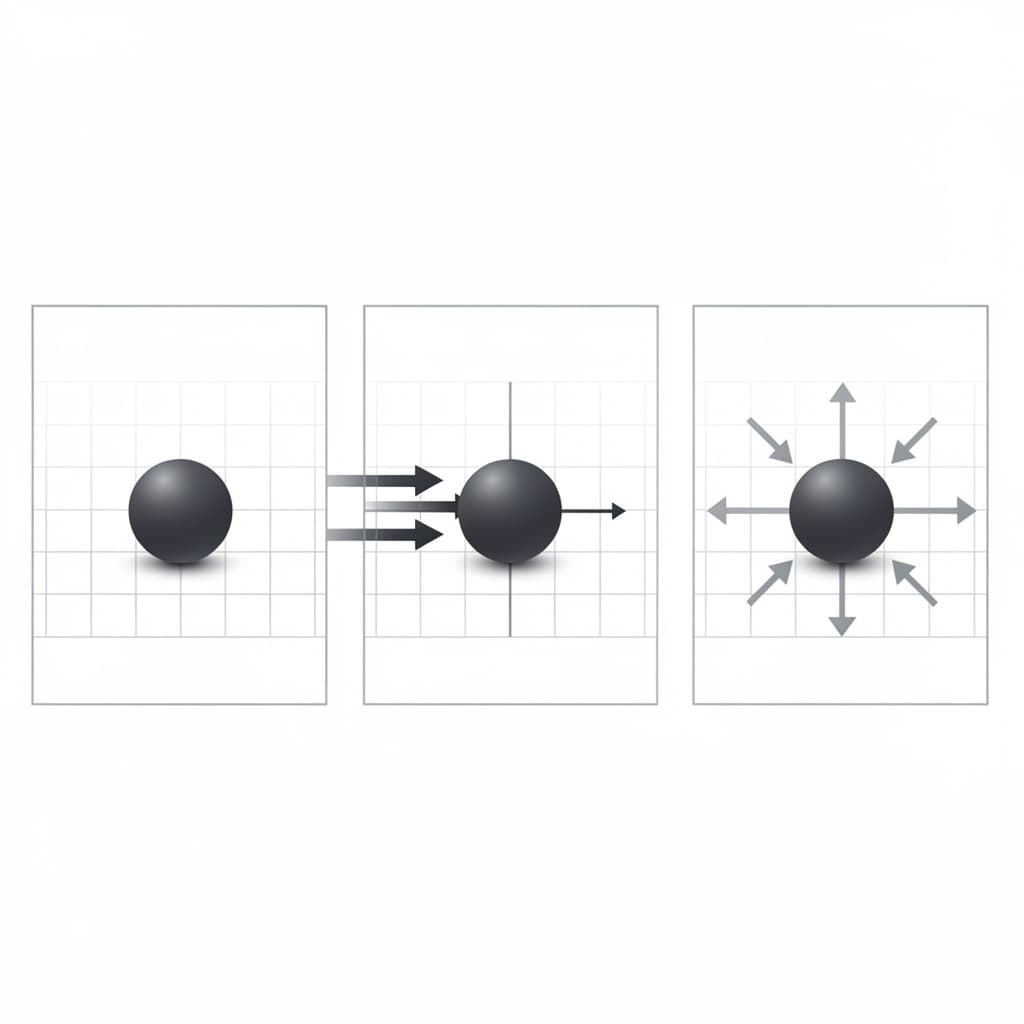
The publication of Sir Isaac Newton’s Philosophiæ Naturalis Principia Mathematica in 1687 remains arguably the most pivotal event in the history of the physical sciences. Before Newton, the understanding of motion was largely dominated by Aristotelian thought, which posited that the natural state of an object was rest and that a continuous application of force was required to maintain movement. Newton shattered this paradigm by introducing a cohesive logical system that treated motion as a state that persists unless interrupted. Newton's Laws of Motion provided the first rigorous mathematical framework to explain the physical universe, bridging the gap between terrestrial mechanics and celestial observations. By synthesizing the work of his predecessors into three fundamental axioms, Newton created a predictive toolset that allowed humanity to engineer the modern world, from the construction of massive suspension bridges to the precise calculation of lunar landings.
The Foundation of Classical Mechanics
The intellectual landscape of the seventeenth century was a fertile ground for the Scientific Revolution, yet it lacked a unifying theory to connect the behavior of falling objects on Earth with the movement of the stars. Isaac Newton filled this void by proposing that the same physical laws apply throughout the entire universe, a concept known as universalism. In his Principia, Newton moved away from qualitative descriptions of "nature" and instead utilized Euclidean geometry and his newly developed "fluxions" (calculus) to quantify physical change. This shift transformed physics from a branch of philosophy into a precise mathematical discipline. Newton’s genius lay not just in his mathematical prowess, but in his ability to abstract complex physical realities into simplified models that could be solved with rigor. Central to this new system was the definition of absolute space and absolute time. Newton conceptualized space as an infinite, unmoving "container" in which physical events occur, independent of the objects within it. Similarly, he defined time as a constant, uniform flow that proceeds at the same rate for all observers, regardless of their state of motion. While Albert Einstein would later refine these concepts in the early twentieth century through the theory of general relativity, Newton’s definitions provided the necessary stable ground for classical mechanics to flourish. Without this assumption of a fixed coordinate system, the mathematical derivation of velocity and acceleration would have lacked a definitive reference point for measurement. To make the mathematics of motion manageable, Newton utilized the concept of a point particle. In this logical abstraction, a complex physical object—whether it be a rotating planet or a sliding block—is treated as a single mathematical point where all its mass is concentrated at its center of mass. This allows physicists to ignore internal rotations, vibrations, and structural deformations when calculating the external path of an object. By treating objects as point particles, Newton’s Laws of Motion can be applied to diverse systems with the same set of equations. This simplification is the cornerstone of classical dynamics, allowing us to model the trajectory of a baseball or a satellite by focusing purely on the net forces acting upon its center.The First Law and the State of Inertia
The first of the three axioms, commonly known as Newton's first law, states that an object will remain at rest or in uniform motion in a straight line unless acted upon by an external, unbalanced force. This principle, also called the Law of Inertia, was a radical departure from the common-sense observation that objects eventually stop moving if you stop pushing them. Aristotle had argued that "violent motion" required a constant cause, but Newton realized that the stopping of an object is itself an effect caused by hidden forces like friction and air resistance. Therefore, inertia is not a force that keeps things moving; rather, it is an inherent property of matter that resists any change in its current state of motion. Newton was deeply influenced by the earlier experimental work of Galileo Galilei, who utilized inclined planes to study the behavior of rolling balls. Galileo observed that if a ball rolled down one plane and up another, it would attempt to reach its original height regardless of the second plane's angle. He reasoned that if the second plane were perfectly horizontal and frictionless, the ball would continue rolling forever in a vain attempt to regain its starting altitude. Newton formalized this insight, identifying mass as the quantitative measure of an object's inertia. A massive lead sphere has much more inertia than a hollow plastic ball, meaning it requires significantly more force to start it moving, stop it, or change its direction. In our daily lives, there are countless law of inertia examples that illustrate this resistance to change. When you are standing in a bus that suddenly accelerates forward, your body tends to stay in its original position, causing you to feel as though you are being pushed backward toward the rear of the vehicle. Similarly, if the bus suddenly brakes, your body continues moving forward at the previous speed until your feet or a handrail apply a stopping force. In the vacuum of outer space, where friction and air resistance are virtually non-existent, the first law is even more apparent. Probes like Voyager 1 continue to travel at tens of thousands of kilometers per hour decades after their engines were shut off, simply because there is no external force in the void to slow them down.Quantifying Motion Through Net Force
While the first law describes what happens in the absence of a net force, Newton's second law provides the mathematical machinery to calculate exactly what happens when a force is applied. It establishes that the acceleration of an object is directly proportional to the net force acting upon it and inversely proportional to its mass. This is the law of "cause and effect" in the physical world: force is the cause, and acceleration is the visible effect. It is important to note that Newton originally framed this law in terms of the rate of change of momentum, though it is most commonly taught today in its simplified algebraic form. The ubiquitous F=ma formula is the heart of classical physics, where $F$ represents the vector sum of all forces (net force), $m$ is the mass, and $a$ is the resulting acceleration. For a constant mass, this linear relationship implies that if you double the force applied to a shopping cart, the cart's acceleration will also double. Conversely, if you double the mass of the cart by filling it with groceries while applying the same force, the acceleration will be halved. The formula is expressed in the International System of Units (SI) where force is measured in Newtons ($N$), mass in kilograms ($kg$), and acceleration in meters per second squared ($m/s^2$). The formal derivation is as follows:$$F = \frac{d(mv)}{dt} = m \frac{dv}{dt} = ma$$
This relationship only holds true when measurements are taken from an inertial frame of reference—a viewpoint that is either at rest or moving at a constant velocity. In non-inertial frames, such as a rapidly spinning merry-go-round or an accelerating airplane, the second law appears to fail because objects move without an apparent force acting on them. To correct for this, physicists introduce "fictitious forces" like the centrifugal force or the Coriolis effect. These are not real physical interactions but mathematical corrections required to make Newton’s Second Law work when the observer themselves is accelerating. Understanding the distinction between these frames is crucial for advanced applications like meteorology and aerospace engineering.Symmetry in Action and Reaction
The most frequently misunderstood of the three principles is Newton's third law, which states that for every action, there is an equal and opposite reaction. The common misconception is that these two forces cancel each other out, leading to no motion at all. However, the logic of the third law dictates that these forces always act on different objects. If you push on a wall with a force of 100 Newtons, the wall simultaneously pushes back on your hands with 100 Newtons of force. You feel the pressure on your palms because the wall is acting on you, while the wall experiences the force because you are acting on it. This reciprocity is fundamental to the concept of action and reaction pairs in isolated systems. When a rocket engine ignites, it expels high-pressure gas out of the nozzle downward (the action); simultaneously, the gas exerts an equal and opposite force upward on the rocket (the reaction), propelling it into the sky. It is a common mistake to think the rocket moves by "pushing against the ground" or "pushing against the air." In reality, the rocket would work even better in a vacuum because there is no air resistance to oppose its motion; the propulsion is entirely due to the internal action-reaction pair between the vehicle and its fuel exhaust. From a broader perspective, the third law is the mechanical foundation for the conservation of momentum. In any closed system where no external forces are present, the total momentum remains constant because all internal forces occur in equal and opposite pairs. If two ice skaters push off from one another, they move in opposite directions. Even if one skater is much heavier than the other, the force exerted on each is identical in magnitude. Because of $F=ma$, the lighter skater will experience a much greater acceleration, but the total momentum of the "two-skater system" remains zero, just as it was before they pushed off. This symmetry ensures that the center of mass of an isolated system cannot be moved by internal forces alone.Force Interactions in Physical Systems
In practical engineering and physics problems, multiple forces often act on a single body simultaneously. One of the most common scenarios involves the interaction between gravity and normal forces. Gravity pulls an object toward the center of the Earth with a force equal to $mg$ (mass times the acceleration due to gravity, approximately 9.8 $m/s^2$). When that object sits on a surface, the surface exerts an upward "normal" force that prevents the object from falling through. On an inclined plane, these forces must be broken down into vector components using trigonometry to determine how much of the gravitational pull is directed down the slope versus into the surface.The force of gravity acting down an incline is given by: $$F_{parallel} = mg \sin(\theta)$$
The normal force on the incline is given by: $$F_{normal} = mg \cos(\theta)$$
Frictional resistance is another critical component of Newtonian logic, acting to oppose the relative motion between surfaces. Friction is categorized into two types: static friction, which prevents an object from starting to move, and kinetic friction, which slows down an object already in motion. For an object to maintain a state of dynamic equilibrium—moving at a constant velocity—the applied force must exactly equal the frictional force. In this state, the net force is zero, and according to the first law, the object's velocity remains unchanged. This is why a car cruising at 100 kilometers per hour on a highway still requires the engine to burn fuel; the engine’s force is needed to cancel out the opposing forces of air drag and rolling resistance. In more complex systems, forces like tension and centripetal force come into play. Tension is the pulling force transmitted through a string, cable, or chain, acting equally on both ends. When an object moves in a circular path, such as a ball whirled on a string or a planet orbiting a sun, it is constantly changing direction. This change in direction constitutes an acceleration, which requires a net force directed toward the center of the circle. This is the centripetal force, and without it, the object’s inertia would cause it to fly off in a straight line tangent to the circle. The magnitude of this required force is defined by:$$F_c = \frac{mv^2}{r}$$
The Universal Application of Newtonian Logic
The true power of Newton's Laws of Motion lies in their universality. Before Newton, people believed the heavens operated under a different set of "perfect" laws compared to the "corrupt" laws of Earth. Newton proved that the same gravity that pulls an apple to the ground is the force that keeps the Moon in orbit around the Earth. By combining his second law with his Universal Law of Gravitation, he was able to derive Kepler’s laws of planetary motion, providing a physical explanation for why planets move in elliptical orbits. This realization unified the terrestrial and celestial realms, creating a single, predictable universe governed by the same mathematical logic. In the modern era, Newtonian mechanics serves as the bedrock of the engineering professions. Every bridge, skyscraper, and airplane is designed using the principles of statics and dynamics derived from Newton’s axioms. Structural engineers use the condition that $\sum F = 0$ and $\sum \tau = 0$ (the sum of forces and torques must be zero) to ensure that buildings remain stable under the loads of wind, gravity, and human occupancy. Similarly, mechanical engineers use the $F=ma$ formula to calculate the necessary torque for engines and the impact forces required for automotive safety features like crumple zones and airbags. Even though we have discovered more fundamental theories, Newton’s laws remain the most efficient and accurate tools for the vast majority of human endeavors. However, it is important to recognize the limits of classical mechanics. As our ability to measure the universe improved, we found that Newton’s laws are actually an approximation—albeit a very good one. When objects move at speeds approaching the speed of light (299,792,458 meters per second), the distortions of time and space described by Einstein’s Special Relativity become significant. Furthermore, at the microscopic scale of atoms and subatomic particles, the deterministic logic of Newton is replaced by the probabilistic nature of Quantum Mechanics. Despite these limits, for the macroscopic world we inhabit, Newton's inertial logic remains an unshakable foundation, providing the clarity and precision necessary to navigate the physical world.References
- Newton, I., "Philosophiæ Naturalis Principia Mathematica", Royal Society, 1687.
- Halliday, D., Resnick, R., and Walker, J., "Fundamentals of Physics", Wiley, 2013.
- Westfall, R. S., "Never at Rest: A Biography of Isaac Newton", Cambridge University Press, 1980.
- Feynman, R. P., Leighton, R. B., and Sands, M., "The Feynman Lectures on Physics, Vol. I", California Institute of Technology, 1963.
Recommended Readings
- The Discovery of Dynamics by Julian Barbour — A deep historical and philosophical dive into how the concepts of space, time, and motion evolved from antiquity to Newton.
- Classical Mechanics by Herbert Goldstein — The standard graduate-level textbook for those who want to see the advanced mathematical reformulations of Newton's laws using Lagrangian and Hamiltonian mechanics.
- The Clockwork Universe by Edward Dolnick — An engaging narrative that places Newton and his contemporaries in the context of the 17th-century Scientific Revolution, explaining the cultural impact of their discoveries.
- Thinking Physics by Lewis Carroll Epstein — A unique book filled with conceptual puzzles that build a strong intuitive grasp of Newtonian mechanics without relying solely on heavy mathematics.
Newton's Laws of MotionNewton's first lawNewton's second lawNewton's third lawF=ma formulalaw of inertia examplesaction and reaction