The Geometric Logic of Snell's Law
The refraction of light is a cornerstone of classical optics, describing the redirection of electromagnetic waves as they transition between materials of differing optical densities. This phenomenon...
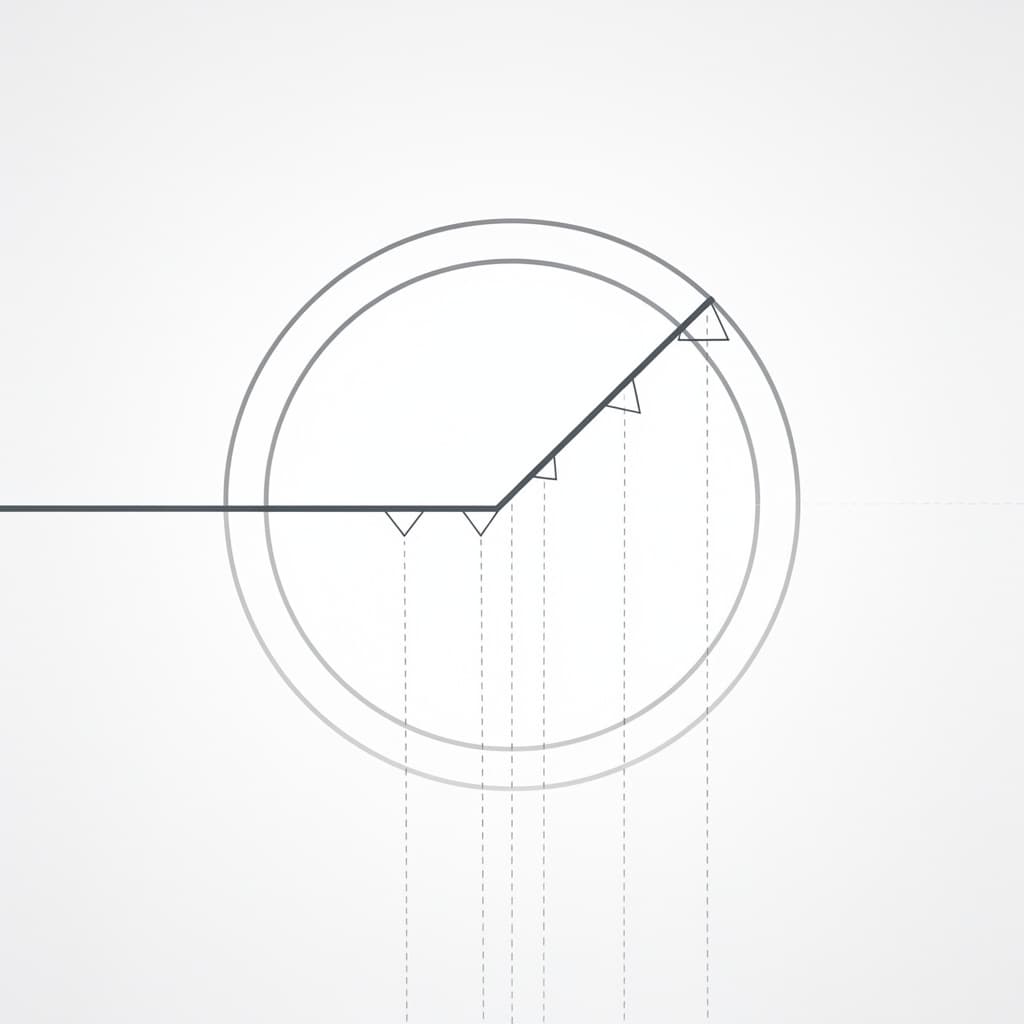
The refraction of light is a cornerstone of classical optics, describing the redirection of electromagnetic waves as they transition between materials of differing optical densities. This phenomenon is not merely a change in direction but a fundamental consequence of the wave nature of light and its interaction with matter at the atomic level. By understanding the geometric logic governing these transitions, physicists have been able to develop sophisticated technologies ranging from corrective eyeglasses and microscope lenses to the expansive fiber-optic networks that facilitate global communication. At the heart of this understanding lies the law of refraction, a mathematical symmetry that links the velocity of light to the angles of its path, providing a predictable framework for light’s behavior across diverse media.
The Fundamental Nature of Light Bending
To understand the refraction of light, one must first view light as an electromagnetic wave propagating through space. When these waves encounter a boundary between two different media, such as air and glass, the oscillation of the electric field interacts with the electrons within the material. These interactions cause a slight delay in the re-emission of the wave, effectively slowing down the phase velocity of the light as it moves through the more "optically dense" substance. This deceleration is the primary driver of the bending effect observed at the interface, as the wave crests do not all slow down simultaneously unless the light hits the surface perfectly perpendicular to the boundary.
The geometric bending of light can be visualized through the analogy of a wavefront, which is a surface representing points of constant phase. Imagine a line of marchers transitioning from a paved road onto a muddy field at an angle; the marchers who hit the mud first slow down immediately, while those still on the pavement continue at their original speed. This discrepancy in speed across the width of the marching line causes the entire column to pivot and change its heading. In optics, this pivot is what we perceive as refraction, where the direction of propagation—which is always perpendicular to the wavefront—shifts toward or away from the "normal" line, an imaginary perpendicular to the surface.
The degree of bending is strictly dependent on the magnitude of the speed differential between the two media. If light enters a medium where it travels slower, it bends toward the normal; conversely, if it enters a medium where it travels faster, it bends away from the normal. This behavior is universal across the electromagnetic spectrum, though its effects are most visible in the transition of visible light through transparent solids and liquids. By quantifying this speed differential, scientists can predict exactly how light will behave, forming the basis for the physics of light refraction as we know it today.
Deciphering the Index of Refraction
The index of refraction, denoted by the symbol $n$, is a dimensionless constant that characterizes how much a medium reduces the speed of light relative to a vacuum. It is defined by the simple ratio $$n = \frac{c}{v}$$ where $c$ is the speed of light in a vacuum (approximately 299,792,458 meters per second) and $v$ is the phase velocity of light in the specific medium. Because light always travels fastest in a vacuum, the value of $n$ for any transparent material is always greater than or equal to 1.0. For instance, air has an index of approximately 1.0003, which is close enough to unity for most practical calculations, while common glass typically ranges from 1.5 to 1.9 depending on its composition.
While we often associate a higher index of refraction with higher physical density, the relationship is actually tied to the "optical density" of the material, which refers to the tendency of the material's atoms to maintain their absorbed energy before re-emitting it as electromagnetic waves. Materials with high polarizability—where the electron clouds can be easily displaced by an incoming electric field—tend to have higher refractive indices. This is why substances like diamond ($n \approx 2.42$) exhibit such profound light-bending capabilities compared to water ($n \approx 1.33$). The higher the index, the more the light is "delayed" during its passage through the lattice of atoms, resulting in a more pronounced change in the light's trajectory upon entry.
The following table provides the refractive indices for several common materials at room temperature using yellow sodium light (wavelength of 589 nanometers):
| Material | Index of Refraction ($n$) | Optical Density Category |
|---|---|---|
| Vacuum | 1.0000 | Baseline |
| Air (STP) | 1.0003 | Very Low |
| Water | 1.333 | Medium |
| Ethyl Alcohol | 1.361 | Medium |
| Fused Quartz | 1.458 | High |
| Crown Glass | 1.52 | High |
| Diamond | 2.417 | Extremely High |
The Mathematical Symmetry of Snell's Law
The Snell's law formula provides the rigorous mathematical description of how light behaves at a boundary. Named after the Dutch astronomer Willebrord Snellius, who rediscovered it in 1621 (though it was described centuries earlier by the Persian scientist Ibn Sahl), the law establishes a constant ratio between the sines of the angles of incidence and refraction. The formula is expressed as: $$n_1 \sin(\theta_1) = n_2 \sin(\theta_2)$$ In this equation, $n_1$ and $n_2$ are the refractive indices of the first and second media, respectively, while $\theta_1$ is the angle of incidence and $\theta_2$ is the angle of refraction. Both angles are measured relative to the normal line at the point of contact.
The use of the sine function in this context is not arbitrary; it emerges from the geometric requirements of maintaining wavefront continuity. When a wavefront strikes a boundary at an angle, the "width" of the wave along the boundary must be consistent in both media to avoid a physical discontinuity. Because the wavelength of light shrinks in a slower medium while its frequency remains constant, the wave must pivot to ensure that the crests of the incoming wave align perfectly with the crests of the refracted wave at the interface. The sine of the angle represents the ratio of the side lengths of the triangles formed by these wavefronts, ensuring that the spatial frequency along the boundary remains identical on both sides.
This symmetry implies that the path of light is perfectly reversible. If a ray of light were to travel backward from the second medium into the first, it would follow the exact same path in reverse, maintaining the same relationship between the angles. This principle of reciprocity is vital in lens design, as it allows engineers to calculate light paths in either direction through a complex series of optical elements. Furthermore, the law shows that if the indices of refraction are equal ($n_1 = n_2$), then $\sin(\theta_1)$ must equal $\sin(\theta_2)$, meaning the light will pass through the boundary without any change in direction, making the boundary effectively invisible.
Deriving the Snell's Law Formula
To derive the Snell's law formula from a geometric perspective, one must consider the path of a single wavefront as it crosses the interface between two media. Suppose a wavefront approaches the boundary at an angle $\theta_1$. During a specific time interval $\Delta t$, one end of the wavefront travels a distance $d_1 = v_1 \Delta t$ in the first medium. Simultaneously, the other end of the wavefront, which has already crossed into the second medium, travels a distance $d_2 = v_2 \Delta t$. Because $v_2$ is different from $v_1$, the distances traveled are unequal, forcing the wavefront to tilt to stay connected as a continuous line across the boundary.
By constructing right triangles using the boundary as a shared hypotenuse $L$, we can define the sines of the angles. For the first medium, $\sin(\theta_1) = d_1 / L = v_1 \Delta t / L$. For the second medium, $\sin(\theta_2) = d_2 / L = v_2 \Delta t / L$. If we solve both equations for the shared hypotenuse $L$ and set them equal to each other, we find that: $$\frac{v_1 \Delta t}{\sin(\theta_1)} = \frac{v_2 \Delta t}{\sin(\theta_2)}$$ Canceling the time interval and rearranging the terms leads to the ratio: $$\frac{\sin(\theta_1)}{\sin(\theta_2)} = \frac{v_1}{v_2}$$ Substituting the definition of the refractive index ($v = c/n$), we arrive at $n_1 \sin(\theta_1) = n_2 \sin(\theta_2)$, the standard form of the law.
This derivation highlights that refraction is essentially a "re-scaling" of the light's geometry to accommodate its change in speed. It also explains why light does not change frequency when entering a new medium. Since the wavefronts must remain continuous at the boundary, the number of wave crests hitting the boundary per second must equal the number of wave crests leaving it. Because $v = f \lambda$, and the frequency $f$ is constant, the wavelength $\lambda$ must change in direct proportion to the velocity. Therefore, light becomes "compressed" in a slower medium, which is why the path must bend to maintain the geometric integrity of the wave train.
Fermat's Principle of Least Time
While Snell's Law provides the geometric "how" of light bending, Fermat’s Principle of Least Time provides the "why." Proposed by Pierre de Fermat in 1662, this principle suggests that light traveling between two points will always follow the path that requires the least amount of time, rather than the shortest distance. When light stays in a single medium where its speed is constant, the path of least time is a straight line. However, when light must transition between materials with different speeds, a straight-line distance is no longer the fastest route. By bending toward the normal in a slower medium, light minimizes the distance it spends in the "difficult" material, even if it has to travel a slightly longer total distance.
A classic analogy used by physics professors is that of a lifeguard on a beach attempting to save a swimmer in the ocean. The lifeguard can run much faster on the sand than they can swim in the water. If the lifeguard runs in a perfectly straight line to the swimmer, they spend a significant amount of time swimming, which is slow. If they run to the point on the shore directly opposite the swimmer, they maximize their running distance but also increase the total distance significantly. The "optimal" path involves running further along the beach and then entering the water at an angle that balances the high speed of running with the low speed of swimming to minimize the total time. Light "calculates" this optimal path naturally through the interference of all possible wave paths.
Mathematically, Fermat's Principle can be proven using calculus by expressing the total time $T$ as a function of the position where the light crosses the boundary. By taking the derivative of the time function with respect to the horizontal distance and setting it to zero (to find the minimum), the resulting expression simplifies exactly into the Snell's law formula. This harmonization of calculus, geometry, and physical intuition demonstrates that the refraction of light is not an accidental property of matter but a manifestation of a deeper universal efficiency in nature. It bridges the gap between simple ray tracing and the complex wave mechanics that would later be defined by Maxwell and Huygens.
Critical Angles and Boundary Phenomena
One of the most fascinating consequences of the law of refraction occurs when light attempts to move from a medium with a high refractive index to one with a lower index (e.g., from water to air). In this scenario, light bends away from the normal. As the angle of incidence $\theta_1$ increases, the angle of refraction $\theta_2$ increases even faster, eventually reaching 90 degrees. At this specific point, the refracted light skims along the surface of the boundary. The angle of incidence that results in this 90-degree refraction is known as the critical angle ($\theta_c$). It can be calculated by setting $\theta_2 = 90^\circ$ in Snell's Law, resulting in: $$\theta_c = \arcsin\left(\frac{n_2}{n_1}\right)$$
If the light strikes the boundary at any angle greater than the critical angle, refraction becomes mathematically impossible because the sine of an angle cannot exceed 1.0. Instead of passing through the boundary, all of the energy is reflected back into the original medium. This phenomenon is known as total internal reflection. Unlike reflection from a metallic mirror, which always absorbs a small percentage of light, total internal reflection is 100% efficient, preserving the full intensity of the light beam. This is why a submerged bubble in water looks like a silvered mirror when viewed from certain angles; the light is not entering the bubble but is being perfectly reflected off the water-air interface.
Total internal reflection is the principle behind many natural and artificial wonders. It is responsible for the extreme "fire" and brilliance of a well-cut diamond, where light is trapped and reflected multiple times inside the stone before exiting toward the viewer. It also creates mirages on hot roads, where a layer of hot air near the pavement has a lower refractive index than the cooler air above it. Light from the sky travels down, hits the hot air at a grazing angle exceeding the critical angle, and reflects back up to the observer's eye, creating the illusion of a pool of water reflecting the sky on the road's surface.
Chromatic Dispersion and Prism Mechanics
The refraction of light is often more complex than a single value of $n$ would suggest because the index of refraction is actually dependent on the wavelength of the light. This phenomenon is called chromatic dispersion. In most transparent materials, shorter wavelengths (violet and blue light) travel slower and thus refract more sharply than longer wavelengths (red light). This means that when white light—which is a mixture of all visible colors—enters a prism at an angle, the constituent colors are spread out into a spectrum. This is the mechanism by which Sir Isaac Newton first demonstrated that white light is not a pure entity but a composite of different colors.
This wavelength dependency is described by various empirical formulas, most notably Cauchy's equation, which approximates the index of refraction as: $$n(\lambda) = A + \frac{B}{\lambda^2} + \frac{C}{\lambda^4} \dots$$ where $A$, $B$, and $C$ are constants specific to the material. Because the $\lambda$ term is in the denominator, as the wavelength decreases, the refractive index increases. This is why a rainbow forms; raindrops act as tiny spherical prisms where light undergoes refraction as it enters, total internal reflection at the back of the drop, and refraction again as it exits, with each color exiting at a slightly different angle (roughly 42 degrees for red and 40 degrees for violet relative to the sun's rays).
In optical engineering, dispersion is often a challenge to be overcome. In camera lenses, dispersion causes "chromatic aberration," where different colors focus at slightly different points, leading to color fringing around high-contrast edges. To correct this, engineers design "achromatic doublets"—lens pairs made of different types of glass (like crown glass and flint glass) with opposing dispersion characteristics. By carefully choosing the indices and shapes, the dispersion of the second lens cancels out the dispersion of the first, allowing multiple colors to focus at a single point, which is essential for high-quality photography and microscopy.
Modern Engineering of Optical Fibers
The most transformative application of the physics of light refraction in the modern era is the development of optical fibers. An optical fiber is a thin strand of glass or plastic consisting of a "core" surrounded by a "cladding" material with a lower refractive index. Because the core has a higher index than the cladding, light launched into the fiber at a shallow angle hits the core-cladding boundary at an angle greater than the critical angle. This triggers total internal reflection, trapping the light within the core and allowing it to travel for kilometers with minimal loss of signal, even as the fiber bends and twists.
This "geometric confinement" of light has revolutionized telecommunications. Unlike traditional copper wires, which transmit data via electrical pulses and are susceptible to electromagnetic interference and significant energy loss over distance, optical fibers transmit data as rapid pulses of light. Because the light is contained through the law of refraction and total internal reflection, thousands of different signals can be sent through a single fiber using different wavelengths (a technique called wavelength-division multiplexing). This has increased the bandwidth of the global internet by several orders of magnitude, allowing for the high-speed transfer of terabytes of data per second across oceans.
Beyond telecommunications, fiber optics have profound uses in medicine through endoscopes. By bundling thousands of optical fibers together, doctors can transmit an image from inside a patient's body to an external monitor without invasive surgery. Each fiber carries one "pixel" of the image, relying on the predictable logic of refraction to ensure that the light entering one end of the fiber perfectly matches the light exiting the other. Whether guiding a surgeon's hand or carrying a video stream halfway around the world, the geometric logic of Snell’s Law remains the invisible infrastructure of the digital age, proving that the simple bending of light is one of the most powerful tools in human history.
References
- Hecht, Eugene, "Optics", Pearson Education, 2016.
- Halliday, David; Resnick, Robert; Walker, Jearl, "Fundamentals of Physics", Wiley, 2018.
- Feynman, Richard P., "The Feynman Lectures on Physics, Vol. 1: Principles of Least Time", California Institute of Technology, 1963.
- Born, Max; Wolf, Emil, "Principles of Optics: Electromagnetic Theory of Propagation, Interference and Diffraction of Light", Cambridge University Press, 1999.
Recommended Readings
- Light: A Very Short Introduction by Ian Walmsley — A concise but deep dive into the nature of light, covering both classical refraction and modern quantum optics in an accessible way.
- QED: The Strange Theory of Light and Matter by Richard Feynman — An exceptional exploration of how the "least time" principle and refraction emerge from the underlying quantum interactions of photons and electrons.
- Introduction to Fiber Optics by Ajoy Ghatak and K. Thyagarajan — For readers interested in the practical application of Snell's Law in the technology that powers the internet and modern telecommunications.