The Eternal Transformation of Earthly Matter
The surface of our planet appears remarkably stable to the human eye, yet it represents a fleeting snapshot of a continuous, multi-billion-year process of recycling and transformation. The rock cycle...
The surface of our planet appears remarkably stable to the human eye, yet it represents a fleeting snapshot of a continuous, multi-billion-year process of recycling and transformation. The rock cycle is the fundamental geological concept that describes how rocks change from one type to another over deep time, driven by the internal heat of the Earth and the external energy of the Sun. This transition is not merely a change in appearance but a complete chemical and structural overhaul of mineral matter. By understanding the relationships between igneous, sedimentary, and metamorphic rocks, we gain a window into the dynamic history of the lithosphere and the tectonic forces that shape our world. This guide explores the mechanisms of these transformations, the physical properties of the resulting materials, and the relentless recycling of the Earth's crust.
1. The Foundation of Global Geological Processes
To comprehend the sheer scale of the rock cycle, one must first view the Earth as a closed system regarding matter, where the total mass of mineral material remains relatively constant while its form is perpetually redistributed. This lithospheric cycle operates on timescales ranging from thousands to hundreds of millions of years, ensuring that no rock on Earth is truly permanent. The concept was first pioneered by the Scottish physician and geologist James Hutton in the late 18th century, who famously observed that the Earth showed "no vestige of a beginning, no prospect of an end." Hutton’s insight laid the groundwork for uniformitarianism, the principle that the same geological processes occurring today have operated throughout Earth's history.
The primary drivers of this mineral change are the two great heat engines of our planet: the internal heat from radioactive decay and primordial formation, and the external heat from solar radiation. Internal heat drives mantle convection and plate tectonics, which are responsible for the melting of rock into magma and the intense pressure required for metamorphism. Conversely, solar energy drives the hydrologic cycle, fueling the wind, rain, and ice that break down solid rock into transportable sediment. Without these competing energy sources, the Earth would be a geologically dead world, devoid of the mountains, basins, and varied landscapes that define our environment.
Mineral change is governed by the laws of thermodynamics, specifically the concept of equilibrium. When a rock is moved from the environment in which it formed—such as a volcanic rock being thrust deep into a subduction zone—it becomes unstable in its new surroundings. The minerals within the rock will undergo chemical reactions or structural reorganization to reach a new state of equilibrium with the local temperature and pressure. This striving for stability is the underlying chemical "engine" of the rock cycle, dictating when a crystal will melt, when a new mineral will grow, or when a solid stone will dissolve into ions.
2. How Igneous Rocks Are Formed via Magma
The genesis of all crustal material begins with the cooling and solidification of molten rock, a process that produces igneous rocks. When this molten material exists beneath the Earth's surface, it is known as magma; once it erupts onto the surface, it is termed lava. The transition from a liquid silicate melt to a solid crystalline structure is a complex journey of chemical differentiation. As the melt cools, different minerals crystallize at specific temperatures, a sequence described by Bowen’s Reaction Series. This series explains why certain minerals, like olivine, are found together in dark, dense rocks, while others, like quartz, are found in light-colored continental rocks.
Intrusive or plutonic igneous rocks form when magma is trapped deep within the crust, where the surrounding rock acts as an insulator. Because the cooling process is incredibly slow—often taking tens of thousands of years—crystals have ample time to grow to sizes visible to the naked eye. This results in a phaneritic texture, characterized by coarse, interlocking grains. Large bodies of intrusive rock, known as plutons or batholiths, form the crystalline cores of many mountain ranges, such as the Sierra Nevada. The slow growth allows for a high degree of structural integrity, which is why granite, a classic intrusive rock, is favored for its durability and strength.
In contrast, extrusive or volcanic rocks form when magma reaches the surface and cools rapidly in contact with the atmosphere or ocean. This rapid heat loss prevents large crystals from forming, leading to an aphanitic (fine-grained) or even glassy texture. In extreme cases, such as the formation of obsidian, the cooling is so instantaneous that no crystalline structure forms at all, resulting in a volcanic glass. Extrusive flows often contain small holes called vesicles, which are the remnants of gas bubbles trapped as the lava solidified. These rocks, such as basalt and rhyolite, provide a direct record of volcanic activity and the chemical composition of the mantle or lower crust from which they originated.
3. The Genesis of Sedimentary Layers and Lithification
Once any rock type is exposed at the Earth’s surface, it is immediately subjected to the relentless forces of weathering. Mechanical weathering physically breaks the rock into smaller fragments, or clasts, through processes like frost wedging and thermal expansion. Chemical weathering, meanwhile, alters the mineral chemistry of the rock, often through reactions with rainwater and atmospheric carbon dioxide to form clays and dissolved ions. These products of decay—sand, silt, clay, and dissolved minerals—are then transported by water, wind, or ice to new locations, a process known as erosion. Over time, these materials accumulate in layers, primarily in low-lying areas like ocean basins or river deltas.
The transformation of loose sediment into solid rock is a process called lithification, which involves two primary stages: compaction and cementation. As more layers of sediment accumulate, the weight of the overlying material squeezes the lower layers, reducing the pore space between grains and expelling water. Following compaction, mineral-rich groundwaters circulate through the remaining pores, precipitating minerals like calcite, silica, or iron oxide. These minerals act as a natural glue, binding the clasts together into a coherent mass. The resulting sedimentary rocks often retain the original layering, or stratification, which serves as a chronological record of environmental conditions at the time of deposition.
Sedimentary rocks are categorized by their origin: clastic rocks (like sandstone and shale) are made of fragments of pre-existing rocks, while chemical and organic rocks (like limestone and coal) form from precipitated minerals or biological debris. Limestone, for instance, often forms from the accumulation of calcium carbonate shells from marine organisms. Because these rocks form at the surface, they are the primary reservoirs for fossils and provide essential clues about Earth's past climates and the evolution of life. The stratigraphic record contained within sedimentary formations is the "history book" of our planet, documenting the rise and fall of sea levels and the shifting of ancient continents.
4. Metamorphism and the Internal Rebirth of Minerals
When existing rocks are subjected to extreme heat and pressure without melting, they undergo metamorphism. This "change of form" occurs deep within the crust or at tectonic plate boundaries where temperatures may range from 200 to 800 degrees Celsius. In these environments, minerals become chemically unstable and begin to reorganize into new, denser structures that are better suited for the high-pressure conditions. Importantly, metamorphism is a solid-state process; if the rock were to melt completely, it would cross the threshold back into the igneous realm. The original rock before metamorphism is referred to as the protolith, and it dictates the initial chemical ingredients available for the transformation.
Heat and pressure act as catalysts for chemical reactions, but they are often aided by chemically active fluids, such as water and carbon dioxide, which migrate through the rock. These fluids facilitate the movement of ions, allowing new minerals like garnet or staurolite to grow even while the rock remains solid. The pressure involved in metamorphism can be confining (equal in all directions) or directed (stronger in one direction). Directed pressure is typical of continental collisions and leads to a distinctive texture known as foliation. In foliated rocks, minerals like mica align themselves perpendicularly to the direction of pressure, creating a layered or banded appearance that allows the rock to be split into thin sheets.
Geologists distinguish between foliated and non-foliated textures to classify metamorphic rocks. Foliated rocks, such as slate, schist, and gneiss, represent a sequence of increasing metamorphic grade, where the size and segregation of mineral bands increase with higher temperature and pressure. Non-foliated rocks, such as marble (from a limestone protolith) or quartzite (from a sandstone protolith), form in environments where the pressure is uniform or the minerals involved, like calcite and quartz, do not have the platy or elongated shapes necessary to create foliation. These rocks often exhibit a granoblastic texture, characterized by equidimensional, interlocking crystals that have grown together in a tight mosaic.
5. Comparing Igneous vs Sedimentary vs Metamorphic Types
Identifying the three main classes of rocks requires a keen eye for texture and mineral assemblage. While a single mineral like quartz can be found in all three types, the way it is arranged tells the story of its formation. Igneous vs sedimentary vs metamorphic identification often comes down to looking for "clues" of the environment: interlocking crystals suggest an igneous or metamorphic origin, while rounded grains and layering suggest a sedimentary one. The chemical composition also varies; igneous rocks are often rich in silicates like feldspar, while sedimentary rocks may be high in carbonates, and metamorphic rocks frequently contain unique "index minerals" that only form under high-pressure conditions.
The following table provides a comparative overview of the physical and chemical characteristics that define these three fundamental classes:
| Characteristic | Igneous Rocks | Sedimentary Rocks | Metamorphic Rocks |
|---|---|---|---|
| Primary Formation | Cooling of magma or lava | Lithification of sediment | Recrystallization of protolith |
| Key Textures | Phaneritic, Aphanitic, Glassy | Clastic, Bioclastic, Crystalline | Foliated, Non-foliated |
| Presence of Fossils | Almost never (destroyed by heat) | Common (preserves remains) | Rare (usually distorted) |
| Mineral Arrangement | Interlocking crystals | Cemented grains or layers | Aligned crystals or bands |
| Common Examples | Granite, Basalt, Obsidian | Sandstone, Limestone, Shale | Gneiss, Marble, Slate |
Understanding the chemical composition of these rocks is equally vital. Igneous rocks are classified by their silica content, ranging from mafic (low silica, high iron/magnesium) to felsic (high silica, high aluminum/potassium). Sedimentary rocks are defined by their grain size and the mineralogy of their "cement," which can be identified via acid tests for carbonates. Metamorphic rocks are often analyzed for their mineral assemblage, which acts as a "geothermometer" and "geobarometer," allowing geologists to calculate the exact depth and temperature at which the rock formed. By integrating these physical and chemical observations, scientists can reconstruct the tectonic history of a region with remarkable precision.
6. The Rock Cycle Diagram Explained in Detail
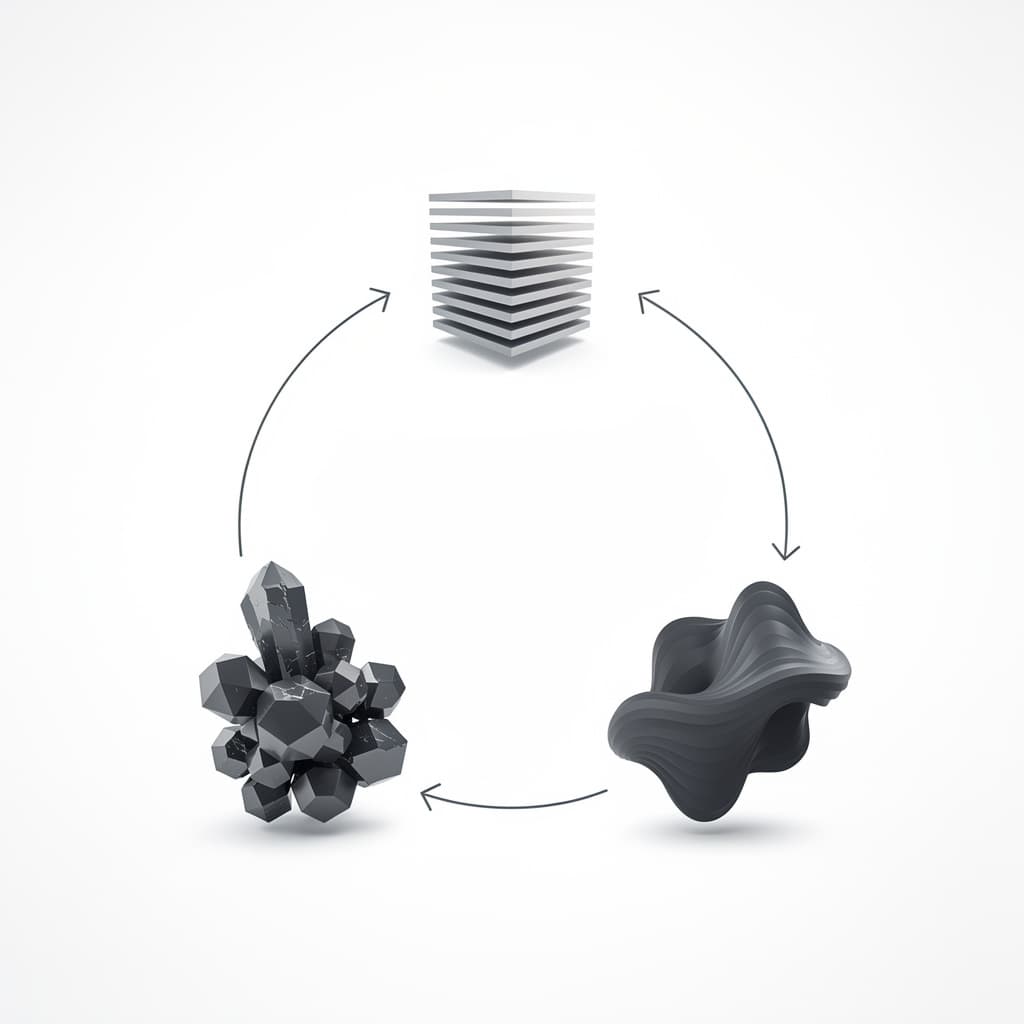
When visualized, the rock cycle diagram explained in most textbooks appears as a simple, clockwise circle: magma cools into igneous rock, which weathers into sediment, which lithifies into sedimentary rock, which metamorphoses, and then melts back into magma. However, the reality of the geological system is much more interconnected and "messy." There are numerous "shortcuts" and sub-cycles that allow matter to bypass certain stages. For example, an igneous rock does not have to become a sedimentary rock; it can be buried and metamorphosed directly into a gneiss. Similarly, a metamorphic rock can be uplifted and weathered back into sediment without ever melting.
Tracing these transition states requires an understanding of the specific pathways available to mineral matter. The path from sedimentary to metamorphic is driven by burial and tectonic compression. The path from any rock type back to sediment is driven by uplift and erosion. The path to magma is driven by subduction or crustal thickening, where the geothermal gradient—the rate at which temperature increases with depth—eventually exceeds the melting point of the rock. This gradient is often expressed as: $$ \Delta T = \frac{dT}{dz} \cdot \Delta z $$ where $T$ is temperature and $z$ is depth. As rocks are pushed deeper into the Earth, the rising temperature eventually triggers partial melting, beginning the cycle anew.
The recycling of matter in the rock cycle is also influenced by the residence time of rocks in different reservoirs. Continental crustal rocks tend to be very old because they are buoyant and resist being recycled back into the mantle. In contrast, oceanic crustal rocks are rarely older than 200 million years because they are dense and are continuously subducted and melted at plate boundaries. This difference in "lifespan" means that the rock cycle operates at different speeds depending on where on the Earth's surface a rock is located. By viewing the cycle as a network of interconnected nodes rather than a simple loop, we can better appreciate the complex flux of material between the Earth's interior and its surface.
7. Tectonic Plate Influence and the Recycling of Matter
The engine that drives the rock cycle on a global scale is plate tectonics. The movement of the Earth's lithospheric plates provides the necessary environments for rock transformation. At divergent boundaries, such as mid-ocean ridges, the mantle partially melts due to decompression, creating new igneous oceanic crust. At convergent boundaries, particularly subduction zones, one plate is forced down into the hot mantle. This process not only melts the subducting plate to create volcanic arcs but also subjects the surrounding crust to the intense heat and pressure required for regional metamorphism.
Orogeny, or mountain building, is another critical tectonic process that facilitates the cycle. When two continental plates collide, the crust is thickened and pushed both upward into mountains and downward into "crustal roots." The uplifted material is immediately attacked by erosion, accelerating the production of sediment and the formation of sedimentary rocks in adjacent basins. Simultaneously, the material pushed deep into the crustal roots undergoes high-grade metamorphism. This "tectonic elevator" ensures that rocks from the deep interior are eventually brought to the surface to be recycled, while surface materials are dragged down to be reborn as metamorphic or igneous rocks.
Finally, the Wilson Cycle describes the long-term opening and closing of ocean basins, which acts as a macro-scale framework for the rock cycle. As oceans open, sedimentary basins form; as they close, those sediments are crumpled into metamorphic mountain ranges and partially melted to form igneous plutons. This grand cycle of continental rifting and collision has repeated several times in Earth's history, leading to the formation and breakup of supercontinents like Pangea and Rodinia. Through these massive tectonic movements, the Earth ensures that no mineral remains static, and the eternal transformation of earthly matter continues to reshape the face of our planet for eons to come.
References
- Marshak, S., "Earth: Portrait of a Planet", W. W. Norton & Company, 2018.
- Hutton, J., "Theory of the Earth; or an Investigation of the Laws observable in the Composition, Dissolution, and Restoration of Land upon the Globe", Transactions of the Royal Society of Edinburgh, 1788.
- Press, F., and Siever, R., "Understanding Earth", W.H. Freeman and Company, 2000.
- Bowen, N. L., "The Evolution of the Igneous Rocks", Princeton University Press, 1928.
Recommended Readings
- Annals of the Former World by John McPhee — A Pulitzer Prize-winning narrative that weaves together the geological history of North America with the human stories of the geologists who uncovered it.
- The Map That Changed the World by Simon Winchester — An engaging biography of William Smith, whose work in stratigraphy laid the foundation for the modern understanding of sedimentary layers.
- Principles of Physical Geology by Arthur Holmes — A foundational textbook that remains a masterpiece of clear, authoritative scientific writing on the processes of the Earth.