The Elegant Logic of PID Control
In the realm of modern engineering, few mechanisms are as ubiquitous and essential as the Proportional-Integral-Derivative (PID) controller . At its core, the question of how does a PID controller...
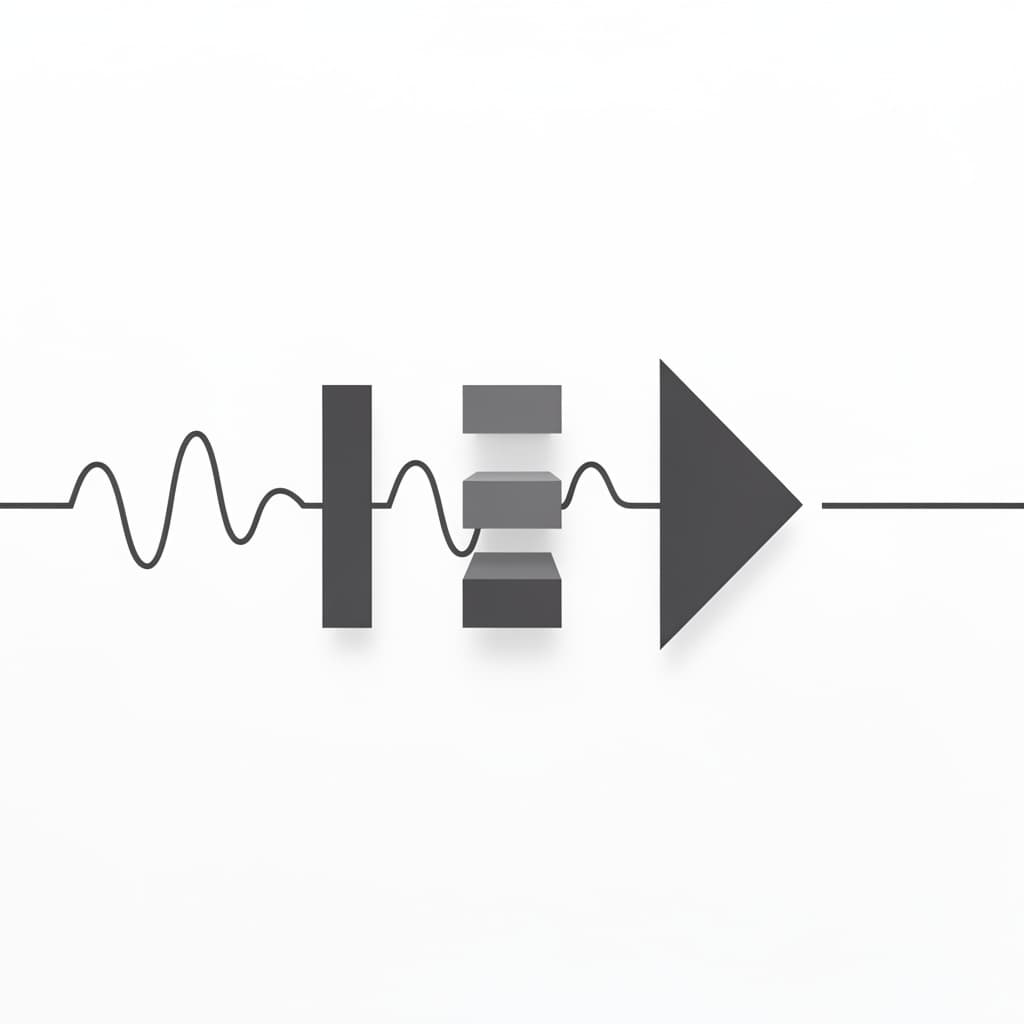
In the realm of modern engineering, few mechanisms are as ubiquitous and essential as the Proportional-Integral-Derivative (PID) controller. At its core, the question of how does a PID controller work can be answered by observing how a system continuously calculates an error value as the difference between a desired setpoint and a measured process variable. This mathematical feedback loop allows for precise control of everything from the temperature of a home espresso machine to the flight stabilization of a multi-million-euro drone. By applying a correction based on proportional, integral, and derivative terms, the controller achieves a level of stability and responsiveness that simple "on-off" switches cannot match.
The Foundations of Feedback Systems
To understand the mechanics of PID controllers, one must first grasp the concept of the Feedback Loop, the fundamental architecture of automated systems. In an open-loop system, a command is given without any monitoring of the outcome, much like a toaster that runs for a fixed time regardless of whether the bread is perfectly browned or burnt. In contrast, a closed-loop system observes its own output to inform its next move. This observation is facilitated by sensors that report the Process Variable (PV), which is then compared against the Setpoint (SP) to determine the accuracy of the current state. The difference between these two values is known as the Error Signal, denoted as $e(t)$, and it serves as the primary input for the PID algorithm.
The beauty of the closed-loop architecture lies in its ability to compensate for Disturbances—external forces that push the system away from its goal. For instance, if you are driving a car at a set speed and encounter a steep hill, the external load of gravity will cause the speed to drop. A human driver acts as the controller, noticing the speedometer (PV) is lower than the desired speed (SP), calculating the error, and pressing the accelerator to compensate. A PID controller automates this exact cognitive process, mathematically processing the error to determine how much "gas" to give the system. This continuous cycle of measuring, comparing, and adjusting is what allows machines to maintain high levels of precision in unpredictable environments.
Within this architecture, the controller’s task is to minimize the error signal as quickly and smoothly as possible. Control systems engineering basics dictate that a "perfect" controller would reach the setpoint instantly with zero overshoot and zero oscillation. In reality, physical systems have inertia, friction, and delays, making perfection impossible. Therefore, the PID algorithm is designed to balance these competing physical demands through three distinct mathematical lenses. By looking at the present (Proportional), the past (Integral), and the predicted future (Derivative), the controller creates a holistic response that satisfies the specific needs of the application, whether that requires surgical precision or rapid-fire response times.
Proportional Action and Static Response
The first and most intuitive component of the controller is the Proportional term, often referred to as the Proportional Gain or $K_p$. This term produces an output that is directly proportional to the current error value; if the error is large, the corrective action is large, and as the error shrinks, the correction decreases accordingly. Mathematically, this is expressed as $P = K_p \times e(t)$. This behavior mimics a simple spring mechanism: the further you pull the spring from its resting position, the harder it pulls back. In a heating system, a proportional controller would provide maximum power when the room is freezing and gradually taper off the power as the temperature approaches the target.
While the proportional term is the primary driver of the system, it suffers from a fundamental limitation known as Steady-State Error or "droop." Because the output of the P-term is a direct product of the error, the error can never actually reach zero in systems that require a constant input to maintain a state. For example, to keep a drone hovering, the motors must produce a certain amount of thrust. If the proportional controller reached the exact target height (zero error), the $P$ term would also become zero, the motors would shut off, and the drone would fall. Consequently, a P-only controller eventually settles at a point slightly below the setpoint where the error is just large enough to generate the power needed to prevent further falling.
To mitigate this, engineers can increase the $K_p$ value to make the controller more aggressive, but this introduces the risk of Instability. If the gain is too high, the system will overshoot the setpoint, realize its mistake, and over-correct in the opposite direction, leading to a state of perpetual oscillation. This trade-off between speed and stability is a recurring theme in control theory. While a high proportional gain reduces the steady-state error, it can never eliminate it entirely without causing the system to vibrate uncontrollably. This inherent flaw necessitates the introduction of the second term in the PID triad: the Integral action.
Integrating Error Over Time
The Integral component, represented by $K_i$, is designed to eliminate the steady-state error that the proportional term leaves behind. Instead of looking at the error at a single moment in time, the integral term looks at the history of the error by calculating the area under the error curve over time. Mathematically, it is defined as $I = K_i \int_{0}^{t} e(\tau) d\tau$. Even if the error is very small, the integral term will continue to accumulate as long as that error exists, slowly but surely increasing the output of the controller. This ensures that the system eventually reaches the exact setpoint, as the integral action will only stop growing once the error is precisely zero.
This "memory" of the system allows it to overcome persistent forces such as friction or gravity that a proportional term might ignore. Consider a robotic arm trying to hold a heavy weight at a specific angle; the proportional term might get it close, but the weight of the object causes it to sag slightly. The integral term notices this persistent sagging and gradually ramps up the torque to the motors until the arm is exactly where it needs to be. This makes the PI (Proportional-Integral) combination the most common form of the controller used in the industry, as it provides both a fast initial response and a guaranteed return to the target value without long-term offset.
However, the integral term introduces a unique challenge known as Integral Windup. This occurs when a large change in setpoint or a physical limitation (like a motor hitting its maximum speed) prevents the system from reaching the target for an extended period. During this time, the integral term continues to sum up the error, growing larger and larger—effectively "winding up" like a coiled spring. When the system finally does reach the setpoint, the integral term is so massive that it causes a huge overshoot because it takes a long time for the accumulated error to "unwind." Modern controllers use Anti-Windup logic, such as clamping the integral or resetting it, to prevent this runaway effect and maintain control during extreme transitions.
Predicting Change Through Differentiation
The third component, the Derivative term ($K_d$), adds a layer of "intelligence" or foresight to the controller. While the proportional term looks at the present and the integral looks at the past, the derivative term examines the Rate of Change of the error. It is defined as $D = K_d \frac{de(t)}{dt}$. By measuring how fast the error is shrinking or growing, the derivative term can predict where the system is heading. If the system is approaching the setpoint very rapidly, the derivative term will produce a negative output that acts as a "brake," slowing the system down to prevent it from overshooting the target. This provides a Damping effect that significantly improves the stability of high-speed systems.
In practice, the derivative term is essential for applications where overshoot is dangerous or undesirable, such as in the movement of a heavy industrial crane. As the crane's load swings toward its destination, the derivative term senses the velocity and begins to apply reverse force before the load even reaches the target. This predictive braking allows for much higher proportional gains than would otherwise be possible, leading to a system that is both faster and more stable. Understanding how does a PID controller work involves recognizing that the derivative term is essentially trying to keep the error's velocity at zero, smoothing out the transition to the steady state.
Despite its benefits, the derivative term is notoriously sensitive to High-Frequency Noise. Because a derivative measures the slope of a line, even a tiny, rapid jitter in a sensor signal can result in a massive derivative output, causing the controller to "kick" or vibrate. In real-world engineering, sensors are rarely perfect; they often have electrical noise that creates small, jagged fluctuations in the Process Variable. To combat this, engineers rarely use a pure derivative. Instead, they apply a Low-Pass Filter to the derivative term to smooth out the noise while still capturing the meaningful trends in the system's movement. Without such filtering, the derivative term can often do more harm than good in a noisy environment.
Synergizing Proportional Integral Derivative Control
The true power of the Proportional Integral Derivative control algorithm is realized when all three terms are combined into a single, unified output signal $u(t)$. The standard parallel form of the PID equation is: $$u(t) = K_p e(t) + K_i \int_{0}^{t} e(\tau) d\tau + K_d \frac{de(t)}{dt}$$ This synergy allows each term to compensate for the weaknesses of the others. The proportional term provides the bulk of the power, the integral term ensures long-term accuracy, and the derivative term provides the stability and damping needed to move quickly without losing control. Balancing these three coefficients is the central task of a control systems engineer, as the "correct" values depend entirely on the physics of the system being controlled.
From a Time-Domain perspective, the PID controller is a continuous conversation between the math and the machine. However, engineers also analyze these systems in the Frequency-Domain using Laplace Transforms. In this context, the PID controller is viewed as a transfer function that adds "zeros" and "poles" to the system's overall response curve. By shifting these values, engineers can mathematically prove whether a system will be stable or if it will diverge into chaos. This dual perspective—one intuitive and one highly mathematical—is what makes PID control such a deep and fascinating field of study within mechanical and electrical engineering.
It is worth noting that not every application requires all three terms. In many industrial processes, a PI Controller is sufficient because the derivative action’s sensitivity to noise outweighs its damping benefits. In other cases, like a simple heater, the system's inherent thermal mass provides enough natural damping that the $K_d$ term is unnecessary. However, in high-performance applications like aerospace or robotics, the full PID triad is essential. The flexibility to "turn off" terms by setting their gains to zero makes the PID algorithm a "one-size-fits-most" solution for a staggering variety of engineering challenges.
Optimization and PID Tuning Methods
Finding the optimal values for $K_p$, $K_i$, and $K_d$ is a process known as PID Tuning. If the gains are too low, the system will be "sluggish" and slow to respond to changes. If they are too high, the system will become unstable, oscillating wildly or even sustaining physical damage. One of the most famous historical methods for tuning is the Ziegler-Nichols Heuristic, developed in the 1940s. This method involves turning off the integral and derivative terms and increasing the proportional gain until the system reaches a state of "ultimate oscillation" ($K_u$). Based on the period of those oscillations ($P_u$), specific formulas are used to calculate the starting points for the three gains.
While Ziegler-Nichols provides a solid baseline, modern engineering often relies on more sophisticated Manual Tuning or software-based optimization. Manual tuning typically follows a specific order: first, increase $K_p$ until the system responds quickly with some oscillation; second, increase $K_i$ to pull the system to the setpoint and eliminate offset; and finally, increase $K_d$ to dampen the oscillations and smooth the arrival. This iterative process requires a deep understanding of the specific hardware, as different systems (like a slow-moving chemical tank versus a high-speed motor) require radically different tuning philosophies.
| Parameter | Rise Time | Overshoot | Settling Time | S-S Error |
|---|---|---|---|---|
| Increase $K_p$ | Decrease | Increase | Small Change | Decrease |
| Increase $K_i$ | Decrease | Increase | Increase | Eliminate |
| Increase $K_d$ | Small Change | Decrease | Decrease | No Change |
In recent years, Auto-Tuning algorithms have become standard in industrial Programmable Logic Controllers (PLCs). These systems inject a small disturbance into the process and measure the response to automatically calculate the best PID parameters. However, even with these tools, the human engineer must understand the underlying physics to define the "cost function" for the tuner—deciding, for example, whether the system should prioritize speed over energy efficiency. Tuning is as much an art as it is a science, requiring a balance between mathematical theory and empirical observation.
Control Systems Engineering Basics in Practice
In the modern era, the elegant logic of PID control is almost always implemented through Digital Algorithms rather than the analog circuits or pneumatic bellows of the past. When moving from the continuous world of calculus to the discrete world of microprocessors, the PID equation must undergo Discretization. Instead of a continuous integral, the computer performs a summation of error values over fixed time steps ($\Delta t$). Instead of a continuous derivative, it calculates the difference between the current error and the error from the previous time step. This discrete nature introduces the concept of the Sampling Rate—the frequency at which the controller "wakes up" to perform its calculations.
The sampling rate is a critical factor in how does a PID controller work in a digital environment. If the sampling rate is too slow, the controller might miss rapid changes in the process variable, leading to instability or poor performance. Generally, the sampling frequency should be at least 10 to 20 times faster than the natural frequency of the system being controlled. For a slow process like a massive industrial oven, a sampling rate of once per second might be plenty; for a high-performance drone motor, the controller might need to run at 8,000 Hz (8,000 times per second). Below is a simplified conceptual implementation of a PID loop in Python code:
def update_pid(setpoint, current_value, last_error, integral, dt):
    # Calculate current error
    error = setpoint - current_value

    # Proportional term
    p_out = Kp * error

    # Integral term (accumulation over time)
    integral += error * dt
    i_out = Ki * integral

    # Derivative term (rate of change)
    derivative = (error - last_error) / dt
    d_out = Kd * derivative

    # Total output
    output = p_out + i_out + d_out

    return output, error, integral
This digital implementation allows for the easy addition of logic that was impossible in the analog era. Gain Scheduling, for instance, allows a controller to use different $K_p$, $K_i$, and $K_d$ values depending on the state of the system—such as an aircraft using one set of gains for low-altitude takeoff and another for high-altitude cruise. Furthermore, digital PID controllers can be easily networked, allowing for Cascade Control where the output of one PID loop serves as the setpoint for another. This layered approach is what enables the management of incredibly complex industrial plants with thousands of interlocking variables.
Ultimately, the PID controller remains the cornerstone of automation because it is remarkably effective and surprisingly simple. While more advanced techniques like Model Predictive Control (MPC) exist, they require much higher computational power and a perfect mathematical model of the system. The PID controller, however, requires only three numbers and an error signal to function. Its ability to manage the delicate balance between the past, present, and future makes it one of the most elegant and enduring solutions in the history of engineering.
References
- Åström, K. J., and Hägglund, T., "Advanced PID Control", ISA (International Society of Automation), 2006.
- Bennett, S., "A History of Control Engineering, 1930-1955", IET History of Technology Series, 1993.
- Ziegler, J. G., and Nichols, N. B., "Optimum Settings for Automatic Controllers", Transactions of the ASME, 1942.
- Franklin, G. F., Powell, J. D., and Emami-Naeini, A., "Feedback Control of Dynamic Systems", Pearson Education, 2018.
Recommended Readings
- Feedback Systems: An Introduction for Scientists and Engineers by Karl Johan Åström and Richard M. Murray — An excellent, mathematically rigorous introduction to the theory that underpins PID and broader control systems.
- The Control Handbook by William S. Levine — A comprehensive reference that covers everything from basic PID loops to advanced state-space control methods.
- Designing PID Controllers with Software by various authors — Explore modern digital implementation and how simulation tools like MATLAB and Simulink are used to tune complex loops before they reach physical hardware.
- Process Control: Designing Processes and Control Systems for Dynamic Performance by Thomas E. Marlin — A practical guide focusing on the industrial application of PID controllers in chemical and manufacturing plants.