The Architecture of a Global Economic Collapse
Explore the complex causes of the Great Depression and its global reach. Learn about the 1929 crash, trade wars, and the era's deep social transformation.
In this articleA Structural Summary of the Great Depression

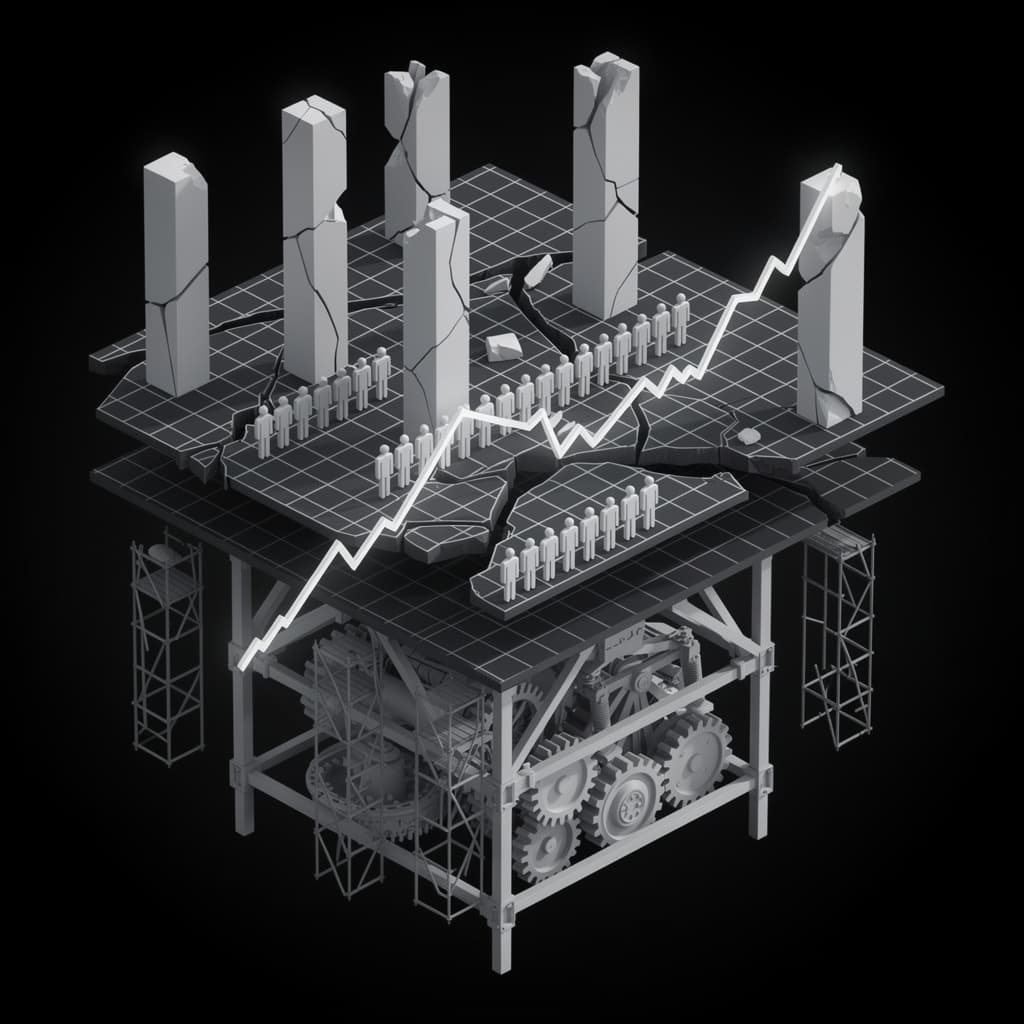
The Great Depression stands as the most profound economic dislocation of the modern era, a decade-long period of systemic failure that redefined the relationship between citizens and their governments. It was not triggered by a single event, but rather by a complex convergence of structural weaknesses in the global financial system, agricultural instability, and misguided policy responses. Understanding the causes of the Great Depression requires a forensic look at the transition from the post-war optimism of the 1920s to the recursive cycle of deflation and unemployment that characterized the 1930s. This article examines the architectural flaws of the global economy that allowed a localized stock market correction to metastasize into a worldwide catastrophe.
A Structural Summary of the Great Depression
The Roaring Twenties and Credit Expansion
The decade preceding the crash, often termed the Roaring Twenties, was characterized by an unprecedented surge in industrial productivity and a radical shift in consumer behavior. For the first time, the "buy now, pay later" philosophy became mainstream, facilitated by the advent of installment credit for durable goods like automobiles and radios. This expansion of credit created a temporary illusion of infinite prosperity, as demand remained high even when real wages for the working class began to stagnate. However, this growth was fundamentally fragile, as it relied on the continuous expansion of debt rather than sustainable increases in household purchasing power. By 1928, the market for consumer durables reached a saturation point, leading to an unnoticed buildup of inventories that signaled the approaching end of the boom.
Central to this expansion was the Federal Reserve and its monetary policy during the mid-1920s, which maintained relatively low interest rates to support the international gold standard. These low rates encouraged commercial banks to engage in aggressive lending, much of which flowed not into industrial innovation, but into speculative ventures. The ease of obtaining credit allowed millions of Americans to participate in the financial markets for the first time, viewing the stock market as a guaranteed vehicle for wealth accumulation. This democratization of investment, while inclusive in theory, lacked the regulatory oversight necessary to prevent the formation of a massive asset bubble. Consequently, the economic foundation of the late 1920s was built upon a precarious mountain of leveraged debt that required constant growth to avoid collapse.
Wealth Inequality and Consumption Limits
Despite the outward appearance of widespread prosperity, the 1920s were marked by a severe concentration of wealth that ultimately crippled the economy's ability to recover from shocks. By 1929, the top one percent of the population held approximately 40 percent of the nation's total wealth, a disparity that limited the broader population's ability to consume the massive output of American factories. Because the wealthy tend to save or reinvest their income rather than spend it on basic commodities, the economy became overly dependent on luxury consumption and capital investment. When these two sectors faltered, there was no robust middle-class consumer base to provide a floor for the falling demand. This imbalance is often cited as one of the primary causes of the Great Depression, as it ensured that any shock to the financial system would immediately translate into a collapse in aggregate demand.
Agricultural workers and manual laborers were particularly marginalized during this era, experiencing a "quiet depression" long before the stock market took its plunge. Farmers, who had expanded production during World War I, faced a sharp decline in prices as European agriculture recovered, leaving them with massive debts and falling incomes. This agricultural distress meant that a large segment of the population was already in a state of economic precariousness by 1929. The lack of a social safety net meant that when these groups lost their purchasing power, the impact rippled through the rest of the economy, reducing the profits of retailers and manufacturers. The structural inability of the masses to consume what they produced created a fundamental "under-consumption" crisis that the market was unable to correct on its own.
Mechanics of the 1929 Stock Market Crash
Speculative Bubbles and Margin Trading
The 1929 stock market crash was the psychological and financial breaking point of the era's speculative fervor. During the late 1920s, the practice of margin trading became ubiquitous, allowing investors to purchase stocks by paying only a small fraction of the price—often as little as 10 percent—and borrowing the rest from brokers. This practice meant that if a stock's value increased, the investor's returns were exponentially magnified; however, if the value dropped, the broker would issue a "margin call," requiring the investor to provide more cash immediately. In a rising market, this system functioned efficiently, but it created a highly volatile environment where even a minor price dip could trigger a cascade of forced liquidations. The total value of broker loans rose from 1,500 million dollars in 1923 to over 6,000 million dollars by 1929, indicating the extreme level of leverage in the system.
As stock prices reached astronomical levels that bore little relation to the actual earnings of the companies, a speculative bubble formed. Sophisticated investors began to realize that the market was overpriced and started quietly divesting their holdings in the summer of 1929. The initial signs of a slowdown were visible in the declining production of steel and automobiles, yet the general public continued to pour money into the market, driven by the fear of missing out on future gains. The psychological state of the market shifted from "irrational exuberance" to extreme fragility, where any negative news could potentially shatter investor confidence. By September 1929, the market began to experience sharp fluctuations, setting the stage for a total systemic collapse.
Black Tuesday and the Panic of Divestment
The collapse reached its zenith on October 29, 1929, known as Black Tuesday, when the stock market experienced the most devastating crash in its history. On that single day, over 16 million shares were traded as investors scrambled to exit their positions at any price, leading to a total loss of billions of dollars in market value. The panic was fueled by the realization that there were no buyers left to support the prices, causing the tickers to fall hours behind the actual trading. This delay added to the chaos, as investors did not know the current price of their holdings, leading to even more desperate selling. The crash was not just a loss of paper wealth; it destroyed the creditworthiness of thousands of individuals and firms who had used their stock portfolios as collateral for loans.
The immediate effects of the Great Depression were felt as the banking system began to reel from the stock market losses. Commercial banks had not only lent money to speculators but had also invested their depositors' funds directly into the market. When the market crashed, many banks found their assets significantly impaired, leading to a crisis of confidence among the general public. While the crash itself did not cause the entire decade-long depression, it acted as the catalyst that exposed the underlying structural weaknesses of the 1920s economy. It effectively wiped out the "wealth effect," leading to a sudden and dramatic contraction in consumer spending and business investment that the economy was unable to absorb.
Studying this for an exam?
Noesis builds the syllabus, notes and tests for you, and you study them with a tutor that knows your material.
Systemic Causes of the Great Depression
Bank Failures and Monetary Contraction
Perhaps the most damaging factor in the causes of the Great Depression was the near-total collapse of the American banking system. Unlike modern banks, which are protected by government-backed insurance, banks in the 1930s were vulnerable to "bank runs" where depositors would rush to withdraw their cash simultaneously. Between 1929 and 1933, over 9,000 banks failed, wiping out the life savings of millions of families and destroying the mechanism for credit creation. As banks closed, the remaining institutions became extremely cautious, refusing to lend even to creditworthy borrowers. This created a "liquidity trap" where, despite a need for capital, the flow of money through the economy effectively seized up.
Economists Milton Friedman and Anna Schwartz argued that the primary culprit was the Federal Reserve's failure to provide sufficient liquidity to the banking system. Instead of expanding the money supply to counteract the hoarding of cash, the Fed allowed the money supply to contract by approximately one-third between 1929 and 1933. This contraction led to deflation, a condition where the prices of goods and services fall, making the real value of debt rise. We can express the relationship between money supply and the economy using the Equation of Exchange:
Where is the total money supply, is the velocity of money (the rate at which money changes hands), is the price level, and is the real output. During the Depression, both and collapsed, forcing a massive reduction in and , which manifested as falling prices and shrinking GDP.
Protectionism and the Smoot-Hawley Tariff
In a misguided attempt to protect domestic industries from foreign competition, the United States Congress passed the Smoot-Hawley Tariff Act in 1930. This legislation raised import duties on over 20,000 goods to record levels, under the assumption that forcing Americans to buy American products would stimulate the domestic economy. However, this move proved to be a catastrophic error in international diplomacy and economics. Foreign nations, particularly in Europe, immediately retaliated by imposing their own tariffs on American exports, leading to a complete freeze in global trade. The volume of world trade plummeted by two-thirds between 1929 and 1932, worsening the downturn for every nation involved.
The collapse of international trade meant that American farmers and manufacturers, who relied on foreign markets to sell their surplus, were left with no outlets for their products. This exacerbated the problem of overproduction and drove prices down even further. Furthermore, the tariff made it impossible for European nations to earn the USD they needed to repay their war debts to the United States, creating a cycle of default and financial instability abroad. Instead of protecting American jobs, the Smoot-Hawley Tariff served to export the Depression to the rest of the world, turning a domestic recession into a global economic war. This period remains a cautionary tale regarding the dangers of protectionism in an interconnected global economy.
Socio-Economic Effects of the Great Depression
Unemployment and the Dislocation of Labor
The human cost of the economic collapse was most visible in the unprecedented rise in unemployment, which peaked at approximately 25 percent in the United States by 1933. This meant that one out of every four able-bodied workers was without a job, and many more were "underemployed," working only a few hours a week for subsistence wages. Unlike today, there was no national unemployment insurance or welfare system to catch those who fell, leading to a state of absolute destitution for millions. The loss of a job was not just a financial blow; it was a devastating loss of dignity and social standing in a society that equated work with moral worth. Men who had been breadwinners were forced to stand in breadlines and soup kitchens, while their families faced the constant threat of eviction.
This mass unemployment led to a massive dislocation of the labor force, as people wandered the country in search of work that did not exist. "Hoovervilles"—shantytowns named after President Herbert Hoover—sprang up on the outskirts of every major city, constructed from scrap metal, cardboard, and wood. These settlements became symbols of the government's perceived failure to address the crisis. The psychological impact of the era was profound, as a generation of workers grew up with a deep-seated insecurity regarding financial stability and a lasting distrust of financial institutions. The effects of the Great Depression were thus not merely statistical but were etched into the collective psyche of the nation, influencing social policy for decades to come.
The Breakdown of the American Social Fabric
The Depression challenged the core tenets of the American social contract, leading to a rise in radical political movements and social unrest. As the economic hardship deepened, many began to question the viability of capitalism and democracy, looking toward alternative models like socialism or communism. Strikes and protests became frequent, sometimes turning violent, as workers demanded better conditions and government intervention. The "Bonus Army" incident of 1932, where World War I veterans were forcibly removed from Washington D.C. after protesting for early payment of their service certificates, highlighted the growing tension between the citizenry and the state. The sense of shared prosperity that had characterized the 1920s was replaced by a sense of shared misery and desperation.
Family structures also underwent significant strain during this period. The birth rate dropped to its lowest level in history as couples postponed marriage and childbearing due to financial uncertainty. In many cases, the traditional roles of men and women were inverted; as men lost their jobs in heavy industry, women often found low-paying work in service sectors, leading to domestic tension and a crisis of masculinity. Despite these hardships, the era also fostered a sense of communal resilience. Communities organized local aid networks, and the shared experience of the Depression created a bond among the "Greatest Generation" that would later define their participation in World War II. The breakdown of the old social fabric ultimately cleared the way for the creation of a new, more interventionist government role in the 1930s.
Environmental Crisis and Dust Bowl Causes
Agricultural Overproduction and Soil Depletion
The economic misery of the 1930s was compounded by a severe environmental catastrophe known as the Dust Bowl, which ravaged the Southern Plains of the United States. The dust bowl causes were a combination of prolonged drought and decades of poor land management practices. During the high-demand years of World War I, farmers had used mechanized tractors to plow millions of acres of virgin prairie grass to plant wheat. This "Great Plow-Up" removed the deep-rooted native grasses that had historically held the soil in place and moisture in the ground. When the wheat prices collapsed and the drought began in 1931, the farmers left the land fallow, leaving the topsoil exposed to the high winds of the Great Plains.
Without the protective cover of vegetation, the dry soil turned to dust. When the winds picked up, they created massive "Black Blizzards" that could blot out the sun for days and travel as far as the Atlantic coast. This was a classic example of an environmental feedback loop: the lack of ground cover increased the surface temperature, which in turn reduced localized rainfall, worsening the drought. The destruction of the topsoil meant that even if the rains did return, the land was no longer fertile enough to support crops. This environmental failure rendered thousands of farms useless and turned the agricultural heartland of the country into a wasteland, exacerbating the already dire economic impact of the Great Depression.
Climate Extremes and the Great Migration
The environmental collapse forced one of the largest internal migrations in American history. Over 2.5 million people fled the Plains states, particularly Oklahoma, Texas, Kansas, and Arkansas, seeking a new life in the West. These migrants, pejoratively labeled "Okies," traveled in dilapidated cars along Route 66 toward California, lured by the promise of agricultural work in the Central Valley. However, they found that California was not the Eden they expected; the state was already struggling with its own economic problems, and the influx of desperate workers led to labor surpluses and falling wages. The migrants were often met with hostility and were forced to live in squalid labor camps, a struggle immortalized in John Steinbeck's The Grapes of Wrath.
The Dust Bowl served as a stark reminder that economic systems do not exist in a vacuum, separate from the natural environment. It forced the federal government to reconsider its approach to land management and conservation, leading to the creation of the Soil Conservation Service in 1935. This agency taught farmers how to use contour plowing, terracing, and crop rotation to prevent erosion. The migration also shifted the demographic and political landscape of the Western United States, bringing the culture and politics of the Plains to the Pacific coast. The environmental crisis of the 1930s proved that the "Architecture of Collapse" was not just financial, but ecological, requiring a holistic approach to recovery.
Economic Impact of the Great Depression Globally
European Debt Cycles and Hyperinflation
The Great Depression was a truly global phenomenon, linked by the complex web of international debt created after World War I. Under the Dawes Plan, the United States lent money to Germany so it could pay reparations to Britain and France, who in turn used that money to repay their own war debts to the U.S. This "circular flow" of capital was dependent on the continued willingness of American banks to lend. When the 1929 crash occurred, American lending stopped abruptly, causing the German economy to collapse and triggering a wave of defaults across Europe. In Germany, the economic misery contributed to political instability, as the Weimar Republic struggled to manage hyperinflation and massive unemployment, providing a fertile ground for the rise of extremist movements.
The interconnectedness of the global financial system meant that the failure of a single major bank could trigger a regional crisis. In 1931, the failure of the Creditanstalt, Austria's largest bank, sent shockwaves through the European continent, leading to a general banking panic. Governments responded by freezing foreign exchange and imposing trade barriers, which only served to deepen the global downturn. The economic hardship in Europe was often more severe than in the U.S. because many nations were still recovering from the physical and financial devastation of the Great War. This global misery ensured that the Depression would last far longer than a standard business cycle downturn, as no single nation could act as an "engine of growth" to pull the others out of the slump.
The Dissolution of the International Gold Standard
At the heart of the global transmission of the Depression was the International Gold Standard. Under this system, nations fixed the value of their currencies to a specific amount of gold, which limited their ability to adjust monetary policy during a crisis. When the Depression hit, nations felt forced to raise interest rates to protect their gold reserves and prevent capital flight, even though the domestic economy desperately needed lower rates and more liquidity. This "golden fetters" effect meant that the very system intended to provide international stability instead acted as a mechanism for spreading deflation. Nations were effectively prevented from using the tools of monetary expansion to combat unemployment as long as they remained on the gold standard.
The turning point for many nations came when they abandoned the gold standard, allowing their currencies to devalue and their central banks to lower interest rates. Great Britain was the first major power to leave the gold standard in 1931, followed by the United States in 1933 under President Franklin D. Roosevelt. Research by economic historians, such as Barry Eichengreen, has shown that the sooner a country left the gold standard, the sooner its economy began to recover. The dissolution of this system marked the end of the 19th-century liberal economic order and the beginning of a new era of managed currencies and national economic planning. The economic impact of the Great Depression thus resulted in a fundamental rewrite of the rules of global finance.
Policy Transformations and Institutional Shifts
The Emergence of Keynesian Macroeconomics
The failure of classical economic theories to explain or solve the persistent unemployment of the 1930s led to a revolution in economic thought. Before the Depression, the prevailing wisdom was that markets were self-correcting and that government intervention only hindered the natural recovery process. However, British economist John Maynard Keynes challenged this view in his 1936 work, The General Theory of Employment, Interest, and Money. Keynes argued that in times of crisis, aggregate demand could remain low for extended periods, leading to a "permanent" state of underemployment. He proposed that the government should use fiscal policy—taxing and spending—to stimulate demand when the private sector was unable or unwilling to do so.
Keynesianism shifted the focus of economics from individual markets to the behavior of the economy as a whole, giving birth to the field of macroeconomics. The central idea was that during a recession, the government should run a budget deficit to fund public works and social programs, essentially acting as the "spender of last resort." While these ideas were controversial at the time, they provided the intellectual framework for the New Deal and the post-war economic order. The shift from "laissez-faire" to active management became the hallmark of modern governance, fundamentally changing how states respond to economic cycles. This shift in perspective is perhaps the most lasting legacy of the Great Depression's policy failures.
Federal Intervention and Social Safety Nets
In the United States, the policy response culminated in the New Deal, a series of programs and regulations enacted by the Roosevelt administration to provide "Relief, Recovery, and Reform." Key institutions that we take for granted today were born from this crisis, including the Social Security Administration, which provided a safety net for the elderly and unemployed, and the Securities and Exchange Commission (SEC), designed to prevent the speculative abuses that led to the 1929 crash. The Federal Deposit Insurance Corporation (FDIC) was also created to restore faith in the banking system by guaranteeing individual deposits. These reforms were intended to ensure that the structural flaws that caused the Depression would never again lead to a total systemic collapse.
The New Deal also marked a massive expansion of the federal government's role in the economy through public works projects like the Works Progress Administration (WPA) and the Tennessee Valley Authority (TVA). These programs not only provided jobs for millions of unemployed workers but also modernized the nation's infrastructure, building roads, bridges, and dams that would support future economic growth. While the New Deal did not fully end the Great Depression—that would only happen with the massive industrial mobilization for World War II—it did prevent the total collapse of American society and established the principle that the government has a responsibility to ensure the economic welfare of its citizens. The architecture of the global economy was rebuilt on a foundation of regulation and social protection, a direct response to the hard-learned lessons of the 1930s.
References
- Friedman, M., & Schwartz, A. J., "A Monetary History of the United States, 1867–1960", Princeton University Press, 1963.
- Eichengreen, B., "Golden Fetters: The Gold Standard and the Great Depression, 1919–1939", Oxford University Press, 1992.
- Keynes, J. M., "The General Theory of Employment, Interest, and Money", Palgrave Macmillan, 1936.
- Bernanke, B. S., "Essays on the Great Depression", Princeton University Press, 2000.
Recommended Readings
- The Grapes of Wrath by John Steinbeck — A seminal work of fiction that provides a visceral, human perspective on the Dust Bowl and the migrant experience.
- Lords of Finance: The Bankers Who Broke the World by Liaquat Ahamed — A compelling narrative history of the four central bankers whose decisions shaped the global economic collapse.
- Manias, Panics, and Crashes: A History of Financial Crises by Charles P. Kindleberger — A definitive academic overview of why financial systems are prone to bubbles and how they eventually burst.
- The Great Crash, 1929 by John Kenneth Galbraith — An accessible and witty analysis of the 1929 stock market collapse and the speculative madness that preceded it.
Turn this topic into a full course
Noesis builds the syllabus, notes and tests for you, and you study them with a tutor that knows your material.