Projectile Motion: Formulas, Equations, Trajectories, Examples & Problem Guide
Projectile Motion Fundamentals Projectile motion is one of the most elegant and instructive topics in classical mechanics, offering a window into how the natural world obeys precise mathematical...
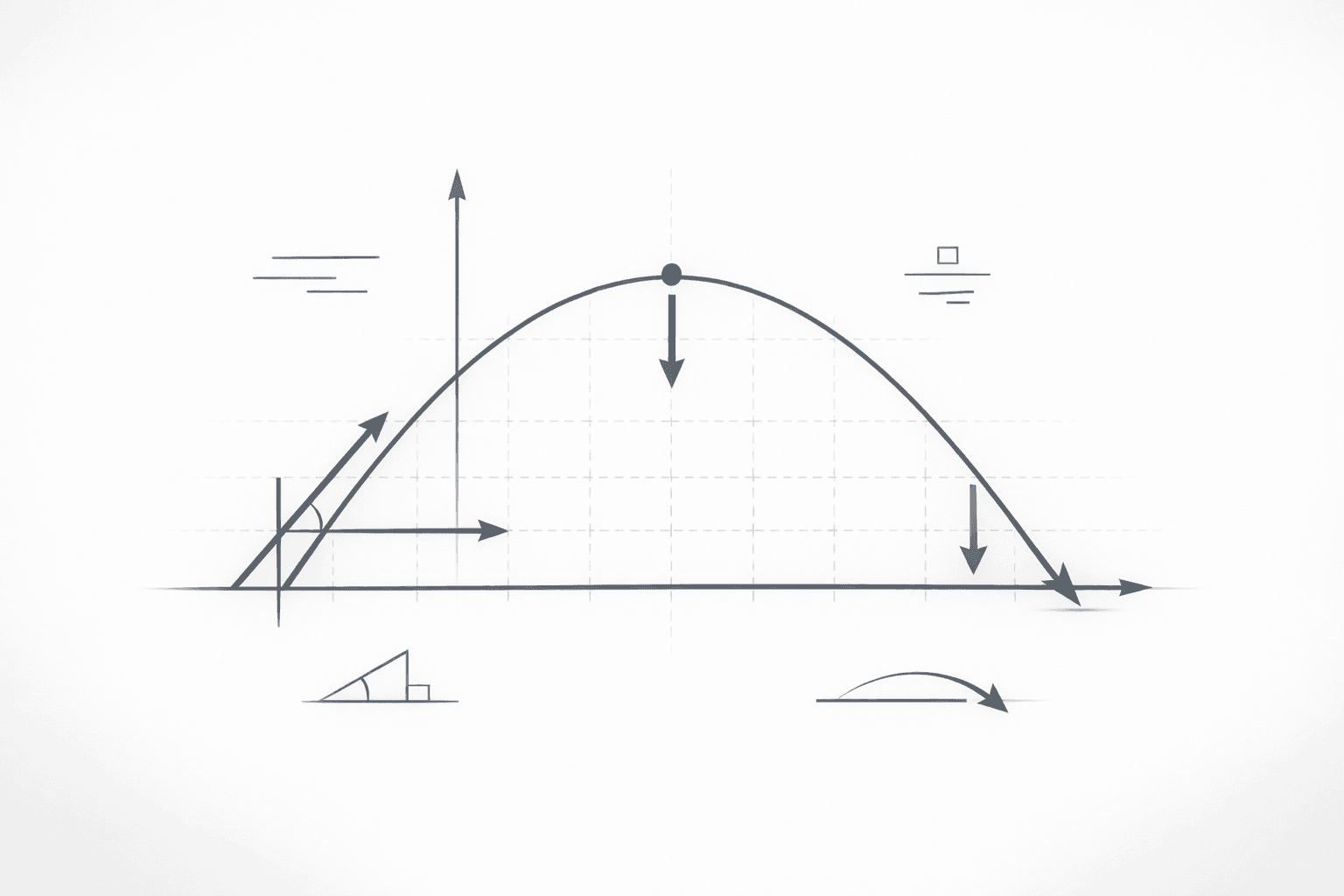
Projectile Motion Fundamentals
Projectile motion is one of the most elegant and instructive topics in classical mechanics, offering a window into how the natural world obeys precise mathematical laws. When Galileo Galilei conducted his legendary experiments in the early seventeenth century, he demonstrated something revolutionary: a moving object launched into the air follows a curved path that can be decomposed into two completely independent motions happening simultaneously. This insight — that horizontal and vertical components of motion are orthogonal and non-interfering — forms the bedrock of all projectile motion analysis. Understanding this principle unlocks the ability to predict where a thrown ball lands, how far an artillery shell travels, and what trajectory a rocket follows before engine ignition.
The scope of projectile motion extends far beyond classroom exercises. Engineers designing sports equipment, military ballistics specialists, animators creating physically realistic game environments, and athletes optimizing their throwing technique all rely on the same foundational principles. The mathematics is surprisingly accessible once the conceptual framework is in place, which is why this topic serves as the perfect bridge between kinematics in one dimension and the richer, more complex world of two-dimensional motion. This guide builds that framework systematically, covering all major formulas, derivations, and problem types with worked examples throughout.
Definition and Types of Projectile Motion
A projectile is any object that is launched into the air and subsequently moves only under the influence of gravity, with no propulsive force acting after the moment of launch. The path traced by such an object is called its trajectory, and under ideal conditions this trajectory is always a parabola. There are two primary categories of projectile motion that appear repeatedly in physics problems. The first is angled projectile motion, where an object is launched at some angle $\theta$ above the horizontal with an initial speed $v_0$, giving it both horizontal and vertical velocity components from the outset. The second is horizontal projectile motion, a special case where the launch angle is exactly zero, meaning the object begins with only horizontal velocity and immediately begins falling under gravity.
Both types share the same governing physics but differ in their initial conditions, which changes the resulting equations in important ways. A ball rolled off the edge of a table exemplifies horizontal projection — it leaves the surface moving purely sideways, then curves downward as gravity acts. A soccer ball kicked at a thirty-degree angle to the ground exemplifies angled projection — it rises, reaches a peak, then descends symmetrically (in the ideal case). A third, more advanced category is projectile motion on an inclined plane, where the launch and landing surfaces are tilted, requiring a rotated coordinate system. All three variants are treated in detail in this guide because each appears frequently in physics curricula and real-world applications.
Key Components: Velocity and Acceleration
The power of projectile motion analysis comes from recognizing that the two-dimensional problem separates cleanly into two one-dimensional problems. Horizontally, in the absence of air resistance, there is no force acting on the projectile, which means horizontal acceleration is exactly zero. Vertically, gravity provides a constant downward acceleration of magnitude $g = 9.8 \, \text{m/s}^2$ (or $9.81 \, \text{m/s}^2$ in more precise treatments). These two facts together mean that the horizontal velocity component $v_x$ remains constant throughout the flight, while the vertical velocity component $v_y$ changes continuously, starting at its initial value and increasing in the downward direction at rate $g$.
For a launch at angle $\theta$ with initial speed $v_0$, the initial velocity components are $v_{0x} = v_0 \cos\theta$ and $v_{0y} = v_0 \sin\theta$. These expressions come directly from vector decomposition using trigonometry, and they are the starting point for every projectile motion problem involving an angled launch. The total velocity at any instant is the vector sum of the horizontal and vertical components, and its magnitude is $v = \sqrt{v_x^2 + v_y^2}$, while its direction relative to the horizontal is $\phi = \arctan(v_y / v_x)$. At the highest point of the trajectory, $v_y = 0$ momentarily, so the velocity is purely horizontal and equals $v_{0x}$ — a fact that is often used as a key condition in problem-solving.
Assumptions in Ideal Projectile Motion
Every standard projectile motion formula rests on a set of simplifying assumptions that make the mathematics tractable while remaining accurate enough for a wide range of practical situations. The most fundamental assumption is that air resistance is negligible. In reality, drag forces depend on the object's speed, cross-sectional area, shape, and the density of the medium through which it travels. For heavy, compact objects moving at moderate speeds — like a shot put or a basketball — neglecting air resistance introduces only a small error. For lightweight or high-speed objects like a badminton shuttlecock or a rifle bullet, the ideal equations become significantly less accurate.
A second important assumption is that the gravitational field is uniform, meaning $g$ is treated as constant throughout the flight. This is entirely valid for trajectories spanning hundreds of meters or less, but breaks down for very long-range ballistics where the curvature of the Earth and the variation of $g$ with altitude must be considered. Third, the analysis assumes the Earth's surface is flat within the region of interest and that the projectile is a point mass with no rotational effects. These assumptions collectively define what physicists call the ideal projectile model, and understanding them is crucial because it clarifies when the standard formulas apply and when more advanced treatments — incorporating drag, Magnus effect, or Earth's rotation — become necessary.
Essential Projectile Motion Formulas
With the conceptual foundation established, the complete set of projectile motion equations follows directly from the kinematic equations for constant acceleration. The horizontal direction has zero acceleration, and the vertical direction has constant acceleration $-g$ (taking upward as positive). These two facts, combined with the initial conditions, generate all the formulas needed to fully describe any ideal projectile's motion. What makes this framework so powerful is its generality: the same four or five core equations, with the appropriate initial conditions plugged in, solve every type of projectile motion problem that appears in standard physics courses.
Horizontal Velocity and Displacement Equations
Because there is no horizontal force, the horizontal component of velocity never changes. At any time $t$ after launch, the horizontal velocity is simply:
$$v_x = v_0 \cos\theta$$
The corresponding horizontal displacement, measuring how far the projectile has traveled in the $x$-direction from its launch point, grows linearly with time:
$$x = v_0 \cos\theta \cdot t$$
This linear relationship is one of the most important features of projectile motion and the reason the trajectory turns out to be parabolic rather than some more complicated curve. Doubling the time always doubles the horizontal distance traveled, regardless of what is happening vertically. In horizontal projectile motion (where $\theta = 0$), these equations simplify to $v_x = v_0$ and $x = v_0 t$, since $\cos(0°) = 1$. These expressions assume the launch point is at the origin; if the projectile starts at some horizontal position $x_0$, then $x = x_0 + v_0 \cos\theta \cdot t$.
Vertical Motion Equations Under Gravity
The vertical motion is governed by constant gravitational acceleration. Taking upward as positive and the launch point as the origin, the vertical velocity at time $t$ is:
$$v_y = v_0 \sin\theta - g t$$
And the vertical displacement — how high above (or below) the launch point the projectile is at time $t$ — is given by:
$$y = v_0 \sin\theta \cdot t - \frac{1}{2} g t^2$$
The negative sign on the $gt$ and $\frac{1}{2}gt^2$ terms reflects the fact that gravity acts downward while the positive direction is upward. At $t = 0$, $y = 0$ and $v_y = v_0\sin\theta$, which matches the initial conditions. As time progresses, the $-gt$ term in the velocity equation pulls $v_y$ toward zero and then negative, corresponding to the projectile slowing its upward motion, stopping at the peak, and then accelerating downward. It is also useful to have the velocity-position relationship that eliminates time:
$$v_y^2 = (v_0 \sin\theta)^2 - 2g y$$
This equation, derived from the standard kinematic relation $v^2 = v_0^2 + 2as$, is particularly valuable for finding the maximum height or the impact speed at a specific height without needing to compute time explicitly.
Combining Formulas for Full Path
The six equations above — two for horizontal velocity and displacement, three for vertical velocity, displacement, and velocity-squared — constitute the complete toolkit for projectile motion problems. To find where a projectile is at any moment, compute $x$ and $y$ separately using those two displacement equations with the same value of $t$. To find when a projectile reaches a specific location, set $x$ or $y$ equal to the known value and solve for $t$. The key strategy is always to treat horizontal and vertical motion as two separate but time-linked one-dimensional problems, solving each with the appropriate kinematic equation and using the shared variable $t$ to connect them.
A useful summary of the equations is presented in the table below for quick reference:
| Quantity | Horizontal | Vertical |
|---|---|---|
| Acceleration | $a_x = 0$ | $a_y = -g$ |
| Initial velocity component | $v_{0x} = v_0\cos\theta$ | $v_{0y} = v_0\sin\theta$ |
| Velocity at time $t$ | $v_x = v_0\cos\theta$ | $v_y = v_0\sin\theta - gt$ |
| Displacement at time $t$ | $x = v_0\cos\theta \cdot t$ | $y = v_0\sin\theta \cdot t - \frac{1}{2}gt^2$ |
| Velocity-position relation | — | $v_y^2 = (v_0\sin\theta)^2 - 2gy$ |
Deriving the Projectile Trajectory Equation
The trajectory equation describes the shape of the path itself — the mathematical relationship between the $y$-coordinate and the $x$-coordinate of the projectile at every point along its flight. Unlike the kinematic equations, which express position as a function of time, the trajectory equation eliminates time entirely and expresses $y$ directly as a function of $x$. This produces the most visually intuitive description of projectile motion and immediately reveals the parabolic nature of the path.
Parabolic Trajectory Basics
Galileo was the first to prove rigorously, in his 1638 work Discourses and Mathematical Demonstrations Relating to Two New Sciences, that the path of a projectile is a parabola. This was a significant departure from the Aristotelian view, which held that projectiles traveled in straight lines until their "impetus" was exhausted, at which point they fell straight down. The parabolic shape arises because horizontal displacement grows linearly with time ($x \propto t$) while vertical displacement grows quadratically with time ($y \propto t^2$). When you eliminate $t$ between these two relationships, you get $y$ as a quadratic function of $x$ — the defining feature of a parabola.
The parabola is symmetric about a vertical axis passing through the highest point of the trajectory, but only when the projectile lands at the same height from which it was launched. If the landing height differs from the launch height — say, a ball thrown off a cliff — the symmetry is broken and only part of the parabola is traced. This distinction matters practically: many real-world problems involve asymmetric trajectories, and solvers must be careful not to apply symmetric-case formulas (like the standard range formula) to asymmetric situations where they do not hold.
Standard Trajectory Formula Derivation
The derivation proceeds by solving the horizontal displacement equation for $t$ and substituting into the vertical displacement equation. Starting from $x = v_0 \cos\theta \cdot t$, we get:
$$t = \frac{x}{v_0 \cos\theta}$$
Substituting this expression for $t$ into $y = v_0 \sin\theta \cdot t - \frac{1}{2}g t^2$ gives:
$$y = v_0 \sin\theta \cdot \frac{x}{v_0 \cos\theta} - \frac{1}{2}g\left(\frac{x}{v_0 \cos\theta}\right)^2$$
Simplifying the first term and expanding the second:
$$y = x\tan\theta - \frac{g}{2v_0^2\cos^2\theta}\, x^2$$
This is the trajectory equation for projectile motion. It has the form $y = Ax - Bx^2$, where $A = \tan\theta$ and $B = g/(2v_0^2\cos^2\theta)$ are constants determined by the launch conditions. This is unmistakably the equation of a downward-opening parabola with its vertex (the highest point) not necessarily at $x = 0$. Alternatively, using the identity $1/\cos^2\theta = \sec^2\theta = 1 + \tan^2\theta$, the equation can be rewritten as:
$$y = x\tan\theta - \frac{g(1+\tan^2\theta)}{2v_0^2}\, x^2$$
This form is sometimes more convenient when $\tan\theta$ is the given quantity rather than $\theta$ itself.
Interpreting Trajectory Graphs
When plotted with $x$ on the horizontal axis and $y$ on the vertical axis, the trajectory equation produces the familiar arch shape associated with projectile motion. The parabola begins at the origin (the launch point), rises to a maximum $y$-value (the maximum height), and then descends back to the $x$-axis at a point whose $x$-coordinate is the range $R$. The slope of the trajectory at any point equals $dy/dx$, which can be computed by differentiating the trajectory equation: $dy/dx = \tan\theta - \frac{g}{v_0^2\cos^2\theta} x$. At $x = 0$, this slope equals $\tan\theta$, confirming that the trajectory begins at the launch angle. At the range $x = R$, the slope equals $-\tan\theta$, showing that the descent angle equals the launch angle — a beautiful geometric symmetry of symmetric projectile motion.
Understanding the trajectory graph also helps build physical intuition about how launch parameters affect the shape. Increasing $v_0$ while keeping $\theta$ fixed stretches the parabola wider and taller proportionally. Increasing $\theta$ toward $45°$ initially increases the range, then decreasing it again as $\theta$ approaches $90°$. At $\theta = 90°$, the horizontal displacement is zero for all time and the projectile simply goes straight up and comes straight back down — a degenerate parabola that collapses to a line segment on a trajectory graph.
Horizontal Projectile Motion
Horizontal projectile motion is the special and frequently encountered case where an object is launched with initial velocity directed entirely horizontally — that is, the launch angle $\theta = 0$. This situation occurs whenever an object slides or rolls off a horizontal surface, is fired horizontally from a gun, or steps off a moving platform. The simplification it offers is significant: the vertical motion is purely free fall from rest, while the horizontal motion is uniform. Despite the simplicity, horizontal projectile motion problems contain all the essential features of the general case and serve as an ideal starting point for building problem-solving skills.
Equations for Horizontal Launch
Setting $\theta = 0$ in the general equations immediately simplifies everything. The initial vertical velocity is $v_{0y} = v_0\sin(0°) = 0$, and the initial horizontal velocity is $v_{0x} = v_0\cos(0°) = v_0$. The equations of motion become:
$$x = v_0 t \qquad \text{and} \qquad y = -\frac{1}{2}g t^2$$
where the negative sign in the $y$-equation reflects downward displacement (taking upward as positive). The vertical velocity at time $t$ is $v_y = -gt$, growing in magnitude as the object falls faster and faster. The trajectory equation for horizontal motion is found by eliminating $t$ via $t = x/v_0$ and substituting:
$$y = -\frac{g}{2v_0^2} x^2$$
This is a downward-opening parabola with vertex at the origin — the launch point. Note that the coefficient $-g/(2v_0^2)$ controls how quickly the parabola bends downward: a larger launch speed $v_0$ produces a flatter, more gently curving trajectory, while a smaller $v_0$ results in a steeper drop for the same horizontal distance.
Time to Reach Ground Calculation
If the object is launched from a height $H$ above the ground, the time of flight is determined by setting $y = -H$ in the vertical displacement equation and solving for $t$:
$$-H = -\frac{1}{2}g t^2 \implies t = \sqrt{\frac{2H}{g}}$$
This result is remarkable and often surprising to students: the time it takes a horizontally launched projectile to reach the ground depends only on the initial height $H$ and the gravitational acceleration $g$. It does not depend at all on the horizontal launch speed $v_0$. A ball rolled off a table at any speed will always hit the ground at the same time as a ball dropped from rest at the same height — a counterintuitive but experimentally verified fact. The horizontal distance traveled before impact — the range in this context — is then simply $R = v_0 t = v_0 \sqrt{2H/g}$, which does scale with launch speed.
Impact Speed and Direction
At the moment of impact, the projectile has both a horizontal velocity component $v_x = v_0$ (unchanged throughout the flight) and a vertical velocity component $v_y = -gt_f = -g\sqrt{2H/g} = -\sqrt{2gH}$. The magnitude of the impact speed is:
$$v_{\text{impact}} = \sqrt{v_0^2 + 2gH}$$
This result also follows directly from energy conservation: the kinetic energy at impact equals the initial kinetic energy plus the gravitational potential energy converted during the fall. The direction of impact, measured below the horizontal, is $\phi = \arctan(|v_y|/v_x) = \arctan(\sqrt{2gH}/v_0)$. For a slow initial speed $v_0$, the impact angle is steep — the object hits nearly vertically; for a fast $v_0$, the impact angle is shallow. This is why bullets fired horizontally at high speed hit the ground at a shallow angle and travel far, while a slow-rolling ball drops more steeply.
Time of Flight and Maximum Height in Projectile Motion
Two of the most frequently requested quantities in projectile motion problems are the total time the object spends in the air and the maximum height it reaches. Both are derived from the vertical motion equations and both depend critically on the initial vertical velocity component $v_{0y} = v_0\sin\theta$. Once these two quantities are in hand, they can be used to find the range, the trajectory shape, and various other derived quantities, making them central to the problem-solving process.
Time of Flight Formula Derivation
For a projectile launched from and landing on the same horizontal level, the total time of flight $T$ is found by setting $y = 0$ in the vertical displacement equation and solving for $t$:
$$0 = v_0\sin\theta \cdot t - \frac{1}{2}g t^2 = t\left(v_0\sin\theta - \frac{1}{2}gt\right)$$
This gives two solutions: $t = 0$ (the launch moment) and:
$$T = \frac{2v_0\sin\theta}{g}$$
The physical interpretation is elegant: the time of flight equals twice the time it takes to reach the peak. This makes sense by symmetry — the upward journey and the downward journey are mirror images of each other (when launch and landing heights are equal), so the total time is twice the ascent time. For a launch angle of $\theta = 30°$ and $v_0 = 20$ m/s, for example: $T = 2(20)\sin(30°)/9.8 = 2(20)(0.5)/9.8 \approx 2.04$ seconds.
Maximum Height Achievement Equation
The maximum height $H_{\max}$ is reached when the vertical velocity equals zero: $v_y = v_0\sin\theta - gt = 0$, giving the time to peak as $t_{\text{peak}} = v_0\sin\theta/g$. Notice that this is exactly half the total time of flight $T$, confirming the symmetry argument above. Substituting $t_{\text{peak}}$ into the vertical displacement equation:
$$H_{\max} = v_0\sin\theta \cdot \frac{v_0\sin\theta}{g} - \frac{1}{2}g\left(\frac{v_0\sin\theta}{g}\right)^2 = \frac{(v_0\sin\theta)^2}{2g}$$
Equivalently, this can be derived directly from the velocity-position equation $v_y^2 = (v_0\sin\theta)^2 - 2gH_{\max}$ by setting $v_y = 0$. The maximum height depends only on the vertical component of the initial velocity — horizontal speed plays no role whatsoever in how high the projectile goes. This is why a ball thrown straight up at $20$ m/s reaches the same maximum height as a ball launched at $45°$ with initial speed $v_0$ such that $v_0\sin(45°) = 20$ m/s, even though the two trajectories look completely different.
Influencing Factors Analysis
The time of flight scales linearly with $v_0\sin\theta$: doubling the vertical launch speed doubles the time in the air. Increasing $g$ — say, performing the same throw on a planet with stronger gravity — decreases both $T$ and $H_{\max}$. This is why sports records set on the Moon would be dramatically different from those on Earth: the Moon's surface gravity of approximately $1.62$ m/s$^2$ (roughly one-sixth of Earth's) would increase time of flight and maximum height by a factor of six for the same launch speed and angle. These dependencies have practical implications in engineering: satellite tracking, long-range artillery computations, and athletic performance analysis all account for local gravitational conditions carefully.
It is also important to recognize the role of launch angle in maximizing these quantities. Maximum height is maximized when $\theta = 90°$ (a vertical launch), giving $H_{\max} = v_0^2/(2g)$. Time of flight is likewise maximized at $\theta = 90°$, giving $T = 2v_0/g$. However, as the next section shows, maximizing height and time of flight does not maximize the horizontal range — these are competing objectives that require different launch angles, a trade-off that lies at the heart of optimization problems in projectile motion.
Projectile Motion Range Formula
The range $R$ of a projectile is the total horizontal distance traveled from launch to landing, measured along the ground. It is the single most practically important quantity in many real-world applications of projectile motion — from athletic field events like javelin throw to military ballistics to the design of irrigation sprinkler systems. The range formula combines both the time of flight (a vertical quantity) and the constant horizontal velocity, linking the two components of motion in a single elegant expression.
Range on Level Ground Derivation
For level ground (launch and landing at the same height), the range is simply the horizontal velocity multiplied by the total time of flight:
$$R = v_x \cdot T = v_0\cos\theta \cdot \frac{2v_0\sin\theta}{g} = \frac{v_0^2 \cdot 2\sin\theta\cos\theta}{g}$$
Using the double-angle identity $2\sin\theta\cos\theta = \sin(2\theta)$, this simplifies to the standard projectile motion range formula:
$$R = \frac{v_0^2 \sin(2\theta)}{g}$$
This compact expression reveals immediately that for a fixed launch speed $v_0$, the range depends only on the launch angle through the factor $\sin(2\theta)$. The range is zero when $\theta = 0°$ (horizontal launch with zero height — the projectile never rises) or $\theta = 90°$ (vertical launch), and it is maximized when $\sin(2\theta) = 1$, i.e., when $2\theta = 90°$, giving $\theta = 45°$.
Optimal Launch Angle for Max Range
The $45°$ optimal angle for maximum range is one of the most celebrated results in introductory physics, and it is worth understanding why it arises. At small launch angles, the projectile barely rises and returns to ground very quickly, limiting horizontal travel. At large angles near $90°$, the projectile goes very high and takes a long time in the air, but most of that time the horizontal velocity is small, so it does not travel far horizontally. The angle $45°$ strikes the perfect balance, allocating the initial speed equally between vertical and horizontal components ($\sin45° = \cos45° = 1/\sqrt{2}$), maximizing the product of horizontal speed and flight time.
The maximum range itself is:
$$R_{\max} = \frac{v_0^2}{g}$$
achieved at $\theta = 45°$. For example, a javelin thrower launching at $v_0 = 25$ m/s at $45°$ would achieve a theoretical range of $(25)^2/9.8 \approx 63.8$ m in ideal conditions. Real javelin throws are somewhat shorter due to air resistance and the need to account for the aerodynamic properties of the javelin, but the ideal result gives a useful baseline. The $45°$ rule also has a limitation: it assumes level ground and neglects air drag. In the presence of air resistance, the optimal angle decreases — typically to somewhere between $30°$ and $40°$ depending on the projectile's drag coefficient.
Range Variation with Angle
A crucial and aesthetically pleasing property of the range formula is the complementary angle symmetry: two launch angles that add up to $90°$ produce the same range. This follows directly from $\sin(2\theta) = \sin(2(90° - \theta)) = \sin(180° - 2\theta) = \sin(2\theta)$. Thus, launches at $30°$ and $60°$ produce identical ranges, as do launches at $20°$ and $70°$, and $15°$ and $75°$. However, the trajectories are very different: the lower angle produces a flatter, faster path with shorter time of flight, while the higher angle produces a taller, slower path with longer time of flight. This has practical consequences — in situations where a target is at a specific range but must be reached with a trajectory that clears an obstacle, the higher-angle "lofted" solution might be the only viable option even though both angles would deliver the same horizontal distance in open space.
Projectile Motion on Inclined Plane
The most geometrically interesting and algebraically demanding variant of projectile motion involves launching a projectile on or from an inclined surface. This scenario appears in problems where a cannon is mounted on a hillside, a ball is thrown up a ramp, or an athlete jumps on a sloped terrain. The complication is that the standard coordinate system — horizontal $x$ and vertical $y$ — is still mathematically valid, but it becomes more convenient in many cases to use a tilted coordinate system aligned with the incline, which changes the effective gravity components along each axis.
Adjusted Coordinate System Setup
Consider a plane inclined at angle $\alpha$ to the horizontal. A projectile is launched from the base of the incline at angle $\beta$ above the incline surface (so the actual angle above horizontal is $\alpha + \beta$). By rotating the coordinate system so that the $x'$-axis lies along the incline and the $y'$-axis is perpendicular to it, gravity $g$ is decomposed into two components: $g\sin\alpha$ acting along the incline (opposing upward motion along the slope) and $g\cos\alpha$ acting perpendicular to the incline (replacing the role of $g$ in the normal equations). This rotated system makes the range along the incline easy to compute directly, without needing to track the ground-level horizontal distance separately.
In the tilted coordinate frame, the initial velocity components are $v_{0x'} = v_0\cos\beta$ (along the incline) and $v_{0y'} = v_0\sin\beta$ (perpendicular to the incline). The accelerations are $a_{x'} = -g\sin\alpha$ and $a_{y'} = -g\cos\alpha$. These are mathematically identical in structure to the standard projectile equations, just with $g$ replaced by $g\cos\alpha$ in the perpendicular direction and $g\sin\alpha$ in the parallel direction. All the standard derivation steps apply, and range and time of flight in the tilted frame can be found using identical algebraic methods.
Range Formulas Up and Down Incline
For a projectile launched up an incline at angle $\beta$ above the slope, the time of flight (until the projectile lands back on the incline) is found by setting the displacement perpendicular to the incline equal to zero:
$$T = \frac{2v_0\sin\beta}{g\cos\alpha}$$
The range along the incline — the distance from launch point to landing point measured along the slope — is:
$$R_{\text{up}} = \frac{2v_0^2 \sin\beta \cos(\alpha + \beta)}{g\cos^2\alpha}$$
For a projectile launched down an incline (the incline descending in the direction of launch), the range formula becomes:
$$R_{\text{down}} = \frac{2v_0^2 \sin\beta \cos(\beta - \alpha)}{g\cos^2\alpha}$$
These formulas show that the incline angle $\alpha$ fundamentally changes both the time of flight and the range. A steeper incline (larger $\alpha$) decreases the effective "perpendicular gravity" $g\cos\alpha$, which increases the time of flight and can increase range under certain conditions. When launching downhill, the range is always greater than on level ground for the same $v_0$ and $\beta$, because the landing surface is dropping away from the projectile as it travels.
Maximum Range Conditions
To find the angle $\beta$ that maximizes the range up the incline, one takes the derivative of $R_{\text{up}}$ with respect to $\beta$ and sets it to zero. Using the product rule on $\sin\beta\cos(\alpha+\beta)$ and applying the sum-to-product identity, the optimal angle is found to be:
$$\beta_{\text{opt}} = \frac{90° - \alpha}{2} = 45° - \frac{\alpha}{2}$$
This means the optimal launch angle above the incline decreases as the incline steepens — on a $30°$ slope, the optimal angle above the slope is $45° - 15° = 30°$, corresponding to an actual angle of $60°$ above horizontal. For launching down the slope, the optimal angle above the slope is $45° + \alpha/2$. These results generalize the $45°$ rule in a natural way: on a flat surface ($\alpha = 0$), both formulas reduce to $\beta_{\text{opt}} = 45°$, recovering the familiar result. The inclined plane problem beautifully illustrates how the geometry of the problem modifies the fundamental optimization principle.
Solved Projectile Motion Problems
The best way to consolidate understanding of projectile motion formulas is to work through complete, methodical solutions to representative problems. The three examples below cover the three main types: angled projection on level ground, horizontal projection from a height, and projection on an inclined plane. Each solution follows the same structured approach: identify given information, choose the relevant equations, solve algebraically or numerically, and interpret the result physically.
Step-by-Step Angled Projection Example
Problem: A soccer ball is kicked from the ground with an initial speed of $v_0 = 18$ m/s at an angle of $\theta = 40°$ above the horizontal. Find (a) the maximum height, (b) the total time of flight, and (c) the horizontal range.
Solution: Begin by finding the initial velocity components. $v_{0x} = 18\cos40° = 18(0.766) = 13.79$ m/s and $v_{0y} = 18\sin40° = 18(0.643) = 11.57$ m/s. For part (a), the maximum height is:
$$H_{\max} = \frac{v_{0y}^2}{2g} = \frac{(11.57)^2}{2(9.8)} = \frac{133.87}{19.6} \approx 6.83 \text{ m}$$
For part (b), the total time of flight is:
$$T = \frac{2v_{0y}}{g} = \frac{2(11.57)}{9.8} = \frac{23.14}{9.8} \approx 2.36 \text{ s}$$
For part (c), the horizontal range is:
$$R = v_{0x} \cdot T = 13.79 \times 2.36 \approx 32.5 \text{ m}$$
This can be verified using the range formula: $R = v_0^2\sin(2\times40°)/g = (18)^2\sin(80°)/9.8 = 324(0.985)/9.8 \approx 32.6$ m — consistent with the direct calculation to within rounding error. The ball reaches nearly 7 meters high — slightly above the crossbar of a soccer goal — and travels over 32 meters horizontally, which represents a strong field kick.
Horizontal Motion Problem Walkthrough
Problem: A stone is thrown horizontally from the edge of a cliff at $v_0 = 12$ m/s. The stone lands $45$ m from the base of the cliff. Find (a) the height of the cliff and (b) the speed of the stone just before impact.
Solution: Since this is horizontal projectile motion, the time of flight is found from the horizontal displacement: $45 = 12 \cdot t_f$, giving $t_f = 45/12 = 3.75$ s. For part (a), the height of the cliff equals the vertical distance fallen during $t_f$:
$$H = \frac{1}{2}g t_f^2 = \frac{1}{2}(9.8)(3.75)^2 = 4.9 \times 14.0625 \approx 68.9 \text{ m}$$
For part (b), the vertical velocity at impact is $v_y = g t_f = 9.8(3.75) = 36.75$ m/s (downward). The horizontal velocity remains $v_x = 12$ m/s throughout. The impact speed is:
$$v_{\text{impact}} = \sqrt{v_x^2 + v_y^2} = \sqrt{(12)^2 + (36.75)^2} = \sqrt{144 + 1350.6} = \sqrt{1494.6} \approx 38.7 \text{ m/s}$$
The impact angle below horizontal is $\phi = \arctan(36.75/12) = \arctan(3.0625) \approx 71.9°$, meaning the stone strikes nearly steeply despite its initial horizontal launch. This illustrates how gravity dominates the motion when the cliff is tall — the stone gains so much vertical speed during the long fall that the original horizontal velocity becomes relatively minor by the time it lands.
Inclined Plane Challenge Solution
Problem: A ball is launched from the bottom of a $25°$ incline at an angle of $\beta = 20°$ above the incline surface with initial speed $v_0 = 15$ m/s. Find the range along the incline.
Solution: Using the range formula for projection up an incline with $\alpha = 25°$, $\beta = 20°$, and $v_0 = 15$ m/s:
$$R_{\text{up}} = \frac{2v_0^2 \sin\beta \cos(\alpha + \beta)}{g\cos^2\alpha}$$
First, compute the necessary values. $\sin(20°) = 0.342$; $\cos(25° + 20°) = \cos(45°) = 0.707$; $\cos^2(25°) = (0.906)^2 = 0.821$. Substituting:
$$R_{\text{up}} = \frac{2(15)^2(0.342)(0.707)}{9.8(0.821)} = \frac{2(225)(0.2418)}{8.046} = \frac{108.81}{8.046} \approx 13.5 \text{ m}$$
To verify this makes intuitive sense, note that on flat ground ($\alpha = 0$), the same launch at $20°$ above horizontal with $v_0 = 15$ m/s would give $R = (15)^2\sin(40°)/9.8 = 225(0.643)/9.8 \approx 14.8$ m. The range on the upward-sloping incline ($13.5$ m) is slightly less than on flat ground, as expected — the ball has to "climb" the slope, which shortens its journey relative to the flat case. Checking the optimal angle for this incline: $\beta_{\text{opt}} = 45° - 25°/2 = 32.5°$. Since $20° < 32.5°$, launching at $32.5°$ above the slope would deliver a greater range, confirming that the chosen angle of $20°$ is sub-optimal but physically reasonable.
These three examples demonstrate the systematic, component-based approach that makes projectile motion problems tractable regardless of their complexity. The fundamental strategy never changes: decompose the motion, apply the kinematic equations to each direction separately, use the shared variable of time to connect the two directions, and apply initial conditions and boundary conditions to extract the quantities of interest. Mastery of this approach, built on a solid understanding of the underlying physics, equips a student to handle not just textbook problems but the genuine engineering and scientific challenges where projectile motion analysis plays a critical role.