Newton's Laws of Motion: Explanations, Formulas, Examples & Applications
Newton's laws of motion form the foundation of classical mechanics, describing the relationship between the motion of an object and the forces acting upon it. Formulated by Sir Isaac Newton in 1687,...
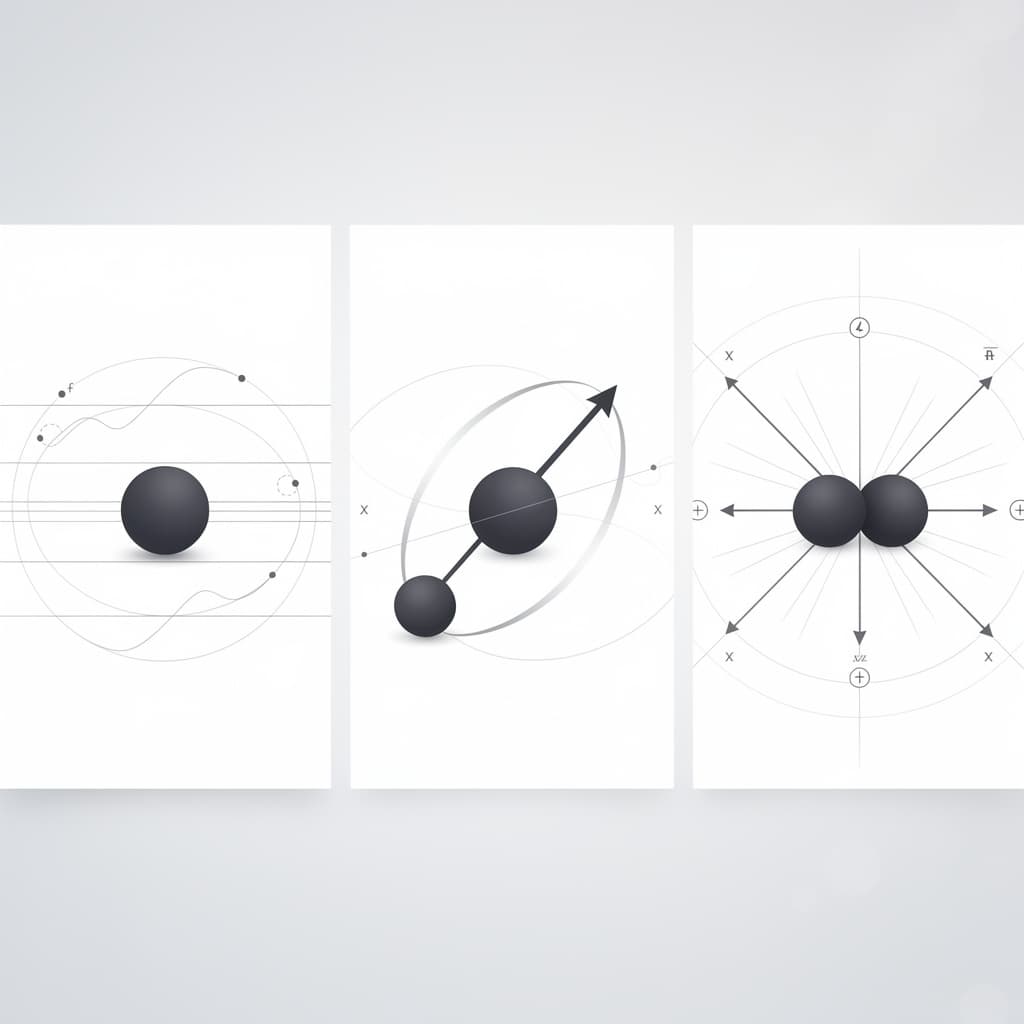
Newton's laws of motion form the foundation of classical mechanics, describing the relationship between the motion of an object and the forces acting upon it. Formulated by Sir Isaac Newton in 1687, these three principles revolutionized physics and remain essential for understanding everyday phenomena and advanced engineering. This article provides a clear explanation of each law, including Newton's first law explained, the Newton's second law formula, and Newton's third law examples, along with formulas, real-world applications, and simple experiments suitable for beginners.
Introduction to Newton's Laws of Motion for Beginners
What Are Newton's Three Laws?
Newton's laws of motion are three fundamental principles that govern the behavior of objects under the influence of forces. The first law, known as the law of inertia, states that an object remains at rest or in uniform motion unless acted upon by an external force. The second law quantifies the relationship between force, mass, and acceleration via the formula $$ \vec{F} = m \vec{a} $$. The third law asserts that for every action, there is an equal and opposite reaction.
These laws, published in Newton's Philosophiæ Naturalis Principia Mathematica in 1687, apply to a wide range of scales, from everyday objects to planetary orbits. They provide a framework for predicting motion and designing technologies. For beginners, understanding these laws demystifies why objects move or stop, bridging intuitive observations with rigorous science.
Sir Isaac Newton and the History
Sir Isaac Newton (1643–1727), an English mathematician and physicist, developed these laws during the Scientific Revolution. Building on Galileo Galilei's work on inertia and Johannes Kepler's laws of planetary motion, Newton synthesized them into a unified theory. His Principia, released on July 5, 1687, used mathematical proofs to demonstrate universal gravitation alongside the laws of motion.
Newton's contributions extended beyond physics; he also advanced calculus and optics. The laws faced initial skepticism but gained acceptance through experiments by contemporaries like Christiaan Huygens. Today, they underpin fields from aerospace to robotics.
Why These Laws Matter in Physics Today
Newton's laws of motion remain relevant in an era of quantum mechanics and relativity because they accurately describe macroscopic phenomena. Engineers use them to design bridges, vehicles, and spacecraft. In education, they serve as the entry point to physics, fostering critical thinking about cause and effect in motion.
While Einstein's relativity modifies them at high speeds or strong gravity, for speeds below 1% of light and everyday masses, Newton's approximations hold precisely. Their simplicity and predictive power make them indispensable for laws of motion for beginners.
Newton's First Law Explained: The Law of Inertia
Full Statement of the First Law
An object at rest remains at rest, and an object in motion continues in uniform motion in a straight line unless acted upon by a net external force.
This Newton's first law explained introduces inertia, the resistance of an object to changes in its motion. Inertia depends on mass: heavier objects require more force to accelerate. The law implies that motion is natural; forces like friction or gravity cause deviations.
In an inertial reference frame—non-accelerating—the law holds perfectly. It counters Aristotelian views that objects naturally stop, shifting paradigms to force-driven change.
Everyday Examples of Inertia
When a bus suddenly brakes, passengers lurch forward due to inertia; their bodies want to continue moving at the bus's speed. A book on a table stays put until pushed, exemplifying rest inertia. These scenarios illustrate how Newton's laws of motion explain daily experiences.
Seatbelts in cars counteract inertia during collisions, preventing passengers from flying forward at highway speeds, say 100 km/h (27.8 m/s). Without frictionless surfaces, we observe apparent violations, but air resistance and surfaces provide the balancing forces.
Inertia in Space and Vehicles
In space, absent significant forces, satellites orbit indefinitely due to inertia combined with gravity. Astronauts float because their spacecraft and bodies share uniform motion. Vehicles demonstrate inertia during high-speed turns, where tires provide centripetal force to alter direction.
Highway design includes gradual curves to minimize required forces against inertia. Understanding this law is crucial for applications of Newton's laws in transportation safety.
Newton's Second Law Formula: F=ma Demystified
Breaking Down F = ma
The Newton's second law formula is $$ \vec{F} = m \vec{a} $$, where $\vec{F}$ is net force (in newtons, N), $m$ is mass (kg), and $\vec{a}$ is acceleration (m/s²). Force causes acceleration proportional to mass and inversely so. A vector equation, it accounts for direction.
The change of motion is proportional to the motive force impressed and takes place along the straight line in which that force is impressed.
This law operationalizes the first, quantifying inertia's resistance.
Mass, Force, and Acceleration Explained
Mass measures inertia; a 1000 kg car accelerates slower than a 1000 kg truck under the same 5000 N force (5 m/s² vs. potentially more if lighter). Force combines strength and direction, like thrust or drag. Acceleration is velocity change rate, $\vec{a} = \frac{d\vec{v}}{dt}$.
Analogy: Pushing a shopping cart (low mass) is easier than a loaded wagon (high mass) up a ramp. Doubling force doubles acceleration if mass constant.
Step-by-Step Calculation Examples
Suppose a 2 kg object experiences 10 N force. Acceleration is $a = \frac{F}{m} = \frac{10}{2} = 5$ m/s². If two 5 N forces act oppositely, net force is 0 N, so $a = 0$ m/s².
| Scenario | Mass (kg) | Net Force (N) | Acceleration (m/s²) |
|---|---|---|---|
| Engine thrust | 1500 | 3000 | 2 |
| Braking car | 1500 | -4500 | -3 |
| Feather fall | 0.005 | 0.049 | 9.8 |
These calculations highlight practical use in engineering.
Newton's Third Law Examples: Action and Reaction
The Principle of Action-Reaction
For every action, there is an equal and opposite reaction.
Newton's third law examples show forces occur in pairs: if object A exerts force on B, B exerts equal/opposite on A. These forces act on different bodies, so no self-cancellation. Magnitudes match, directions oppose.
The law applies simultaneously, unlike sequential motion changes.
Real-Life Examples Like Walking
When walking, your foot pushes backward on the ground (action); ground pushes forward on foot (reaction), propelling you. Swimmers push water backward, water pushes forward. Birds flap wings downward/backward for upward lift.
In collisions, a tennis ball hitting a racket: ball pushes racket left, racket pushes ball right with equal force, determining rebound speed via momentum.
Rockets and Propulsion Applications
Rockets expel gas downward (action), gas pushes rocket upward (reaction). SpaceX Falcon 9 generates ~7.6 MN thrust from mass flow. Jet engines work similarly, compressing air expelled rearward.
This principle enables space travel, as no external medium needed in vacuum.
Real-World Applications of Newton's Laws
Sports and Athletics
In soccer, kicking applies second law force for ball acceleration; goalkeepers use first law inertia to dive. Baseball pitchers leverage third law arm-whip for speed. Friction in track spikes aids action-reaction grip.
High jumpers crouch to maximize ground reaction force per Newton's third.
Car Safety and Braking Systems
Antilock braking prevents wheel lock (first law skid) by pulsing brakes. Airbags extend collision time, reducing deceleration force via $F = m \Delta v / \Delta t$. Crumple zones absorb energy, applying second law principles.
Seatbelts stretch slightly, increasing stopping time from 0.1 s to 0.2 s, halving force on a 70 kg person from 20,000 N to 10,000 N.
Engineering and Everyday Machines
Elevators counter gravity with cable tension (third law). Bridges resist wind inertia loads. Elevators use motors for $F = ma$ to accelerate cabins smoothly.
Robotic arms calculate joint torques using all three laws for precise motion.
Simple Experiments to Demonstrate Newton's Laws
At-Home Inertia Demo
- Place a coin on a card over a cup.
- Flick card horizontally fast; coin drops in due to inertia.
- Repeats first law: coin resists motion change.
Safe, uses household items; quantifies with slow-motion video.
Coin and Feather Fall Experiment
In air, feather lags due to drag; vacuum equalizes (Apollo 15, 1971). Demonstrates first/second laws: gravity accelerates both at 9.8 m/s² ideally. Use tall tube, vacuum pump for advanced.
Analogy: Heavy vs. light parachutists.
Balloon Rocket for Third Law
- Inflate balloon, pinch nozzle, tape to straw on string.
- Release: air exits back (action), balloon forward (reaction).
- Measure distance vs. inflation for force relation.
Illustrates propulsion like model rockets.
Frequently Asked Questions on Newton's Laws
What is Newton's First Law in Simple Terms?
Things keep doing what they're doing—resting or moving straight—until pushed or pulled. Like a hockey puck gliding on ice until friction slows it.
How Does F=ma Work in Practice?
To stop a 2000 kg truck from 20 m/s in 5 s, $\Delta v = 20$, $a = -4$ m/s², $F = 8000$ N brakes needed. Engineers size brakes accordingly.
Do Newton's Laws Apply in Space?
Yes, for spacecraft trajectories; relativity tweaks only near lightspeed or black holes. Voyager probes obey them over 40+ years.
Conclusion: Key Takeaways from Newton's Laws
Recap of the Three Laws
- First: Inertia maintains motion/rest without net force.
- Second: $$F = ma$$ links force to acceleration.
- Third: Action-reaction pairs on different bodies.
Tips for Students and Learners
Practice free-body diagrams, solve problems varying mass/force. Relate to sports/videos. Master vectors for full power.
Further Resources and Reading
Newton's Principia; Khan Academy videos; Halliday/Resnick textbooks. Simulations at PhET Interactive.
Newton's laws of motion, with their elegant simplicity, unlock the physics of the universe, from Newton's laws examples in daily life to sophisticated applications of Newton's laws. Mastering them equips learners for deeper scientific exploration.